
Why Enterprise IT Asset Disposition Needs a Plan
Enterprise IT asset disposition (ITAD) is a plan for retiring business computers and servers without losing track of the hardware, the data on it, or its remaining value. Start with an inventory, keep a record of who handles each asset, securely erase or destroy its data, then test it for resale or send it for responsible recycling. Keep records of each step for your audits.
Without that plan, a hardware refresh can leave sensitive data exposed and useful equipment sitting idle. A clear ITAD process helps you reduce those risks while recovering value where possible. The Journal of the Midwest Association for Information Systems has examined enterprise IT asset disposition as a formal governance discipline, underscoring why structured retirement workflows matter for modern IT operations.
I’m Mike Haden, founder and director of business development at Innovative IT Solutions. I’ve spent 14 years working in enterprise it asset disposition, helping organizations manage retired business hardware, data security, and resale.
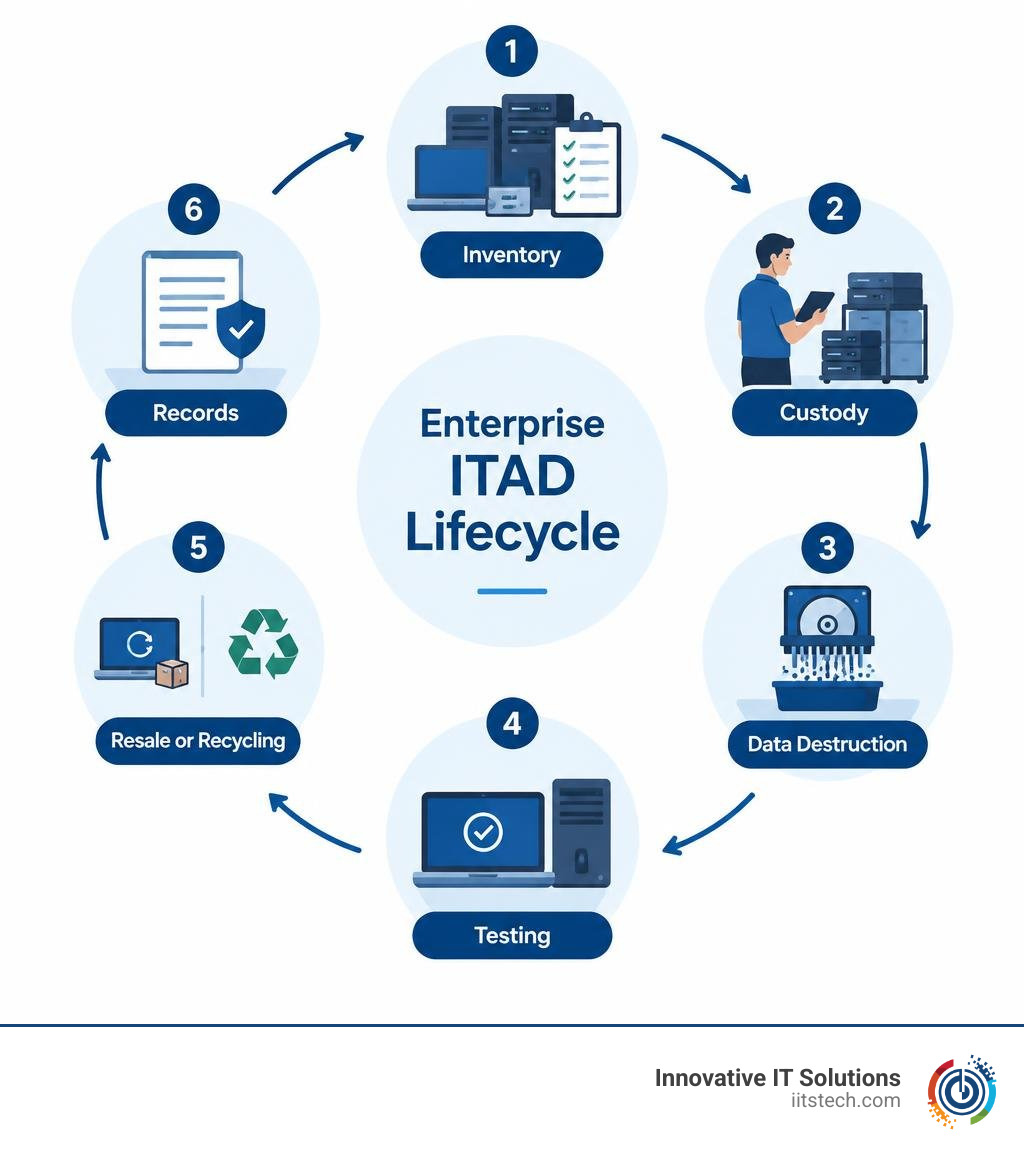
Enterprise it asset disposition terms you need:
What Is Enterprise IT Asset Disposition and Why It Matters
Every enterprise hardware refresh cycle produces decommissioned server chassis, storage arrays, networking appliances, and corporate workstations. When these systems reach their end-of-life, organizations cannot simply toss them into a storage closet or hand them off to standard waste haulers. Enterprise hardware disposition fundamentals focus on turning retired technology into secure, recoverable value while eliminating compliance and environmental vulnerabilities.
As organizations scale their computing footprints, maintaining a dedicated hardware retirement strategy ensures that corporate data is never compromised during equipment transitions. Structured disposition bridges the gap between everyday IT operations and enterprise governance, giving IT leaders complete control over asset security, asset accounting, and environmental stewardship from the moment a machine is unplugged.
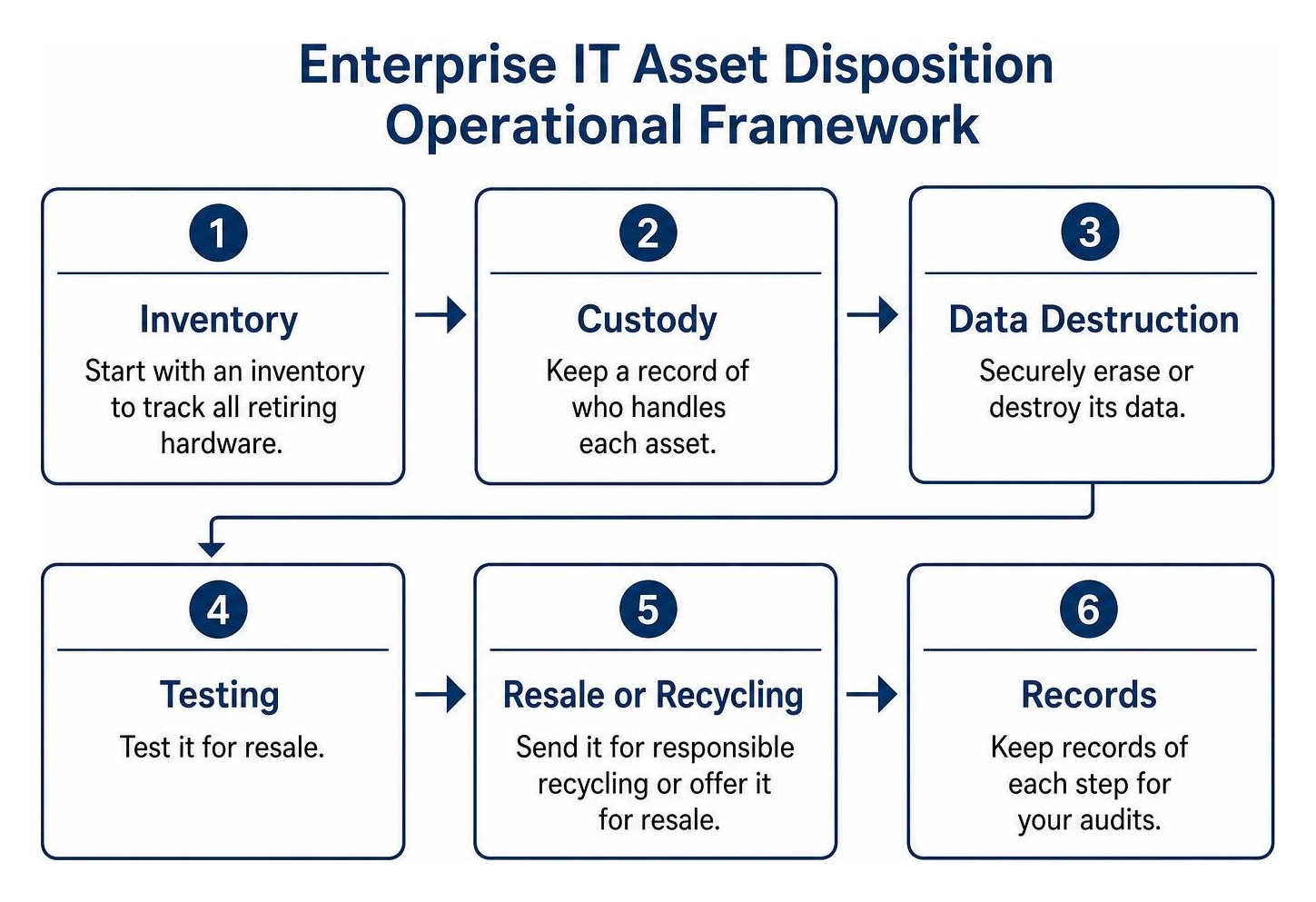
Core Principles of Enterprise IT Asset Disposition
At its core, enterprise IT asset disposition governs how retired infrastructure is cataloged, sanitized, evaluated, and channeled back into the market or into material recovery streams. Implementing structured IT asset disposal practices relies on four foundational pillars:
- Information Security: Total eradication of corporate, customer, and proprietary data residing on solid-state drives, hard drives, and system memory.
- Regulatory Compliance: Strict adherence to data privacy mandates and hazardous materials regulations, backed by detailed audit trails.
- Environmental Protection: Complete diversion of toxic electronic waste from landfills through certified circular recycling streams.
- Financial Optimization: Strategic testing and refurbishment of business-grade hardware to maximize capital recovery through resale.
The Hidden Financial, Legal, and Security Risks of Neglected Hardware
When retired hardware sits neglected in staging rooms, enterprise risk compounds daily. Storage drives contain intellectual property, financial records, and employee information that remain vulnerable to internal or external theft. Understanding cybersecurity integration with ITAD is critical: data security policies must extend past the active deployment phase through final media sanitization.
Failing to properly manage end-of-life computing assets can result in regulatory penalties under state and federal privacy acts, alongside hefty environmental fines for improper e-waste dumping. When equipment goes missing without a documented audit trail, corporations face catastrophic legal exposure and irreparable brand damage.
Key Stages in the Enterprise IT Hardware Disposition Process
A mature ITAD engagement follows a repeatable, strictly controlled workflow designed to remove ambiguity, preserve hardware value, and protect corporate data.

Inventory Discovery and Asset Tracking Technology
The process begins with comprehensive reconciliation. Before any device leaves a server rack or workstation cubicle, technicians cross-reference physical assets against the company’s Configuration Management Database (CMDB) or IT Asset Management (ITAM) platform.
Every business desktop, server blade, modular power supply, and network switch is recorded by serial number, asset tag, configuration specifications, and physical condition. Real-time scanning tools capture these records instantly, ensuring that not a single piece of hardware falls through administrative cracks.
Chain of Custody and Secure Logistics
Moving retired assets requires tightly managed logistics. Maintaining chain of custody protects enterprise hardware against loss or unauthorized access while in transit.
Organizations preserve accountability through unbroken custody protocols, utilizing dedicated, GPS-tracked transportation fleets, tamper-evident security seals, and signed bill-of-lading handoffs between company personnel and logistics specialists.
Certified Data Destruction and Sanitization Protocols
Once assets arrive at a secure facility, data sanitization begins. Standard operating procedures follow strict industry benchmarks:
- Logical Erasure (NIST 800-88 & DoD 5220.22-M): High-level software wiping overwrites every addressable sector of mechanical hard drives and solid-state media with multi-pass randomized characters.
- Cryptographic Erasure: Cryptographic keys protecting self-encrypting drives (SEDs) are permanently sanitized, rendering stored data completely unrecoverable.
- Physical Degaussing: High-energy electromagnetic fields instantly neutralize magnetic domains on traditional spinning platters and tape backup media.
- Mechanical Shredding: Inoperable or non-cleared drives are processed through industrial shredders that reduce storage media into small fragments.
Upon completion, the provider issues a serialized Certificate of Data Destruction for every sanitized drive, creating an irrefutable audit record.
Testing, Value Recovery, and Sustainable Recycling
Data-sanitized hardware enters grading, diagnostic testing, and sorting. Business-grade computers and server components often retain strong market value when processed promptly.
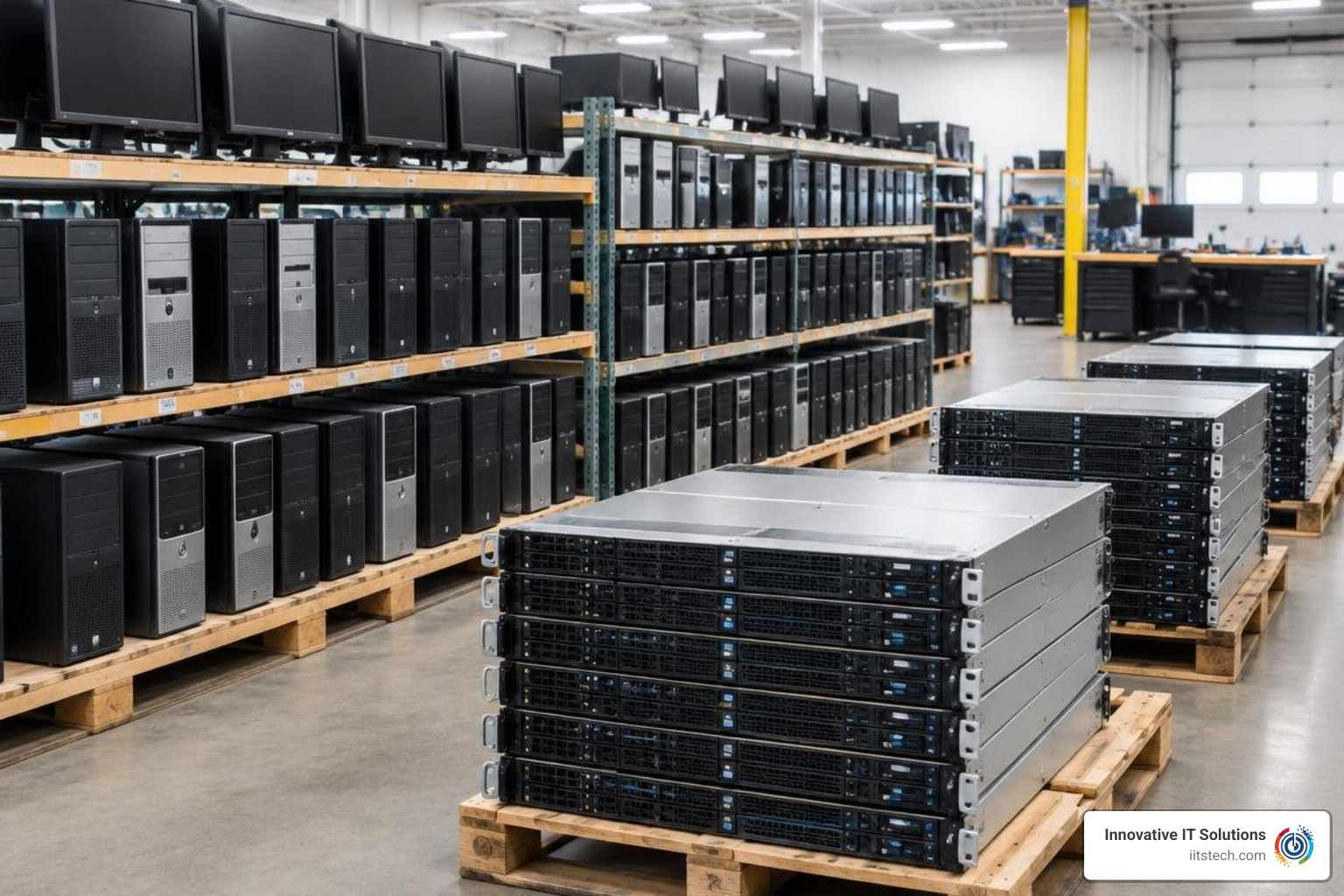
Leveraging commercial asset recovery solutions allows organizations to systematically offset the costs of hardware refreshes. Experienced technicians clean, repair, and upgrade servers, workstation units, RAM modules, and enterprise processors for secondary market deployment. Exploring maximizing hardware value recovery helps IT directors extract maximum yield from their capital investments while understanding all potential equipment lifecycle outcomes.
| Operational Phase | Internal In-House Decommissioning | Certified Third-Party ITAD Vendor |
|---|---|---|
| Inventory Verification | Manual spreadsheets; prone to internal human error | Automated barcode scanning integrated with enterprise CMDB |
| Data Sanitization | Basic software wipes; limited audit validation | NIST 800-88 / DoD-compliant wiping with serialized certificates |
| Logistics & Transport | Standard courier shipping; unmonitored transit | Dedicated GPS-tracked logistics with tamper-evident seals |
| Value Remarketing | Low return; limited wholesale and retail channels | Established secondary channels for maximum financial return |
| Regulatory Defense | High internal liability; fragmented documentation | Guaranteed audit trails and full regulatory compliance indemnification |
Compliance, Certifications, and Environmental Sustainability in ITAD
Corporate IT operations must continually prove compliance to external auditors, regulatory boards, and stakeholders.
Employing audit-ready compliance frameworks keeps enterprises protected against shifting data handling mandates, while adopting legal compliance in green ITAD ensures end-of-life computing equipment never compromises organizational environmental goals.
Required Industry Certifications: R2, e-Stewards, and ISO Standards
Third-party accreditations verify that an ITAD provider adheres to rigorous standards for data security, worker safety, and environmental stewardship. When selecting an R2 certified provider, enterprises confirm that downstream materials are handled responsibly.
Key certifications to look for include:
- R2v3 (Responsible Recycling): Focuses on secure data handling, equipment testing, and responsible materials recovery.
- e-Stewards: Rigorous standard banning the export of hazardous electronic waste to developing nations.
- ISO 14001: Validates operational environmental management systems.
- ISO 27001: Governs information security management controls across all facilities.
Enterprises must also audit partner networks by evaluating downstream partner compliance to ensure accountability across the entire processing chain.
Navigating Industry-Specific Privacy Regulations
Different business sectors face distinct regulatory frameworks:
- Healthcare (HIPAA): Requires total sanitization of protected health information (PHI) stored on diagnostic servers, hospital workstations, and storage appliances. Review healthcare hardware disposition rules to avoid heavy regulatory penalties.
- Financial Services (FACTA / GLBA): Mandates strict disposal controls for consumer records to prevent identity theft.
- International Standards (GDPR): Demands verifiable accountability for records containing personal identity data.
Organizations must understand preparing for third-party compliance audits by maintaining centralized, tamper-proof disposal repositories.
Corporate ESG Impact and Zero-Landfill Metrics
Hardware retirement directly affects Corporate Social Responsibility (CSR) and Environmental, Social, and Governance (ESG) scoring. The environmental benefits of structured ITAD go well beyond clean offices:
- Scope 3 Emissions Abatement: Refurbishing and redeploying corporate server components prevents the raw carbon expenditure of manufacturing new hardware.
- Circular IT Economy: Harvesting working enterprise microprocessors, memory sticks, and power components keeps materials in high-utility lifecycles.
- Zero-Landfill Processing: Non-reusable chassis, circuit boards, and copper wiring are processed by EPA-compliant commodity recyclers, recovering precious metals without soil or groundwater contamination.
Strategic Execution: Best Practices for Enterprise IT Hardware Retirement
Building an efficient retirement program requires systematic planning and ongoing vendor evaluation.
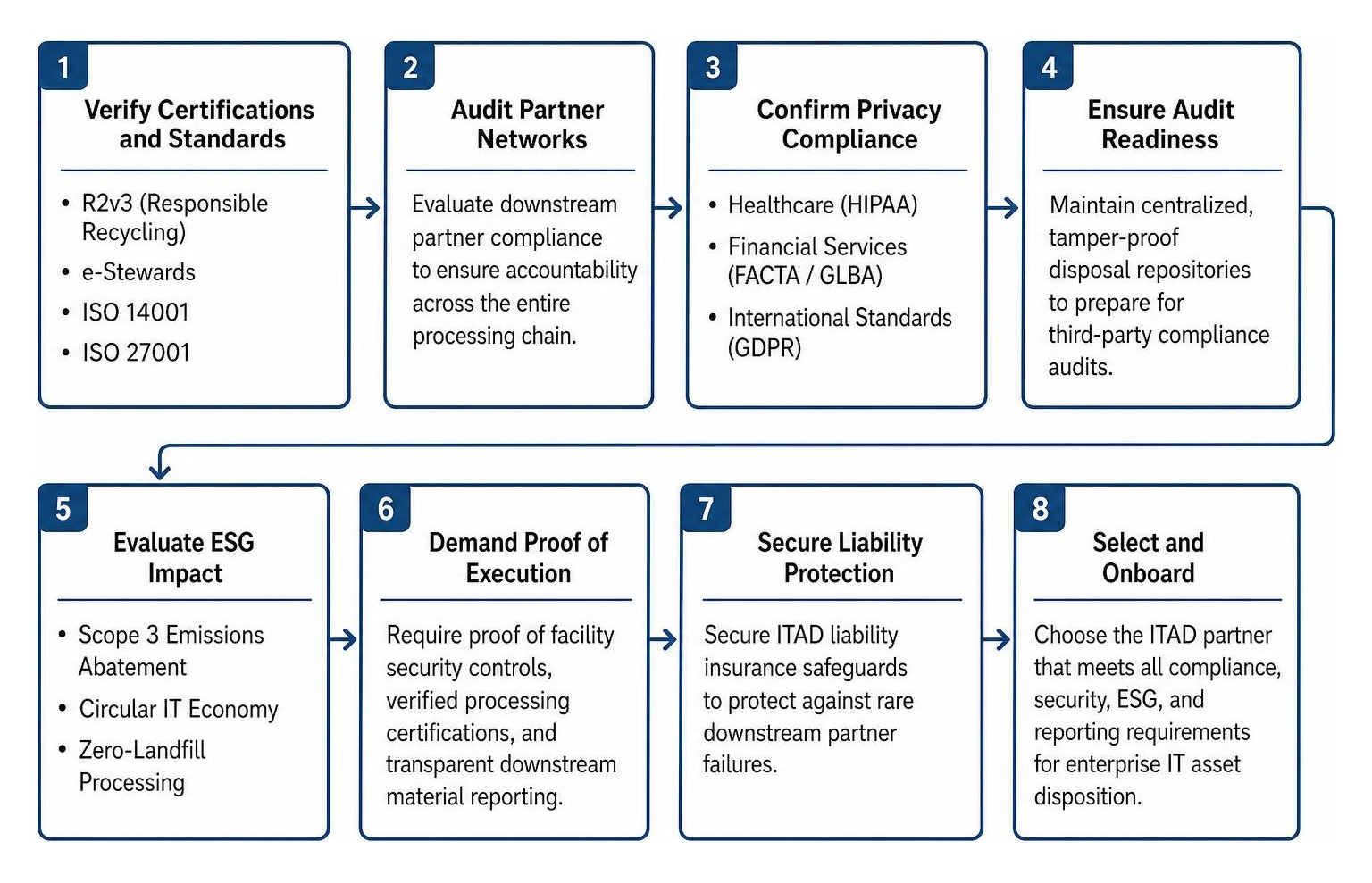
When vetting enterprise ITAD vendors, IT leaders must demand proof of facility security controls, verified processing certifications, and transparent downstream material reporting. Securing ITAD liability insurance safeguards adds a vital layer of financial and legal protection against rare downstream partner failures.
Managing Enterprise IT Asset Disposition Across Scaling and Hybrid Workforces
Modern enterprise work environments span corporate data centers, regional satellite offices, and remote employee homes.
- Distributed Endpoint Returns: Establishing pre-labeled, secure shipping kits ensures remote laptops and business computers safely return to centralized ITAD processing hubs. Learn more about managing remote workforce asset disposition.
- Rapid Scale-Up Decommissioning: Expanding enterprises frequently refresh data center nodes to keep pace with demand. Adopting specialized frameworks for scaling hardware infrastructure management prevents decommissioned hardware backlogs from cluttering expensive rack space.
Balancing Value Recovery, Data Security, and Sustainability
A well-balanced ITAD program balances three competing priorities:
- Security vs. Resale Potential: While shredding drives provides absolute certainty, it destroys drive value. Using NIST 800-88 certified software sanitization clears data securely while preserving high-capacity enterprise SSDs and HDDs for remarketing.
- Speed vs. Return: Promptly decommissioning and clearing retired hardware preserves market relevance before residual resale values decline.
- Automated Documentation: Integrating ITAD portal reporting into IT management software cuts administrative overhead while keeping audit records current.
Frequently Asked Questions About Enterprise ITAD
What types of hardware are covered under enterprise IT asset disposition?
Enterprise ITAD programs handle business-grade computing systems, including rackmount servers, blade chassis, SAN/NAS storage arrays, enterprise network switches, routers, corporate desktop computers, professional laptops, and modular power infrastructure.
How does ITAD differ from traditional electronics recycling?
Traditional scrap recycling treats hardware solely as base scrap commodities (shredding plastics, steel, and precious metals). ITAD is an end-to-end governance discipline prioritizing serialized inventory tracking, certified multi-pass data sanitization, testing for hardware resale, and transparent compliance documentation before responsible zero-landfill material recycling.
What documentation should an enterprise receive after IT asset disposal?
A complete audit pack includes:
- Serialized asset manifests detailing make, model, and tag numbers.
- Certificates of Data Destruction specifying sanitization method and technician validation.
- Certificates of Sustainable Recycling verifying zero-landfill processing.
- Chain-of-custody transfer logs, signed bills of lading, and settlement statements detailing secondary market value recovery.
Conclusion
A well-planned IT asset disposition strategy protects your enterprise from data breaches, keeps you compliant with environmental and privacy regulations, and recovers valuable budget from retired hardware.
At Innovative IT Solutions, we partner with enterprises across Oklahoma City and throughout the region to deliver reliable, end-to-end hardware lifecycle management. Our NIST- and DoD-compliant data destruction, zero-landfill processing, and transparent remarketing channels ensure your hardware retirement is secure, sustainable, and financially optimized.
Protect your data, prove your compliance, and maximize your return on investment by exploring our certified enterprise electronics recycling services today.


