
Choosing Recovery Services for Business Computers and Servers
If business computers or servers are damaged, displaced, or exposed to water, hire an IT asset recovery provider that can inventory each asset, protect data-bearing components, document chain of custody, and arrange secure transport. Ask how the provider handles damaged drives, storage, recycling, and insurance documentation before work begins.
Heavy equipment recovery services address a different kind of job. For IT hardware, the goal is not just to move equipment quickly. It is to limit downtime without losing track of sensitive data or the value left in usable assets.
I’m Mike Haden, founder of Innovative IT Solutions, and I have spent 14 years helping businesses manage enterprise IT assets; heavy equipment recovery services are a separate specialty from my work. This guide explains what to expect when recovering business computers and server components.
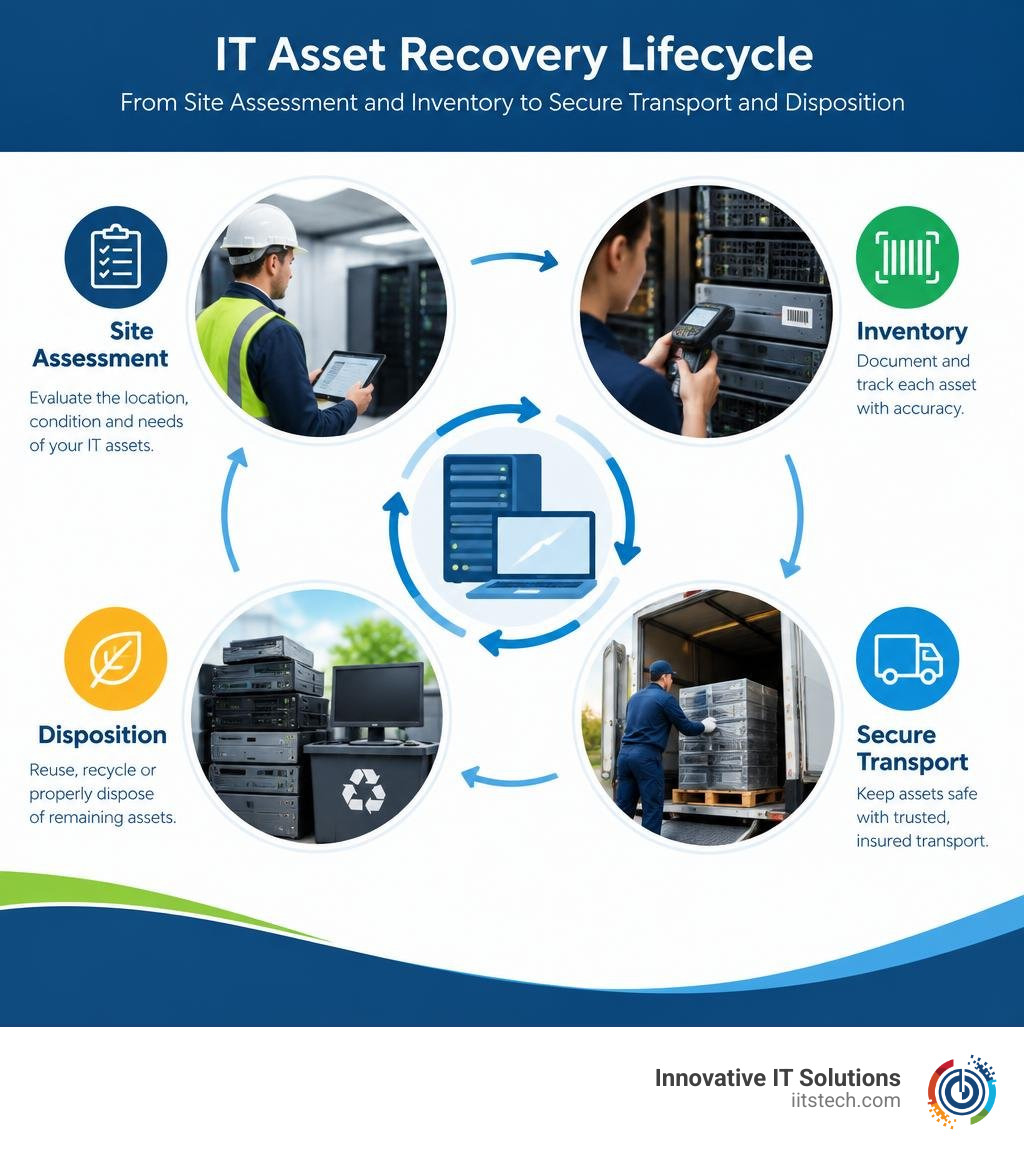
Key terms for heavy equipment recovery services:
When Businesses Require IT Asset Recovery Services
When critical IT infrastructure is disrupted, standard office moves or traditional cleanout methods simply do not suffice. Enterprise IT environments house sensitive business intelligence, intellectual property, and critical data components that require careful, systematic extraction. Server room failures, physical data center disruptions, facility water damage, or severe regional weather can throw enterprise operations into complete disarray.
In our work serving enterprises across Oklahoma City and throughout the United States, we frequently see facilities facing unexpected infrastructure crises. A ruptured sprinkler pipe above a server room or an HVAC breakdown leading to localized electrical damage can put hundreds of enterprise-grade computers and server racks in immediate jeopardy.
Mitigating these incidents requires rapid mobilization and operational stabilization. The primary goal is twofold: mitigate the physical loss of high-value business computers and server components, and ensure that zero data-bearing hardware is mishandled or compromised during the incident management phase.
IT Incidents and Critical Failures
Critical hardware incidents rarely happen at a convenient time. Physical server rack collapses, structural ceiling drops onto server enclosures, or localized electrical fires in power distribution units demand immediate tactical stabilization.
When heavy enterprise server chassis, storage arrays, and business workstations are compromised, specialized triage is mandatory. You cannot simply drag damaged server enclosures across a wet floor or toss hard drive arrays into standard transport bins. Proper handling prevents secondary damage to internal platters, solid-state drives, and expensive processing components.
Following the ultimate guide to asset recovery, our teams stabilize displaced server components, disconnect power systems securely, tag individual assets, and isolate intact data drives from physically ruined chassis. Protecting assets post-incident ensures that usable enterprise parts retain their fair market value while ruined hardware moves into compliant recycling channels.
Specialized Support for IT Asset Recovery Services
Recovering enterprise-grade hardware requires dedicated tools and engineered material-handling gear designed specifically for sensitive electronics. Standard cargo transport often lacks the shock absorption, climate protection, and physical security measures required for high-density compute infrastructure.
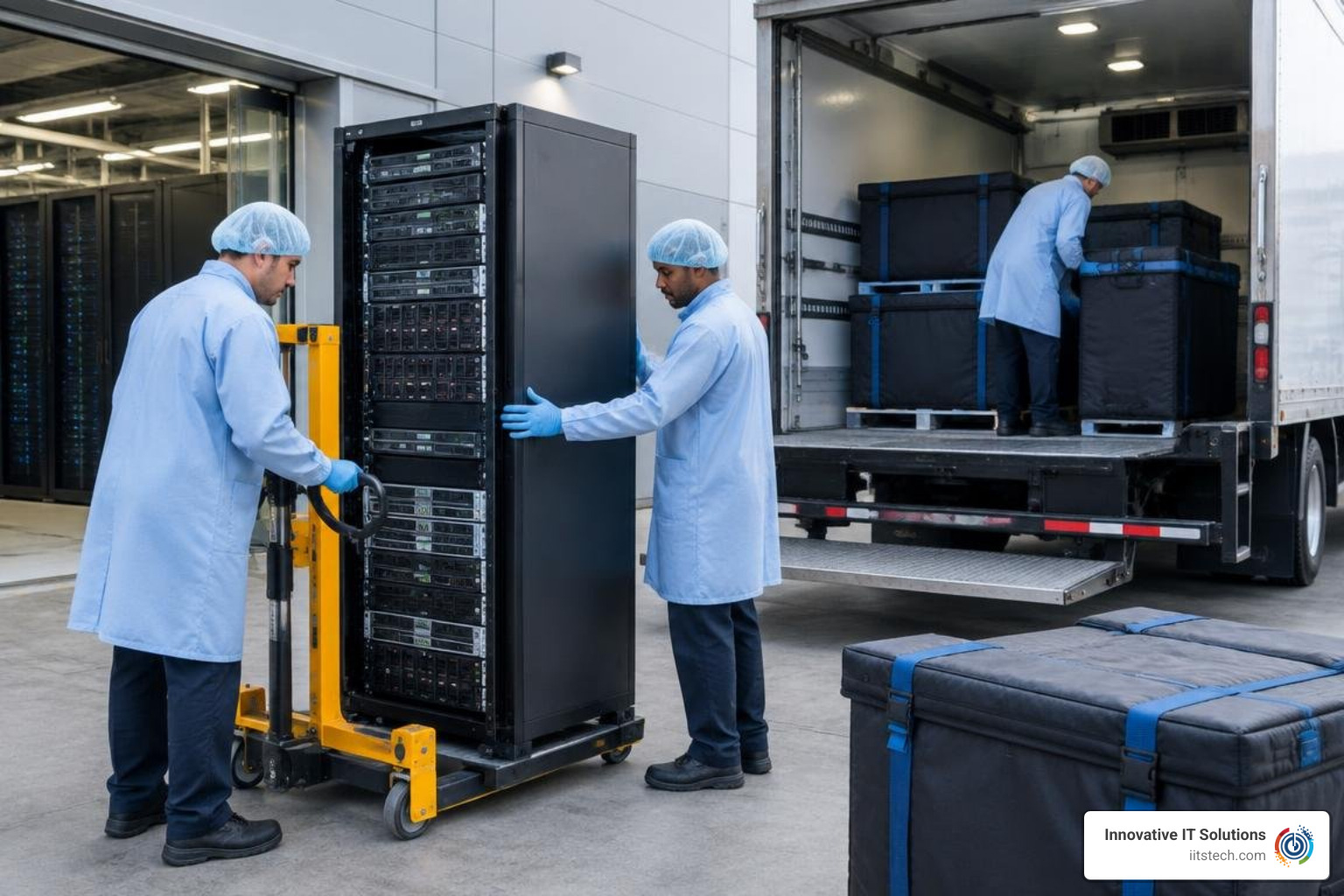
Our specialized support framework includes:
- Custom Anti-Static Rigging & Padding: Electrostatic discharge (ESD) safe wraps and specialized crating for sensitive server blades, backplanes, and desktop motherboards.
- Heavy-Duty Server Lifts & Ramps: Controlled hydraulic equipment built to safely extract 800-pound server racks without causing structural shifts.
- Barcoded Tamper-Evident Enclosures: Immediate serialized containment of loose hard drives, memory modules, and enterprise storage trays.
- Climate-Controlled, GPS-Tracked Logistics: Secure transit vehicles that shield water-compromised or sensitive electronic hardware from environmental swings during transport to our secure processing facilities.
Operational Stages of IT Asset Recovery
An effective commercial IT asset recovery process follows a disciplined, step-by-step workflow designed to restore order, secure hardware, and guarantee complete chain of custody.
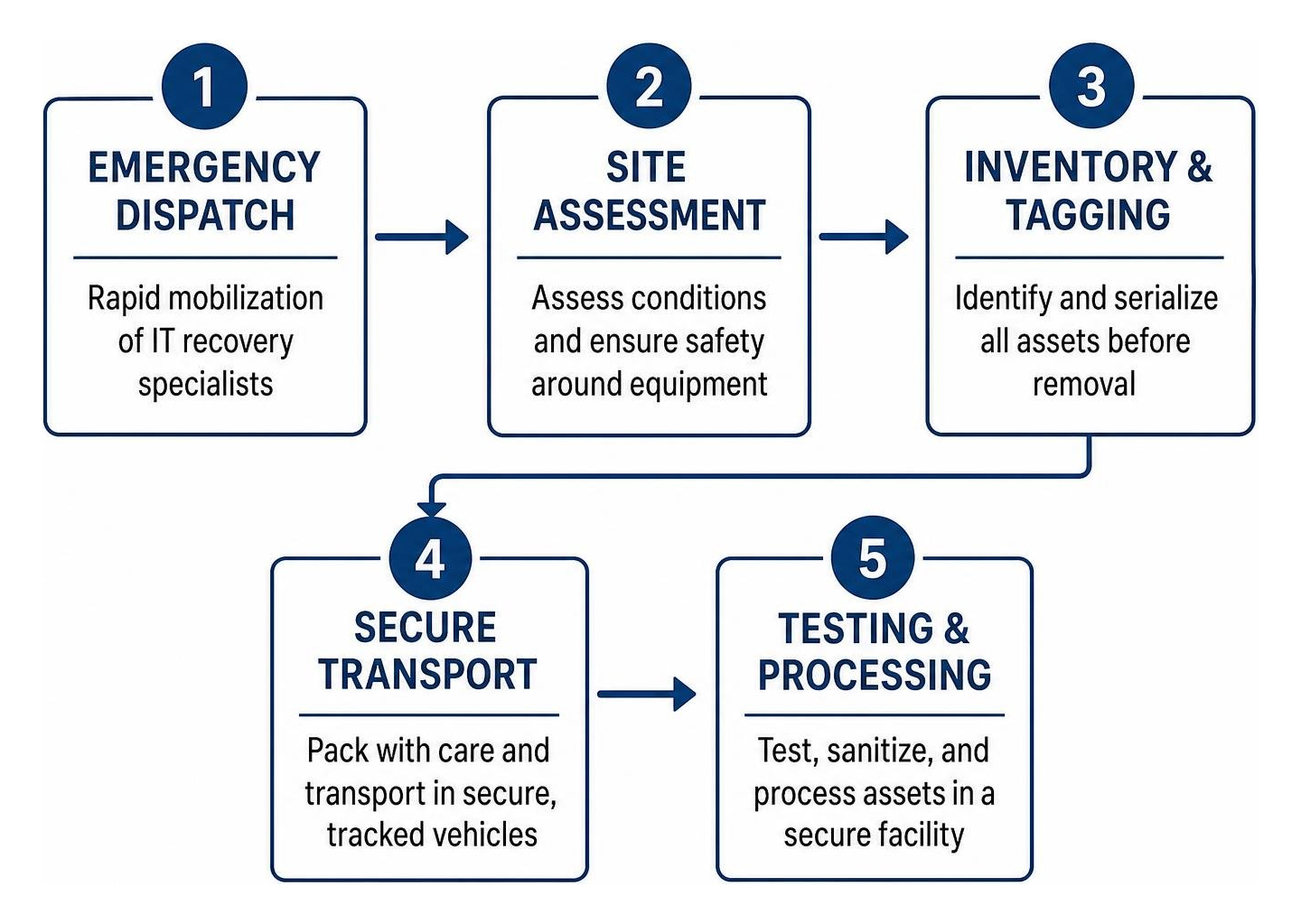
- Emergency Dispatch & Incident Triage: Rapid mobilization of trained ITAD logistics specialists equipped with custom packaging, data-security bins, and extraction gear.
- On-Site Assessment & Hazard Clearance: Assessing environmental conditions, structural stability, and electrical safety around server cabinets and computer banks.
- Asset Identification & Serialized Tagging: Real-time logging of every business PC, server blade, storage array, and auxiliary component before it leaves the rack or desk.
- Secure Packing & Controlled Transport: Deploying specialized anti-static packaging, secure lockboxes, and tracked transport vehicles.
- Secure Facility Storage & Processing: Housing recovered systems in a 24/7 monitored, climate-controlled facility for testing, data sanitation, component refurbishing, or zero-landfill recycling.
Site Assessment, Data Security, and Environmental Compliance
The moment our technicians arrive at an impacted commercial site, establishing a rock-solid chain of custody is our top priority. We perform comprehensive asset inventories, identifying every data-bearing device—including SAS/SATA enterprise drives, NVMe storage cards, and embedded flash arrays.
Data protection is non-negotiable. Whether hardware is fully functional or physically battered, data-bearing media must undergo verified, serialized sanitization or physical shredding compliant with NIST SP 800-88 Rev. 1 and Department of Defense (DoD) standards.
Simultaneously, non-salvageable hardware must be handled with strict adherence to environmental regulations. Compliance with state regulatory requirements across jurisdictions and EPA guidelines ensures that zero hazardous electronic waste enters municipal landfills. As an EPA-compliant operator, we provide serialized Certificates of Data Destruction and Recycling for every recovered machine.
Water-Damaged and High-Risk Site Operations
Water intrusion from fire suppression discharges or roof leaks introduces complex challenges to commercial hardware recovery. Standing water and high humidity immediately trigger corrosion on motherboards, memory channels, and enterprise power supplies.
When extracting water-damaged servers and business computers, speed and careful isolation are essential:
- Immediate Power Isolation: Verifying that zero residual current remains in server power supplies or uninterruptible power supply (UPS) backups to prevent short circuits and shock hazards.
- Controlled Moisture Extraction: Safely removing damp components into desiccated, climate-controlled containers to halt active oxidation on logic boards.
- Drive Extraction: Carefully pulling enterprise hard drives and SSDs from soaked server trays to prepare them for forensic data extraction or immediate mechanical destruction.
- Condition Documentation: Taking photographic and serialized logs of each asset’s physical condition to support your insurance claim and asset disposition reporting.
Coordinating Logistics, Claims, and Insurance Adjusters
Navigating the aftermath of a commercial disaster requires tight collaboration between facility managers, IT directors, logistics providers, and insurance adjusters. Adjusters require precise, auditable proof of loss, while IT teams need to establish clear accountability for all data-bearing equipment.
To avoid costly claim delays or compliance liabilities, companies must understand the sharp differences between emergency recovery and routine hardware pickup:
| Operational Parameter | Emergency On-Site IT Asset Recovery | Standard IT Equipment Collection |
|---|---|---|
| Response Window | 24/7 emergency dispatch; on-site within hours | Scheduled days or weeks in advance |
| Site Environment | Water-damaged, compromised, or hazardous server rooms | Clean, powered, and accessible office environments |
| Asset Condition | Displaced, physically damaged, or wet server components | Intact, operational, or cleanly decommissioned systems |
| Handling Protocols | Anti-corrosion isolation, structural rigging, hazard containment | Standard palletizing and anti-static wrapping |
| Documentation | Itemized damage reports, forensic chain of custody, claim proof | Standard bills of lading and asset manifests |
| Insurance Coordination | Direct liaison with adjusters, TPAs, and site risk managers | Standard commercial vendor invoicing |
Our structured damage assessments, serial-matched condition logs, and formal site clearance documentation give adjusters the transparent data they need to process commercial claims without disputes.
Cost Factors and Pricing for IT Asset Recovery Services
Transparent pricing in recovery logistics depends heavily on site-specific operational variables. Unlike standard IT pickup, emergency recovery operations require rapid resource allocation and specialized protective handling.
Key factors that shape recovery costs include:
- Total Volume and Density of Assets: The number of commercial workstations, enterprise server cabinets, and storage arrays requiring extraction.
- Site Accessibility & Structural Integrity: Overcoming obstacles like non-working freight elevators, waterlogged floors, or remote facilities requiring specialized staging equipment.
- Specialized Handling & Extraction Gear: Requirements for hydraulic server lifts, heavy-duty rigging, and desiccant-based packing for damp electronics.
- Mobilization Speed: Emergency 24/7 callouts requiring immediate deployment versus planned operational extractions.
- Value Offset via Refurbishing & Resale: In many scenarios, our ability to harvest usable enterprise CPUs, enterprise RAM, and clean compute modules offsets total project logistics costs, putting budget back into your organization.
Vetting Commercial IT Asset Recovery Providers
Entrusting your organization’s compromised IT infrastructure to an unverified third party poses massive security, compliance, and legal risks. A vendor without proven experience can mishandle live data drives, ruin salvageable hardware, or generate regulatory fines.
When evaluating potential partners, look for these critical benchmarks:
- Documented Data Security Protocols: Verified adherence to NIST SP 800-88 and DoD standards for all data-bearing components.
- Robust Liability Protections: Strong operational safeguards, including ITAD liability insurance protocols, protecting your organization against transit loss or regulatory penalties.
- Zero-Landfill Environmental Compliance: Documented downstream tracking and EPA compliance to ensure ethical, sustainable electronics disposition.
- Transparent Chain of Custody: Serialized asset tracking from the moment technicians secure the equipment on-site to final disposition reporting.
Frequently Asked Questions About IT Asset Recovery
What qualifies as a critical IT asset recovery incident?
A critical IT asset recovery incident involves any catastrophic disruption—such as server room flooding, HVAC thermal failure, physical rack collapse, or facility structural damage—that leaves enterprise servers and business computers compromised, displaced, or unpowered. It requires immediate, specialized technical triage to protect sensitive data and salvage high-value enterprise hardware.
How quickly can specialized recovery teams mobilize on site?
Emergency recovery providers operate 24/7 dispatch capabilities. For organizations located within primary metropolitan hubs—such as our central service areas across Oklahoma City and surrounding corridors—teams can frequently deploy specialized gear on site within 2 to 4 hours to begin asset stabilization and containment.
How do recovery teams protect data during asset handling?
Data protection begins at the rack or workstation level. Each data-bearing hard drive, SSD, and storage blade is scanned, logged by serial number, and sealed in tamper-evident, anti-static security enclosures. Assets are transported in GPS-monitored vehicles directly to secure facilities where they undergo certified NIST/DoD-compliant data sanitization or physical destruction with full auditing documentation.
Conclusion
Protecting your enterprise hardware during a sudden facility incident is vital to safeguarding your organization’s bottom line, business continuity, and data privacy. Navigating unexpected server room disruptions requires a calm, disciplined approach backed by certified logistics, uncompromising data security standards, and zero-landfill environmental compliance.
At Innovative IT Solutions, we bring 14 years of dedicated IT asset disposition and asset recovery experience to commercial clients across Oklahoma City and throughout the United States. We manage every phase of the recovery lifecycle—from immediate site containment and serialized tracking to certified data sanitization and maximum value recovery through hardware remarketing.
When your business computers, server racks, or data storage arrays face unexpected operational threats, turn to our experienced team for comprehensive enterprise asset recovery solutions.


