
Why Asset Recovery Matters — For Businesses and Governments Alike
Asset recovery is the process of identifying, tracing, and reclaiming valuable assets — whether that means recovering proceeds of corruption stolen from a nation, or extracting maximum value from decommissioned enterprise IT hardware.
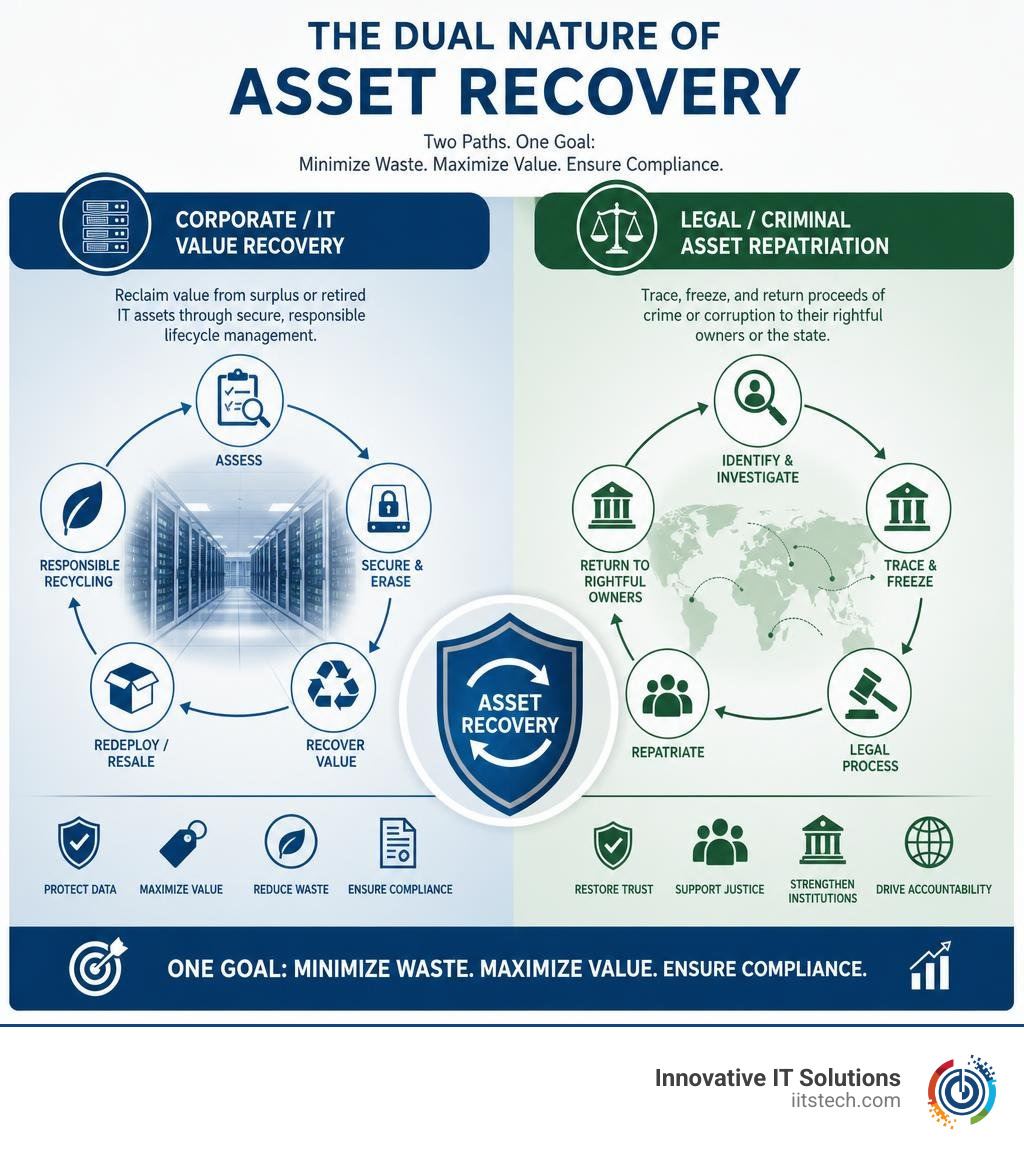
Quick answer: What is asset recovery?
| Context | What It Means |
|---|---|
| Corporate / IT | Reclaiming value from surplus or retired business-grade hardware through resale, redeployment, or recycling |
| Legal / Criminal | Tracing and returning proceeds of crime or corruption to their rightful owners or the state |
| Key goal (both) | Minimize waste, maximize value, and ensure compliance |
The scale of the problem — in both contexts — is staggering.
On the criminal side, developing countries lose an estimated US$20–40 billion every year to corruption. Yet countries worldwide recover less than one percent of global illicit financial flows. That gap is enormous.
On the corporate side, enterprises routinely leave money on the table by mismanaging retired servers, computers, and hardware — while also exposing themselves to serious data breach and compliance risks.
Whether you’re an IT manager trying to securely dispose of decommissioned servers, or simply trying to understand how asset recovery works at a global level, this guide covers both worlds clearly and practically.
My name is Mike Haden, and as the founder of Innovative IT Solutions, I’ve spent 14 years helping enterprises recover real value from surplus IT hardware through responsible asset recovery and disposition. I’ve processed over a million pieces of enterprise equipment — and I’ll share what actually works.
Easy asset recovery word list:
Understanding the Two Pillars of Asset Recovery
While the term “asset recovery” is used in different industries, it generally splits into two massive pillars: corporate asset recovery and sovereign (or legal) asset recovery. Though they operate under different rules, both share a fundamental objective: preventing value from evaporating.

What is Commercial Asset Recovery for IT Hardware?
In the business world, commercial asset recovery — specifically within IT Asset Disposition (ITAD) — is the process of identifying retired, surplus, or obsolete business-grade IT hardware and turning it back into capital.
When an enterprise updates its infrastructure, it is often left with hundreds of server components, enterprise computers, storage arrays, and networking gear. If left in a storage closet, these items do nothing but collect dust and lose value.
Commercial asset recovery steps in to maximize returns. Through professional testing, refurbishment, and hardware resale, companies can recoup a significant portion of their original investment. To understand how this impacts your bottom line, explore The Business Benefits of Selling Your Used IT Equipment.
Furthermore, when organizations face major structural shifts, proper planning is essential. Knowing What to Do with Old IT Equipment When Your Business Closes or Downsizes ensures that value is reclaimed rather than thrown away.
What is Legal and Sovereign Asset Recovery?
On the sovereign side, asset recovery is a vital tool in the global fight against organized crime, money laundering, and grand corruption. In this context, it refers to the process of tracing, freezing, confiscating, and repatriating state assets that were illegally taken by corrupt officials or criminal enterprises.
According to data from the Asset Recovery – UNCAC Coalition, the gap between stolen funds and recovered assets is incredibly wide. Between 2010 and 2012, OECD countries froze US$1.398 billion in assets but returned only US$147.2 million.
Despite these challenges, there have been historic successes:
- The Philippines has recovered more than US$1 billion of money stolen by Ferdinand Marcos.
- Peru recovered over US$174 million stolen by Vladimiro Montesinos.
- Nigeria has seen the return of US$700 million stolen by Sani Abacha, alongside recovering US$17.7 million of illicit gains obtained by Diepreye Alamieyeseigha.
Whether dealing with a decommissioned enterprise server array in Oklahoma City or stolen treasury funds in a foreign bank account, asset recovery is about restoring resources to their rightful place.
Global Frameworks and Challenges in Criminal Asset Recovery
Sovereign asset recovery is a highly complex legal puzzle. Because criminals rarely keep their stolen wealth in the jurisdiction where the crime was committed, tracing these illicit financial flows requires seamless international cooperation and a deep understanding of cross-border legal frameworks.

As detailed in the World Bank Document (the Asset Recovery Handbook), practitioners face numerous legal, operational, and institutional barriers when trying to claw back stolen funds across borders.
The Five Stages of the Sovereign Recovery Process
The legal asset recovery process is typically divided into five distinct stages:
- Identification: Recognizing that an asset exists and is connected to a crime.
- Tracing: Following the paper trail (or digital ledger) across multiple bank accounts, shell companies, and jurisdictions.
- Freezing (or Seizure): Temporarily blocking the transfer, conversion, or disposition of the property to prevent it from disappearing.
- Confiscation (or Forfeiture): Permanently depriving the criminal of the property through a court order.
- Return (or Repatriation): Transferring the recovered assets back to the victim state or rightful owners.
When it comes to confiscation, legal systems generally rely on two different approaches:
| Confiscation Type | Legal Basis | Target | Key Advantage |
|---|---|---|---|
| Property-Based | Requires proving that a specific asset is direct instrument or product of a crime. | The physical or digital asset itself. | Direct link to the criminal act. |
| Value-Based | Permits the seizure of equivalent value when the direct proceeds of crime cannot be located. | Any asset of equivalent value owned by the offender. | Highly flexible; prevents criminals from hiding specific assets. |
International Standards and Legal Frameworks
To make cross-border recovery possible, international organizations have established robust standards and treaties.
The primary global framework is Chapter V of the United Nations Convention against Corruption (UNCAC), which establishes the return of stolen assets as a fundamental principle of international law. Additionally, the Financial Action Task Force (FATF) issues influential recommendations that push countries to implement robust anti-money laundering (AML) and asset-tracing laws.
In Europe, legislative frameworks continue to tighten. For instance, Directive – 2024/1260 – EN – EUR-Lex sets out strict minimum rules across the EU for tracing, freezing, confiscating, and managing criminal property. With organized crime generating at least EUR 139 billion every year in the EU, this directive aims to ensure that member states can act swiftly — requiring urgent cross-border information requests to be answered within eight hours when assets are at risk of disappearing.
Conviction-Based vs. Non-Conviction-Based Confiscation
One of the biggest debates in modern asset recovery is how to secure a confiscation order when a traditional criminal trial is impossible.
- Conviction-Based Confiscation: This traditional route requires a formal criminal conviction of the offender. Once the court finds the individual guilty beyond a reasonable doubt, it orders the forfeiture of their illicit assets.
- Non-Conviction-Based Confiscation (NCB): Also known as civil forfeiture or in rem proceedings, this mechanism targets the asset itself rather than the person. Because it does not require a criminal conviction, it is incredibly useful when the offender has fled the country, died, or holds political immunity.
NCB confiscation only requires proving that the asset is the proceed of crime under a lower civil standard of proof (the balance of probabilities), making it a powerful weapon against international kleptocrats.
Asset Management Offices and Social Reuse
Once assets like real estate, corporate bank accounts, or complex digital currencies are frozen, they cannot simply sit unattended. Their value must be preserved.
This is where Asset Recovery Offices (AROs) and Asset Management Offices (AMOs) come in. These specialized agencies are given the legal power to manage seized assets, preventing depreciation during lengthy court cases.
In the modern landscape, managing these assets has gone digital. Platforms like Asset Reality | Seized Assets. Solved. provide the infrastructure needed to track, secure, and liquidate both physical and virtual assets (such as cryptocurrency and NFTs) in a secure, transparent workflow.
In many progressive jurisdictions, recovered assets are put toward social reuse. For example, confiscated properties once owned by criminal syndicates are converted into community centers, public parks, or funding sources for victim compensation programs, turning the proceeds of crime into public good.
Maximizing Value in Corporate IT Asset Recovery
While sovereign nations fight financial crime, modern enterprises face a different financial challenge: managing the rapid obsolescence of their business-grade IT hardware.
If your business in Oklahoma City or the surrounding areas is upgrading its servers or migrating to the cloud, you are sitting on a depreciating goldmine. Without active management, old server components and enterprise computers quickly turn from valuable assets into expensive liabilities.
The ITAD Lifecycle: Identification, Redeployment, and Disposition
An effective corporate asset recovery strategy follows a structured lifecycle to extract the highest possible value from your retired hardware:
- Identification: Cataloging your current hardware inventory to determine which assets are surplus or nearing the end of their lifecycle.
- Redeployment: Reusing functional hardware in other areas of your business. For instance, a server that is no longer powerful enough for your primary database might perfectly serve a testing environment or a branch office in South OKC.
- Disposition (ITAD): For hardware that cannot be reused internally, the best path is professional liquidation. This includes:
- Parts Cannibalization: Extracting high-value server components like CPUs, RAM, and enterprise SSDs to repair or upgrade other systems.
- Refurbishment and Resale: Cleaning, testing, and selling functional hardware to the secondary market to recover capital.
- Responsible Recycling: Safely breaking down non-functional gear into raw materials, keeping hazardous e-waste out of landfills.
To avoid costly mistakes during this process, it is wise to learn How to Sell Used IT Equipment Without Getting Burned.
Timing is also critical. If your company is navigating structural changes, read our guide on What to Do with IT Equipment After a Company Merger or Acquisition.
Delaying this process is highly unprofitable. We break down the hidden financial drains of procrastinating in The Hidden Costs of Storing Old IT Equipment and The Real Cost of Holding on to Old IT Equipment.
Data Security, Compliance, and Environmental Standards
You cannot talk about corporate IT asset recovery without talking about security and environmental compliance. Simply selling old computers on an open marketplace without certified data destruction is a recipe for a devastating data breach.
To protect your business, any ITAD partner you choose must adhere to strict data sanitization standards:
- NIST SP 800-88 & DoD 5220.22-M Compliance: These are the gold standards for data destruction, ensuring that data on hard drives and solid-state drives is completely unrecoverable through overwriting, degaussing, or physical shredding.
- EPA Regulations & Zero-Landfill Policies: Electronics contain heavy metals and toxic chemicals. Responsible asset recovery requires an EPA-compliant, zero-landfill process where non-recyclable components are disposed of in an environmentally safe manner.
- Full Documentation: A reputable ITAD provider will issue a formal Certificate of Destruction and a detailed audit report for every asset processed, giving you an unbroken chain of custody for your compliance records.
When choosing a vendor to handle your retired hardware, consult A Professional Guide to IT Asset Liquidation and Vendor Selection.
If you are trying to decide on the best environmental and economic path for your hardware, check out our comparison: Is It Better to Recycle or Resell Old IT Equipment?.
Frequently Asked Questions about Asset Recovery
What is the difference between conviction-based and non-conviction-based confiscation?
Conviction-based confiscation requires a formal criminal trial where the offender is found guilty of a crime. The confiscation order is part of the criminal sentencing.
Non-conviction-based confiscation (also known as civil asset forfeiture) is a legal action directed against the asset itself (in rem). It does not require a criminal conviction, making it highly effective when an offender is deceased, has fled the jurisdiction, or is immune to prosecution.
How do Asset Recovery Offices (AROs) cooperate across borders?
AROs utilize secure communication networks like SIENA (the Secure Information Exchange Network Application) to share intelligence rapidly. They also rely on formal Mutual Legal Assistance Treaties (MLATs) and informal inter-agency networks to trace bank accounts, share database access, and coordinate the freezing of assets across different international jurisdictions.
What procedural rights protect third parties during asset confiscation?
To protect innocent parties, legal frameworks include safeguards for “bona fide third parties.” If a third party can prove they acquired an asset in good faith, for fair market value, and without knowing it was connected to criminal activity, the courts will generally protect their ownership rights and exclude their property from the confiscation order.
Conclusion
Whether we are talking about a nation reclaiming millions in stolen sovereign funds or a business in Oklahoma City recovering capital from retired enterprise servers, the core principle of asset recovery remains the same: identifying hidden value and protecting it from going to waste.
At Innovative IT Solutions, we help Oklahoma businesses navigate the corporate side of this equation. Our team provides expert IT asset disposition (ITAD) services, including secure, NIST- and DoD-compliant data destruction, electronics recycling, and high-yield hardware resale.
By utilizing our zero-landfill, EPA-compliant processes, you get full compliance documentation and maximum returns on your decommissioned server components and enterprise computers.
If you are ready to turn your retired IT hardware into working capital, explore our dedicated Asset Recovery services or visit Sell Your Gear to get a detailed assessment of your equipment’s value today.


