
Why Choosing an R2 Certified ITAD Provider Is One of the Most Important IT Decisions You’ll Make
Choosing the right r2 certified itad provider can mean the difference between a clean, compliant hardware retirement and a costly data breach or regulatory fine.
Here’s a quick summary of what to look for:
- Active R2v3 certification – Verify current status in the SERI directory
- Correct appendices – Confirm Appendix B (data destruction) and Appendix A (downstream management) are included
- In-house data sanitization – Provider should not subcontract this to uncertified third parties
- Chain-of-custody documentation – Serial number tracking, certificates of destruction, and full audit trails
- Downstream vendor accountability – All recycling partners must meet the same R2v3 standards
- No red flags – Watch for expired certificates, missing insurance, or vague destruction methods
Every year, businesses replace servers, laptops, and storage devices by the thousands. Most IT managers know they need to dispose of this equipment securely. But how that disposal happens — and who handles it — carries serious legal, financial, and environmental consequences.
A 2017 NAID study found that 40% of used devices purchased online still contained recoverable personal data — including devices from vendors who claimed they had wiped them. And if a breach traces back to improper disposal, the average cost in healthcare alone hits $9.77 million.
R2 (Responsible Recycling) certification, managed by Sustainable Electronics Recycling International (SERI), is the independently verified standard that separates trustworthy ITAD providers from those cutting corners. There are currently 1,256 R2 certified facilities operating across 42 countries — but not all certifications are equal, not all are current, and not all cover the services you actually need.
This guide walks you through exactly how to evaluate and choose the right provider for your business.
I’m Mike Haden, Founder and Director of Business Development at Innovative IT Solutions, where I’ve spent 14 years building and operating an R2v3 certified ITAD company focused on responsible electronics reuse, recycling, and secure data destruction. In that time, we’ve processed over a million pieces of enterprise IT equipment — so I know what separates a genuinely certified provider from one that just talks the talk.
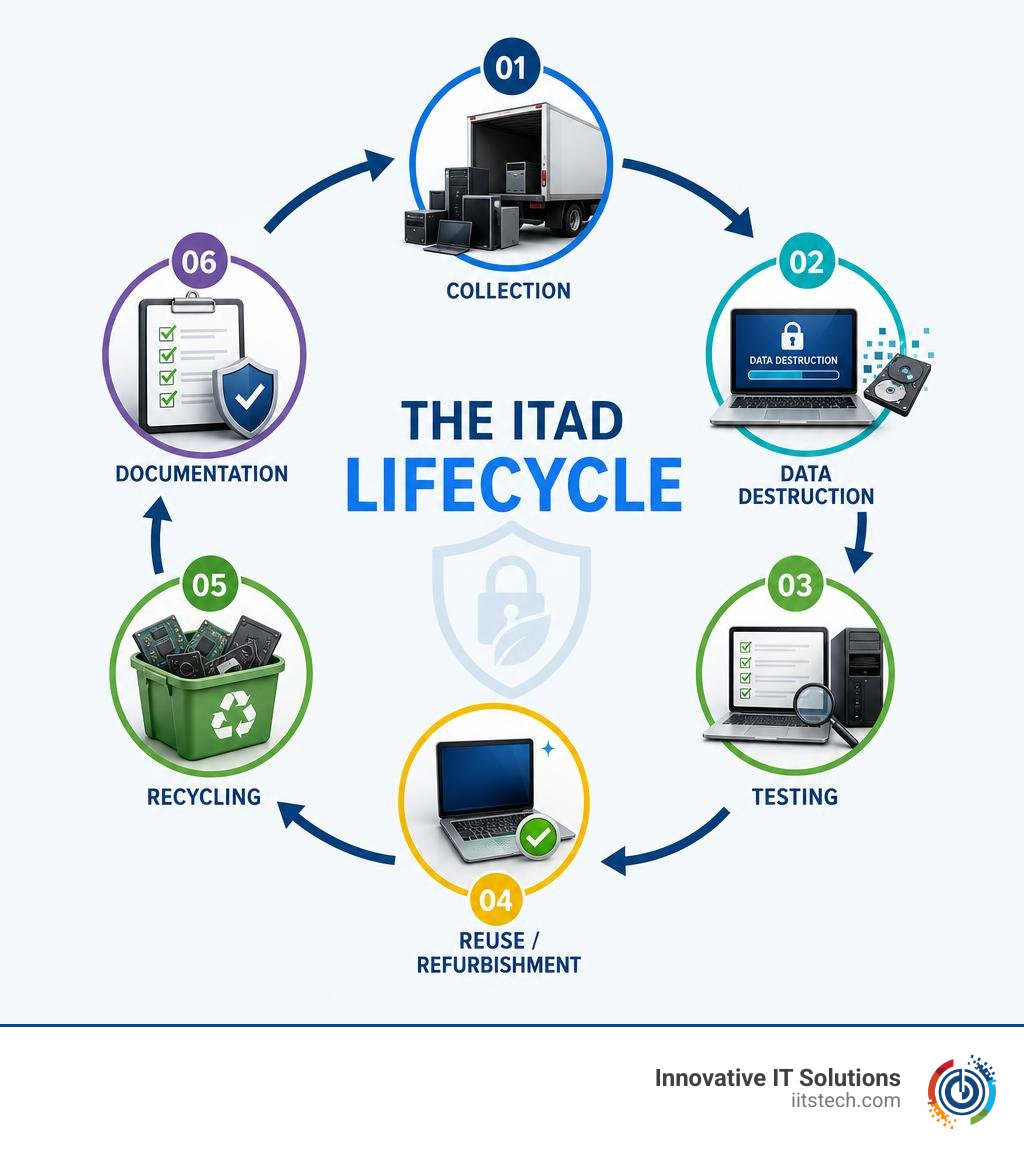
Understanding R2 Certification and the R2v3 Standard
When you hear the term “R2 certification,” it refers to the Responsible Recycling standard managed by R2 – SERI . Think of it as a comprehensive regulatory, environmental, and security framework specifically engineered for the electronics recycling and IT asset disposition (ITAD) industries. It’s like the ISO standards, but custom-tailored for the high-stakes world of retired technology.

Currently, there are exactly 1,256 R2 certified facilities operating across 42 countries worldwide. It has become the global gold standard because it does not allow facilities to simply “promise” they are doing the right thing. Instead, it forces them to prove it through rigorous, independent third-party audits.
For businesses operating in Oklahoma City, South OKC, and across the state of Oklahoma, working with a locally rooted, globally compliant partner ensures that your retired IT equipment doesn’t end up in an local landfill or, worse, an offshore dump.
Why Work with an R2 Certified ITAD Provider?
If you dispose of old office laptops or decommission an entire data center without a certified partner, you are playing Russian roulette with your brand’s reputation. Partnering with an r2 certified itad provider addresses three major corporate pain points:
- Corporate ESG and Sustainability Goals: Modern enterprises must document their environmental footprint. An R2-certified partner provides clear metrics showing how much equipment was diverted from landfills, refurbished for a second life, or broken down into raw commodities. To understand how this fits into the bigger picture, read our guide on What is IT Asset Disposition (ITAD) and Why it Matters in 2025.
- Regulatory Compliance: Between HIPAA, PCI-DSS, GDPR, and local EPA guidelines, the legal landscape surrounding data and e-waste is a minefield. Certified providers ensure your disposal practices keep you fully compliant and audit-ready.
- Brand Protection: Imagine your company’s proprietary data or customer list being found on a hard drive sold on eBay. The fallout is catastrophic. R2 certification legally and operationally protects your brand from these nightmare scenarios.
Key Differences: R2v3 vs. R2:2013
If your current ITAD vendor tells you they are “R2 certified,” your very next question must be: “Are you certified to R2:2013 or R2v3?”
R2v3 is the latest, most stringent version of the standard. It introduced several major structural changes designed to close compliance loopholes:
- Modular Structure (The Appendices): Unlike the old one-size-fits-all R2:2013 standard, R2v3 uses a modular approach. Facilities are certified for specific “Appendices” based on the actual services they perform (e.g., Appendix B for Data Sanitization, Appendix C for Test and Repair). A vendor can be R2v3 certified but not certified to sanitize data if they don’t hold Appendix B.
- Independent Facility Certification: Under R2v3, every single facility must be audited and certified individually. A vendor cannot claim their Oklahoma City facility is certified just because their headquarters in another state passed an audit.
- Strict Downstream Vendor Tracking: R2v3 requires relentless traceability. Every single ounce of “Focus Materials” (like mercury, lead, and circuit boards) must be tracked through the entire downstream recycling chain until it reaches its final destination.
- Enhanced Oversight: The audit processes are far more rigorous, requiring deeper documentation, video surveillance verification, and tighter physical security controls.
The Cost and Time Commitment of R2 Compliance
Achieving and maintaining R2v3 compliance is not cheap, nor is it easy. For an ITAD provider, obtaining initial R2v3 certification typically costs approximately $35,000, with ongoing annual maintenance and audit costs hovering around $15,000 to maintain compliance.
The process is a marathon, taking anywhere from 8 to 12 months of intense preparation, process mapping, and employee training. It requires two separate stages of third-party audits conducted by accredited, independent certification bodies.
When you pay for certified ITAD services, you aren’t just paying for logistics or labor. You are paying for the peace of mind that comes from a vendor who invests tens of thousands of dollars annually to prove their operational integrity.
How R2v3 Protects Your Data and the Environment
At its core, the R2v3 standard is built on a dual promise: absolute data security and complete environmental protection.
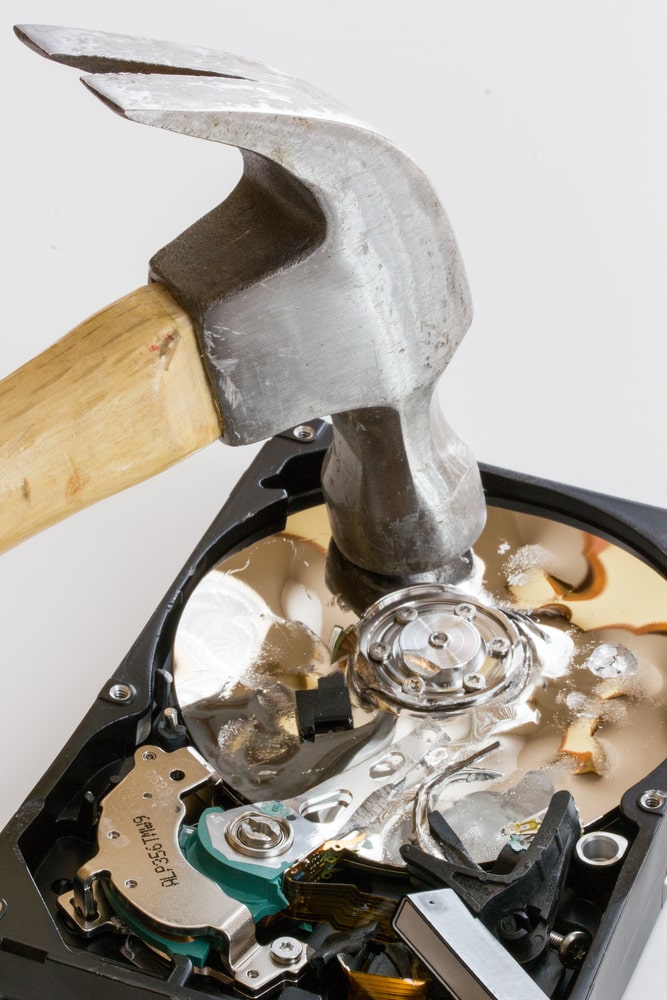
When we handle assets at our facility, we follow strict protocols to ensure that neither data nor hazardous waste escapes into the wild. To see how these two concepts intertwine, check out our resource on The Environmental Impact of ITAD Done Right.
Secure Data Destruction and Breach Prevention
Data security is usually the primary concern for IT managers, and for good reason. NAID study: 40% of used devices purchased online contained recoverable PII. That includes 44% of hard drives and 13% of mobile phones.
An r2 certified itad provider prevents this by enforcing strict adherence to NIST SP 800-88 Rev. 1 guidelines—the gold standard for media sanitization. R2v3 requires:
- Logical Sanitization: Using specialized software to overwrite data sectors, rendering the original data completely unrecoverable while preserving the hardware for reuse.
- Physical Destruction: Shredding, degaussing, or disintegrating drive media to precise physical specifications when logical wiping is impossible or not requested.
- Strict Security Controls: Monitored security cameras, dual-custody handling, and secure storage areas for uncleared media.
With average healthcare data breaches costing $9.77 million and financial services breaches averaging $6.08 million, skipping certified data destruction is a multi-million dollar gamble. Learn more about protecting your business in our guide on How to Ensure Certified Data Destruction for Retired Devices.
Downstream Accountability and Chain of Custody
What happens to your equipment after it leaves your loading dock? If you work with a non-certified vendor, they might sell your old monitors or circuit boards to the highest bidder, who then exports them illegally to developing countries where they are burned in open pits to extract precious metals.
Under R2v3 Appendix A (Downstream Recycling Chain), this is strictly prohibited. Certified providers must perform exhaustive due diligence on every single downstream partner. We must verify that our partners handle “Focus Materials” with the same level of environmental safety and legal compliance that we do. You can read more about why this matters in our article Why Your ITAD Provider’s Downstream Partners Matter.
Supporting the Circular Economy and Asset Recovery
We live in a world where electronic waste is the fastest-growing waste stream. Shockingly, the Global E-Waste Monitor 2024 revealed that only 22.3% of global electronic waste is properly documented and recycled.
R2v3 addresses this by prioritizing a strict “reuse, recover, recycle” hierarchy. Before we shred an asset for its raw metals, we evaluate it for refurbishment and resale. Extending the lifespan of a server or laptop is the single most environmentally friendly action we can take.
When assets are refurbished and resold, it also allows businesses to recoup value, turning a disposal headache into an asset recovery win. Discover the journey of your retired gear in our deep-dive, What Happens to Your Equipment After ITAD.
Comparing R2v3, e-Stewards, and NAID AAA Certifications
When researching ITAD vendors, you will likely encounter three primary certifications: R2v3, e-Stewards, and NAID AAA. While they overlap, they serve different primary functions.
| Feature / Standard | R2v3 Certification | e-Stewards Certification | NAID AAA Certification |
|---|---|---|---|
| Primary Focus | Environmental responsibility, data security, and operational reuse. | Strict environmental justice, global export bans, and social responsibility. | Dedicated, high-security data destruction (logical and physical). |
| Prerequisites | ISO 14001 & ISO 45001 (or equivalent EHSMS). | ISO 14001 or RIOS. | Comprehensive employee background checks and security systems. |
| Export Rules | Allows export of functional, tested devices for reuse under strict controls. | Bans all exports of electronic waste to developing countries (even functional ones). | Focuses on destruction security; does not regulate environmental export. |
| Auditing | Scheduled annual third-party audits. | Scheduled annual third-party audits. | Scheduled audits plus unannounced random audits. |
| Relative Cost | Baseline industry standard pricing. | Typically 10-20% more expensive than R2v3-only options. | Standard addition for data-focused facilities. |
When to Require e-Stewards or NAID AAA
So, which ones do you actually need?
If your organization is highly focused on strict environmental justice—such as preventing any possibility of functional equipment exports to developing countries—you may want to look for an e-Stewards certified provider, though keep in mind it typically costs 10-20% more.
If your primary concern is absolute data security, regulatory compliance, and bulletproof liability protection, you should look for a provider that holds both R2v3 and NAID AAA certifications. NAID AAA is unique because it uses unannounced, random audits to ensure the facility is operating securely 365 days a year, not just on the days the auditor is scheduled to visit.
Integrating these certifications into your broader corporate defense plan is highly recommended; see Why ITAD Should Be Part of Your Cybersecurity Strategy for more details.
How to Evaluate and Choose an R2 Certified ITAD Provider
Now that you know what the standards mean, how do you actually pick the right r2 certified itad provider for your business?
It comes down to verification, auditing, and watching out for common industry red flags. To start with the basics of vendor selection, review How to Choose the Right ITAD Vendor for Your Business.
Verifying Active R2v3 Credentials
The most critical rule of ITAD procurement is: Never take a vendor’s word for it. Anyone can put an R2 logo on their website, but that doesn’t mean they are currently certified.
To verify a provider:
- Go directly to the official Find An R2 Certified Facility directory managed by SERI.
- Search for the vendor by name or location.
- Confirm their status is listed as Active. (Watch out for status indicators like Suspended, Revoked, or Expired).
- Check their certified address. Ensure the facility processing your equipment is the one listed on the certificate.
- Check their active Appendices. Make sure they are certified for the specific services you require (e.g., Appendix B for data sanitization).
Interestingly, SERI directory data shows how difficult this standard is to maintain globally; several countries (such as Italy, South Korea, and Taiwan) have only a single R2v3 certified facility available. In the United States, while there are more options, you still must do your homework to verify local facility compliance.
Red Flags When Auditing an R2 Certified ITAD Provider
When you are interviewing or auditing a potential ITAD partner, keep an eye out for these major red flags:
- Expired or Outdated Certificates: If their certificate says R2:2013, they are operating on an outdated standard. Insist on R2v3.
- Subcontracted Data Sanitization: A major red flag is a provider that collects your drives but ships them to another uncertified company for shredding or wiping. Under R2v3, data sanitization must be tightly controlled and documented.
- Lack of Specialized Liability Insurance: If a data breach or environmental accident occurs, standard general liability insurance won’t cover you. Your provider must carry specialized professional liability and environmental pollution insurance. Learn how to protect your organization in ITAD Liability Insurance: Protecting Your Business When Vendors Fail.
Frequently Asked Questions about R2 ITAD Providers
What specific requirements must a facility meet to maintain R2 certification?
An R2v3 certified facility must maintain a fully operational Environmental, Health, and Safety Management System (EHSMS)—usually certified to ISO 14001 and ISO 45001. They must also undergo annual third-party surveillance audits, maintain a zero-landfill policy for focus materials, perform regular employee health and safety training, and keep detailed, auditable records of all incoming and outgoing assets. For more on keeping your own business compliant during audits, read ITAD Compliance: How to Keep Your Business Audit-Ready and Secure.
How does R2 certification handle remote and hybrid workforce device disposal?
Managing end-of-life devices for remote employees is a logistical headache. R2v3 certified providers address this by offering secure reverse logistics programs. This includes shipping secure, trackable, pre-labeled boxes directly to remote workers, who pack their old laptops and drop them at secure shipping locations. Once received at our certified facility, the devices immediately enter our secure chain-of-custody workflow for data sanitization. For a deeper look at these logistics, read ITAD for Remote and Hybrid Workforces: New Challenges for IT Disposal.
What are the core appendices of the R2v3 standard?
The R2v3 standard is built on a modular structure of six appendices:
- Appendix A – Downstream Recycling Chain: Covers the tracking and due diligence of all focus materials.
- Appendix B – Data Sanitization: Validates advanced logical and physical data destruction processes.
- Appendix C – Test and Repair: Certifies the capability to test, repair, and refurbish electronics for reuse.
- Appendix D – Specialty Electronics Reuse: Focuses on specialized equipment like medical or telecom gear.
- Appendix E – Materials Recovery: Governs the safe dismantling and processing of equipment for raw materials.
- Appendix F – Brokering: Covers the sourcing and trading of electronic components.
Conclusion
Selecting the right r2 certified itad provider is about more than just checking a box on an IT checklist. It is a fundamental business decision that protects your company’s data, preserves the environment, and keeps you compliant with strict regulations.
At Innovative IT Solutions, we provide premier IT asset disposition services tailored for businesses in Oklahoma City, South OKC, and throughout Oklahoma. Our NIST/DoD-compliant, zero-landfill, and EPA-compliant processes guarantee that your retired technology is handled with absolute security and environmental integrity—all while maximizing your return on asset recovery.
Don’t leave your data security and environmental compliance to chance. Secure your business with certified asset recovery services from Innovative IT Solutions today.


