
Why Certified Media Sanitization Matters for Oklahoma Businesses
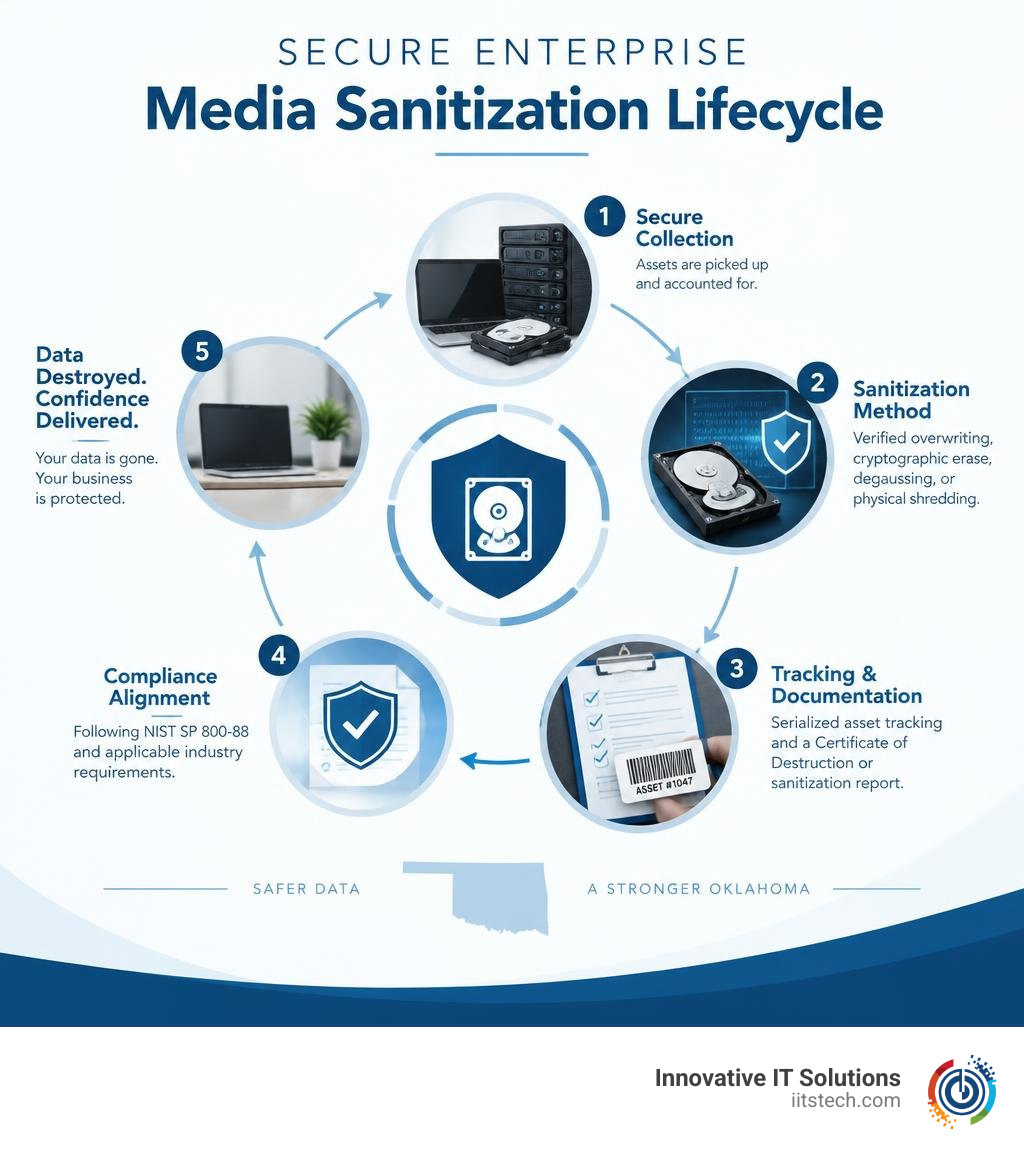
For Oklahoma organizations retiring computers, servers, and storage hardware, certified media sanitization means using a documented process to make sensitive data unrecoverable – then receiving records that prove what happened to each asset. Whether you are decommissioning a single server rack in Oklahoma City or clearing an entire data center, certified media sanitization Oklahoma services provide the verification that internal IT teams often cannot produce on their own. Choose a provider that can offer:
- A method appropriate for the media, such as verified overwriting, cryptographic erase, degaussing, or physical shredding.
- A secure chain of custody from pickup through final processing.
- Serialized asset tracking and a Certificate of Destruction or sanitization report.
- Practices aligned with recognized guidance such as NIST SP 800-88, plus the requirements that apply to your industry.
Simple deletion, reformatting, and factory resets do not provide the same assurance. Data can remain on retired drives, especially in enterprise servers, RAID systems, and SSDs. For organizations handling health, payment, customer, or employee data, an unmanaged disposal process can become a breach, compliance, and reputation problem.
I am Mike Haden, founder and Director of Business Development at Innovative IT Solutions, with 14 years of experience in secure IT asset disposition, documented data destruction, and responsible technology recovery. This guide explains what to expect from certified media sanitization Oklahoma services and how to protect retired enterprise hardware without creating an unnecessary compliance risk.
Terms related to certified media sanitization oklahoma:
The Critical Risks of Incomplete Data Purging vs. Certified Sanitization
Many organizations assume that dragging files to the trash bin, repartitioning a volume, or clicking “factory reset” removes information. In reality, these actions only remove directory pointers while leaving the underlying binary files completely intact. Anyone equipped with basic, freely available recovery tools can reconstruct customer databases, proprietary code, financial ledgers, or employee records in minutes.
The forensic recovery risk multiplies across enterprise solid-state drives (SSDs) and Non-Volatile Memory Express (NVMe) storage. Modern flash storage uses complex wear-leveling algorithms that distribute write cycles across spare, unmapped blocks. Standard operating system utilities cannot reach these over-provisioned sectors, leaving sensitive data fragments hidden throughout the flash memory chips. Without specialized firmware-level purge commands or physical destruction, residual data remains accessible to forensic specialists.

Skipping verified processes leads directly to data breaches, regulatory penalties, and reputational damage. To safeguard operations, businesses rely on certified media and server destruction in Oklahoma to guarantee that retired hard drives, server arrays, and backup units leave zero recoverable traces behind.
Overwriting, Degaussing, and Physical Destruction Compared
Choosing an effective sanitization method depends on drive architecture, media sensitivity, and whether the hardware will be refurbished or recycled.
- Logical Sanitization (Wiping/Overwriting): Replaces stored bits with patterns of random characters across all addressable storage sectors. Modern protocols follow NIST SP 800-88 Clear or Purge guidelines or legacy multi-pass standards. SSDs leverage hardware-level cryptographic erasure commands to invalidate encryption keys instantly, rendering encrypted content permanently unreadable across all logical blocks.
- Magnetic Degaussing: Exposes magnetic media (such as spinning hard disks and tape cartridges) to powerful electromagnetic fields measuring thousands of Gauss. This completely scrambles magnetic domains, erasing stored data along with factory-written track layout servo data, rendering the drive completely inert and unreadable. Degaussing is not effective on flash-based SSDs.
- Physical Destruction (Industrial Shredding): Reduces storage drives to small metal fragments using high-torque industrial shredders. This process guarantees complete destruction for damaged or end-of-life hardware, eliminating any possibility of microscopic data recovery.
To determine which route fits your enterprise environment, review our breakdown on physical destruction vs data wiping.
| Sanitization Method | Target Media Types | Reusability | Security Standard Level |
|---|---|---|---|
| NIST Multi-Pass Overwrite | Functional HDDs, Enterprise SSDs | Yes (Hardware can be repurposed) | High (NIST SP 800-88 Clear/Purge) |
| Cryptographic Erase (CE) | Self-Encrypting Enterprise SSDs/NVMe | Yes (Instantaneous key wipe) | High (NIST Purge Compliant) |
| High-Field Degaussing | Magnetic HDDs, LTO Backup Tapes | No (Drive unusable post-treatment) | Very High (DoD / NSA Equivalent) |
| Mechanical Shredding | HDDs, SSDs, Flash Media, RAID Units | No (Physical particle destruction) | Maximum Physical Security |

Enterprise Certified Media Sanitization Oklahoma Standards and Compliance
Data privacy mandates demand documented proof of data destruction. Oklahoma organizations handling sensitive records must satisfy a complex matrix of state, federal, and global regulatory frameworks:
- HIPAA Security Rule: Requires healthcare entities and their business associates to implement formal policies addressing final hardware disposal and e-PHI sanitization. Learn more about navigating HIPAA compliance for healthcare IT disposal.
- Gramm-Leach-Bliley Act (GLBA): Demands financial institutions establish administrative and technical safeguards protecting non-public personal information during device retirement.
- Oklahoma State Agency Directives: Higher education institutions and public agencies must follow strict handling rules, such as those detailed in the Media Disposal Guideline – IT Support resources published by regional academic networks.
- Federal & Global Standards: Organizations contracting with government bodies often require DoD compliant data destruction methods alongside NIST SP 800-88 Rev. 1 adherence.
Chain of Custody and Audit Documentation
Compliance depends on complete verification. An unverified claim that hardware was destroyed will not hold up during a regulatory audit or legal discovery process. Enterprise risk management requires demonstrable, third-party proof that every storage asset was accounted for from the moment it was decommissioned until its final disposition.
A secure sanitization workflow requires an unbroken chain of custody. Hardware moves from data centers and server closets into locked, tamper-evident security bins before secure transit. Each hard drive, server blade, and storage controller is scanned by its unique serial number into an asset management ledger.
Following sanitization or mechanical shredding, we issue a formal certificate of destruction. This legal document details equipment serial numbers, timestamps, method of destruction, and technician sign-offs, effectively transferring liability away from your organization and establishing a bulletproof audit trail.
Selecting an Enterprise Sanitization and ITAD Provider
Choosing an IT Asset Disposition (ITAD) partner requires evaluating physical security, operational credentials, and facility controls.
When evaluating vendors, confirm whether they offer both plant-based processing and mobile on-site shredding. On-site shredding allows enterprise IT directors to witness data destruction at their facility loading dock before any drive leaves the premises.

Our team delivers end-to-end data destruction workflows tailored to enterprise environments, providing transparent tracking across every device.
Implementing Certified Media Sanitization Oklahoma Protocols for Enterprise Fleets
Managing massive enterprise fleets requires proven processes. Working with an R2 certified ITAD provider ensures your organization adheres to the highest operational, environmental, and security standards in the asset recovery sector.
Large-scale sanitization engagements typically involve:
- Bulk SAN & NAS Sanitization: Performing verified wipes across massive multi-terabyte arrays without risking data leakage across logical partitions.
- High-Density Server Blade Eradication: Systematically pulling compute nodes, wiping internal boot drives, and decommissioning chassis.
- Off-Network Fleet Purges: Processing retired desktop and laptop fleets safely after corporate hardware refresh cycles.
ESG and Sustainability Impacts of Certified Media Sanitization Oklahoma Programs
Secure data eradication directly supports corporate sustainability goals. When drives and enterprise components are wiped logically following NIST standards, functional hardware can be refurbished and repurposed rather than scrapped.
When hardware reaches its end of life and requires physical shredding, certified recycling facilities separate shredded materials into clean commodity streams, including aluminum, steel, and precious metals from printed circuit boards. This zero-landfill approach meets EPA standards, helping Oklahoma companies advance environmental, social, and governance (ESG) reporting benchmarks.
Frequently Asked Questions About Certified Media Sanitization
What is the difference between standard drive wiping and certified media sanitization?
Standard drive wiping typically involves basic operating system commands or drive reformatting, which often leaves file data intact and recoverable with forensic software. Certified media sanitization follows strict NIST SP 800-88 Purge standards, systematically overwriting every addressable storage location or destroying the physical media, accompanied by a legally defensible audit trail and certificate.
Which enterprise storage media require certified destruction upon retirement?
Every enterprise medium storing sensitive information requires certified sanitization. This includes SAS and SATA server drives, enterprise NVMe and SATA SSDs, magnetic LTO backup tapes, storage area network (SAN) arrays, optical storage, and motherboard NVRAM caches.
How does a Certificate of Destruction protect an Oklahoma business during an audit?
A Certificate of Destruction provides indisputable third-party proof that your organization complied with relevant data privacy laws. It logs the exact serial number, media type, destruction timestamp, method used, and processing technician, shielding your organization against data breach fines and regulatory liability.
Conclusion
Overlooking IT asset disposition exposes organizations to severe data security and financial liabilities. As server fleets and enterprise compute environments retire, maintaining verifiable data destruction protocols is essential.
Innovative IT Solutions helps organizations navigate the decommissioning lifecycle through NIST-compliant data destruction, certified shredding, and responsible electronics recycling. Contact us today to secure your retired hardware and safeguard your organization’s sensitive data.


