
Why RFID IT Asset Tracking Matters for Enterprise Hardware
IT asset tracking RFID uses radio tags and readers to identify and verify business computers, servers, storage, and network components without scanning every label one at a time. Tag each asset with a unique RFID ID, link it to its asset record and location, then use handheld readers for audits and fixed readers at key doors or zones to record movement.
For an IT manager, the practical value is simple: faster inventory, fewer ghost assets, and a stronger chain of custody from deployment through decommissioning. In dense data center racks, a handheld RFID sweep can read many tagged devices without direct line of sight, turning a task that may take hours per rack into a much shorter verification process.
RFID is not a replacement for a CMDB, DCIM platform, or IT asset management process. It is the physical evidence layer that helps those systems reflect what is actually in each room, rack, and storage area. That matters when preparing for audits, investigating missing equipment, planning refreshes, or documenting secure handoff to IT asset disposition.
I am Mike Haden, founder and Director of Business Development at Innovative IT Solutions, with 14 years of experience in secure ITAD, asset auditing, data sanitization, and enterprise hardware recovery. This field guide explains how IT asset tracking RFID can support reliable inventory control and a documented lifecycle for retired equipment.
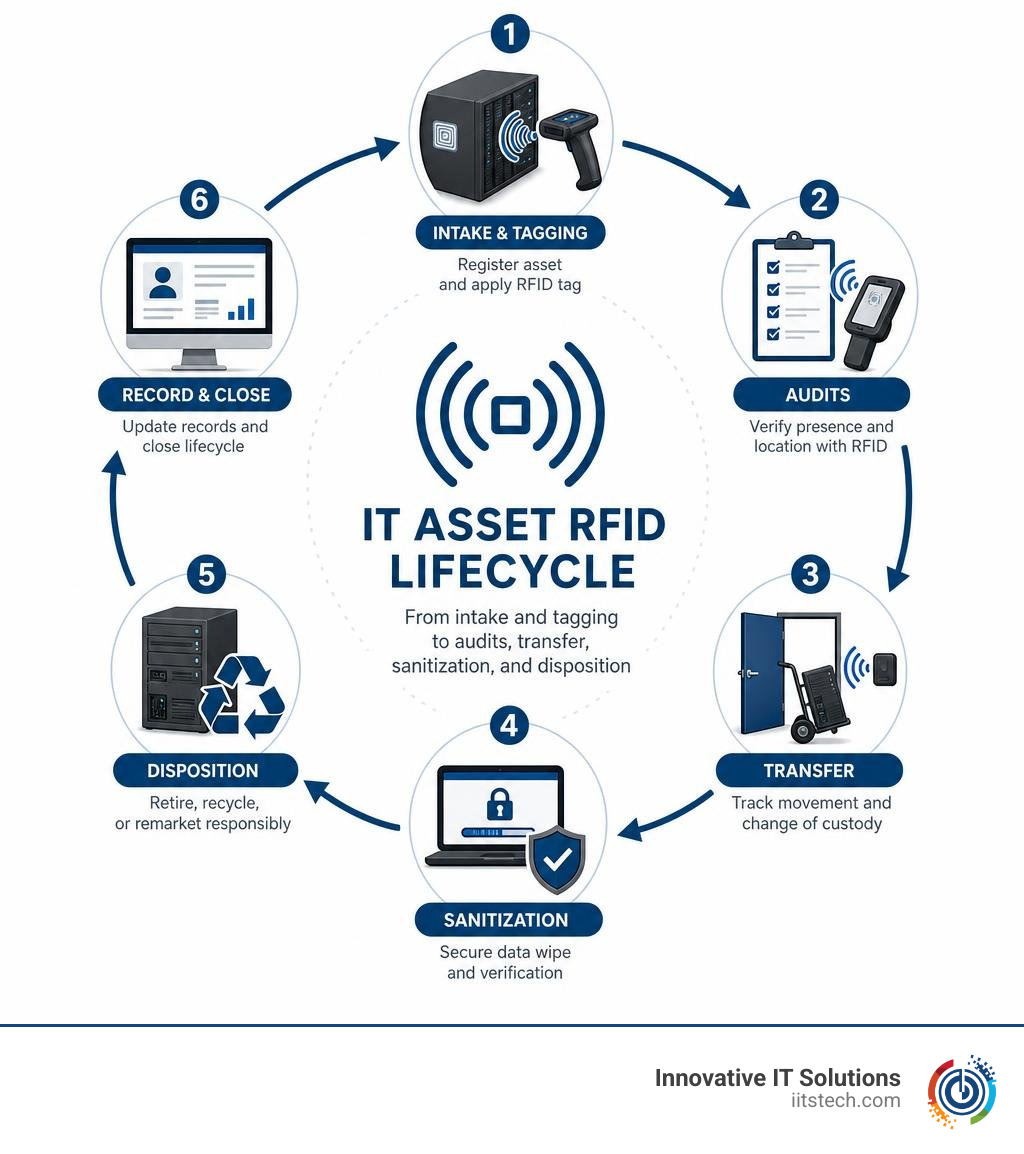
Core Fundamentals of IT Asset Tracking RFID Systems
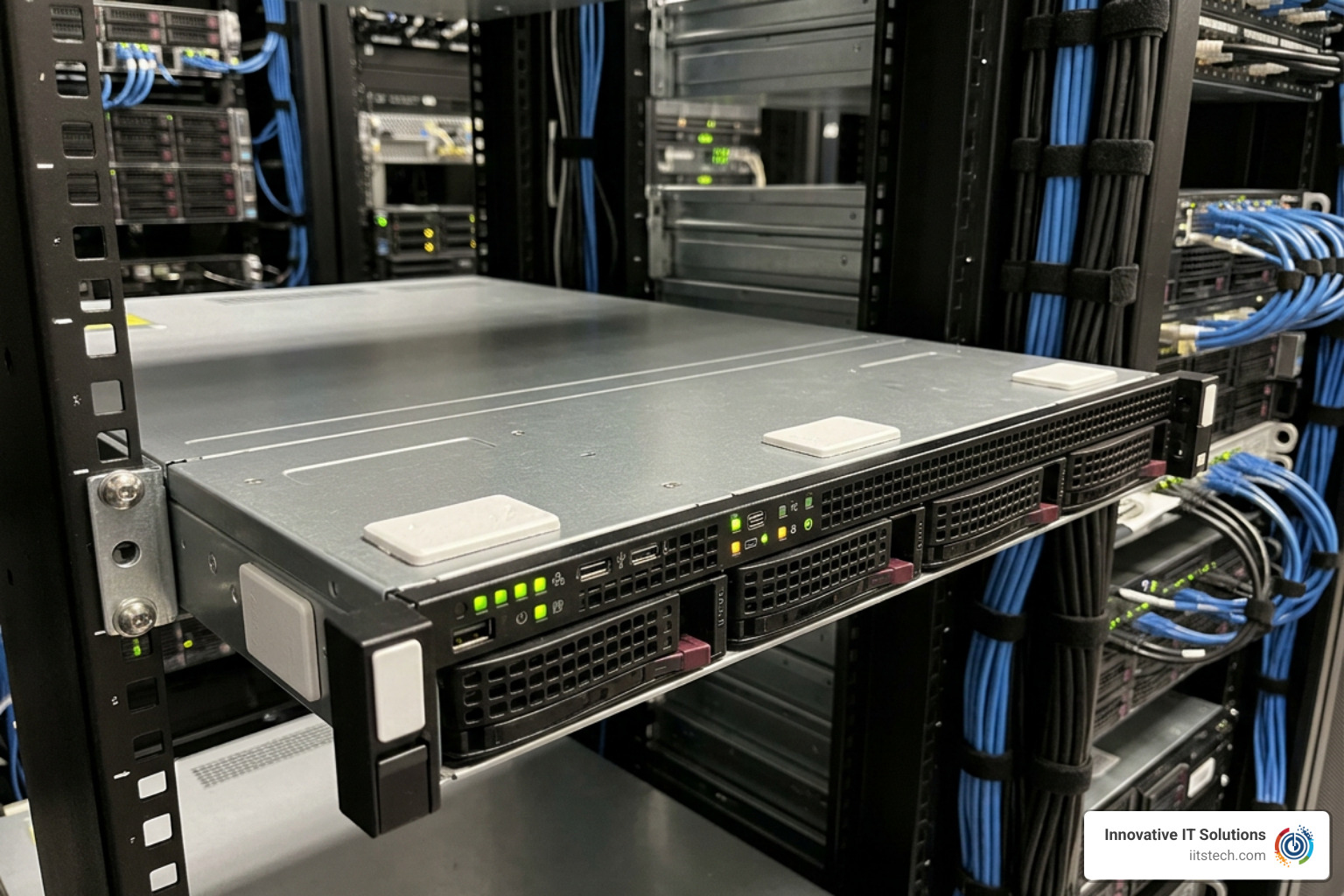
At its foundation, an RFID infrastructure translates the physical presence of enterprise computing hardware into digital events. Unlike optical barcodes that demand an unobstructed line of sight and steady hands, radio-frequency identification captures data wirelessly across electromagnetic fields. In high-density environments packed with servers, disk arrays, and network switches, this capability transforms how IT operations track assets.
Modern deployments rely heavily on the EPC Gen2 (ISO/IEC 18000-6C) protocol operating within the Ultra High Frequency (UHF) spectrum (860–960 MHz). UHF passive systems enable readers to power tiny microchips embedded in asset tags using incoming RF energy. The tag then modulates and backscatters that signal to return its identification data.
To maintain global uniqueness across distributed environments, enterprises encode tags using the GS1 GIAI-96 (Global Individual Asset Identifier) standard. While retail items use serial product codes tied to merchandise batches, GIAI-96 uniquely identifies an individual physical asset across its entire operational lifespan—from initial provisioning to final hardware retirement.
Standardizing on GIAI-96 ensures that when an enterprise server chassis, storage blade, or company laptop moves between data centers, facilities, or maintenance depots, its digital identity remains completely distinct within the Configuration Management Database (CMDB).
Passive vs. Active IT Asset Tracking RFID Technologies
Selecting the right tracking tier requires balancing read range, installation footprint, infrastructure cost, and rack granularity. While active solutions broadcast their own signals, passive UHF represents the enterprise standard for high-volume IT hardware tracking due to its zero-maintenance profile and long operational life.
| Feature / Metric | Passive UHF RFID | Active RFID (433/900 MHz) | BLE Beacons (Bluetooth) | NFC (High Frequency) |
|---|---|---|---|---|
| Power Source | Reader backscatter (No battery) | Internal battery (3–5 yr life) | Internal battery (2–4 yr life) | Reader induction field |
| Typical Read Range | 1 to 10 meters (3–30 ft) | Up to 100+ meters (300+ ft) | Up to 30 meters (100 ft) | Under 5 centimeters (< 2 in) |
| Asset Granularity | Room, zone, rack, and 1U slot | Zone and broad room level | Room and zone level | Direct contact / touch-level |
| Tag Unit Cost | Low ($0.50 – $3.00) | High ($15.00 – $50.00+) | Moderate ($5.00 – $20.00) | Low ($0.20 – $0.80) |
| Best Enterprise Use Case | High-density racks, blades, ITAD | Data center transit carts, mobile server racks | Room-level laptop tracking | Direct smartphone technician audits |
Selecting Tag Form Factors for High-Density Metallic Environments
Data centers are harsh RF environments. Standard adhesive labels fail on servers because bare metal chassis detune tag antennas and absorb radio waves, rendering ordinary tags unreadable. To overcome this physics hurdle, specialized anti-metal RFID tags incorporate an engineered dielectric spacer or a ferrite-layer backing. This isolation layer creates a buffer between the metal surface and the antenna, allowing the RF wave to reflect constructively rather than ground out.
When selecting tags for enterprise IT hardware, consider these primary form factors:
- Anti-Metal Foam-Back Labels: Flexible, low-profile labels with closed-cell foam spacers. They work well for standard server faceplates, workstation towers, and laptop lids where clearance is tight.
- FR-4 Hard Tags: Encapsulated in rigid fiberglass-reinforced epoxy resin, these rugged tags withstand physical impact, vibration, and cleaning agents. They are well-suited for hot-aisle server exhaust frames and rack infrastructure.
- High-Temperature PPS Tags: Encased in polyphenylene sulfide, these specialized tags withstand continuous operating temperatures up to 200°C, making them suitable for high-density compute blades and power distribution hardware.
Chip selection is equally critical. Modern integrated circuits such as the Impinj M800 series (M830/M850) and NXP UCODE 9 offer advanced read sensitivity (down to -24 dBm). This sensitivity ensures that readers reliably pick up signals even when tags are nestled among dense network cabling or shielded inside perforated cabinet doors.
Designing Real-Time RFID Infrastructure for Enterprise Data Centers
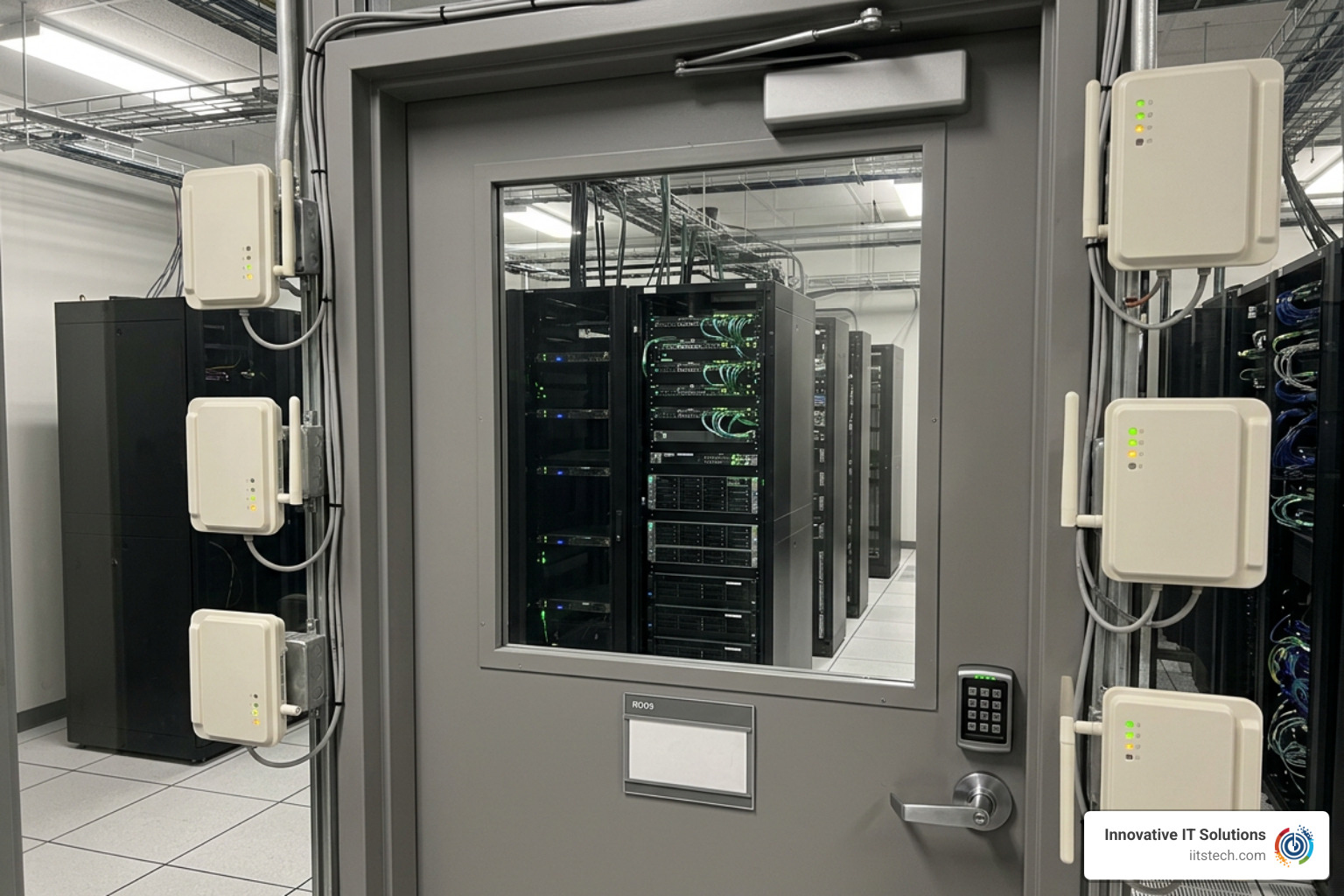
A resilient data center RFID deployment combines mobile scanning flexibility with fixed perimeter controls. Instead of relying on manual entry logs when equipment moves, fixed portal readers (such as the Impinj R700 or Zebra FX9600) mounted at server room entryways, dock doors, and staging zones detect tagged assets passing through chokepoints.
Connecting these readers via Power over Ethernet (PoE) simplifies cabling by delivering network connectivity and operational power over a single Cat6 run. These portals feed real-time movement data into an open-source real-time IT asset tracking architecture or enterprise middleware platform.

Optimizing Rack-Level and Component-Level Audits
Manual inventory checks often take up to an hour per dense server cabinet as technicians squint at tiny serial numbers, move patch cables, and hand-key entries into spreadsheets. Studies show that without automated tracking, upward of 25% of IT assets can go missing or become untracked ghost assets over time.
By deploying handheld UHF readers, an engineer can sweep an entire 42U or 48U rack in under a minute without opening cabinet doors or disconnecting active power lines. The radio waves pass through perforated mesh doors, reading servers, power supplies, and storage arrays in parallel.
When organizations need precise 1U-level positioning, magnetic connector strips with modular sensors can be mounted directly on cabinet vertical rails. These sensors match each tagged blade or chassis to its exact vertical slot. This level of automation yields a baseline inventory accuracy above 99%, freeing systems engineers to focus on operational uptime rather than manual inventory checklists.
On-Premise Data Security and Tamper-Proof Event Logging
For defense contractors, financial institutions, and security-conscious enterprises, asset telemetry must remain strictly governed. Security policies often forbid transmitting internal hardware configurations or serial numbers to multi-tenant public clouds.
A robust on-premise RFID architecture stores scanning telemetry behind internal firewalls. To maintain data integrity:
- Append-Only Logging: Movement and audit events are written to an append-only transaction ledger (such as a partitioned PostgreSQL database table) where historical records cannot be edited or deleted.
- Row-Level Security: Access control policies isolate asset classes so that technicians only see hardware categories relevant to their authorization clearance.
- Hardware-Level Tag Locking: Engineers apply EPC memory lock commands during tag provisioning. This step prevents unauthorized parties from cloning or overwriting asset IDs in the field.
These measures ensure that hardware records remain reliable during compliance reviews, aligning with proven data security best practices during hardware upgrades.
Software Architecture and Enterprise System Integrations
An RFID reader is only as valuable as the business logic that processes its data stream. In high-traffic data centers, fixed readers can capture hundreds of tag reads per second. Enterprise middleware acts as the intelligent buffer, deduplicating repetitive reads, smoothing RF signal noise, and packaging raw EPC hex strings into structured JSON payloads.
Middleware layers communicate upward through authenticated REST APIs and real-time webhooks, feeding asset events into central management systems.
Integrating IT Asset Tracking RFID with CMDB and ServiceNow ITAM
Connecting RFID scans directly to enterprise IT Service Management platforms like ServiceNow transforms physical audits from an operational chore into a background workflow.
When a handheld reader completes a room sweep or a portal detects hardware passing through a doorway, the scan data routes through a local MID Server into the ServiceNow Identification and Reconciliation Engine (IRE). The IRE matches the tag’s GIAI-96 identifier against existing Configuration Items (CIs) in the CMDB.
If the server is in its designated location, the system updates its “Last Verified” timestamp. If a technician moved a blade chassis to a different rack or staging room without filing a change request, the IRE flags the discrepancy immediately. This automated verification supports broader hardware governance, as detailed in our comprehensive IT asset management and disposal guide.
DCIM and ERP Synchronization for Multi-Location IT Estates
For companies running facilities across multiple campuses—such as operations distributed throughout the Oklahoma City metro, South OKC, and regional corporate hubs—centralized visibility is essential. Synchronizing RFID data across Data Center Infrastructure Management (DCIM) and ERP platforms (like SAP or Oracle) ensures that physical assets match financial depreciation ledgers.
Hierarchical location schemas structure the data logically:
- Enterprise (Global Organization)
- Campus / Region (e.g., Oklahoma City Operations)
- Building / Facility (Data Center 1)
- Room / Zone (Raised Floor Suite B)
- Rack / Cabinet (Rack 14-A)
- U-Slot / Blade Slot (1U – Slot 22)
- Campus / Region (e.g., Oklahoma City Operations)
When equipment moves between sites, automated variance alerts notify IT managers of unexpected relocations, simplifying how multi-location businesses manage equipment logistics.
Lifecycle Workflows: Tagging, Maintenance, and Secure Disposition
An effective RFID implementation follows enterprise hardware through every stage of its operational life. Establishing disciplined tagging and tracking workflows protects hardware investments and maintains chain-of-custody integrity from day one through retirement.
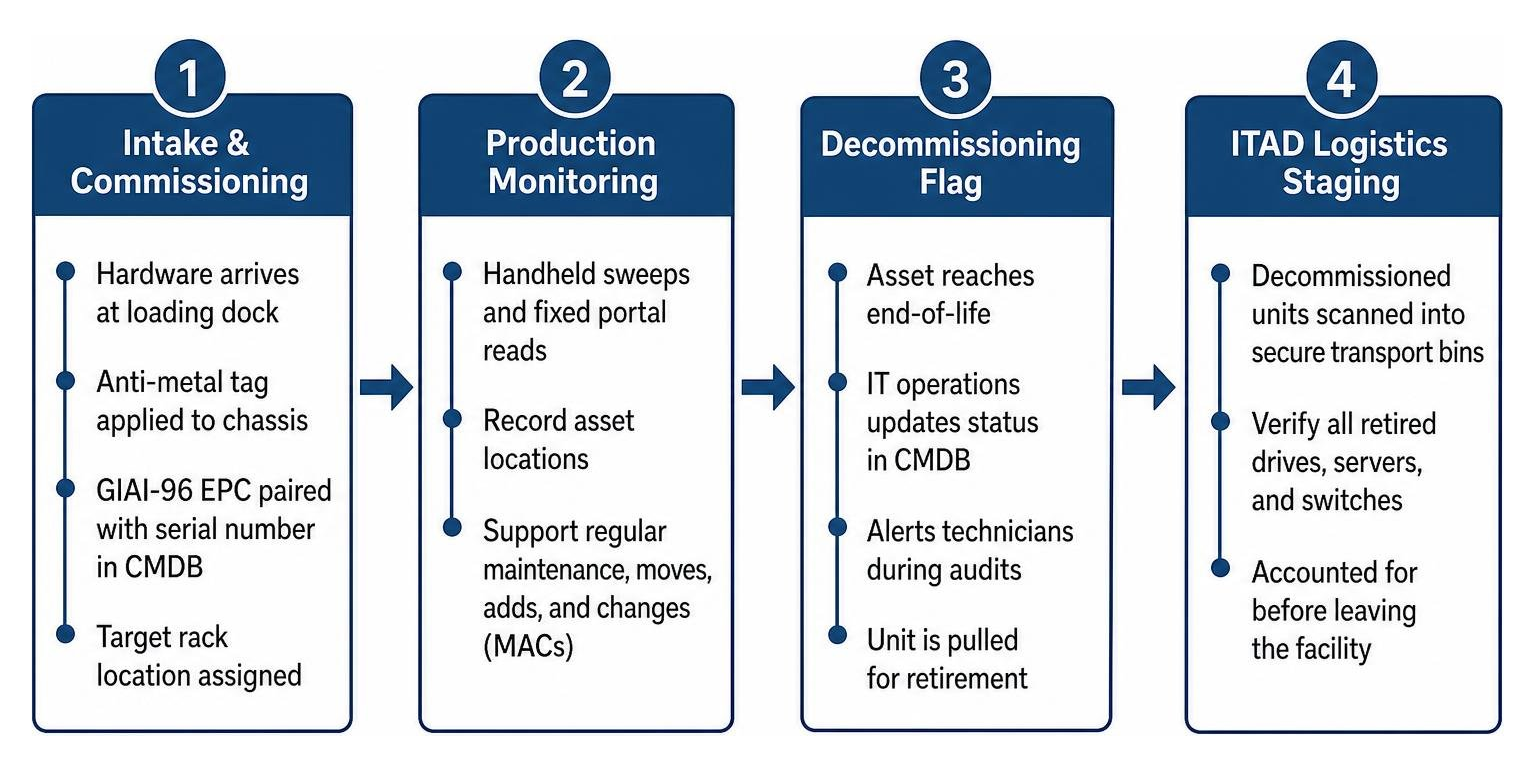
- Intake & Commissioning: As new hardware arrives at the loading dock, technicians affix an anti-metal tag to the chassis, pair the GIAI-96 EPC with the manufacturer serial number in the CMDB, and assign its target rack location.
- Production Monitoring: Routine handheld sweeps and fixed portal reads record asset locations during regular maintenance, moves, adds, and changes (MACs).
- Decommissioning Flag: When an asset reaches end-of-life, IT operations update its status in the CMDB, which alerts technicians during room audits to pull the specified unit.
- ITAD Logistics Staging: Decommissioned units are scanned into secure transport bins, verifying that every retired drive, server, and switch is accounted for before leaving the facility.
Maintaining this real-time log ensures an unbroken chain of custody, helping organizations understand how to maintain chain of custody compliance across all operational phases.
Auditing Multi-Facility Assets and Reconciling Discrepancies
Discrepancy reconciliation is where automated RFID workflows save substantial labor. Instead of manually cross-referencing paper manifests against live racks, audit teams conduct walkthroughs with Bluetooth-connected handheld readers. The mobile software compares scanned tags in real time against the expected room manifest.
The system groups exceptions into actionable categories:
- Missing Assets: Tags present on the manifest but undetected during the sweep. Assets unread for 30 consecutive days trigger automated investigation tickets.
- Misplaced Assets: Tags detected in the room that belong in a different rack, zone, or building.
- Unregistered Assets: Active tags detected by the reader that have no corresponding record in the CMDB.
By generating instant variance reports on-site, technicians can find misplaced servers immediately rather than spending days researching spreadsheet discrepancies after the fact.
ITAD Decommissioning and NIST SP 800-88 Compliance
The final stage of the IT lifecycle—IT asset disposition (ITAD)—carries significant regulatory, security, and environmental obligations. When servers and storage arrays leave active production, tracking must account for every data-bearing device through media sanitization and physical destruction.
Under NIST SP 800-88 Rev. 1 guidelines (Guidelines for Media Sanitization), storage media must undergo verifiable sanitization tiers: Clear, Purge, or Destroy. Affixing tamper-evident RFID tags to drive caddies, server chassis, and storage arrays allows technicians to log each device through data wipe systems, degaussers, or industrial shredders.
Once sanitization is complete, the RFID tag can be permanently decommissioned using chip-level write-once lock commands or physical destruction. The resulting audit logs provide verifiable certificates of data destruction.
Working with certified ITAD specialists ensures that retired assets follow EPA-compliant, zero-landfill electronic recycling processes while meeting strict R2v3 and ISO standards, reinforcing why understanding secure IT asset disposition requirements is essential for modern enterprise compliance.
Frequently Asked Questions about IT Asset Tracking with RFID
How accurate is RFID compared to manual barcode scanning in enterprise data centers?
In real-world data center deployments, properly configured UHF RFID systems achieve read accuracy rates exceeding 99%. Manual barcode scanning is prone to human error—such as skipped labels, misread numbers, and inaccessible ports behind cables—and often requires up to an hour per rack. RFID handheld sweeps audit dense 42U server cabinets in under a minute without needing a direct line of sight.
Can passive RFID tags interfere with live server operations or networking signals?
No. Passive UHF RFID tags are completely dormant until energized by the radio field of a reader. They emit low-power, non-ionizing electromagnetic backscatter signals that comply with FCC and international electromagnetic compatibility (EMC) standards. Extensive enterprise testing confirms that passive tags do not interfere with high-speed fiber channels, copper networking cables, or sensitive server compute hardware.
How do organizations handle RFID tracking across distributed remote workforces?
For laptops and mobile workstations assigned to remote employees, organizations often deploy hybrid tags combining UHF and NFC in a single label. UHF enables bulk scanning when hardware passes through central IT provisioning depots, while NFC allows technicians or remote employees to scan the laptop using a smartphone app during inventory check-ins, return shipments, or depot repairs.
Conclusion
Managing enterprise IT hardware across corporate offices and data centers requires clear, real-time physical visibility. Relying on manual spreadsheets and periodic barcode scans leaves blind spots that lead to ghost assets, failed audits, and unnecessary hardware purchases.
Deploying it asset tracking rfid establishes an automated physical evidence layer that keeps CMDB, DCIM, and ERP platforms synchronized with what is actually running on your data center floor.
From initial hardware provisioning through moves, maintenance, and regular room audits, RFID captures accurate asset telemetry in minutes rather than days. When hardware reaches the end of its useful lifecycle, that same tracking infrastructure provides an auditable, verifiable record through media sanitization, decommissioning, and responsible recycling.
At Innovative IT Solutions, we help enterprises maintain complete visibility and security across every stage of the hardware lifecycle. Based in Oklahoma City, our NIST/DoD-compliant, zero-landfill, and EPA-compliant processes provide verified data destruction, hardware refurbishing, and maximum value recovery.
When your organization is ready to retire, refresh, or audit its data center hardware, partner with us for certified enterprise IT asset disposition and recovery services.


