
What a Certificate of Destruction Actually Is (And Why It Matters for IT Compliance)
A certificate of destruction is an official document issued by a qualified destruction or IT asset disposition (ITAD) provider that confirms your sensitive data — stored on hard drives, servers, or other enterprise hardware — has been permanently and securely destroyed.
Here is a quick breakdown:
| Question | Answer |
|---|---|
| What is it? | A formal document proving data-bearing assets were securely destroyed |
| Who issues it? | A certified ITAD or shredding vendor after completing destruction |
| What does it include? | Date of service, destruction method, asset serial numbers, authorized signature |
| Who needs it? | Any business handling sensitive data — especially in healthcare, finance, or government |
| Why does it matter? | It is your primary evidence of compliance during audits, legal reviews, and regulatory inspections |
When your organization decommissions servers or wipes a fleet of enterprise computers, deleting files or formatting drives is not enough. Regulators, auditors, and insurers want documented proof. Without it, your business carries full liability if data is later recovered or exposed.
The stakes are real. Companies using third-party ITAD vendors without obtaining certificates of destruction face an average data breach cost increase of $4.45 million per incident. On the other side, organizations that maintain proper destruction records reduce their risk of regulatory fines by up to 70% during compliance audits.
I’m Mike Haden, Founder and Director of Business Development at Innovative IT Solutions — an R2v3-certified ITAD company with over 14 years of experience processing and securely disposing of enterprise IT hardware for corporate clients. Throughout that time, the certificate of destruction has been one of the most critical documents we provide to ensure our clients’ data security and audit readiness.
What is a Certificate of Destruction and Why Does Your Business Need It?
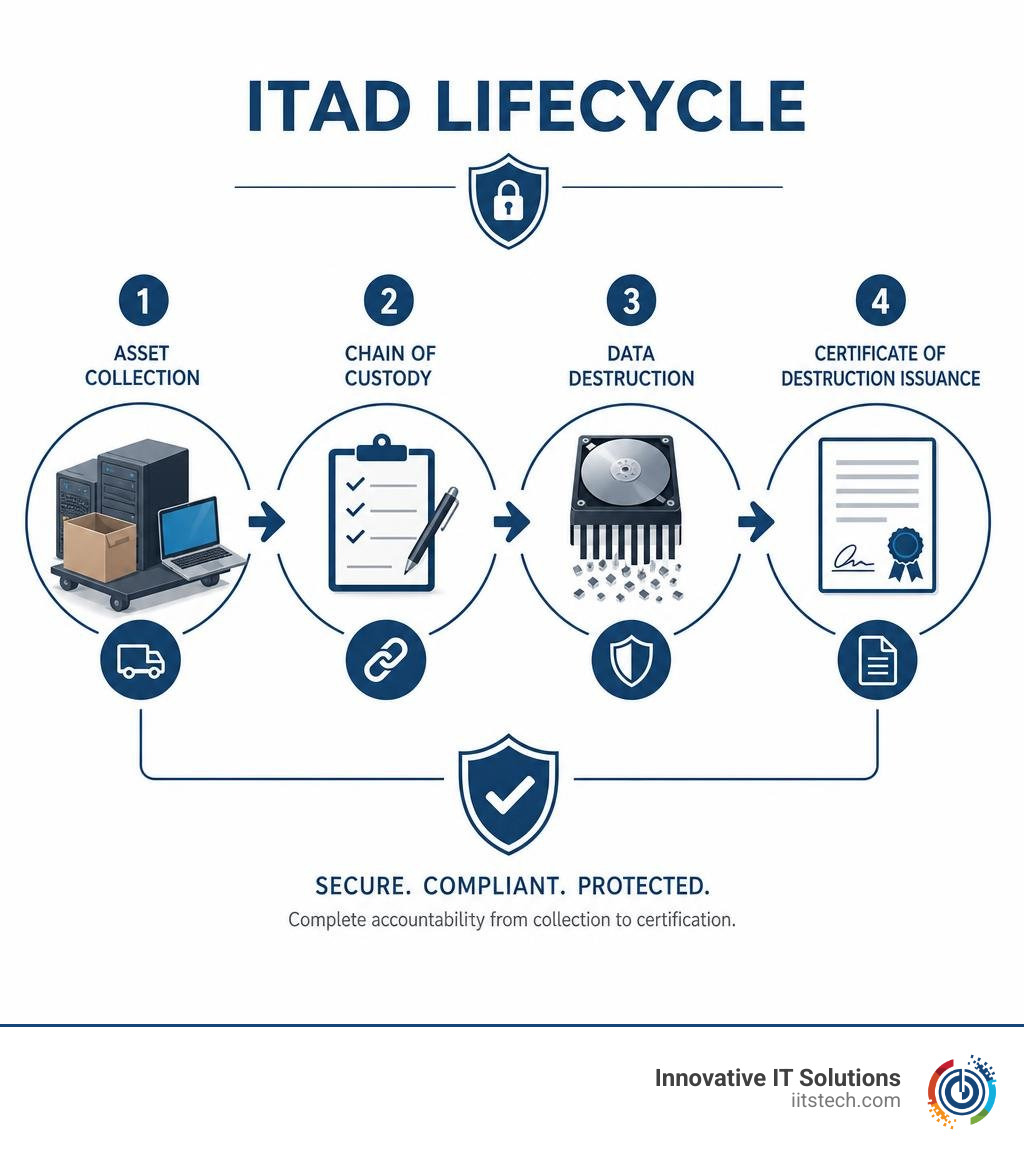
To put it plainly, a certificate of destruction (COD) is your get-out-of-jail-free card — or more accurately, your “keep-out-of-court” card. When we process retired servers, enterprise laptops, or backup tapes, the COD serves as the final, legally recognized link in your chain of custody. It is a formal declaration that specific, serialized assets have been rendered completely and permanently unrecoverable.
Many business owners confuse a COD with a simple receipt or a Proof of Service (POS). This is a dangerous mistake. A Proof of Service merely says, “Hey, we picked up 50 hard drives from your South OKC office today.” It does not prove that those drives were actually destroyed, nor does it detail the method used. A Certificate of Destruction, on the other hand, is issued after the work is completed. It certifies the exact date, location, and method of physical destruction or data sanitization for every single device by its unique serial number.
Understanding the importance of data destruction is central to protecting your company’s intellectual property. When you hand over business-grade computers or server components to a third-party vendor, you retain regulatory responsibility for that data until it is destroyed. By securing a formal COD, you shift a massive portion of that operational liability to the certified ITAD provider.
This is why data destruction is important for your business: it legally documents your due diligence. If a decommissioned server drive from your Oklahoma City headquarters somehow ends up on an online marketplace years from now, your COD is the concrete evidence proving that you followed compliant disposal protocols and that any subsequent leak occurred outside your operational boundary.
Regulatory Compliance and Industry Standards
In the enterprise IT world, “shredding” isn’t just about making big things into little pieces. It is a highly regulated, scientifically validated process. To withstand a federal or state-level audit, your data destruction methods must align with recognized global frameworks.
Two of the most prominent standards governing IT hardware disposal are:
- NIST SP 800-88 (Rev. 1): The National Institute of Standards and Technology’s Guidelines for Media Sanitization. This is the gold standard for both government and corporate sectors. It defines three levels of sanitization: Clear (software-based overwriting), Purge (degaussing or cryptographic erasure), and Destroy (physical shredding or melting).
- DoD 5220.22-M: The Department of Defense standard, which historically required a three-pass overwrite process. While largely superseded by NIST guidelines for modern high-density storage drives, it remains a common contract requirement for legacy enterprise systems.
Understanding why your business should use certified data destruction services for compliance comes down to audit defensibility. An uncertified vendor might hand you a piece of paper they printed themselves, but a certified ITAD partner utilizes processes that are independently audited to ensure compliance with these precise federal standards. Knowing how to ensure certified data destruction for retired devices means verifying that your vendor’s certificates explicitly reference NIST SP 800-88 compliance.
Key Regulations Requiring a Certificate of Destruction
Depending on your industry, failing to secure a compliant certificate of destruction can result in catastrophic legal penalties. The role of data destruction in cybersecurity is now codified into several major legislative frameworks:
- HIPAA (Health Insurance Portability and Accountability Act): Healthcare organizations are heavily targeted by cybercriminals. Under HIPAA’s Security Rule, covered entities must implement policies for the secure disposal of electronic protected health information (ePHI). Over 80% of healthcare organizations require a formal COD as standard documentation.
- FACTA (Fair and Accurate Credit Transactions Act) Disposal Rule: This rule requires any business that handles consumer credit information to destroy it securely to prevent identity theft.
- GLBA (Gramm-Leach-Bliley Act): Financial institutions — including local Oklahoma City credit unions and accounting firms — must comply with strict data safeguarding rules, making certified server and computer hard drive destruction mandatory.
- PIPEDA (Personal Information Protection and Electronic Documents Act): For businesses dealing with international clients or operations crossing northern borders, Canadian standards parallel US laws, requiring verifiable proof that personal data has been safely eliminated.
Audit-Compliant Standards for Enterprise IT Hardware
When dealing with enterprise-grade IT hardware, a “one-size-fits-all” approach to destruction does not work. The physical architecture of computer components dictates how they must be sanitized:
Solid-State Drives (SSDs), commonly found in modern enterprise servers and high-end business laptops, store data on flash memory chips rather than magnetic platters. This means traditional magnetic degaussing is completely ineffective on SSDs. To safely destroy an SSD, we must perform a certified cryptographic erasure or use specialized industrial micro-shredders that reduce the drive to 2mm particles. This physical destruction process ensures that the tiny silicon memory chips are completely pulverized.
When deciding between physical destruction vs data wiping, your compliance team must weigh the reuse value of the hardware against the absolute finality of physical shredding. A compliant COD will clearly identify which method was used for each individual asset.
Anatomy of an Audit-Ready Certificate of Destruction
Not all certificates are created equal. If your current ITAD vendor hands you a document that looks like a basic receipt with “Shredded some hard drives” scribbled at the bottom, your business is highly vulnerable to audit findings.
To help you distinguish between a valid, audit-ready document and an insufficient one, we have put together this comparison:
| Required Element | Audit-Ready Compliant COD | Non-Compliant “Receipt” |
|---|---|---|
| Asset Identification | Serialized list matching device serial numbers | Generic description (e.g., “Box of IT assets”) |
| Method Specification | Explicitly lists method (e.g., “NIST 800-88 Physical Shredding”) | Vague terms (e.g., “Disposed of securely”) |
| Chain of Custody | Documents transfer dates, secure transport, and custody handoffs | Missing transport and custody logs |
| Certification Details | Features the provider’s NAID AAA or R2v3 certification numbers | No formal industry certification listed |
| Signatures | Signed by both the destruction technician and a witness | Unsigned or signed by an anonymous employee |
Before you send your corporate hardware off for disposal, it is highly recommended to review a Certificate of destruction template: Fill out & sign online | DocHub to understand what a standard, legally defensible template looks like. Additionally, knowing how to prepare IT equipment for secure disposal ensures your internal inventory perfectly matches the serial numbers that will eventually appear on your certified COD.
Essential Elements of a Valid Certificate of Destruction
To satisfy meticulous corporate auditors, a valid certificate of destruction must contain several non-negotiable data points.
First, it must include a unique job or certificate number for tracking purposes. Second, it must feature a fully itemized, serialized list of every single hard drive, solid-state drive, or server component destroyed. Generic weights (e.g., “300 lbs of steel”) will not pass a HIPAA or GLBA audit.
Third, the certificate must proudly display the provider’s NAID AAA certification number. NAID (National Association for Information Destruction) AAA-certified providers undergo rigorous, unannounced audits to verify their security protocols. It is no surprise that 95% of clients working with certified providers insist on receiving a formal COD for every single project to satisfy their insurance underwriters. Securely documenting these details is one of the most critical, yet frequently overlooked, unfolding reasons for hard drive shredding in the corporate landscape.
Chain of Custody and Timing: On-Site vs. Off-Site Destruction
The physical logistics of your data destruction project will directly impact the timing of your COD. Businesses generally choose between two primary workflows:
- On-Site (Mobile) Shredding: A specialized mobile shredding truck equipped with industrial pulverizers comes directly to your corporate facility in Oklahoma City. Your internal IT staff can physically witness the hard drives being dropped into the shredder. Because the destruction occurs on your premises, a preliminary or final COD can often be generated and signed on the same day.
- Off-Site (Facility-Based) Destruction: Your retired servers and computers are secured in locked transit bins and transported via GPS-tracked vehicles to our secure recycling and ITAD facility.
If you choose off-site destruction, understanding what is chain of custody in ITAD is vital. The vendor must provide a transfer of custody document when the assets leave your building. Once the assets arrive at our facility, they are scanned, quarantined, and destroyed. The official certificate of destruction is then generated and sent to you digitally once the process is complete. Knowing how to keep your ITAD chain of custody unbroken requires choosing a partner that utilizes real-time scanning and secure, locked transport vehicles.
Risks and Best Practices for Managing Destruction Records

Skipping out on proper certified data destruction is a massive gamble. The financial and reputational consequences of a data breach involving discarded IT assets are far higher than the cost of secure recycling.
Understanding the hidden costs of skipping data destruction services is crucial for modern risk management. Many businesses try to save a few dollars by throwing old computers into standard recycling bins or selling un-wiped servers online, only to face massive regulatory fines and devastating public relations crises later. This is precisely why you should destroy electronics hard drives through a certified, documented process rather than leaving their disposal to chance.
The Dangers of Skipping Certified Destruction
When you hire an uncertified vendor or handle disposal in-house without documentation, you are essentially flying blind. If those drives are lost in transit or sold to a buyer who recovers your proprietary database, your company faces severe liabilities.
Without a certificate of destruction, you cannot prove to regulators that you took “reasonable measures” to protect consumer or employee data. The shift in liability only occurs when a certified provider signs off on a formal COD, legally taking responsibility for the secure eradication of that data. If your provider cannot or will not issue a compliant certificate, it is time to look for professional hard drive shredding services that prioritize compliance.
Retention and Storage Best Practices for Compliance
Once you receive your certificates of destruction, how should you store them?
- The 7-Year Retention Rule: For optimal compliance and audit-readiness, businesses should retain their CODs for at least 7 years. Organizations that follow this retention guideline are 3x more likely to pass data protection audits without any negative findings or compliance citations.
- GRC Platform Integration: Modern Governance, Risk, and Compliance (GRC) platforms allow you to centralize your CODs, linking them directly to the specific retired hardware assets in your internal inventory.
- Secure Digital Archiving: Keep digital copies of your certificates in a highly secure, cloud-based directory with restricted access controls. This ensures that when an auditor asks for proof of disposal for a specific batch of servers, your IT team can retrieve the exact COD in seconds.
Recognizing the essentiality of hard drive shredding and maintaining a flawless archive of your destruction records is the best way to protect your business from future liability.
Frequently Asked Questions about Certificates of Destruction
Can a Certificate of Destruction be reversed or canceled?
No. When it comes to physical IT hardware and enterprise storage media, a certificate of destruction is completely absolute and irreversible. Once a hard drive has been physically shredded into tiny fragments or solid-state drives have been micro-shredded down to 2mm particles, the physical state of that media is permanently altered. There is no technology on Earth that can reconstruct a pulverized silicon chip or a shredded magnetic platter.
In rare cases where software-based sanitization (like cryptographic erasure) is used, the data is also permanently gone once the encryption keys are destroyed. Therefore, before signing off on a destruction order, your IT department must ensure that all critical business data has been fully backed up and migrated to your new server environment.
How do we verify if a third-party ITAD vendor’s certificate is legitimate?
To verify that a vendor’s COD is legitimate and compliant, you should look for third-party credentials rather than taking their word for it. Legitimate providers are audited by independent bodies.
First, ask for their official NAID AAA Certification and R2v3 (Responsible Recycling) credentials. You can easily verify these certifications by searching the provider’s name directly on the official NAID or SERI (Sustainable Electronics Recycling International) directories. A legitimate vendor will also gladly provide detailed, serialized tracking logs and allow your team to witness the destruction process if requested.
What is the difference between a Proof of Service and a Certificate of Destruction?
Think of a Proof of Service (POS) as a delivery receipt and a Certificate of Destruction (COD) as a legal affidavit.
A POS is handed to you the moment the ITAD vendor picks up your locked bins or decommissioned servers. It simply confirms that a transaction occurred and that the physical assets are now in the vendor’s possession.
A COD is only issued after the data sanitization or physical shredding process is completed. The COD is the highly detailed, legally binding document that contains the individual serial numbers of the destroyed drives, the specific NIST-compliant destruction methods used, and the authorized technician signatures. For compliance audits, a POS is insufficient; only a formal COD provides true audit defensibility.
Conclusion
At Innovative IT Solutions, we believe that secure data disposal should never be a guessing game. Based right here in Oklahoma City, we provide premier, certified IT asset disposition (ITAD) and certified data destruction services tailored specifically for business-grade IT hardware, enterprise servers, and corporate computer fleets.
Our fully compliant processes align with strict NIST SP 800-88 and DoD standards, ensuring your sensitive corporate data is permanently destroyed. With our zero-landfill, EPA-compliant policies, we help OKC businesses maximize their financial returns on retired assets while maintaining a flawless, audit-ready chain of custody.
Protect your business, secure your compliance, and gain complete peace of mind. Contact us at Innovative IT Solutions today to schedule your secure data destruction and receive your certified Certificate of Destruction.


