
Why IT Asset Solutions Matter for Enterprise Hardware
IT asset solutions give IT teams one reliable record of every business computer, server, and component from purchase through secure retirement. The right platform combines automated discovery, asset tags, lifecycle workflows, and audit-ready reporting so you can answer four urgent questions: what hardware you own, where it is, who is responsible for it, and whether it holds sensitive data.
For a mid-sized enterprise, this visibility helps prevent lost devices, unmanaged servers, surprise replacement costs, and compliance gaps. It also makes offboarding and decommissioning safer by documenting chain of custody, data sanitization, resale or recycling, and final disposition.
Modern ITAM replaces scattered spreadsheets with a central system that can:
- Discover connected hardware and flag unknown or unpatched assets.
- Track ownership, location, condition, maintenance, and refresh dates.
- Support barcode, RFID, GPS, BLE, or mobile scanning for on-site and remote equipment.
- Improve financial records with depreciation, utilization, and recovery-value data.
- Create time-stamped records that speed up HIPAA, GDPR, PCI, and internal audit preparation.
I am Mike Haden, founder and Director of Business Development at Innovative IT Solutions, with 14 years of experience in secure IT asset disposition, data sanitization, hardware recovery, and responsible reuse. In this guide, I will show how IT asset solutions help organizations control hardware throughout its lifecycle while reducing security, compliance, and e-waste risk.
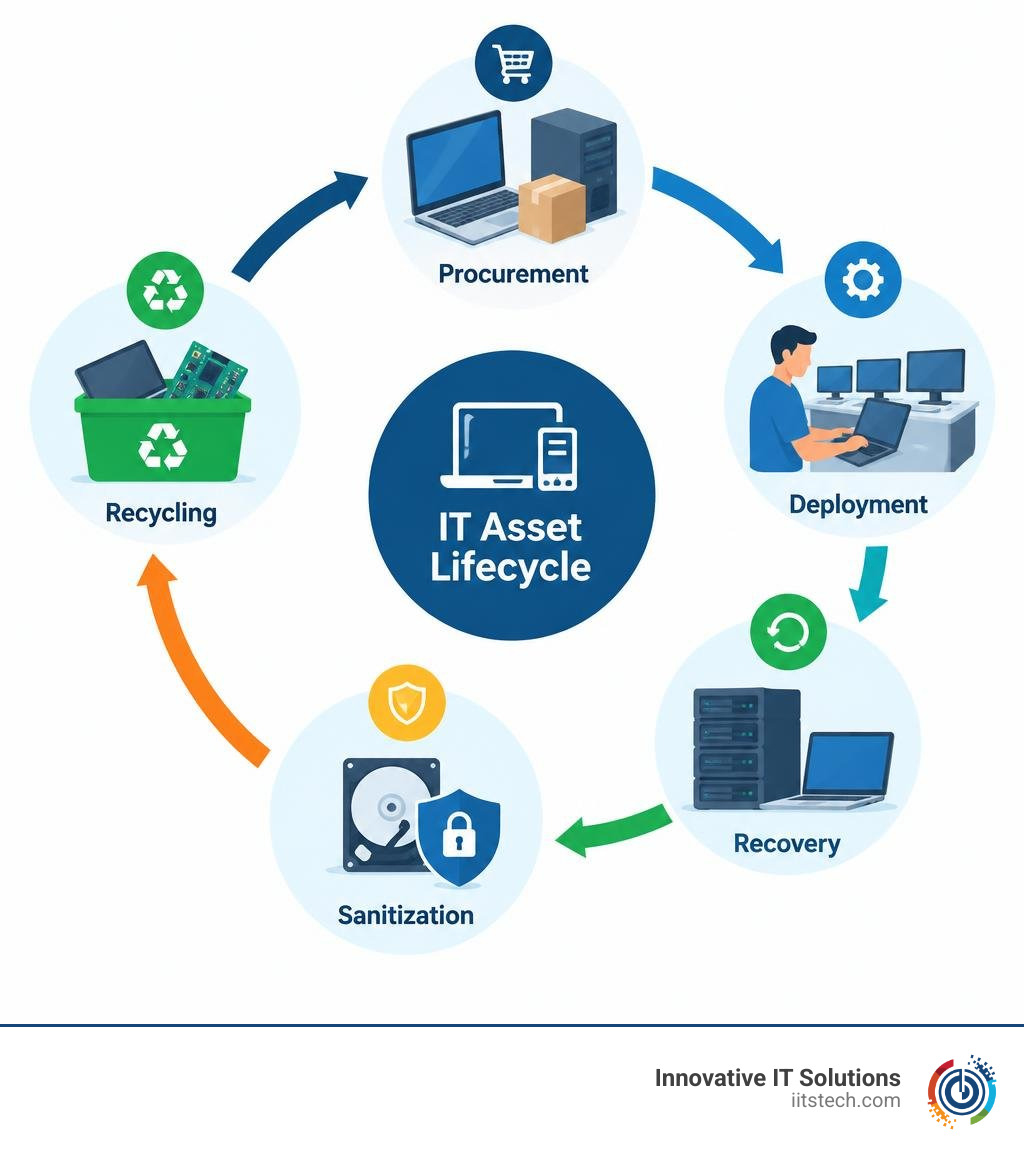
Core Capabilities of Modern IT Asset Solutions
Managing enterprise hardware across distributed offices and hybrid setups is difficult when IT teams rely on static lists. Modern enterprise ITAM platforms centralize physical, virtual, and cloud infrastructure into a unified view. Instead of guessing how many operational workstations reside in storage or whether retired rack servers still hold sensitive data, enterprise solutions provide continuous visibility across every stage of the hardware lifecycle.

By ingesting real-time telemetry from enterprise networks, hypervisors, and endpoint agents, these systems build an accurate discovery map that reflects active infrastructure. Automated workflows streamline operational tasks like provisioning workstations, reassigning components during team restructures, and tracking warranty expiration dates.
Automated Discovery Across Enterprise Infrastructure
Enterprise infrastructure spans multi-node server clusters, storage arrays, edge computing units, and distributed business laptops. Modern ITAM platforms use agentless network scanning alongside active endpoint monitors to detect every device connected to your subnets.
These engines scan IP ranges, query Active Directory, poll SNMP endpoints, and ingest telemetry across virtual and bare-metal environments. High-performance discovery engines build maps exceeding 12.8k+ assets, linking network interfaces, serial numbers, installed memory modules, and storage drives directly to assigned departmental owners.
These discovery mechanics ensure compliance with public sector IT asset governance guidelines and commercial regulatory benchmarks. When an undocumented blade server connects to an enterprise subnet or an unmonitored hypervisor host comes online, the system alerts administrators, flags potential compliance gaps, and updates configuration records.
Implementing IT Asset Solutions for Lifecycle Tracking
Visibility requires pairing automated network discovery with physical tracking tools across every hardware lifecycle stage:
- Procurement and Ingestion: Registering enterprise laptops, rack servers, and drive arrays at arrival with barcode or RFID tags.
- Deployment and Configuration: Assigning tagged assets to business units, configuring base images, and logging custody handoffs.
- Active Operation and Maintenance: Tracking performance, scheduling maintenance intervals, and monitoring warranty expirations.
- Decommissioning and Recovery: Logging devices flagged for retirement, isolating sensitive storage media, and recording final disposition.
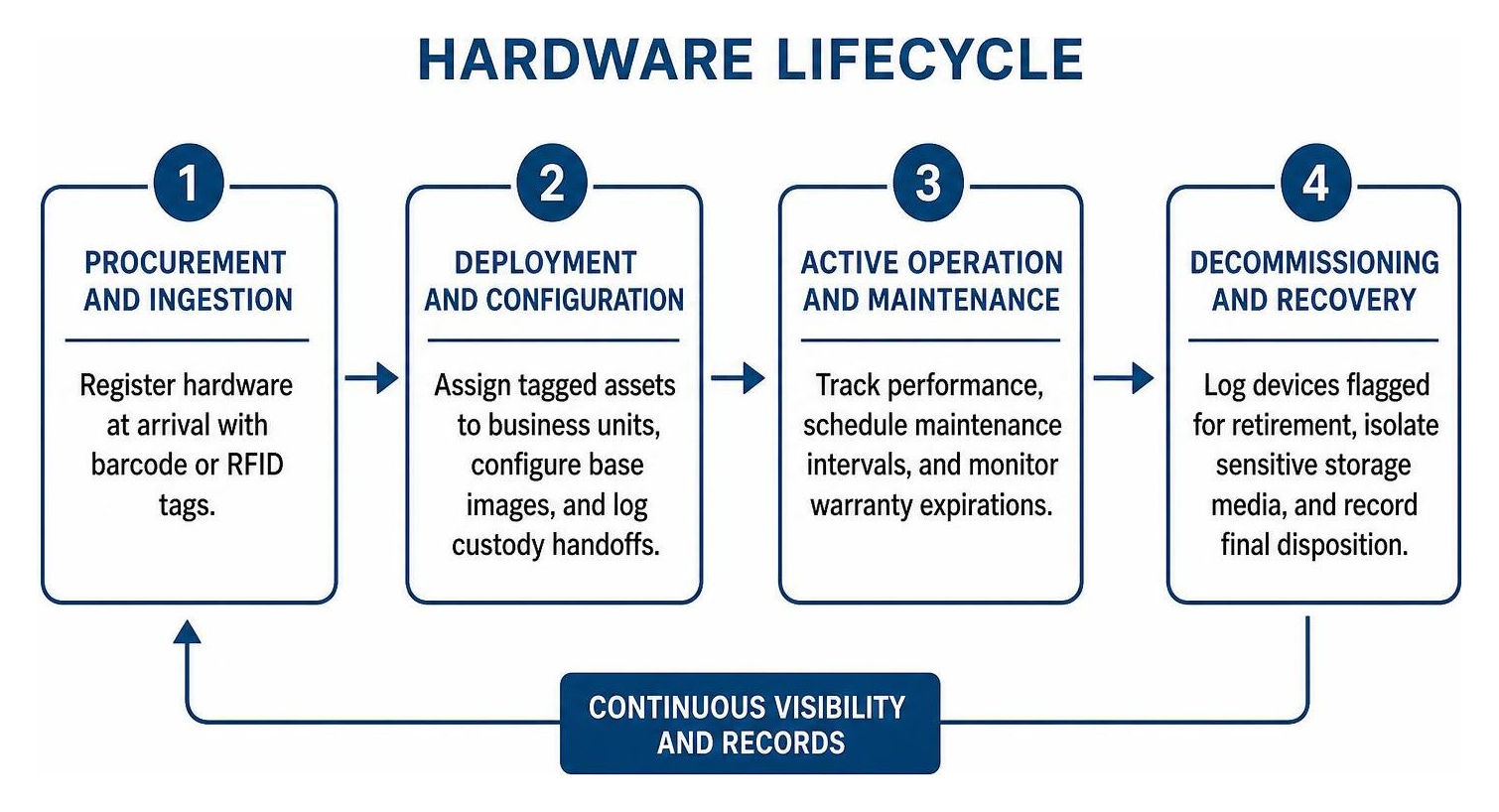
Integrating barcode scanners, RFID readers, and Bluetooth Low Energy (BLE) sensors bridges digital records with physical warehouse shelves. When internal teams deploy new hardware or relocate enterprise servers between data center racks, mobile scanning keeps the centralized registry updated, preventing inventory drift across multiple operational sites.
Legacy Tracking Challenges vs. Modern ITAM Platforms
Relying on manual tracking creates operational bottlenecks. Many enterprise IT teams still manage multi-million-dollar server environments using disconnected spreadsheets. As workforces expand and hardware moves across facilities, static files fall out of sync with actual deployments.
This divergence results in data silos, shadow IT, and ghost assets—equipment recorded on financial ledgers that has been lost, stolen, or decommissioned without documentation.
| Operational Area | Legacy Manual Tracking | Modern Automated ITAM Platform |
|---|---|---|
| Asset Discovery | Manual physical audits and periodic surveys | Continuous agentless scanning and network ingestion |
| Data Accuracy | Degrades rapidly due to human entry errors | Real-time synchronization across network endpoints |
| Ghost Asset Risk | High; unmonitored hardware remains on books | Low; automated alerts flag inactive hardware |
| Audit Preparation | Weeks of manual log consolidation | 40% faster audit preparation via automated ledgers |
| Vendor Management | Disjointed records across multiple regional vendors | Unified platform enabling up to 5-to-1 vendor consolidation |
| Lifecycle Visibility | Fragmented between procurement and helpdesk | Single pane of glass from intake to certified disposition |
Overcoming Spreadsheet Sprawl and Ghost Assets
When organizations lack a centralized asset repository, spreadsheet sprawl introduces significant administrative friction. Departments create duplicate asset lists, technicians skip manual checkout logs during urgent server maintenance, and remote equipment goes untracked.
These tracking failures create several operational bottlenecks:
- Uncontrolled Inventory Drift: Discrepancies between balance sheet records and active physical inventory, leading to unnecessary purchases.
- Ghost Assets and Capital Waste: Paying software licenses, endpoint protection fees, and property taxes on servers and laptops no longer in service.
- Support Ticket Backlogs: IT helpdesks spend valuable time diagnosing hardware issues without baseline visibility into device age or specifications.
- Vendor Fragmentation: Engaging different third-party vendors across disparate sites without unified oversight over service levels or costs.
(The cycle above illustrates the compounded operational risk of legacy asset tracking.)
Comparing Manual Methods and Automated IT Asset Solutions
Replacing manual processes with an automated ITAM platform delivers measurable operational improvements. Automating device onboarding, hardware refresh cadences, and employee offboarding workflows helps organizations achieve up to 40% fewer IT tickets. Routine provisioning tasks occur through standardized, policy-driven workflows rather than ad-hoc email chains.
Automated discovery also helps reduce administrative overhead. By consolidating disparate tracking tools into one system, enterprises can achieve a 5-to-1 vendor consolidation, replacing fragmented regional service providers with a single operational standard.
These efficiency gains allow a single IT administrator to manage equipment for up to 2,500 employees without adding headcount. Rather than spending weeks reconciling asset lists, IT teams can focus on strategic infrastructure improvements and system reliability.
Financial Accuracy, Compliance, and Audit Readiness
Enterprise hardware represents significant capital investment. Without precise asset tracking, finance teams struggle to model depreciation, project capital expenditures (CAPEX), and forecast operational expenses (OPEX). IT asset management platforms provide structured data that links physical assets directly to financial ledgers, ensuring purchase costs, service contracts, and depreciation schedules match active inventory.
Maintaining up-to-date hardware records also supports audit-ready compliance workflows, giving internal and external auditors verifiable proof of device locations and security baselines.
Streamlining Software Licensing and Hardware Depreciation
Hardware tracking directly impacts software compliance. Tier-1 enterprise applications, database servers, and virtualization platforms often use core-based licensing models tied to specific CPU architectures. If IT teams lack visibility into installed processors or decommissioned hosts, companies risk purchasing redundant licenses or failing software audits.
Accurate lifecycle tracking also improves hardware depreciation accounting. Connecting physical assets to depreciation models ensures balance sheets accurately reflect hardware value over its useful lifespan.
When enterprise servers reach the end of their operational lifecycle, organizations can offset replacement costs by maximizing value through asset recovery. By identifying operational components, enterprise memory, and processors suitable for resale or refurbishment, companies capture residual hardware value rather than writing off retired infrastructure entirely.
Maintaining Continuous Regulatory and Audit Compliance
Operating under frameworks like HIPAA, PCI-DSS, SOC 2, or ISO 27001 requires verifiable proof of data security controls across all computing hardware. Modern ITAM solutions generate immutable audit logs that record every change in asset ownership, hardware modifications, and physical relocations.
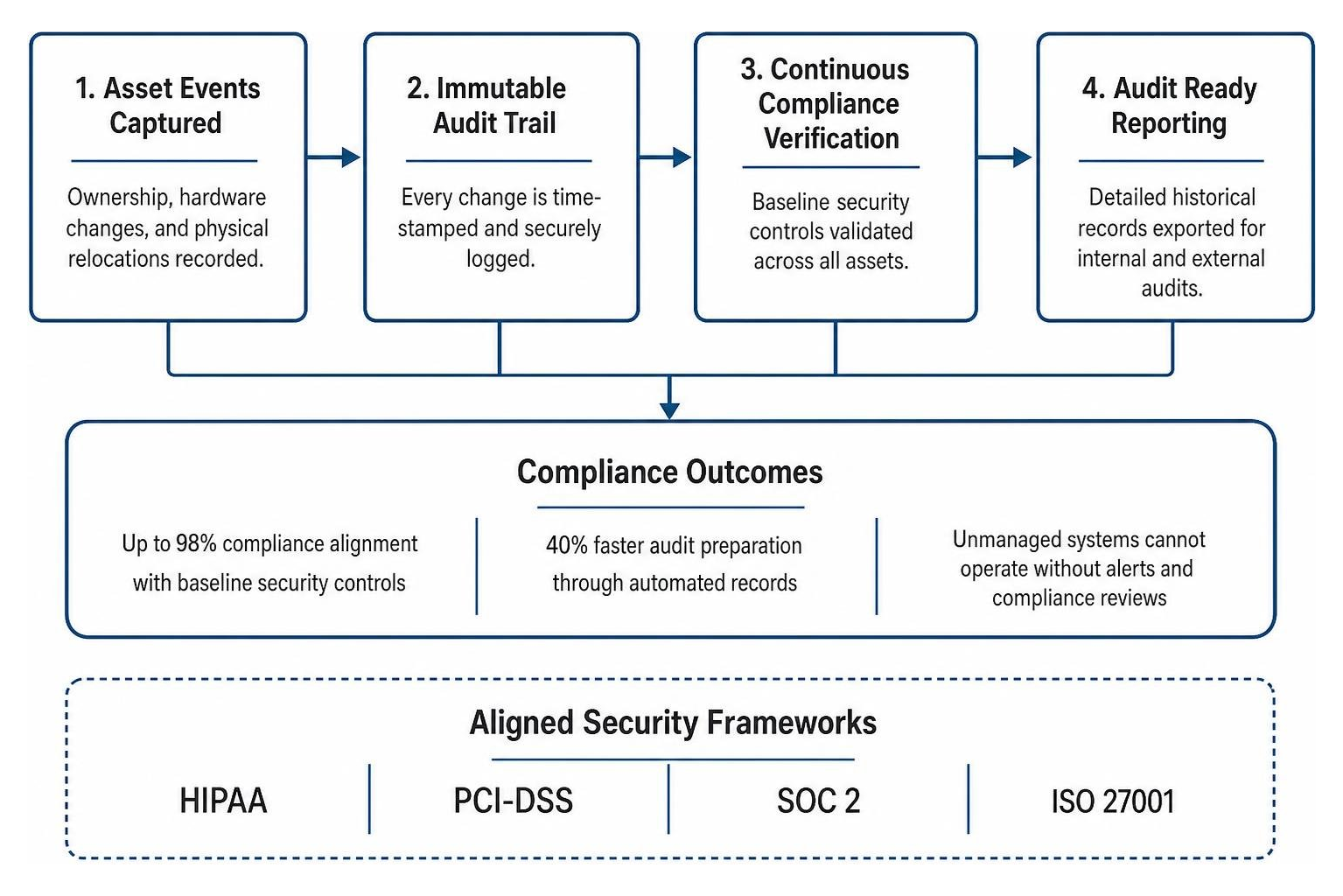
These automated audit trails allow enterprises to maintain up to 98% compliance alignment with baseline security controls. During audits, compliance officers can export detailed historical records, leading to 40% faster audit preparation compared to manual record compilation. Continuous verification ensures unmanaged systems cannot operate on corporate networks without triggering alerts and compliance reviews.
Securing Remote Endpoints and End-of-Life Hardware
The shift to hybrid work environments has expanded corporate perimeters, distributing enterprise laptops, external storage devices, and micro-servers far beyond traditional office boundaries. Managing distributed endpoints requires robust logistics tracking and security controls to maintain chain of custody throughout each device’s lifespan.
At end-of-life, hardware management transitions into data sanitization and physical disposition. Failing to control this stage exposes businesses to severe regulatory penalties, data breaches, and corporate liability.
Managing Distributed Workforces and Asset Retrieval
Remote employee turnover creates logistical challenges for enterprise IT teams. Without structured tracking, offboarding distributed employees frequently leads to lost laptops, unreturned storage media, and data exposure risks.
Modern IT asset platforms combine centralized tracking with secure shipping workflows to improve device recovery rates. Automated offboarding protocols initiate equipment return requests, generate prepaid tracking labels, and notify logistics teams when packages are delayed.
Organizations using automated recovery protocols achieve up to 30% more retrievals for remote equipment, keeping track of valuable hardware assets. Applying structured workflows for managing remote workforce equipment logistics ensures every offboarded device is returned, sanitized, and reassigned or retired under secure chain-of-custody protocols.
Sustainable ITAD and Certified Data Sanitization
When business computers, enterprise storage arrays, and network switches reach their end-of-life, simple disposal is not an option. Data-bearing components must undergo certified sanitization to prevent sensitive intellectual property, customer data, and corporate credentials from leaking.
Developing and implementing a secure ITAD strategy ensures all storage media undergoes data sanitization meeting NIST SP 800-88 Rev. 1 and DoD 5220.22-M standards. If drives are inoperable or cannot be overwritten, they must undergo physical shredding or degaussing to guarantee complete destruction.
Partnering with an experienced vendor through careful certified ITAD provider selection guarantees that end-of-life hardware is processed responsibly. At Innovative IT Solutions, our Oklahoma City operations adhere to strict EPA compliance and zero-landfill standards. We process retired hardware to divert toxic e-waste from municipal dumps, recover valuable raw materials, and issue serialized Certificates of Data Destruction for your compliance records.
Frequently Asked Questions About ITAM
How do IT asset management platforms reduce operational overhead?
ITAM platforms reduce operational overhead by automating time-consuming manual processes like hardware onboarding, inventory audits, and helpdesk provisioning. Integrating automated discovery with endpoint management tools helps organizations resolve hardware support requests faster and eliminates repetitive spreadsheet maintenance.
This automation allows lean IT teams to support growing enterprise workforces without expanding administrative headcount, while reducing capital waste caused by duplicate hardware purchases and ghost assets.
What is the difference between ITAM and ITAD?
IT Asset Management (ITAM) encompasses the complete hardware lifecycle—from initial procurement, configuration, and active maintenance to software tracking and operational monitoring.
IT Asset Disposition (ITAD) is the final stage of the ITAM framework. ITAD focuses specifically on the secure retirement, certified data sanitization (following NIST 800-88 guidelines), remarketing, asset recovery, and EPA-compliant recycling of retired enterprise hardware.
How does automated discovery support cybersecurity posture?
Automated discovery continuously scans corporate networks and cloud environments to identify every connected physical and virtual asset. This real-time visibility prevents shadow IT by alerting security teams whenever an unauthorized, unmanaged, or unpatched device connects to internal subnets.
By maintaining an updated inventory of firmware revisions, operating system versions, and hardware specifications, IT teams can quickly locate vulnerable endpoints, apply necessary security patches, and isolate compromised equipment.
Conclusion
Controlling enterprise hardware across its lifecycle requires moving beyond static spreadsheets and disconnected tools. Modern IT asset management platforms provide the visibility and automation modern enterprises need to eliminate ghost assets, streamline regulatory compliance, protect sensitive corporate data, and lower operational costs.
From automated network discovery and real-time inventory tracking to certified end-of-life processing, unified asset governance helps organizations scale efficiently while maintaining security. At Innovative IT Solutions, we help businesses protect their operations with certified data destruction, sustainable electronics recycling, and maximized value recovery on retired computer and server hardware. Contact our team in Oklahoma City today to strengthen your hardware lifecycle strategy and maintain complete audit readiness.


