
How an E-Waste Collection Drive Works
To organize an e waste collection drive for business IT hardware, set a clear collection timeline, confirm which enterprise computers and server components are accepted, and arrange secure on-site handling protocols before any decommissioned asset leaves your facility. Systematically record each device during intake, then route it through documented data destruction, component harvesting, refurbishing for secondary deployment, or certified material recovery.
Executing a structured plan keeps retired data center equipment and corporate workstations out of municipal landfills while providing IT directors, security officers, and compliance teams with a verifiable audit trail for assets that previously stored proprietary data.
I’m Mike Haden, founder of Innovative IT Solutions. Having spent over 14 years specializing in enterprise IT asset disposition, I have seen that a successful e waste collection drive relies on granular asset tracking, certified data sanitization, and responsible downstream processing pipelines.
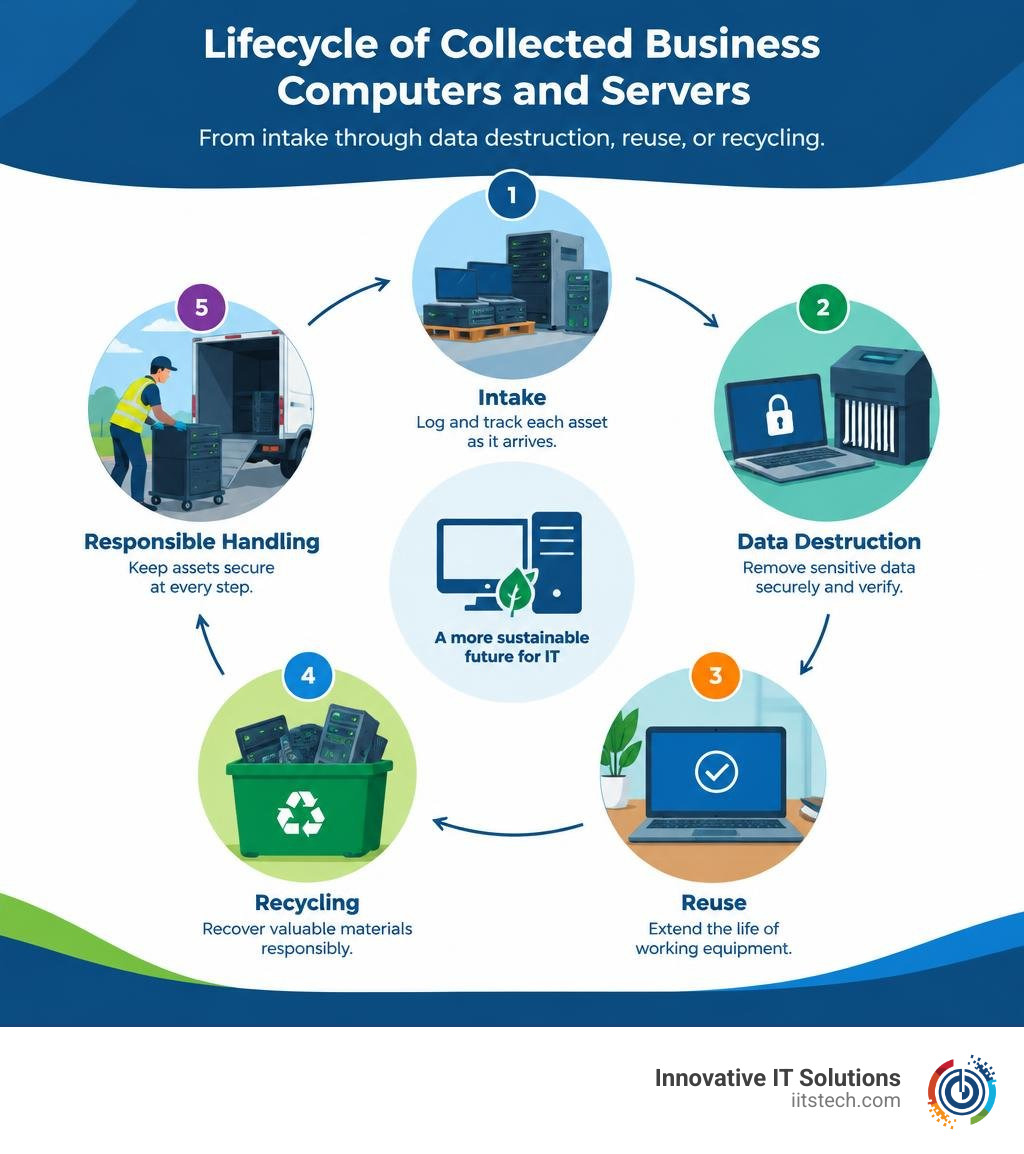
Simple e waste collection drive glossary:
The Business and Environmental Value of an E-Waste Collection Drive
Every year, enterprise organizations decommission thousands of rack servers, enterprise desktop fleets, and high-density storage arrays during routine hardware refresh cycles. When these retired IT assets linger indefinitely in unmanaged storage rooms or, worse, enter standard commercial refuse streams, they create significant regulatory non-compliance risks, data exposure vulnerabilities, and serious ecological liabilities. Exploring the broader environmental impact of corporate electronic waste helps executive decision-makers understand why systematic, planned disposal campaigns are vital for risk mitigation and environmental stewardship.
Worldwide, organized IT disposition events prove how corporate and municipal coordination diverts metric tons of discarded computing equipment from industrial landfills. For instance, municipal programs highlighted in coverage of Nagercoil Corporation municipal collection initiatives successfully diverted over two tonnes of equipment in single collection rounds, illustrating the immense material volume recovered through coordinated collection events.
Environmental and Health Hazards of Unregulated IT Disposal
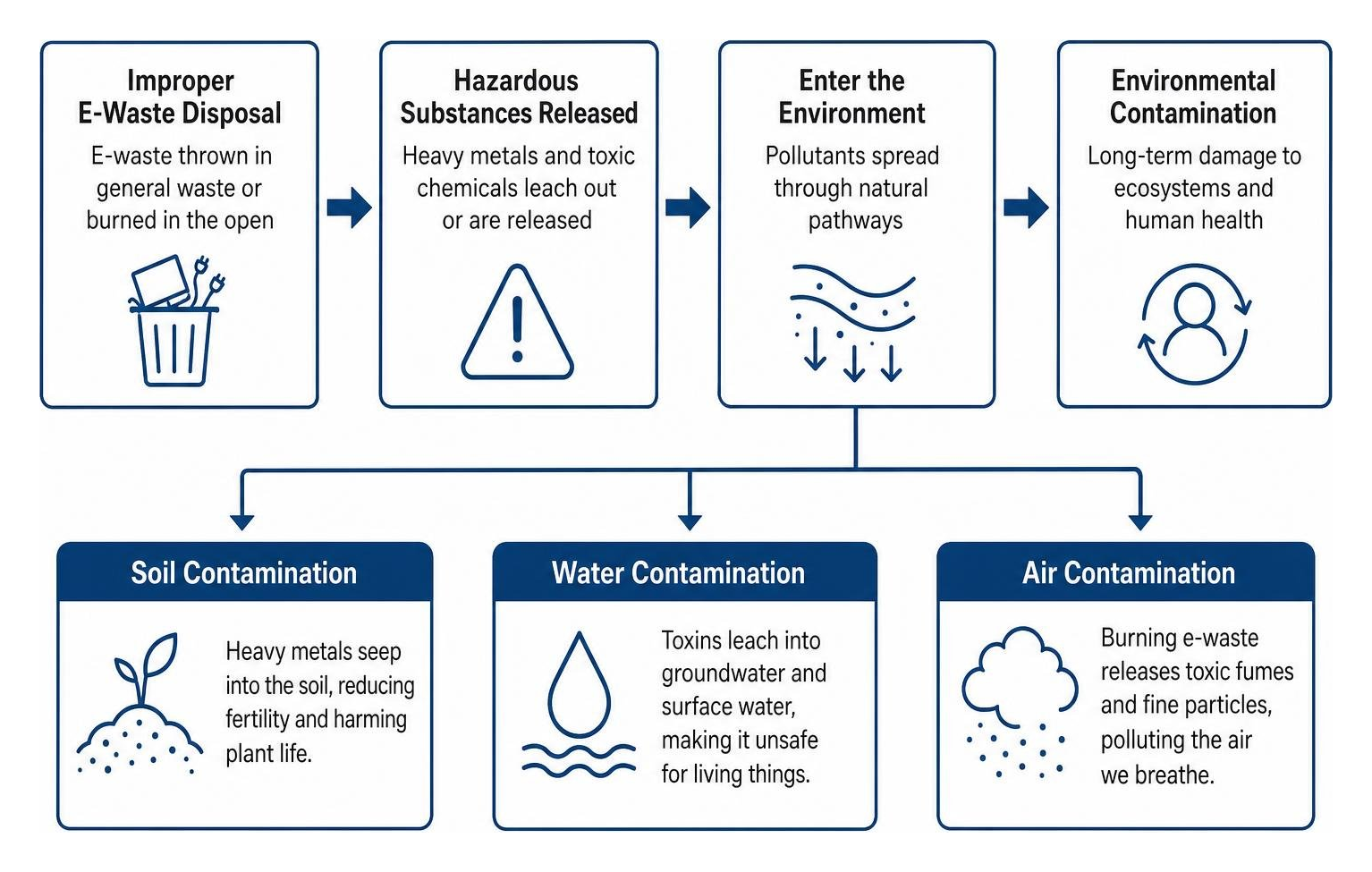
Enterprise computing equipment contains dense configurations of microprocessors, multi-layer printed circuit boards, high-output power supplies, and soldered connections. When discarded hardware degrades in unlined municipal dumps, hazardous heavy metals including lead, mercury, hexavalent chromium, and cadmium leach into subterranean soil and percolate into local aquifers. Examining the documented health effects of e-waste in complete detail demonstrates how chronic heavy metal bioaccumulation damages nervous systems, kidneys, and respiratory health.
Beyond underground water contamination, the uncontrolled thermal destruction of flame-retardant enterprise cabling, plastic chassis shrouds, and epoxy fiberglass circuit boards generates brominated dioxins and airborne particulates. Comprehensive international efforts—such as those led by the Department of Forestry, Fisheries and the Environment on clean air initiatives—consistently emphasize that compliant electronics disposition is essential for atmospheric preservation and community health.
Corporate ESG Compliance and Resource Recovery
A disciplined IT asset collection initiative directly elevates corporate environmental, social, and governance (ESG) reporting metrics. Retired compute nodes, managed network switches, and commercial desktop motherboards represent rich concentrations of refined raw elements, including high-purity copper, aluminum, platinum, silver, and gold.
Routing enterprise hardware into certified closed-loop recycling channels allows these strategic metals to be smelted, purified, and returned to original equipment manufacturers. Reviewing the benefits of IT recycling reveals that recovering secondary commodities significantly reduces greenhouse gas emissions and curtails resource-intensive primary mining operations across the technology sector.
Accepted Business Hardware vs. Prohibited Materials at Collection Events
Establishing precise intake parameters prevents severe operational bottlenecks and safety hazards during corporate IT collection events. Explicit guidelines ensure collection personnel and logistics staff handle exclusively enterprise-grade compute hardware, data center racks, and business workstation equipment.

Consulting comprehensive e-waste recycling guidelines for businesses prior to launch ensures staging zones and loading docks operate efficiently. The operational matrix below outlines standard equipment accepted versus non-qualifying materials during corporate hardware drives:
| Accepted Enterprise Hardware | Prohibited Materials & Non-IT Items |
|---|---|
| Rackmount and Blade Enterprise Servers | Loose Industrial Chemicals & Solvents |
| Desktop Computer Towers & Workstations | Biohazard or Medical Waste Items |
| SAN Storage Arrays, HDDs, and SSDs | Radioactive Devices & Smoke Detectors |
| Managed Network Switches and Routers | Commercial Refrigerants & Compressed Gases |
| Circuit Boards, RAM, and Server CPUs | Non-Computing Municipal Refuse |
Key Hardware Accepted During an E-Waste Collection Drive
Intake procedures prioritize data-bearing digital storage media, processing architecture, and supporting corporate IT infrastructure:
- Data Center Server Infrastructure: Multi-node rackmount servers, high-density blade enclosures, mainframe drawers, and redundant enterprise power distribution units (PDUs).
- Corporate Workstations and PCs: Enterprise desktop towers, CAD engineering workstations, compact micro-form-factor units, and internal switch-mode power supplies.
- Enterprise Networking Hardware: Core routing switches, enterprise firewalls, patch panels, load balancers, fiber distribution hubs, and optical transceivers.
- Modular Component Assemblies: It is vital to recycle your printed circuit boards, including server-grade registered ECC RAM modules, multi-socket enterprise CPUs, RAID controller cards, and host bus adapters.
- Mass Storage Systems: Hard disk drives (HDDs), enterprise solid-state drives (SSDs), NVMe expansion cards, SAS arrays, and enterprise magnetic backup tape cartridges.
Prohibited and Non-Accepted Equipment
To safeguard staff, comply with environmental laws, and maintain processing facility certifications, collection events exclude non-IT hazardous waste. Understanding the top 5 mistakes companies make when recycling electronics helps companies avoid staging non-compliant items, such as:
- Radioactive calibration devices or legacy smoke ionization sensors.
- Cracked or leaking lead-acid battery banks lacking secondary containment.
- Contaminated laboratory instrumentation or non-decontaminated medical diagnostic devices.
- Pressurized industrial gas canisters, HVAC chillers, and loose chemical refrigerants.
Secure Processing: Data Sanitization and Certified Recycling
Data privacy and regulatory compliance represent the chief operational priorities when liquidating corporate hardware assets. A professional e waste collection drive must guarantee an unbroken, verifiable chain of custody, ensuring that confidential corporate records, customer databases, and proprietary source code never leave storage media unprotected.
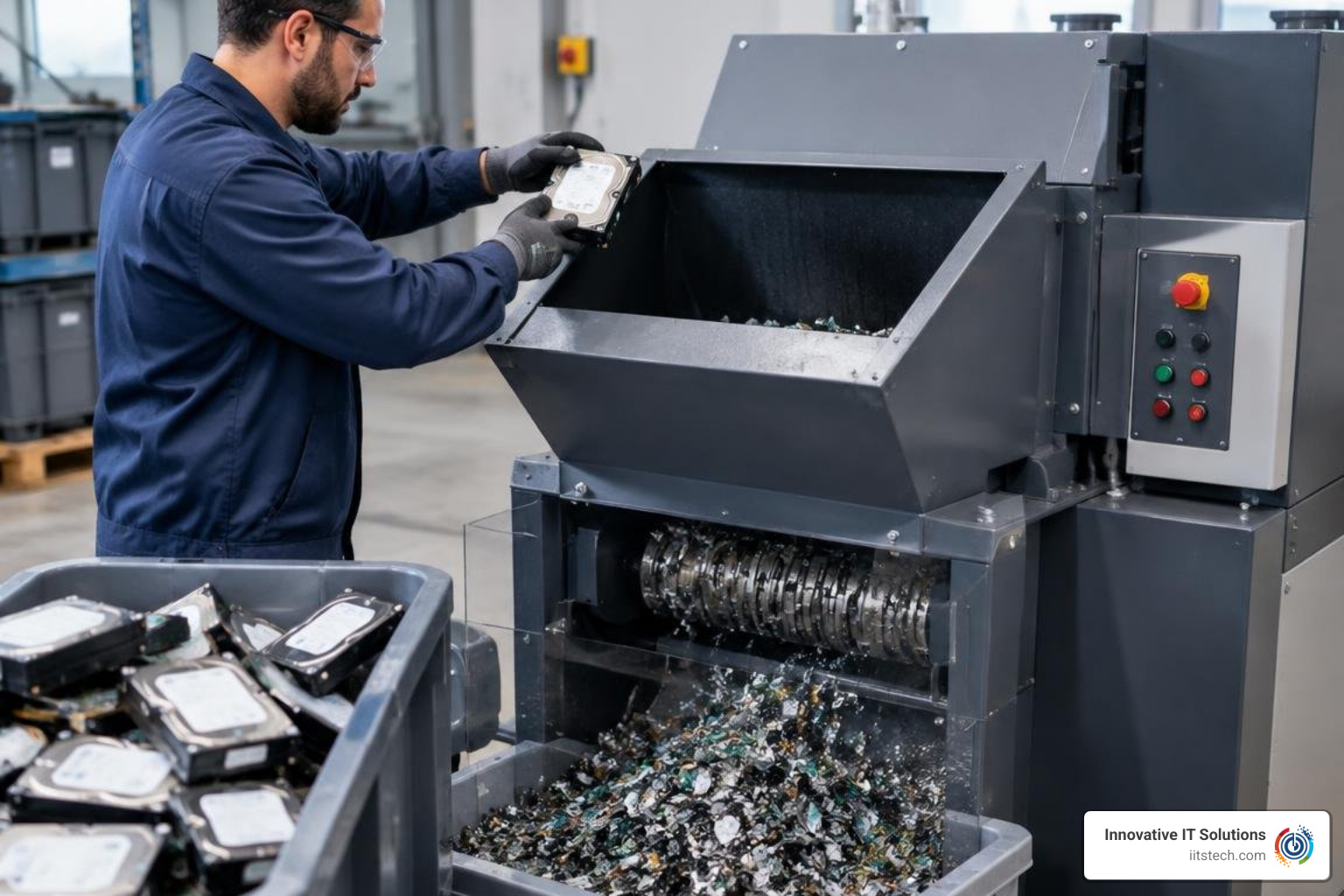
Tracing the steps of electronic recycling illustrates how retired enterprise devices move seamlessly through receipt logging, barcode serialization, physical sanitization, and advanced material separation.
Organizing a Corporate E-Waste Collection Drive Step-by-Step
Executing a seamless corporate IT collection event involves four critical phases:
- Define Scope and Partners: Engage accredited ITAD specialists to clear out retired business IT hardware and verify their downstream processing certifications for enterprise equipment.
- Audit and Stage Assets: Record serial numbers, chassis asset tags, and MAC addresses prior to staging. Follow established industry guidelines on how to prepare your computer prior to recycling by de-registering BIOS locks, removing physical asset labels, and placing devices in access-controlled staging areas.
- Deploy Tamper-Evident Staging: Secure collected assets inside lockable, serialized pallet containers, rolling security cages, or sealed gaylord boxes.
- Execute Certified Transport: Dispatch equipment utilizing dedicated, GPS-tracked freight transport vehicles directly to an authorized processing facility.
NIST and DoD Data Destruction Standards for Storage Media
Completely destroying corporate data requires specialized sanitization protocols rather than basic operating system partitions or quick format commands. Rather than risking accidental data leakage, organizations should understand why they must never smash a hard drive manually and should instead mandate certified media destruction.
Compliant enterprise disposal workflows rely on two core data erasure benchmarks:
- NIST SP 800-88 Rev. 1 (Guidelines for Media Sanitization): Encompasses Clear, Purge, and Destroy classifications, employing cryptographic erasure, multi-pass sector overwriting, or mechanical pulverization to render residual data recovery mathematically impossible.
- DoD 5220.22-M: Uses synchronized multi-pass binary overwrites across sectors, followed by magnetic degaussing for spinning platters.
High-torque industrial shredders reduce magnetic hard drive platters and solid-state NAND flash chips into tiny, unrecoverable fragments. Following processing, recycling providers issue an itemized Certificate of Data Destruction recording every serialized drive for complete compliance auditing.
Frequently Asked Questions About IT Asset Collection
Who is eligible to participate in an enterprise IT collection event?
Commercial corporations, cloud data centers, financial institutions, healthcare providers, universities, and government agencies can participate. Developing a comprehensive electronic recycling program for your business ensures that retired server racks, enterprise network switches, and employee desktop fleets are processed securely, sustainably, and cost-effectively.
What legal regulations govern corporate IT hardware disposal?
Enterprise hardware disposal is governed by strict federal, state, and industry mandates, including the Resource Conservation and Recovery Act (RCRA), HIPAA, Sarbanes-Oxley, and state-level electronic disposal bans. Reviewing strategies to align with the EPA zero-landfill policy helps organizations prevent severe environmental penalties, costly legal liabilities, and regulatory enforcement actions.
How is data security maintained during mass collection drives?
Data security relies on a verifiable, unbroken chain of custody. Implementing the IT manager’s guide to enterprise electronics recycling allows operations personnel to deploy serialized asset tagging, tamper-evident security bins, GPS-monitored logistics, and certified data destruction protocols with full audit trails.
Conclusion
Hosting an e waste collection drive gives modern enterprises a secure, auditable, and environmentally sound framework to retire obsolete compute infrastructure. By partnering with certified IT asset disposition specialists, corporate leaders can accelerate hardware refresh cycles, safeguard mission-critical data assets, achieve ambitious ESG goals, and eliminate the legal and ecological liabilities of municipal electronic dumping.
At Innovative IT Solutions, we deliver full-scope ITAD, asset recovery, and NIST/DoD-compliant data sanitization services for enterprise computers and data center hardware. Serving corporate clients across Oklahoma City, OKC, and South OKC, our zero-landfill, EPA-compliant processes provide maximum value recovery and complete compliance documentation. Safeguard your business, streamline your IT lifecycle, and support sustainable operations with our certified electronics recycling services today.


