
Why Enterprise Electronics Recycling Is an IT Manager’s Most Overlooked Responsibility
Enterprise electronics recycling is the process of securely decommissioning, data-wiping, and responsibly disposing of or remarketing business-grade IT hardware — computers, servers, storage arrays, and related components — in a way that protects your data, meets regulatory requirements, and minimizes environmental harm.
Here is what every IT manager needs to know upfront:
- Business-grade hardware falls under strict hazardous waste rules. Unlike standard consumer exemptions, enterprise IT assets are subject to rigorous regulatory oversight.
- Data security is non-negotiable. Improper disposal of decommissioned servers or workstations can expose your organization to HIPAA, GDPR, or PCI-DSS violations.
- Electronics are the fastest-growing segment of the solid waste stream. Servers and computers contain lead, mercury, cadmium, and other hazardous materials that can cause serious environmental and health damage if landfilled.
- There is real value left in retired hardware. A certified IT Asset Disposition (ITAD) partner can recover, refurbish, and remarket equipment — sometimes returning revenue to your organization.
- Documentation matters. Regulators and sustainability auditors expect a clear chain of custody and a certificate of destruction for every asset you retire.
From running payroll systems to storing patient records, enterprise IT equipment powers modern business. But when that hardware reaches end of life, most organizations have no structured plan for what happens next. That gap creates real risk — legal, financial, and environmental.
This guide walks you through every stage of the enterprise e-waste lifecycle: the regulations you need to know, the options for recovering value, and how to choose a compliant recycling partner.
I’m Mike Haden, Founder and Director of Business Development at Innovative IT Solutions, Inc., where I’ve spent 14 years building an R2v3-certified ITAD operation focused on responsible enterprise electronics recycling — processing over a million pieces of corporate IT equipment with a strict emphasis on data security and chain of custody. That hands-on experience is the foundation for everything covered in this guide.
Enterprise electronics recycling further reading:
The Environmental and Regulatory Imperative of Enterprise Electronics Recycling
As IT managers, we are often hyper-focused on uptime, system performance, and software deployments. However, the physical reality of our infrastructure eventually catches up with us. Every server swap, storage array migration, and fleet upgrade of corporate laptops contributes to a massive global challenge. Electronic waste is the fastest-growing component of our daily solid waste stream.
When enterprise-grade computers and servers are improperly discarded, they do not just take up space in a landfill; they release highly toxic materials into the surrounding ecosystem. Understanding these materials is the first step in recognizing why certified enterprise electronics recycling is so critical.
The Toxins Hiding in Your Server Room
Corporate IT hardware is packed with complex materials. While these components are safe during normal operation, they become severe hazards when exposed to the elements or crushed in a standard landfill:
- Lead: Historically used in solder on printed circuit boards and heavily concentrated in older cathode ray tube (CRT) monitors (which contain an average of four pounds of lead depending on size and make). Lead is a potent neurotoxin that can leach into soil and groundwater.
- Mercury: Commonly found in the backlighting systems of older LCD monitors and laptop screens. Electronics have been cited as a leading source of mercury in municipal waste, posing severe risks to aquatic life and human nervous systems.
- Cadmium: The largest source of cadmium in municipal waste is rechargeable nickel-cadmium (NiCd) batteries, which were historically common in older portable enterprise equipment, laptops, and uninterruptible power supplies (UPS). Cadmium is a known carcinogen that targets kidney and bone health.
- Brominated Flame-Retardants (BFRs): These chemicals are applied to plastic casings, cables, and circuit boards to prevent fires. When e-waste is incinerated or left to degrade in landfills, BFRs can release highly toxic dioxins and furans into the air and soil.
For a deeper look at how these substances interact with local ecosystems, read our articles on What Are the Effects of E-Wastes on the Environment and E-Waste and the Environment A Guide to Our Growing Digital Footprint.
Legal Consequences for Commercial Generators
If the ethical and environmental reasons do not convince your C-suite to prioritize green disposal, the legal ones certainly will.
Under federal regulations, businesses and government entities are classified as commercial generators. This means your organization is subject to strict hazardous waste rules and must comply with rigorous disposal standards for all retired IT assets.
In Oklahoma, the Department of Environmental Quality (DEQ) aligns closely with the EPA guidelines on hazardous waste. If your business in Oklahoma City, OKC, or South OKC is caught dumping business-grade computers, server racks, or backup batteries into municipal solid waste landfills, your company faces severe EPA fines, regulatory audits, and catastrophic public relations damage.
Sustainable Lifecycle Management: Reuse, Refurbish, and Asset Recovery
The most sustainable way to manage enterprise IT equipment is to delay its path to the shredder. Before we even talk about smelting down circuit boards, we must look at the top tier of the waste management hierarchy: reduction and reuse.
Extending the Lifespan of Enterprise Hardware
We often upgrade our corporate hardware on a rigid three-to-five-year lease or depreciation schedule. However, many enterprise-grade servers and laptops still have years of high-performance life left in them. By implementing smart maintenance and strategic upgrades, we can drastically reduce our e-waste footprint:
- Component Upgrades: Instead of replacing entire server nodes or workstation fleets, consider upgrading individual components. Swapping mechanical hard drives for solid-state drives (SSDs) or adding more RAM can breathe new life into older machines at a fraction of the cost.
- Protective Measures: Using high-quality surge protectors, proper server room climate controls, and regular dust cleaning extends the operational life of sensitive silicon.
- Leasing Strategies: Working with leasing companies that have structured end-of-life return programs ensures that equipment is immediately funneled back into secondary markets rather than sitting in a storage closet gathering dust.
Turning E-Waste Into Opportunity
When it is time to clear out the server room, physical recycling should be your last resort. Partnering with a professional ITAD provider allows you to extract maximum residual value from your retired assets.
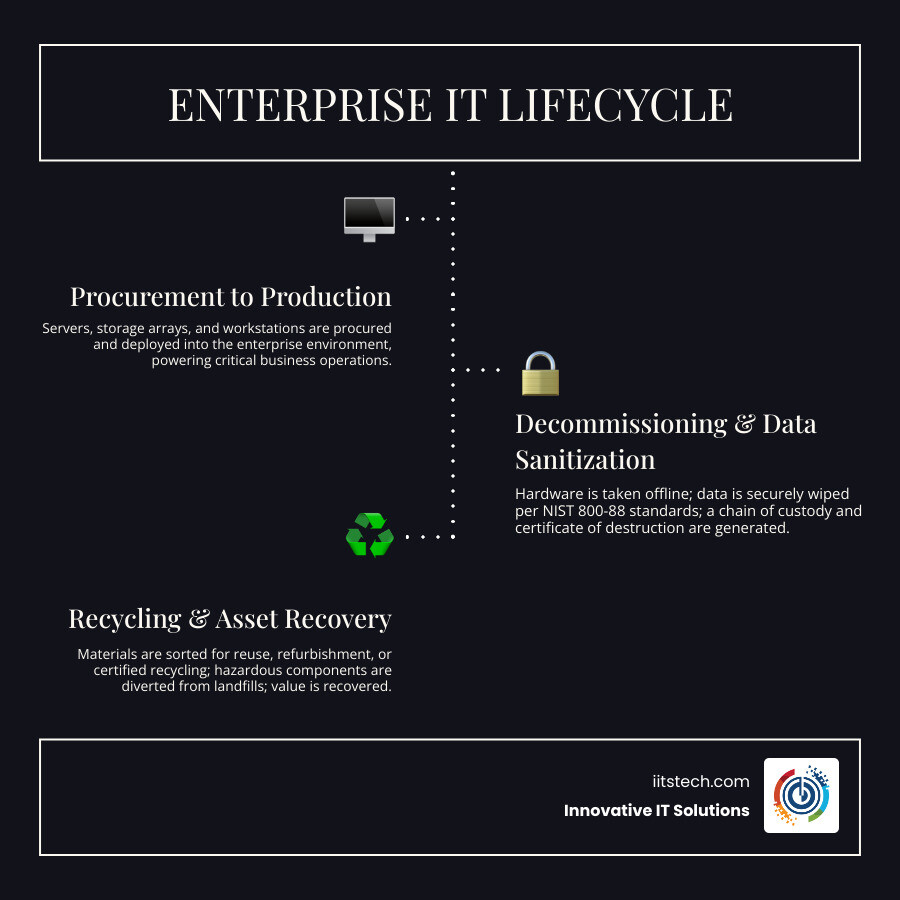
Through structured asset recovery, an ITAD specialist will test, repair, and clean your decommissioned servers and computers. These refurbished units are then resold on secondary markets, returning capital directly to your IT budget.
To learn more about how this process works, see our guide on Smart IT Equipment Recycling for Businesses Turning E-Waste Into Opportunity and our practical overview of How to Dispose of Electronic Waste.
Data Security and Compliance in Enterprise ITAD
While environmental protection is a major pillar of enterprise electronics recycling, data security is often the primary driver for IT managers. When you retire a server or a corporate laptop, you are not just disposing of plastic and metal; you are disposing of intellectual property, proprietary software, employee records, and customer data.

The Gold Standards of Data Destruction
Simply deleting files or formatting a drive is not enough. Sophisticated recovery software can easily retrieve data from drives that have not been properly sanitized. To remain compliant with modern privacy laws (including HIPAA, PCI-DSS, and SOC 2), enterprises must adhere to recognized federal standards:
- NIST SP 800-88 (Guidelines for Media Sanitization): This is the absolute gold standard for data destruction. It outlines specific methods for “Clear” (overwriting), “Purge” (degaussing or advanced overwriting), and “Destroy” (physical destruction) based on the media type. You can read the official document here: NIST Special Publication 800-88 Guidelines for Media Sanitization.
- DoD 5220.22-M: The Department of Defense standard requires overwriting hard drives multiple times to ensure data is completely unrecoverable.
Why You Need a Documented Chain of Custody
If your business is audited, saying “we recycled those drives” will not cut it. You need proof. A certified ITAD partner provides a complete, unbroken chain of custody. This includes:
- Serialized Inventory Tracking: Every server and hard drive is scanned and logged the moment it leaves your facility in Oklahoma City or South OKC.
- Secure Logistics: Transporting assets in GPS-tracked, locked vehicles.
- Certificates of Destruction: A legally binding document listing the serial numbers of all drives that were physically shredded or digitally wiped to NIST standards.
To understand how high-standard ITAD protects your enterprise from liability while supporting your corporate green initiatives, check out The Environmental Impact of ITAD Done Right.
Implementing a Compliant Enterprise Electronics Recycling Program
Building a reliable e-waste program from scratch can feel overwhelming, but breaking it down into structured phases makes it highly manageable. The first step is understanding that standard local scrap metal recyclers are not equipped to handle the compliance, data security, and specialized processing that enterprise hardware requires.
| Feature / Service | Standard Scrap Metal Recycler | Certified Enterprise ITAD Partner |
|---|---|---|
| Data Destruction Standards | None (or basic physical crushing) | NIST SP 800-88 / DoD 5220.22-M Compliant |
| Asset Recovery & Resale | None (crushed for raw metals) | Refurbishment, component harvesting, profit sharing |
| Environmental Compliance | Basic state/local permits | Certified R2v3, EPA-compliant, zero-landfill policy |
| Chain of Custody Tracking | None | Serialized tracking, locked transport, portal access |
| Documentation Provided | Basic weight receipt | Certificate of Destruction, detailed audit reports |
Selecting a Partner for Enterprise Electronics Recycling
When choosing an ITAD vendor to handle your company’s digital footprint in Oklahoma, you must verify their certifications. Look for providers holding R2v3 (Responsible Recycling) or e-Stewards certifications. These standards guarantee that the recycler:
- Adheres to strict environmental and worker safety standards.
- Enforces a strict zero-landfill policy for hazardous materials.
- Wipes or destroys all data-bearing media in accordance with federal mandates.
For a step-by-step framework on setting up your internal workflow, review our dedicated guides:
- Electronic Recycling Program for Your Business
- The Steps of Electronic Recycling
- The Details of Electronic Recycling
- 3 Steps to Take for Electronic Waste Recycling
Best Practices for Enterprise Electronics Recycling Logistics
To avoid the most common pitfalls — which we outline in The Top 5 Mistakes Companies Make When Recycling Electronics — your team should adopt these logistics best practices:
- Secure Storage: Store decommissioned hardware in a secure, access-controlled room while waiting for pickup. Leaving old laptops piled in an open hallway is an open invitation for data theft.
- Pre-Sorting: Separate data-bearing assets (servers, hard drives, SANs) from non-data assets (cables, rack mounts, keyboards) to streamline processing.
- Verify Locations: Ensure your partner operates locally or has certified logistics networks near you. For regional options, check Best Electronics Recycling Locations Near You and read about E-Waste Recycling Services The Smart Way to Dispose of Electronics.
Frequently Asked Questions about Enterprise ITAD
What are the primary regulations governing business e-waste?
Businesses and government entities must comply with strict state and federal hazardous waste laws, such as the Resource Conservation and Recovery Act (RCRA). Disposing of business-grade IT assets in standard municipal landfills is illegal and subject to heavy regulatory fines, requiring certified disposal processes.
How do enterprises track and document their e-waste recycling?
Enterprises track their e-waste using serialized asset logging. When your ITAD partner collects your equipment, they scan every asset tag and serial number.
Once processing is complete, they provide you with an audit-ready report and a Certificate of Destruction. This documentation is crucial for corporate sustainability reporting, environmental audits, and proving compliance with data privacy regulations.
What are the risks of improper server and computer disposal?
The three primary risks are:
- Data Breaches: Unwiped hard drives falling into the wrong hands can expose confidential corporate, employee, and client data.
- Environmental Fines: Landfilling hazardous heavy metals like lead, mercury, and cadmium violates EPA regulations, leading to severe penalties.
- Brand Damage: Finding your company’s asset tags on equipment illegally dumped in a landfill or shipped to developing nations can cause irreparable public relations damage.
Conclusion
Managing the end of your IT hardware’s lifecycle is just as important as managing its deployment. Proper enterprise electronics recycling protects your organization from catastrophic data breaches, keeps your business compliant with environmental laws, and can even recover valuable capital for your IT budget.
At Innovative IT Solutions, we provide full-service IT Asset Disposition (ITAD) to companies throughout Oklahoma City, OKC, South OKC, and the surrounding regions. Our processes are fully NIST and DoD-compliant, EPA-compliant, and run on a strict zero-landfill policy. We handle everything from secure data destruction and physical drive shredding to asset recovery and hardware resale — providing you with the complete documentation and audit trails your business needs.
Ready to secure your data and streamline your hardware lifecycle? Let us help you turn your retired IT hardware into a secure, sustainable opportunity.
Partner with Innovative IT Solutions for Secure Asset Recovery


