
Why Electronics Recycling Is a Business-Critical Priority in 2026
Electronics recycling is the process of recovering, processing, and responsibly disposing of end-of-life electronic devices — and for businesses managing decommissioned IT hardware, it is no longer optional.
Here is a quick overview of what business IT managers need to know:
| Topic | Key Point |
|---|---|
| What it covers | Computers, servers, networking gear, storage arrays, and data-bearing devices |
| Why it matters | Data breach risk, environmental liability, and state landfill bans |
| What to look for | R2v3 and NAID AAA certified providers with zero-landfill guarantees |
| Data security | NIST SP 800-88 wiping or physical hard drive shredding with Certificate of Destruction |
| Value recovery | Certified ITAD providers can return revenue through asset remarketing |
The U.S. generates over 6.9 million tons of e-waste annually, yet only around 17.4% of global electronic waste is actually recycled. For every million corporate mobile devices recycled, up to 35,000 pounds of copper, 772 pounds of silver, and 75 pounds of gold can be recovered. Those numbers scale dramatically when you factor in enterprise server and data center hardware.
But the risk goes beyond wasted materials. Retired servers and hard drives still carry sensitive data. Improper disposal can trigger regulatory fines, failed audits, and costly data breaches — the average of which now exceeds $4.88 million.
I’m Mike Haden, Founder and Director of Business Development at Innovative IT Solutions, where I’ve spent 14 years building an R2v3-certified ITAD operation focused on secure electronics recycling, responsible asset disposition, and maximizing returns for enterprise clients. In that time, we’ve processed over a million pieces of corporate IT equipment with an uncompromising focus on data security and chain-of-custody compliance. Let’s walk through exactly what you need to know to recycle your business hardware safely, legally, and efficiently.
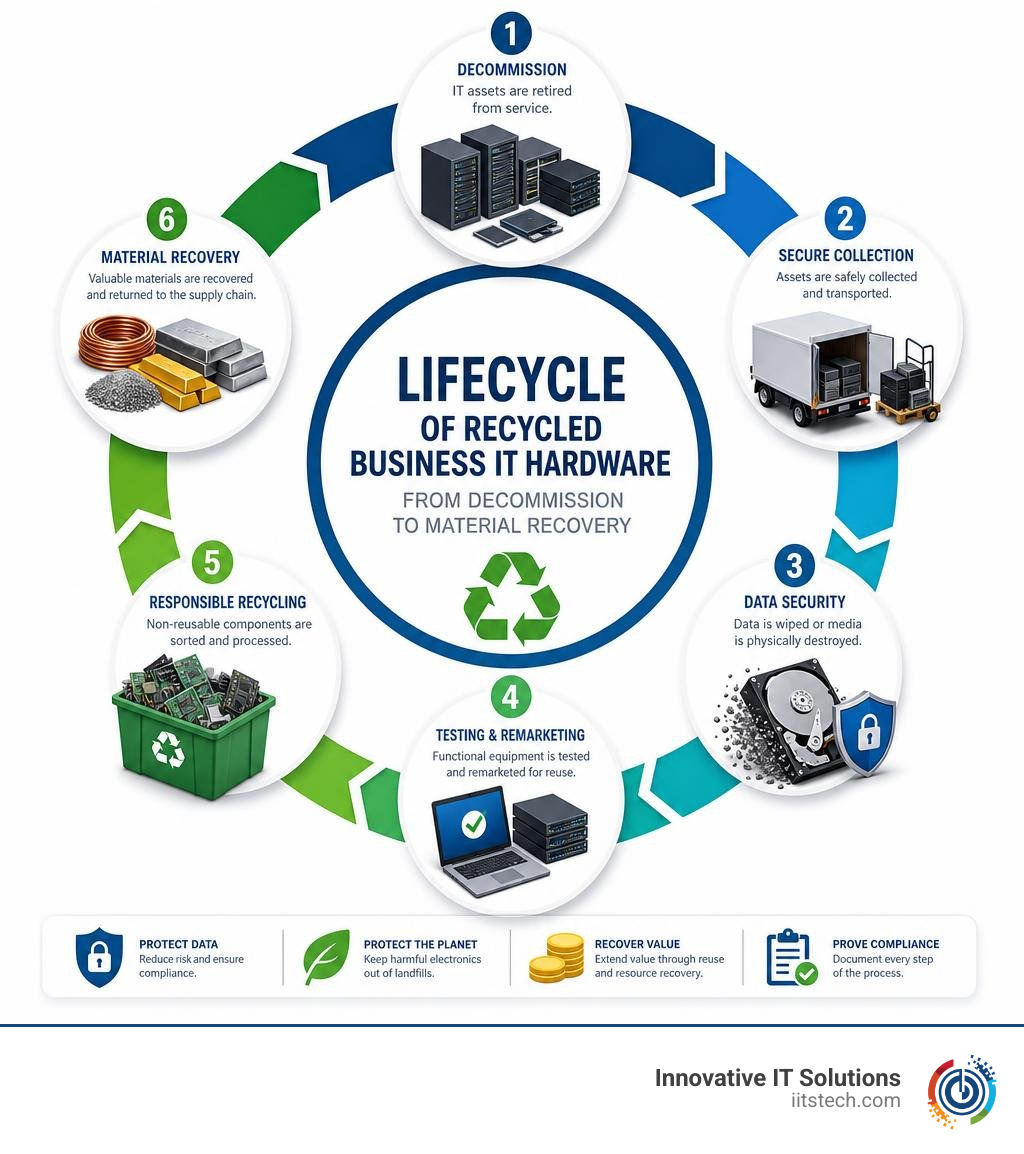
The Critical Need for Enterprise Electronics Recycling
For modern enterprises in Oklahoma City and beyond, managing retired IT assets is a multi-layered challenge. Technology lifecycles are shorter than ever in June 2026, meaning corporate data centers, local offices, and storage facilities are constantly cycling through servers, switches, and desktop workstations. Simply stacking this decommissioned hardware in a back room or, worse, throwing it into a standard commercial waste stream is a recipe for operational and environmental disaster.
Understanding what are the effects of e-wastes on the environment? is the first step toward building a sustainable corporate waste policy. When heavy enterprise electronics are discarded improperly, they do not simply sit silently in a landfill. They pose persistent, long-term threats to local ecosystems and public health, while exposing your organization to massive legal liabilities and preventable data security vulnerabilities. Conversely, embracing the advantages of recycling the old technology allows businesses to recover valuable raw materials, secure their intellectual property, and even offset the cost of new equipment deployments.
Environmental and Public Health Impacts of E-Waste
Enterprise-grade IT hardware — particularly server motherboards, power supplies, and network switches — is incredibly complex. These components require heavy metals and toxic substances to function at high speeds. When corporate hardware is tossed into landfills, these hazardous materials eventually break down and escape into the surrounding environment.
- Lead: Found in older cathode-ray tubes and circuit board soldering, lead is a potent neurotoxin that can leach into soil and contaminate groundwater.
- Mercury: Used in backlighting systems and older switches, mercury bioaccumulates in aquatic food chains, posing severe risks to human health and wildlife.
- Cadmium: Present in chip resistors and semiconductor chips, cadmium is a known carcinogen that damages soil microflora and can contaminate local agricultural water supplies.
When these toxins leach into the Oklahoma soil, they pollute local municipal water systems. This environmental damage is entirely preventable. By choosing certified electronics recycling programs, we ensure that these hazardous components are carefully extracted and kept out of the biosphere entirely.
Legal Compliance and Landfill Bans for Businesses
Environmental stewardship is a powerful motivator, but legal compliance is often the driving force behind corporate e-waste policies. State and federal regulatory bodies have established strict frameworks to govern how businesses dispose of technology. Throwing commercial electronics into standard trash is illegal in many jurisdictions, and regulatory enforcement has never been tighter.
To avoid costly legal consequences, companies must navigate complex hazardous waste laws and be prepared for rigorous environmental audits. One of the top 5 mistakes companies make when recycling electronics is failing to secure verifiable documentation of where their equipment went. If an auditor asks for proof of compliance and your business cannot provide a certified paper trail, you could face substantial EPA fines and severe reputational damage. Partnering with a professional recycler guarantees that your company stays fully compliant with all local, state, and federal environmental laws.
How to Choose the Best E-Waste Disposal Providers

Not all recycling operations are created equal. Some local scrap yards may accept metal components, but they lack the infrastructure to handle data security, environmental tracking, or industry-specific compliance. For enterprise organizations, selecting the right partner requires a deep look at their certifications and processing standards.
Implementing a structured electronic recycling program for your business means working with a provider that treats your retired technology with the same level of security and care as your active production network. Utilizing professional e-waste recycling services the smart way to dispose of electronics protects your company from data leaks, ensures federal compliance, and keeps your sustainability metrics accurate.
Verifying Certifications for Secure Electronics Recycling
When evaluating an IT asset disposition (ITAD) partner, certifications are your absolute baseline. You should never hand over data-bearing devices or heavy infrastructure to an uncertified vendor. Look for these industry-standard credentials:
- R2v3 (Responsible Recycling): The gold standard for electronics recyclers. This certification ensures that all materials are processed safely, legally, and with strict downstream tracking all the way to the final smelter.
- RIOS (Recycling Industry Operating Standard): An all-inclusive standard that governs quality, environmental protection, and health and safety practices within the recycling facility.
- NAID AAA: Managed by the National Association for Information Destruction, this certification verifies that the provider adheres to the most stringent physical and digital data destruction protocols.
Understanding what are the benefits of old IT equipment recycling? goes hand-in-hand with verifying these certifications. A certified provider protects your brand while maximizing the resource recovery of your assets. For businesses with a national footprint, utilizing certified electronics recycling across the USA | US Recycling ensures that your satellite offices and remote data centers adhere to the exact same high standards of security and sustainability as your headquarters.
Evaluating Downstream Tracking and Data Security
A common industry pitfall is the “out of sight, out of mind” mentality. Once a truck leaves your loading dock, where does the hardware actually go? A certified provider must offer absolute transparency throughout the entire process.
A secure chain of custody begins the moment the hardware is loaded onto GPS-tracked transport vehicles. Upon arrival at the processing facility, each asset should be logged into an inventory system to generate serialized asset reports.
Once processing is complete, the recycler must issue a formal Certificate of Destruction and a Certificate of Recycling. These documents prove that all data-bearing drives were physically shredded or wiped to NIST SP 800-88 standards and that all remaining metals and plastics were processed under a strict zero-landfill policy. If you want to know exactly what happens behind closed doors, check out our guide on computer recycling services what happens to your old tech to see how raw materials are recovered and kept out of global landfills.
Finding and Preparing Business Hardware for Recycling
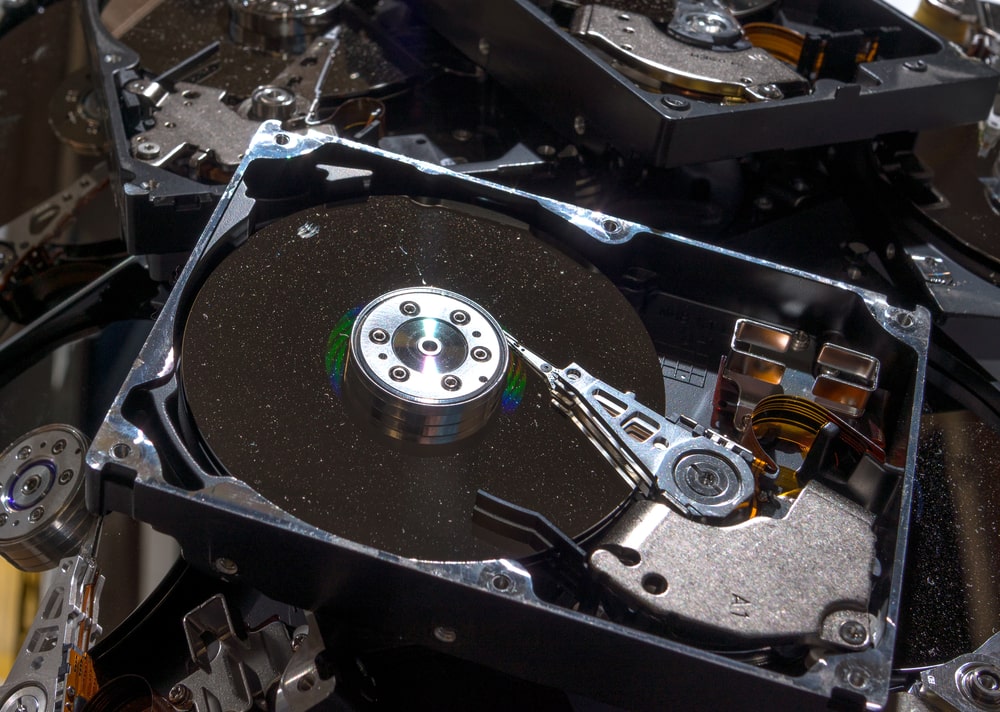
Before you schedule a pickup or drop off your equipment, your internal IT team needs to identify what assets are ready for retirement and prepare them for transport. This stage is critical for both data security and efficient asset processing.
A clear understanding of e-waste recycling for businesses what you can and can’t recycle will help your team sort through storage closets and server rooms, saving time and avoiding unexpected processing fees for non-recyclable materials.
Identifying Acceptable Business IT Assets
Enterprise recycling programs focus strictly on business-grade infrastructure. Commercial ITAD services are designed to process heavy-duty, high-value technology:
- Servers: Blade servers, rack-mount units, and tower servers from enterprise data centers.
- Networking Gear: Managed switches, enterprise routers, firewalls, and wireless access points.
- Enterprise Storage: SAN/NAS arrays, tape libraries, and hard drive enclosures.
- Workstations: Corporate laptops, desktop towers, and executive mobile devices.
Ensuring that your team is e-wastes recycling computer parts properly means separating these high-value components from general office waste. This separation makes it easier to track serial numbers and maximize the potential resale value of your retired assets.
Step-by-Step Preparation for Electronics Recycling
Proper preparation protects your data and ensures a smooth transfer of custody. We recommend following these steps before your recycling partner arrives:
- Document and Inventory: Create a complete list of all assets being retired, noting serial numbers, asset tags, and specifications.
- Remove External Batteries: If possible, separate lithium-ion batteries from laptops and mobile devices, as they require specialized, fire-safe transport.
- De-Authorize and De-Link: Remove all devices from your corporate network, active directory, and cloud management consoles (such as MDM software).
- Physically Isolate Data Drives: If you are not utilizing certified on-site sanitization, ensure that all hard drives and solid-state drives are clearly marked and secured within their chassis.
For a deeper dive into the specific operational phases, you can read about the steps of electronic recycling. If your business is located in the Oklahoma metro area, learning how to properly dispose of electronics computer recycling in Oklahoma city will help you coordinate local logistics seamlessly.
For businesses organizing their local logistics, utilizing Oklahoma City electronic recycling services and checking the official where to recycle – Oklahoma recycling association directory are excellent ways to verify approved local processing routes.
Frequently Asked Questions About Business E-Waste Disposal
Navigating enterprise IT asset retirement can raise a lot of technical and logistical questions. To help your team make informed decisions, we have compiled the most common questions we receive from IT directors and facility managers.
Data Destruction Methods: Physical Shredding vs. Software Wiping
| Feature | Physical Shredding | Software Data Wiping (NIST SP 800-88) |
|---|---|---|
| Security Level | Absolute (Physical destruction of media) | High (Cryptographic erasure or multi-pass overwrite) |
| Asset Recovery Value | Low (Destroys the drive entirely) | High (Allows the drive to be safely reused or resold) |
| Environmental Impact | Materials are recycled as shredded scrap | Minimizes electronic waste by extending drive life |
| Best Used For | Defective drives, highly classified data | Functional enterprise drives with remarketing potential |
What business IT hardware can be recycled?
Virtually all business-grade IT infrastructure can be recycled. This includes enterprise servers, mainframe systems, network switches, routers, firewalls, SAN/NAS storage arrays, desktop computers, corporate laptops, and enterprise-grade uninterruptible power supplies (UPS). High-value components like motherboards, CPUs, RAM, and expansion cards contain precious metals that are highly recyclable.
How do businesses ensure data is completely destroyed before recycling?
To guarantee complete data destruction, businesses should only work with providers who adhere to NIST SP 800-88 standards or DoD 5220.22-M wiping protocols. This process involves using specialized software to overwrite every sector of a hard drive or SSD, rendering the original data completely unrecoverable. For drives that are non-functional or contain highly sensitive proprietary data, physical shredding or degaussing (which uses powerful magnetic fields to neutralize magnetic storage media) should be performed, accompanied by a serialized Certificate of Destruction.
To understand the meticulous steps involved in this process, we recommend reading the details of electronic recycling to see how modern facilities handle data sanitization.
Are there legal penalties for improper business e-waste disposal?
Yes, the legal and financial penalties for improper disposal can be devastating. Under federal laws like the Resource Conservation and Recovery Act (RCRA), businesses can face massive EPA fines for disposing of hazardous waste (such as lead- and mercury-containing electronics) in standard municipal landfills. Furthermore, if personal, financial, or healthcare data is leaked from an improperly discarded hard drive, your business could face severe penalties under HIPAA, Sarbanes-Oxley (SOX), or Gramm-Leach-Bliley (GLBA), alongside class-action lawsuits and permanent damage to your brand’s reputation.
Conclusion
Managing your decommissioned IT hardware does not have to be a source of stress or regulatory risk. By prioritizing certified electronics recycling, your organization can protect its sensitive data, maintain absolute environmental compliance, and support a sustainable, circular economy.
At Innovative IT Solutions, we provide comprehensive, business-grade ITAD services designed to make technology retirement simple, secure, and profitable. Operating right here in Oklahoma City, OKC, and South OKC, we deliver NIST/DoD-compliant data destruction, zero-landfill material recovery, and maximum asset value returns for corporate clients across Oklahoma and the United States.
If you are ready to build a smarter disposal strategy, discover how e-waste recycling can help you protect your company’s bottom line. Local businesses can also explore the Oklahoma city electronics recycling 7 local centers to try or learn why you should don’t trash your tech best places to recycle electronics the right way to keep your operations secure.
Let us handle the heavy lifting. We invite you to explore our certified IT Equipment Recycling programs, learn more about the benefits of IT recycling you should be aware of, and read our guide on smart IT equipment recycling for businesses turning e-waste into opportunity to see how we can turn your retired hardware into a strategic asset.
Contact our expert team today to schedule a secure pickup, request an audit-ready compliance evaluation, and experience the peace of mind that comes with industry-leading Secure IT Asset Recycling Solutions.


