
Why a Documented Data Destruction Process Matters
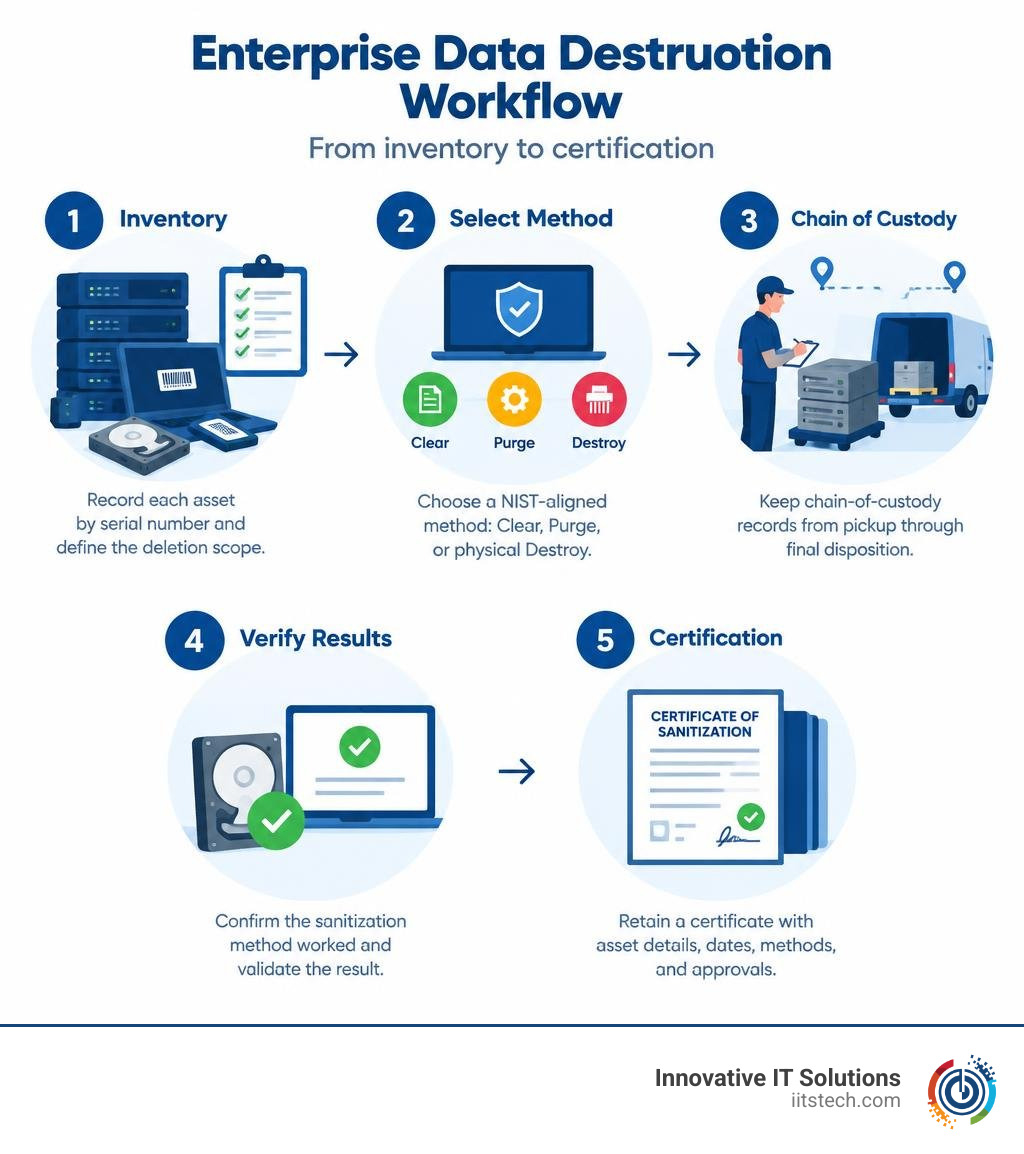
A documented data destruction process protects your organization when servers, laptops, storage arrays, and retired drives leave service. To make it audit-ready, follow five basics:
- Inventory each data-bearing asset by serial number and define the deletion scope.
- Select a NIST-aligned method: Clear, Purge, or physical Destroy.
- Keep chain-of-custody records from pickup through final disposition.
- Verify the sanitization method worked and validate the result.
- Retain a Certificate of Sanitization with asset details, dates, methods, and approvals.
This matters because deleting files or reformatting a drive is not the same as making its data unrecoverable. Enterprise hardware can retain sensitive information in hidden areas, backup copies, remapped blocks, or encryption systems. A defensible process accounts for the storage type, data risk, reuse plan, and applicable obligations such as HIPAA, GDPR, and PCI requirements.
For cloud and active systems, deletion may also happen in stages: a deletion request, a temporary recovery period, logical removal from active systems, and eventual expiration from backups. Physical media follows a separate path, with controlled handling, sanitization, verification, and documented release for reuse, recycling, or destruction.
I am Mike Haden, Founder and Director of Business Development at Innovative IT Solutions. Over 14 years in enterprise ITAD, I have helped develop standardized auditing, chain-of-custody, and documented data destruction process procedures for secure handling of retired corporate IT hardware.
Documented data destruction process terms simplified:
Key Standards Governing the Documented Data Destruction Process
Navigating media sanitization requires strict alignment with established industry and government benchmarks. When handling business-grade computers, server blades, and enterprise storage arrays, simply relying on internal IT scripts introduces severe regulatory exposure. Aligning with recognized regulatory compliance standards ensures that sanitization activities satisfy auditors, privacy regulators, and corporate risk officers alike.
The primary framework used across commercial and government sectors is the NIST SP 800-88 Guidelines for Media Sanitization. This publication outlines how to evaluate the confidentiality level of stored information and choose a sanitization technique that prevents forensic data recovery.
NIST SP 800-88 Purge, Clear, and Destroy Framework
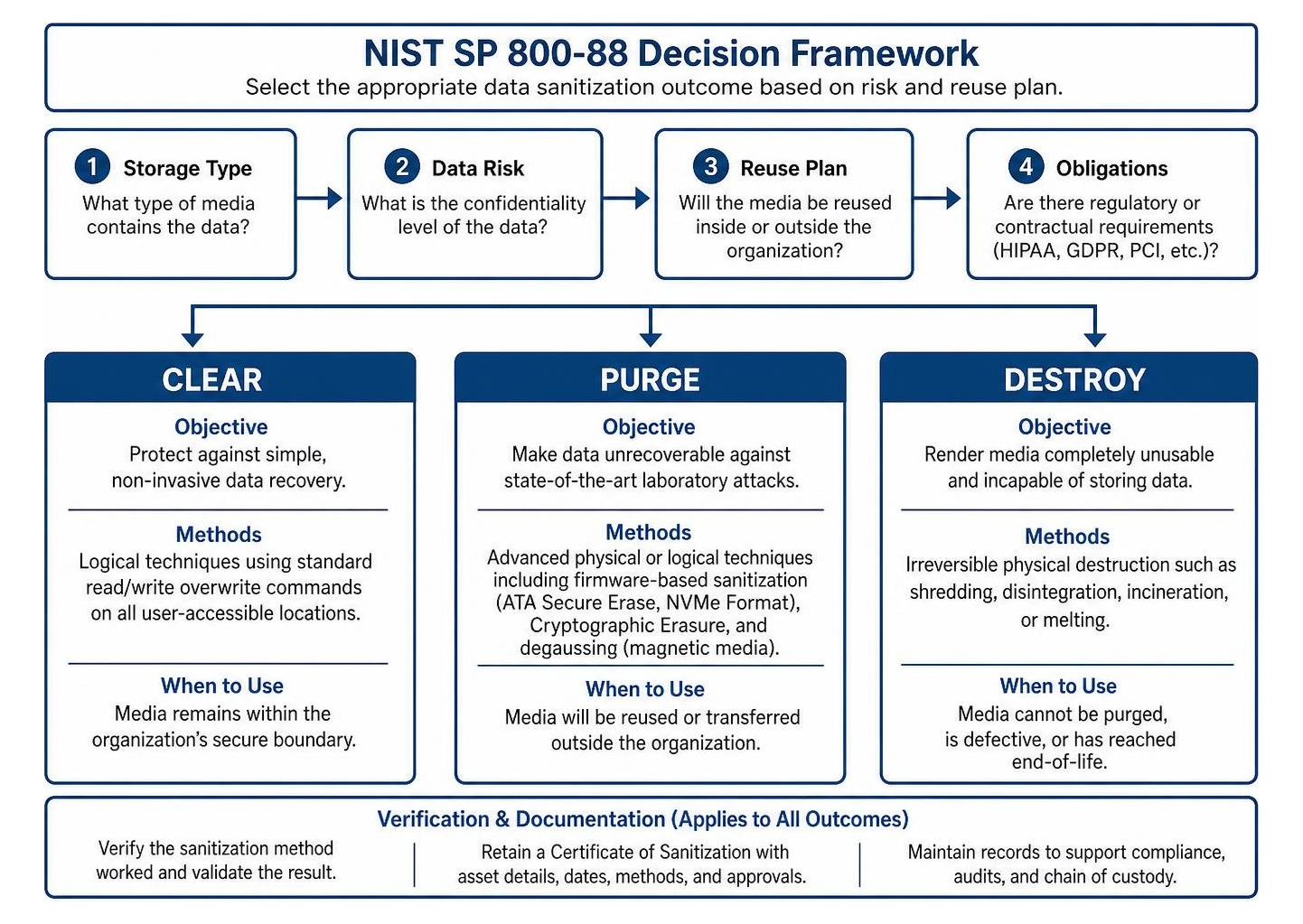
The NIST SP 800-88 standard organizes data sanitization into three progressive tiers based on security requirements and whether the target storage media will be reused:
- Clear: Employs logical techniques on all user-accessible storage locations to protect against simple, non-invasive data recovery attacks. This typically involves standard read/write overwrite commands using tools native to the interface. Clear is suitable when devices remain within the organization’s secure boundary.
- Purge: Utilizes advanced physical or logical techniques to make target data unrecoverable against state-of-the-art laboratory attacks. Purge methods include low-level firmware-based sanitization commands (such as ATA Secure Erase or NVMe Format), Cryptographic Erasure (CE), and complete degaussing for magnetic media. Selecting appropriate secure data destruction methods at this tier allows enterprise drives to be securely redeployed or resold outside the organization.
- Destroy: Renders the media completely unusable and incapable of storing data through irreversible physical mechanisms like shredding, disintegration, incineration, or melting. Destroy is required when media cannot be purged, is defective, or has reached end-of-life.
ISO/IEC 21964 and NSA Compliance Requirements
For global and defense-oriented enterprises, additional frameworks dictate specific handling protocols. The international standard detailed in the ISO/IEC 21964 standard preview (derived from DIN 66399) establishes precise security levels and physical particle size thresholds across different media varieties, including magnetic hard drives (H) and electronic solid-state storage (E). Crucially, ISO/IEC 21964 emphasizes that data controllers retain ultimate legal responsibility throughout the destruction lifecycle, requiring explicit take-over records and formal destruction logs.
For high-security operations handling classified records, the classified storage device sanitization manual (NSA/CSS Policy Manual 9-12) outlines non-negotiable physical destruction benchmarks. These include disintegrating magnetic storage and solid-state chips to particle sizes not exceeding 2 millimeters, or subjecting magnetic tape to temperatures exceeding 650°C. Meeting these rigorous DoD compliant data destruction requirements guarantees that no residual magnetic charge or microscopic charge trap can yield readable bits.
End-to-End Stages of an Enterprise Data Sanitization Pipeline

A comprehensive data deletion lifecycle spans both logical cloud infrastructures and physical hardware retirements. Understanding the broader cloud data deletion lifecycle shows how hyperscalers handle multi-stage data erasure—transitioning from deletion requests to soft-delete recovery holding periods, active system purge, and eventual expiration from backup snapshots over a defined window (often reaching up to 180 days).
For on-premises enterprise data centers, managing hardware retirement demands careful discipline when preparing IT equipment for disposal. We execute this through three structured stages.
Step 1: Media Classification and Decommissioning Inventory
Every enterprise data sanitization pipeline begins with rigorous asset tracking. Before any server blade is unmounted or any drive pulled from a SAN array, each item must be cataloged in an asset management system.
- Serial Number Capture: Scanning serial numbers directly from physical barcodes and cross-referencing with controller-level electronic queries.
- Data Classification: Identifying regulatory categorization (HIPAA, PCI-DSS, corporate IP) to assign the appropriate Clear, Purge, or Destroy mandate.
- Scope Definition: Determining whether the retirement impacts an individual drive, an entire chassis, a virtualization cluster, or multi-tenant cloud storage volumes. Recognizing the critical role of data destruction in cybersecurity ensures that unallocated blocks, hidden partitions, and system state snapshots are never overlooked during asset intake.
Step 2: Executing Logical Sanitization and Cryptographic Erasure
When enterprise hard drives and server SSDs are designated for redeployment, remarketing, or return to lease, logical sanitization is applied:
- Cryptographic Erasure (CE): If the storage media utilized full-disk encryption with a robust algorithm (such as AES-256), sanitization is achieved by securely destroying the Media Encryption Key (MEK). By purging the MEK and all wrapped keys from persistent device memory, the remaining ciphertext becomes computationally infeasible to decrypt.
- Block-Level Firmware Erasure: Executing native SCSI, SAS, or NVMe sanitize commands (e.g., Sanitize Block Erase or Crypto Scramble) ensures that wear-leveling pools and bad-block tables are thoroughly cleared.
- Addressing In-House Gaps: Relying on informal drive formatting scripts creates serious exposure. Understanding in-house data wiping risks highlights how software-level formatting routinely misses over-provisioned flash blocks, reallocated sectors, and host protected areas (HPAs).
Step 3: Physical Destruction and Shredding Protocols
When storage devices fail functional diagnostics, reach end-of-life, or hold top-tier classified information, physical destruction is mandatory.
We utilize industrial-grade drive shredders and disintegrators to physically shear platters, circuit boards, and memory chips. While standard commercial shredding reduces hard drives to strips between 20mm and 40mm, high-security specifications demand disintegration down to 2mm particles to prevent electron microscopy reconstruction. Following proper hard drive destruction protocols guarantees that magnetic coatings are fractured and solid-state silicon dies are pulverized into unrecognizable dust.
Media-Specific Sanitization: HDDs, NVMe SSDs, and Magnetic Tape
Different storage architectures require tailored sanitization approaches. Applying an HDD-specific protocol to an SSD will result in incomplete sanitization. When evaluating enterprise hardware, choosing physical destruction vs data wiping depends entirely on the physical characteristics of the media.
| Media Type | Clear Method | Purge Method | Destroy Method | Recovery Risk Post-Sanitization |
|---|---|---|---|---|
| Enterprise HDD (SAS/SATA) | Single-pass logical zero/pattern overwrite across all LBA addresses | High-coercivity degaussing (minimum 10,000+ Gauss) or multi-pass overwrite with bad-block verification | Mechanical shredding (≤19mm), shearing platters, or high-temp smelting | None (Laboratory attacks impossible if Purge/Destroy executed) |
| Enterprise SSD (NVMe/SATA) | Logical overwrite of addressable LBAs (leaves over-provisioned blocks intact) | NVMe Cryptographic Erase, Sanitize Block Erase, or drive controller microcode Purge | Disintegration to ≤2mm particle size or industrial incineration (>670°C) | None (When chips are physically fractured or crypto-erased) |
| Magnetic Tape (LTO/Enterprise) | Writing tape-length initialization patterns from beginning to end-of-tape marker | Bulk degaussing in NSA-listed degausser matched to tape coercivity rating | Industrial cross-cut shredding, disintegration (≤2mm), or incineration (>650°C) | None (Degaussing renders modern servo tracks unreadable) |
Hard Disk Drive Magnetic Degaussing and Overwriting
Magnetic hard disk drives store bits by orienting magnetic domains on spinning ceramic or aluminum platters.
- Degaussing: Exposing the drive to a powerful electromagnetic pulse (measured in Oersteds or Gauss) disrupts these magnetic domains, resetting magnetic remanence back to a randomized state. High-coercivity enterprise hard drives require high-energy degaussers to ensure data is non-recoverable. Degaussing modern HDDs destroys the factory-written magnetic servo tracks, permanently rendering the drive unusable for future operations.
- Multi-Pass Overwrites: Writing predictable bit streams (e.g., zeros, ones, and pseudo-random characters) ensures the entire addressable surface is overwritten. We caution against avoiding ineffective data destruction methods like simple OS-level deletions, partition removals, or single quick-formats, which leave raw sector data intact and accessible through basic data recovery tools.
Solid-State Drive Sanitization and Disintegration Challenges
Solid-state drives present unique sanitization complexities due to their internal architecture:
- NAND Flash & Wear Leveling: SSD controllers distribute writes across the drive using dynamic wear-leveling algorithms to prevent premature block degradation. As a result, standard OS-level overwrite tools cannot directly target specific physical sectors.
- Over-Provisioning & Remapped Blocks: When flash cells fail, the drive controller silently marks them as defective and remaps them to a hidden, over-provisioned area. These retired blocks can still harbor readable data that software overwrites cannot touch.
- Disintegration Requirements: Because SSD data resides inside compact surface-mounted silicon chips (NAND dies), a standard hard drive shredder that cuts drives into 1-inch pieces can leave individual flash memory packages completely intact. To achieve certified physical destruction for solid-state storage, devices must undergo micro-disintegration into 2mm particles or complete chip pulverization.
Verification, Auditing, and Chain of Custody
A data destruction program is only as defensible as its audit trail. Regulators and third-party auditors require verifiable proof that every retired serial number was processed using compliant methods. Utilizing certified data destruction compliance benefits protects organizations against regulatory fines under HIPAA, GLBA, and international privacy mandates.
Implementing a Documented Data Destruction Process for Audit Readiness
Achieving full audit readiness requires maintaining strict oversight across each phase of equipment retirement:
- Chain-of-Custody Logging: Tracking the movement of decommissioned hardware from the client data center floor, into secure locked transport bins, through transit, and into the processing facility. Every handover must be logged with date stamps, driver manifests, and dual-custody signatures.
- Post-Destruction Inspection and Sampling: For software sanitization, independent verification software must read back 100% of pseudorandom sectors or a statistically significant sample (e.g., minimum 5% to 10% sampling of addressable space) to verify that only erasure patterns or ciphertext remain. For physical destruction, screens and particle classifiers must be verified to ensure shred size thresholds are strictly maintained.
- Securing Retired Assets: Implementing comprehensive certified data destruction for retired hardware ensures that all IT asset disposition (ITAD) workflows remain auditable, transparent, and completely documented from receipt to final disposition.
Essential Elements of a Valid Certificate of Sanitization
At the conclusion of the sanitization or destruction cycle, the data controller must be provided with a formal Certificate of Sanitization (or Certificate of Destruction).
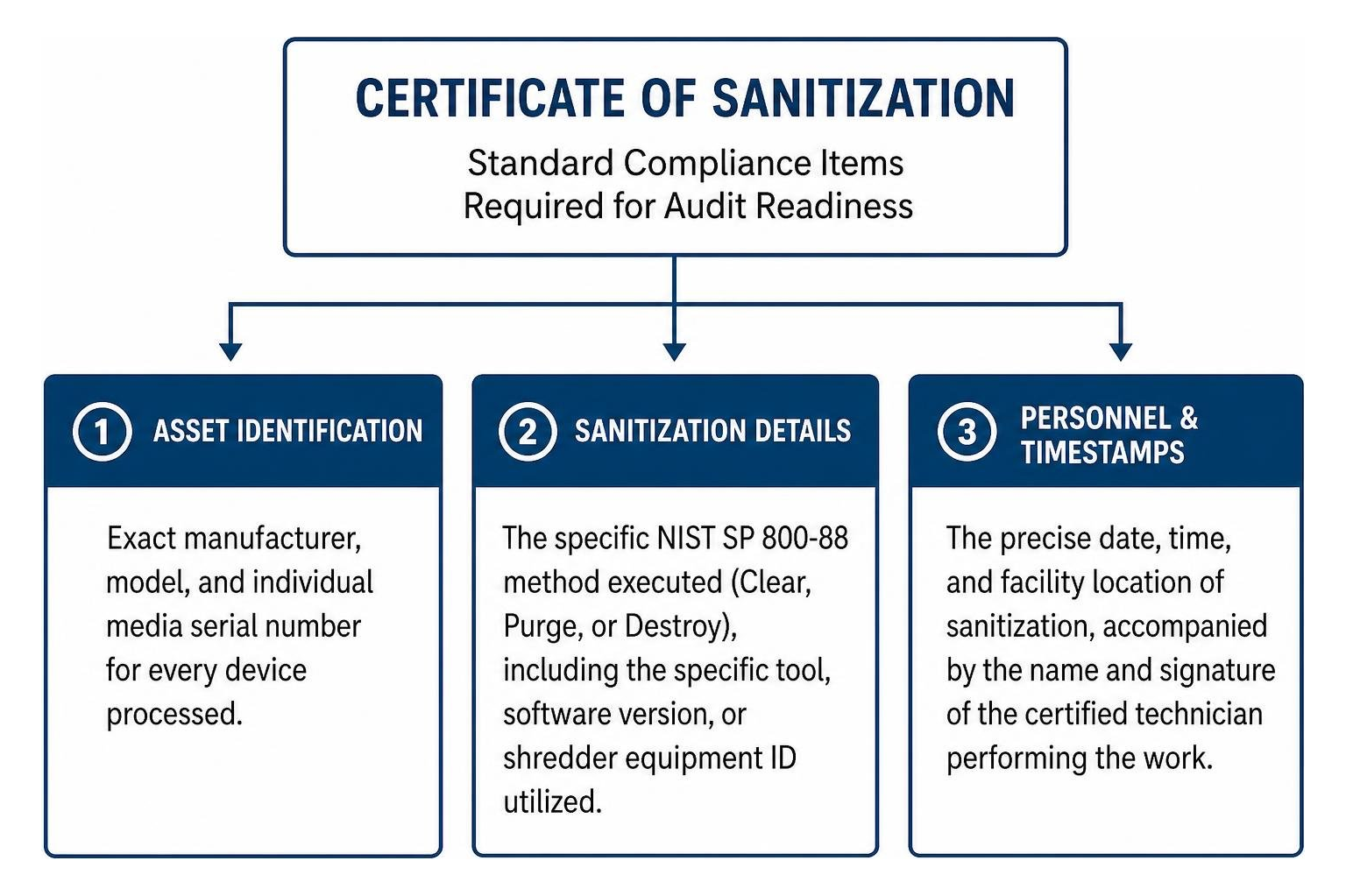
As outlined in demystifying the certificate of destruction, an audit-proof certificate must explicitly contain:
- Asset Identification: Exact manufacturer, model, and individual media serial number for every device processed.
- Sanitization Details: The specific NIST SP 800-88 method executed (Clear, Purge, or Destroy), including the specific tool, software version, or shredder equipment ID utilized.
- Personnel & Timestamps: The precise date, time, and facility location of sanitization, accompanied by the name and signature of the certified technician performing the work.
- Validation Sign-Off: Confirmation of post-sanitization read-back verification or shred size inspection signed by an independent compliance officer or witness.
Frequently Asked Questions About Enterprise Data Sanitization
How long does the documented data destruction process take across active and backup systems?
The time required depends on whether the scope involves physical enterprise hardware or distributed logical environments. In active, physical data center operations, on-site drive shredding can process hundreds of drives in a few hours, with Certificates of Destruction generated immediately.
In enterprise cloud environments, complete data deletion operates on a multi-stage schedule. When an account or storage bucket deletion request is submitted, cloud platforms typically initiate a soft-delete grace period lasting up to 30 days to protect against accidental removal.
Following this window, logical deletion from active production disks occurs through cryptographic erasure or block-level overwrites over the next 30 to 60 days. Finally, because snapshot architectures use rotational backup cycles (daily, weekly, and monthly), fully purging residual data across all backup tiers can take up to 180 days (six months) before snapshots expire and overwrite completely.
What is the difference between soft deletion and cryptographic erasure?
Soft deletion is a reversible administrative action where a file, database table, or virtual machine is flagged as deleted and removed from standard user visibility. The underlying data remains intact on the storage media during a retention window (often 14 to 30 days) to allow for error recovery.
In contrast, Cryptographic Erasure (CE) is a permanent, non-reversible Purge sanitization method. CE involves intentionally shredding or overwriting the dedicated encryption keys that protect encrypted storage volumes. Without the Media Encryption Key (MEK), the stored data is instantly rendered indecipherable ciphertext, making forensic recovery computationally impossible even while physical blocks remain on disk.
Why is physical shredding preferred over standard degaussing for solid-state storage?
Degaussing works strictly on magnetic media (such as hard drive platters and magnetic tapes) by generating powerful magnetic fields that disrupt magnetic orientation. Solid-state drives (SSDs, NVMe drives, and flash cards) store binary data as electrical charges trapped inside non-volatile floating-gate or charge-trap NAND flash memory cells. Because SSDs contain no magnetic components, degaussers have zero effect on the stored data.
To permanently sanitize enterprise solid-state drives without relying on firmware commands, physical shredding or micro-disintegration into 2mm particles is required to physically fracture every silicon NAND die.
Conclusion
Establishing a certified, auditable data sanitization framework is critical for enterprise risk management and regulatory compliance. From initial asset intake and serial tracking to executing NIST-aligned Clear, Purge, or Destroy methods, maintaining an unbroken chain of custody ensures that business-grade hardware never exposes sensitive corporate data.
At Innovative IT Solutions, we provide comprehensive IT asset disposition (ITAD) services that combine security, regulatory compliance, and environmental responsibility. We specialize in managing the entire lifecycle of enterprise IT hardware, including servers, data center arrays, and commercial computer fleets. Our certified data destruction processes align with NIST SP 800-88 and DoD standards, supported by full serial-tracked Certificates of Sanitization and an EPA-compliant, zero-landfill recycling commitment.
Whether your organization is upgrading data center infrastructure, managing a corporate hardware refresh, or seeking to safely recover value from retired equipment, our team is equipped to protect your brand. Explore our complete suite of enterprise IT asset recovery solutions to schedule secure on-site sanitization, certified drive destruction, and compliant hardware disposition.


