
Why High-Volume Size Reduction Is Critical for Enterprise IT Waste
Managing decommissioned enterprise IT hardware at scale requires aggressive mechanical processing. Server chassis, workstation enclosures, networking switches, and enterprise storage arrays arrive at processing facilities with irregular geometries, reinforced steel structural framing, and integrated component assemblies. Without rapid volumetric reduction, bulk hardware quickly exhausts warehouse footprint and creates severe logistical bottlenecks.
Understanding the steps of electronic recycling demonstrates that size reduction is the operational pivot point for an entire facility. Primary industrial shredders crush, rip, and shear high-density enterprise computers into uniform, free-flowing particle streams. This initial breakdown increases bulk density, vastly reduces transport costs, and exposes every sub-assembly to automated processing.
Beyond storage logistics, mechanical shearing liberates fused components. Server mainboards, aluminum heat sinks, copper wiring harnesses, and power supplies are tightly bound with structural rivets and industrial fasteners. High-torque comminution shatters these mechanical bonds, allowing downstream sorting lines to isolate individual commodity streams with high precision. By mitigating the environmental impact of corporate electronic waste, efficient size reduction prevents complex electronic assemblies from ending up in landfills while maximizing pure material extraction.
Recovering Critical Raw Materials from Enterprise Hardware
Enterprise-grade compute infrastructure represents a dense concentration of critical raw materials. A single high-performance motherboard or blade server contains significantly higher concentrations of precious and base metals than standard commercial desktop hardware. High-volume granulators liberate these commodities from surrounding steel enclosures, enabling closed-loop material circularity.
- Printed Circuit Boards (PCBs): Server mainboards, memory modules, and expansion cards contain gold-plated connectors, silver solder, and palladium contacts. Responsible facilities must recycle printed circuit boards properly to prevent the loss of these scarce elements.
- Refined Copper: Enterprise-grade transformer coils, power distribution units, and high-gauge power supply cables yield dense, high-purity copper fractions when granulated properly.
- Aluminum Extrusions: Passive server heatsinks, enterprise chassis rails, and processor cooling assemblies provide clean, high-grade aluminum streams that require minimal energy to re-smelt compared to virgin ore processing.
- Engineering Polymers: Flame-retardant structural polymers (such as high-impact polycarbonate and ABS blends used in server bezels and modular bays) can be granulated into clean regrind pellets for industrial manufacturing.
Complying with Secure Data Destruction Protocols
For enterprise IT facilities, physical hardware comminution serves an indispensable role in data governance. When storage drives reach terminal end-of-life or fail mechanical read/write diagnostics, physical destruction remains the definitive method to eliminate breach liability.
Understanding the essentiality of hard drive shredding requires evaluating both magnetic platters and solid-state storage architecture. Traditional rotational hard drives contain magnetic coatings across rigid aluminum or glass platters, while solid-state drives (SSDs) store binary data in microscopic NAND flash memory cells. Standard large-shred primary machines may leave flash storage chips intact between the cutting teeth.
To maintain chain-of-custody compliance with NIST SP 800-88 Rev. 1 and Department of Defense (DoD) sanitization frameworks, high-volume facilities implement dedicated secondary drive granulators. These units utilize precise screen sizing (typically reducing material to particles under 2mm to 10mm), completely pulverizing flash silicon dies and magnetic platters into unrecoverable fragments. For broader context on how mechanical processing fits into global recovery efforts, the electronic waste lifecycle shows why industrial comminution is essential for enterprise hardware streams.
Core Configurations of an Industrial E Waste Recycling Machine
An industrial recycling line is not a single generic device; it is a synchronized sequence of specialized comminution stages designed to handle specific structural materials.
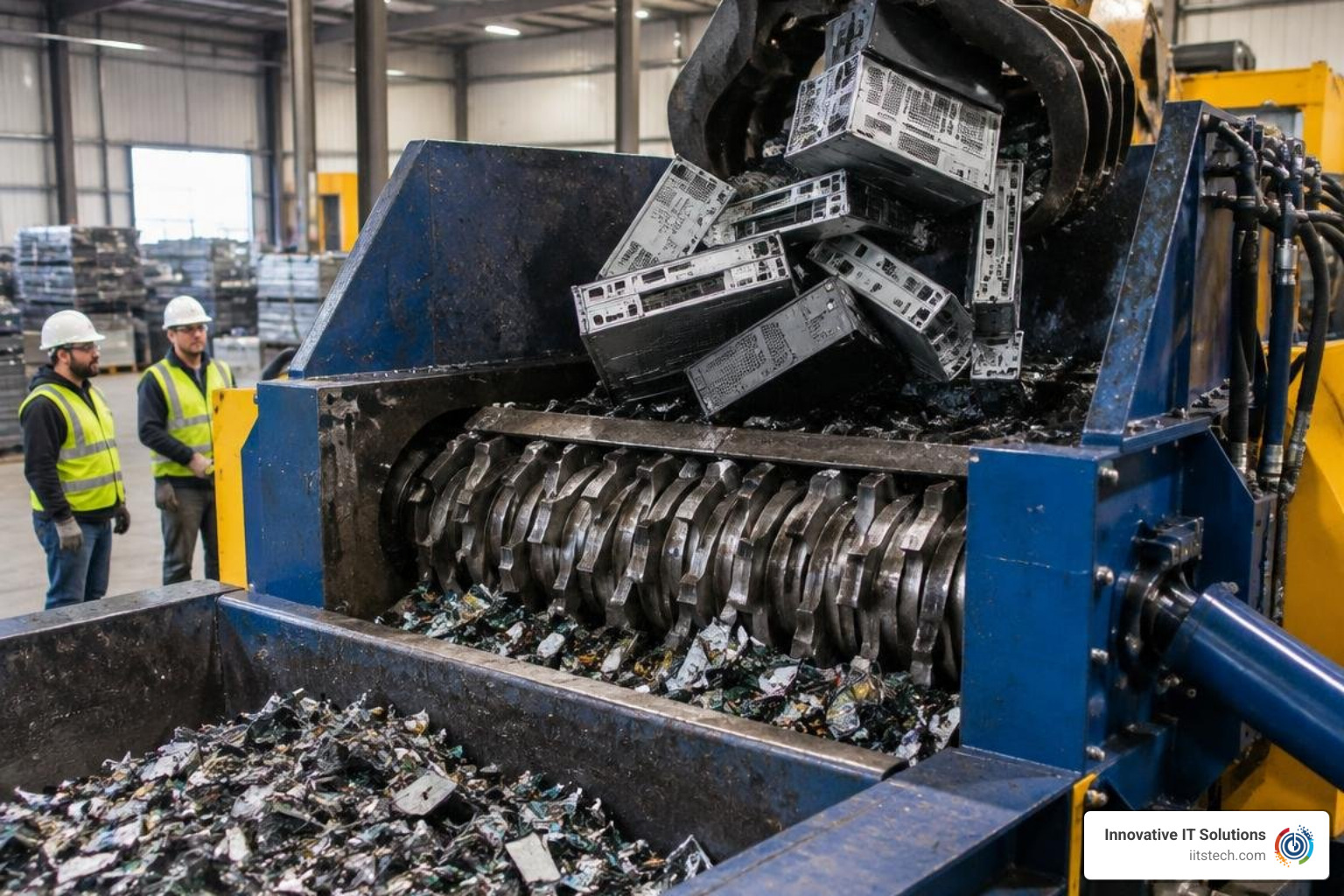
A comprehensive sizing system relies on a two-tier reduction strategy:
- Primary Industrial Shredders: Heavy-duty, low-speed, high-torque machines engineered to tear through 2U–4U server frames, heavy gauge steel power supplies, and intact desktop computers. These units utilize counter-rotating hex shafts fitted with hardened alloy steel hook knives.
- Secondary Granulators: High-speed rotary mills fitted with high-wear tool steel knives and bed blades that shear primary shreds against a sizing screen. Granulators reduce material into consistent flakes (typically 5mm to 12mm) to release micro-fasteners, solder pins, and laminate layers.
Proper operation ensures facility teams recycle computer parts properly without generating excessive metallic dust fines or damaging the cutting tools. Blade geometry must match the target material stream; aggressive, multi-hook rotary cutters provide continuous bite on sheet steel, while rotary shear blocks handle mixed cabling and resilient circuit assemblies.
Comparing Single-Shaft and Multi-Shaft Shredder Architectures
Selecting the proper machine architecture determines overall throughput, maintenance overhead, and particle consistency.
| Shredder Architecture | Typical Rotor Speed | Torque Profile | Ideal IT Scrap Input | Key Operational Advantage |
|---|---|---|---|---|
| Single-Shaft Shredder | High / Variable (60–120 RPM) | Medium to High (Hydraulic Ram Assisted) | Server housings, engineering plastics, mixed PC boards | Integrated screen sizing ensures uniform single-pass output. |
| Dual-Shaft (Twin-Shaft) | Low (15–35 RPM) | Very High (Gearbox Driven) | Whole desktop computers, steel server chassis, power supplies | High-grip counter-rotating shafts draw in bulky items without pushers. |
| Four-Shaft Shredder | Low (15–30 RPM) | Maximum Instantaneous Cutting Torque | High-security hard drives, server racks, dense server enclosures | Dual cutting shafts plus auxiliary clearing shafts with an integrated sizing screen. |
Single-shaft shredders rely on an internal hydraulic or electric swing-ram to push scrap directly against a high-speed cutting rotor fitted with replaceable concave knives. In contrast, four-shaft systems utilize four interacting cutter shafts that cut both vertically and horizontally. This configuration continuously draws bulky server enclosures downward while circulating oversized chunks back into the cutting chamber until they pass through the lower sizing screen.
Sizing an E Waste Recycling Machine for High-Volume Server Processing
Accurate equipment sizing prevents premature machine fatigue and processing downtime. When decommissioning data centers, hardware arrives in multi-ton batches consisting of dense server trays, enterprise storage chassis, and heavy rack rail equipment.
Facility owners must assess three primary mechanical sizing metrics:
- Drive Motor Horsepower: Primary enterprise lines require continuous duty ratings ranging from 75 kW to over 250 kW. Undersized motors stall frequently on thick structural steel brackets, triggering repetitive auto-reverse cycles that slow processing.
- Continuous Infeed Throat Dimensions: The cutting chamber must measure at least 1,200mm to 1,600mm in width to swallow standard 19-inch rackmount chassis and server towers without manual pre-cutting or hydraulic pre-crushing.
- Alloy Blade Composition: Cutting knives must be forged from high-wear, shock-resistant alloy tool steels (such as Hardox 500, D2, or nickel-chromium alloy steels). These alloys withstand unpredictable shock loads caused by hardened tool-steel structural bolts and industrial heatsink blocks.
Downstream Sorting and Purification Technologies
Size reduction is only half the battle. Once an enterprise chassis is shredded into uniform particles, the resulting mixed fraction must be separated into clean, saleable commodity streams.
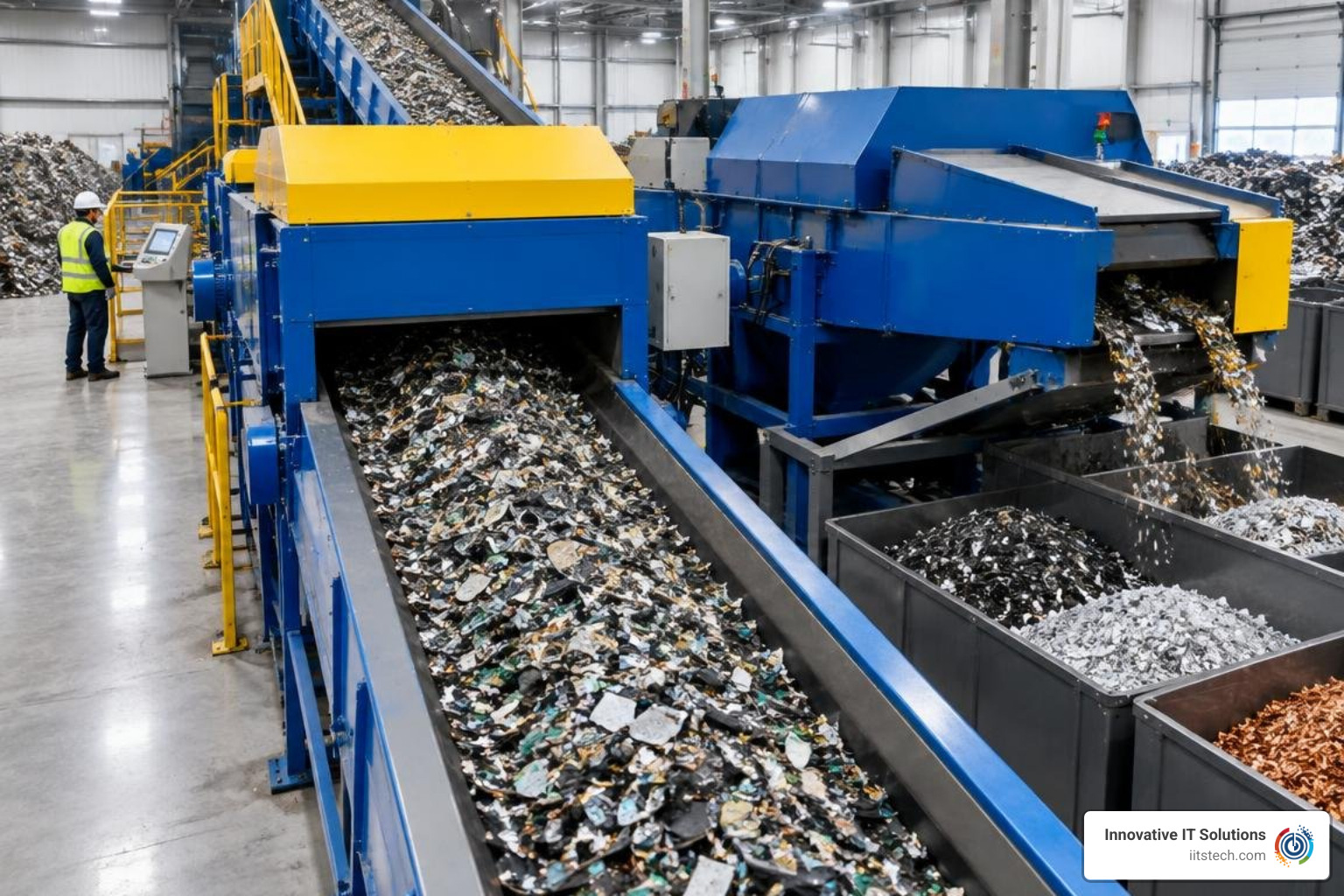
An automated mechanical sorting line routes granulated e-scrap through multiple physical separation stages:
- Overbelt and Drum Magnets: High-intensity neodymium magnetic separators continuously pull structural steel, drive casings, and ferrous screws from the main vibratory conveyor bed.
- Eddy Current Separators (ECS): High-speed rotating magnetic rotors induce alternating eddy currents in non-ferrous particles, physically projecting aluminum heatsinks and copper busbars away from inert materials.
- Density Air Classifiers (Zig-Zag Classifiers): Upward air streams lift lightweight flexible films, label polymers, and insulation fibers away from heavier granulated circuit board pieces.
- Optical Sorters: High-resolution multi-spectral cameras and near-infrared (NIR) sensors analyze conveyor streams at high speeds, using pneumatic air jets to eject targeted printed circuit board fragments.
Integrating a Downstream E Waste Recycling Machine for Material Separation
To achieve zero-waste discharge and maximum scrap purity, modern lines integrate dry electrostatic separation and automated washing equipment. Electrostatic separators exploit differences in electrical conductivity between crushed non-ferrous metals and granular plastics. As material feeds over a grounded conductive drum exposed to a high-voltage corona discharge field, conductive metal particles discharge instantly and fall into collection chutes, while non-conductive plastic particles retain charge, adhere to the drum surface, and drop into separate bins.
When processing heavy engineering polymers from server housings, dedicated washing lines (such as specialized plastic washing systems) remove surface lubricants, thermal pastes, and dust residues. Advanced friction washers and centrifugal dewatering modules ensure clean plastic flakes are ready for direct compounding without requiring hazardous chemical reagents.
Managing Hazardous Dust and Flame Retardant Residues
High-volume comminution of enterprise server electronics generates fine airborne particulate matter that must be contained. Processing printed circuit boards, power supplies, and older legacy hardware releases fiberglass dust, residual leaded solder fines, and brominated flame retardants (BFRs) embedded in structural polymers.
Compliant industrial facilities install fully enclosed negative-pressure dust extraction manifolds directly over shredder discharge chutes, granulator screens, and transfer conveyor hoods. These extraction systems route air through multi-cyclone pre-separators to drop out heavy particulates before exhausting through automated reverse-pulse HEPA filtration units. Maintaining strict air quality controls protects operating personnel, prevents combustible dust accumulation, and maintains full environmental compliance with industrial emissions standards.
Key Equipment Selection Factors for Facility Owners
Investing in industrial size-reduction machinery requires balancing capital expenditure (CapEx) against long-term operational expenditure (OpEx) and system availability.
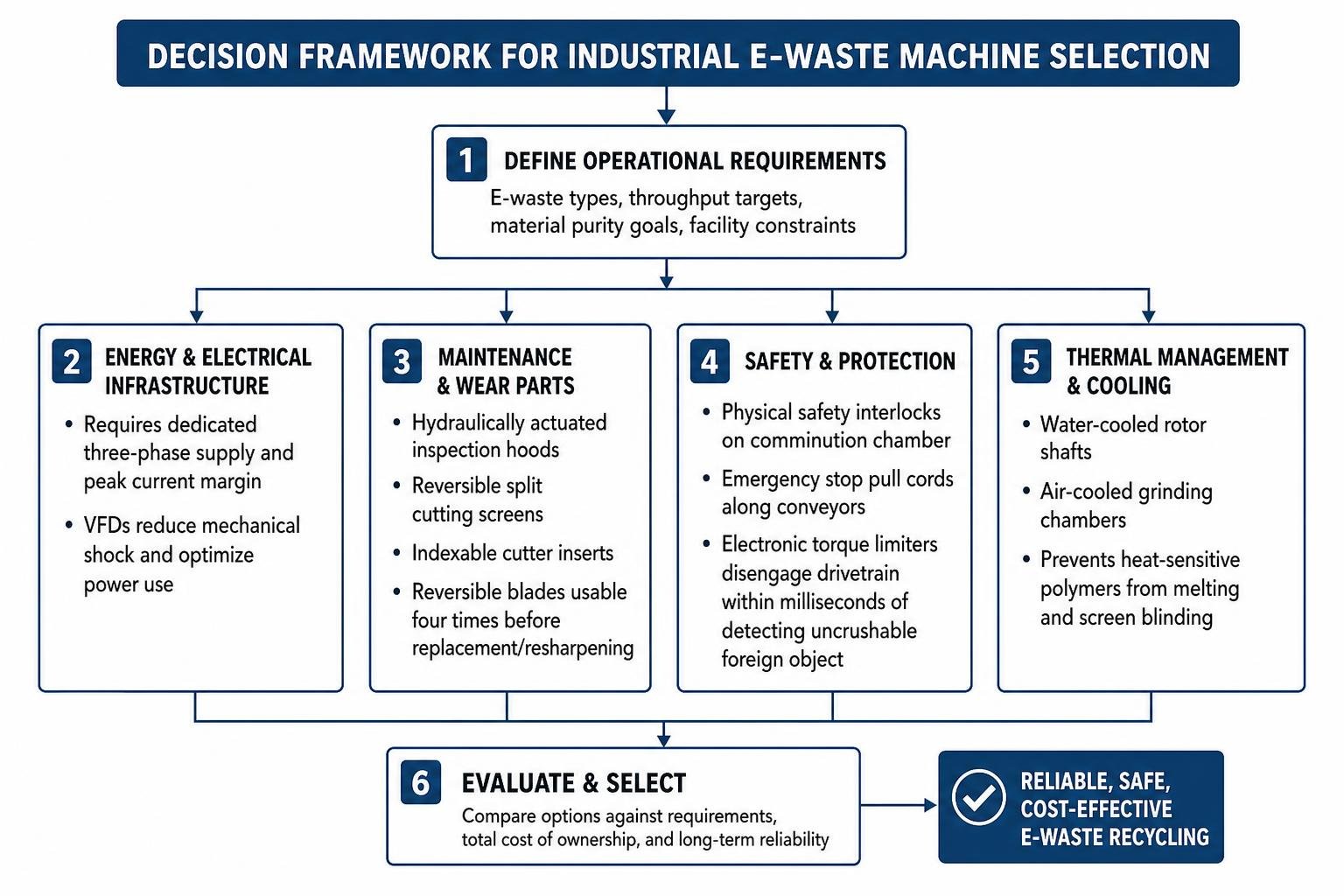
Before purchasing equipment, evaluate these operational requirements:
- Energy Consumption and Electrical Infrastructure: Heavy dual-shaft and four-shaft lines require dedicated three-phase electrical supplies and substantial peak current margins. Variable frequency drives (VFDs) reduce mechanical shock loads and optimize power consumption based on scrap density.
- Maintenance Accessibility and Wear Parts: Choose machines equipped with hydraulically actuated inspection hoods, reversible split cutting screens, and indexed cutter inserts. Reversible indexable blades can be rotated four times before requiring replacement or resharpening, lowering tooling costs per metric ton.
- Integrated Safety Interlocks: The comminution chamber must feature physical safety interlocks, emergency stop pull cords along conveyors, and electronic torque limiters that disengage the drivetrain within milliseconds of detecting an uncrushable foreign object.
- Rotor Cooling Systems: High-throughput fine granulation generates friction heat. Water-cooled rotor shafts and air-cooled grinding chambers prevent heat-sensitive engineering polymers from melting and blinding the screen perforations.
Frequently Asked Questions About E-Waste Shredding and Processing Equipment
How does an e-waste granulator differ from an industrial shredder?
An industrial shredder operates at low speeds (15 to 60 RPM) using high torque to tear, crush, and shear large, whole electronic devices into coarse fragments (typically 20mm to 100mm). A granulator operates at high speeds (400 to 800 RPM) using a rotary knife assembly to cut primary shreds against stationary bed blades, producing fine, uniform particles (typically 2mm to 10mm) that pass through an integrated sizing screen.
What throughput capacity is needed for enterprise IT recycling lines?
Throughput capacity depends on facility volume and scrap profile. Small to mid-sized ITAD processing facilities operate efficiently with lines rated between 500 kg/h and 1,500 kg/h. High-volume regional recovery hubs and automated data center decommissioning lines require continuous processing capacities ranging from 3,000 kg/h to upwards of 10,000 kg/h to process multi-ton hardware deliveries without accumulating backlog.
How do modern shredders handle mixed materials in computer power supplies and motherboards?
Modern industrial shredders utilize heavy alloy steel cutting hooks driven by high-torque planetary gearboxes. If an exceptionally dense structural component or uncrushable steel shaft enters the chamber, advanced programmable logic controllers (PLCs) detect the motor amperage spike and automatically reverse rotor rotation within milliseconds. The machine re-orients the item before resuming the forward cutting stroke, preventing mechanical damage and blade breakage.
Conclusion
High-volume e-waste shredders and granulators are the foundation of modern enterprise IT recovery. By selecting the right combination of high-torque primary shredding, precision secondary granulation, and downstream separation, facility owners can maximize material recovery yields, guarantee absolute data security compliance, and operate profitable, environmentally responsible recycling operations.
At Innovative IT Solutions, we provide comprehensive, compliant enterprise IT asset disposition and recovery. To learn more about our sustainable hardware disposal processes, explore our certified commercial electronics recycling services and discover how we help organizations securely retire enterprise infrastructure while maximizing asset recovery returns.


