
Accepted Business IT Assets for Electronics Recycling Drop Off
Commercial IT departments frequently accumulate retired equipment during tech refreshes, server migrations, and office consolidations. Unlike municipal solid waste facilities, certified commercial facilities accept a broad spectrum of enterprise computing infrastructure. Utilizing certified e-waste recycling services guarantees that high-density computing components are safely dismantled, recovered, and processed in accordance with environmental standards like the Fairfax County Electronics Guidelines and Oklahoma state environmental frameworks.
| Enterprise Asset Category | Accepted Hardware Items | Disposal & Handling Protocol | Restriced / Prohibited Items |
|---|---|---|---|
| Data Center Infrastructure | Rackmount servers, blade chassis, SAN storage arrays, core switches | Complete teardown, board-level recovery, serial tracking | Leaking capacitors, liquid cooling freon units |
| Computing Hardware | Business laptops, desktop towers, thin clients, CAD workstations | Data sanitization, RAM/CPU harvesting, metal recycling | Broken CRT glass, loose alkaline cells |
| Circuitry & Processing | Server motherboards, daughterboards, CPU processors, ECC RAM modules | Precious metal extraction (gold, silver, palladium) | Unsorted hazardous chemical waste |
| Power & Cabling | Server power supply units (PSUs), SAS cables, copper wiring, patch cords | High-grade copper refining, plastic granulation | Loose unsealed lead-acid wet cells |
Enterprise Servers and Data Center Infrastructure
Enterprise data centers generate dense, heavy computing scrap that requires dedicated material handling. When retiring server rooms and modular compute racks, specialized processing facilities accept:
- Blade Servers and Modular Chassis: High-density compute nodes, midplanes, backplanes, and multi-node blade enclosures.
- Storage Area Network (SAN) Units: High-capacity hard drive arrays, network-attached storage (NAS) controllers, SAS expansion shelves, and fiber channel disk arrays.
- Enterprise Networking Gear: Managed layer-2 and layer-3 switches, core routers, hardware firewalls, security gateways, and patch panels.
- Infrastructure Power Distribution: Rack-mount intelligent power distribution units (ePDUs), server cabinet power supply units, and static transfer switches.
Commercial Workstations and Peripheral Computing Devices
Workstation refreshes produce high volumes of modular computer hardware across enterprise floors:
- Commercial Laptops and Desktops: Executive ultrabooks, enterprise desktop towers, small-form-factor PCs, and specialized CAD workstations.
- Commercial Displays: LED, LCD, and OLED business monitors, commercial digital signage controllers, and conference room presentation screens.
- Workstation Peripherals: Enterprise USB-C docking stations, SAS/SATA controller cards, PCIe expansion boards, and multi-port Gigabit network interface cards.
- Structured Cabling: Cat5e, Cat6, Cat6a copper cabling, optical fiber patch cords, and internal server wiring harnesses.
For businesses managing large-scale refreshes, understanding where to find reputable IT drop depots ensures that all accepted assets are handled through a secure, compliant chain of custody.
Preparing Enterprise Hardware for Secure Disposal and Recycling
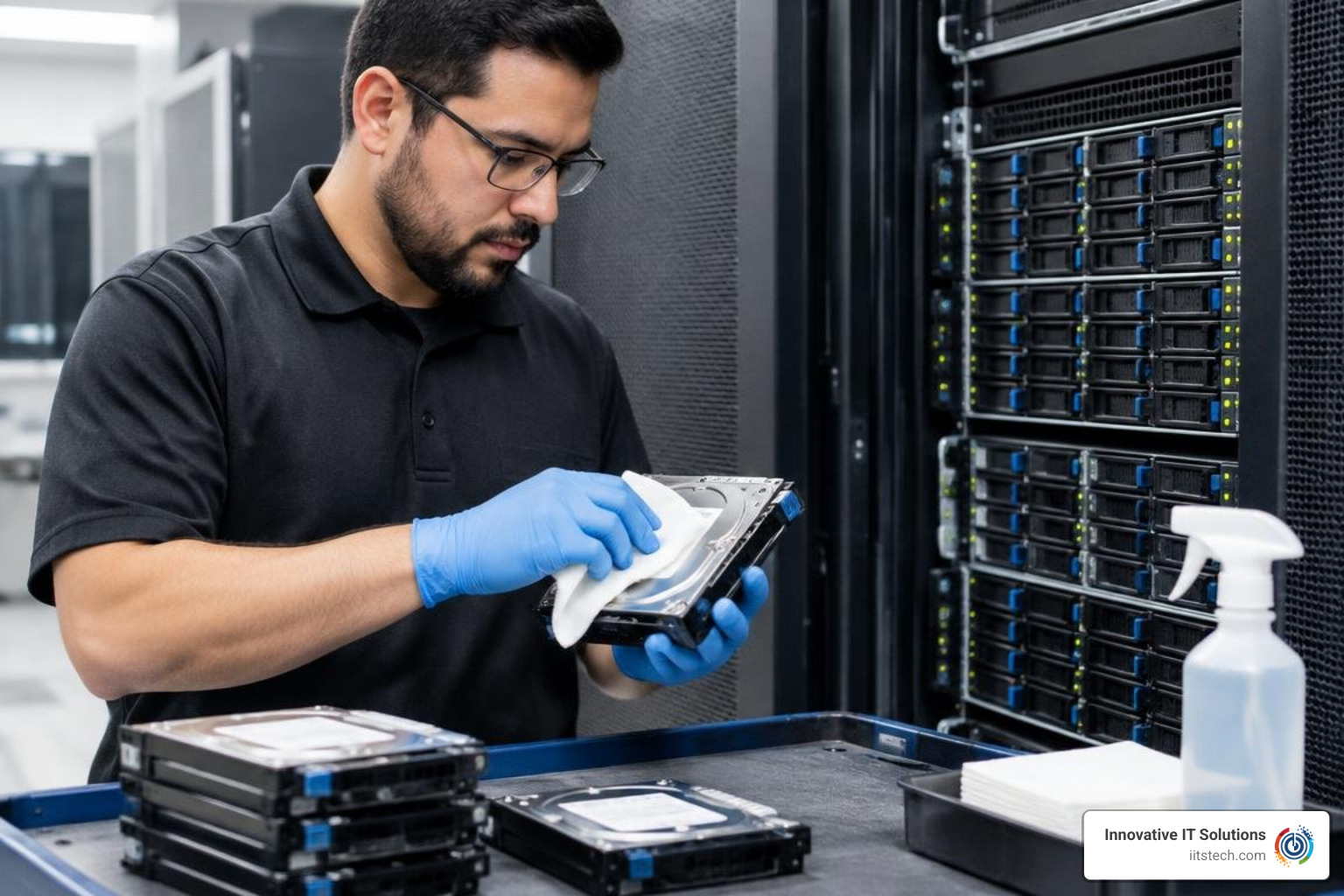
Before delivering assets to commercial receiving bays, IT teams must establish clear hardware preparation workflows. Understanding where to find reputable IT drop depots ensures that enterprise data security is maintained through the final custody transfer.
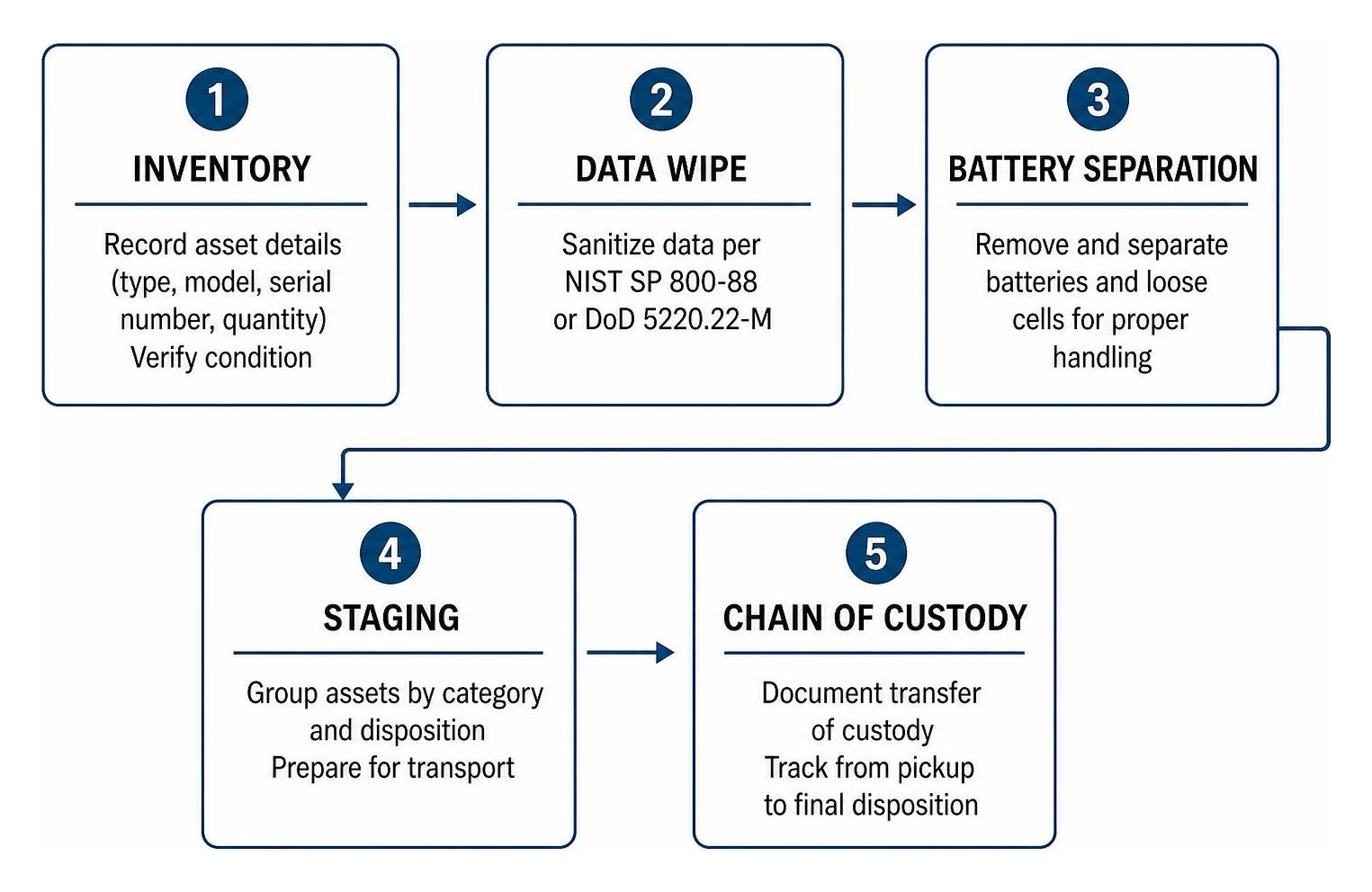
Data Sanitization Protocols for Electronics Recycling Drop Off
Physical possession of hardware means access to proprietary enterprise data unless strict sanitization takes place prior to drop off:
- NIST SP 800-88 Standards: Hardware sanitization must adhere strictly to NIST SP 800-88 Rev. 1 guidelines for data clearance, cryptographic purging, and physical destruction across all magnetic and solid-state storage.
- DoD 5220.22-M Compliance: Magnetic storage media requires multi-pass overwrite sequences to prevent forensic bit-level data retrieval.
- Physical Degaussing and Shredding: Solid-state drives (SSDs), NVMe storage, and legacy enterprise hard disk drives (HDDs) containing sensitive IP should undergo industrial degaussing followed by mechanical shredding to 2mm–20mm particulate sizes.
- Audit Documentation: Always secure a formal Certificate of Data Destruction linked directly to the serial numbers of the processed drives and storage arrays.
Physical Preparation and Hazardous Component Removal
Prior to freight staging and delivery, enterprise systems must be physically neutralized to comply with transport regulations:
- Uninterruptible Power Supply (UPS) Batteries: Isolate internal batteries from commercial UPS systems. Sealed lead-acid (SLA) cells must be disconnected, terminal-taped, and stored separately to eliminate short-circuit risks.
- Lithium-Ion Battery Segregation: Remove modular laptop batteries, enterprise tablet packs, and CMOS motherboard coin cells to eliminate thermal runaway risks during bulk transport.
- Component Sorting and Harvesting: Strip easily removable components—such as CPU processors, server RAM modules, host bus adapters, and enterprise power supplies—into dedicated sorting bins to maximize reclamation value and recycling throughput.
Proper preparation not only protects sensitive corporate data but also streamlines downstream processing, ensuring that materials are recovered efficiently and in full compliance with environmental regulations.
Commercial Logistics, Site Policies, and Chain of Custody
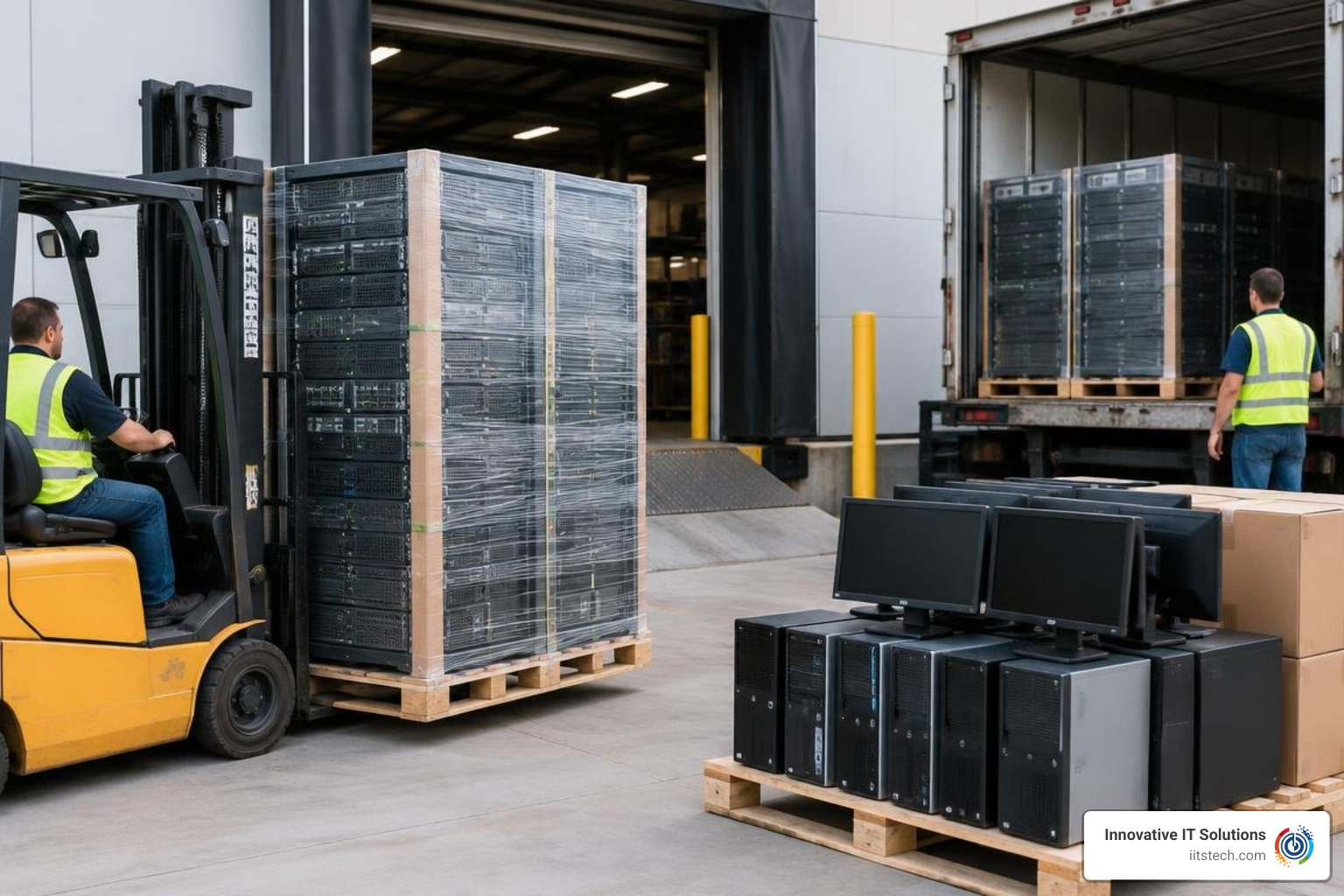
Commercial recycling intake involves structured logistics designed for high-density enterprise operations. Municipal standards documented by programs like the SWALCO Year-Round Electronics Recycling Details illustrate the importance of structured intake policies, especially when managing high volumes of IT equipment through enterprise computer recycling services.
Site Policies for Large-Scale Electronics Recycling Drop Off
When delivering business-grade IT hardware, commercial facilities require strict operational adherence at the receiving dock:
- Palletization and Shrink-Wrapping: Bulk desktop towers, blade chassis, and 1U/2U/4U rack servers must be stacked evenly on standard 48×40-inch wooden pallets, reinforced with corner boards, and securely wrapped with heavy-duty stretch film.
- Freight Scheduling and Dock Logistics: Commercial facilities typically require 24- to 48-hour advance notice for standard box truck or semi-trailer deliveries. Ensure you possess a formal Bill of Lading (BOL) and pre-registered dock appointment.
- Weight Verification: High-volume commercial loads pass over certified gross vehicle scales to verify raw tonnage before and after unloading, establishing verifiable weight records.
- Commercial Verification: Businesses must present valid company identification, tax documentation, and an authorized manifest before transferring hardware custody to recycling personnel.
Post-Drop-Off Processing and Material Recovery
Once business IT assets clear intake verification, modern material separation and resource recovery begin:
- Mechanical Shredding: Specialized high-torque industrial shredders reduce complex server housings, steel chassis, and circuit assemblies into uniform fragments.
- Precious Metals Extraction: Advanced smelting and chemical hydrometallurgical refining recover gold, silver, copper, and palladium embedded in enterprise microprocessors, memory contacts, and multi-layer printed circuit boards.
- Secondary Commodity Refining: Aluminum heat sinks, copper wiring, and steel casing brackets are sorted using eddy-current separators and optical sorters, re-entering global manufacturing streams as clean raw commodities.
- Zero-Landfill EPA Compliance: All non-metallic residues and engineering-grade polymers undergo downstream thermal or mechanical reclamation, preventing e-waste from entering municipal landfills.
By adhering to these logistics and processing standards, businesses can ensure that their retired IT assets are handled responsibly, with maximum material recovery and minimal environmental impact.
Frequently Asked Questions About Electronics Recycling Drop Off
Finding the best electronics recycling locations requires evaluating intake capabilities, chain-of-custody protocols, and operational compliance.
What business IT hardware is typically restricted at drop-off sites?
Drop-off facilities generally reject hazardous materials that fall outside solid-state and computing equipment boundaries:
- Server liquid-cooling loops containing hazardous chemical coolants or freon refrigerants.
- Cracked cathode-ray tube (CRT) glass or broken fluorescent backlights containing mercury vapor.
- Swollen, punctured, or leaking lithium-ion batteries that present immediate fire hazards.
- Polychlorinated biphenyl (PCB) industrial capacitors found in decommissioned pre-1980 power infrastructure.
Are there volume limits or fees for commercial IT drop-offs?
Enterprise drop-off facilities operate under specialized business intake protocols:
- Intake Minimums and Thresholds: Commercial processors often set minimum weight requirements (e.g., 500 lbs or 1 full pallet) to qualify for free or value-return asset recovery.
- Processing and Sorting Fees: Non-separated, mixed commercial loads may incur baseline sorting charges. However, high-value compute equipment (such as modern Xeon/EPYC servers and enterprise RAM) can often offset these costs entirely.
- Asset Resale Opportunities: Enterprise IT hardware that retains market viability can be refurbished and resold through formal ITAD channels, turning recycling efforts into operational cost recovery.
What documentation should businesses require upon drop-off?
To satisfy corporate governance, Sarbanes-Oxley, HIPAA, and environmental compliance, businesses must retain complete audit records:
- Intake Manifest / Transfer Receipt: Countersigned document logging the itemized piece count, gross pallet weight, and date of custody transfer.
- Serial Number Inventory Log: Precise record tracking every hard drive, solid-state drive, and primary computing chassis.
- Certificate of Data Destruction: Legal certification detailing the sanitization method, date, software verification hash, or shredding verification.
- Certificate of Recycling (Zero-Landfill): Formal attestation verifying that all scrap materials were processed in strict accordance with EPA regulations.
These documents provide a verifiable audit trail, demonstrating that your organization has met its legal and ethical obligations for data security and environmental stewardship.
Conclusion
Managing retired corporate technology demands a structured, secure, and environmentally compliant approach. Simply clearing out an IT closet or offloading retired data center racks without verifiable data sanitization and certified downstream processing exposes your organization to severe regulatory penalties and catastrophic data breaches.
At Innovative IT Solutions, we provide full-spectrum IT asset disposition and enterprise recycling built for modern business requirements. Based in Oklahoma City, we serve organizations across South OKC, greater Oklahoma, and nationwide with NIST SP 800-88-compliant data destruction, transparent chain of custody tracking, and absolute zero-landfill processing.
Partner with our certified team today to safeguard your corporate data and extract maximum residual value from your decommissioned infrastructure through our comprehensive IT asset recycling solutions.


