
Detailed Guide to Secure Data Destruction Methods
Understanding Media Sanitization: Clear vs. Purge vs. Destroy
When enterprise computers, storage arrays, or server blades reach the end of their production lifecycle, handling the underlying drives requires a systematic approach. Media sanitization is the formal process of rendering access to target data on physical storage media infeasible for a specific level of recovery effort.
The benchmark for sanitization across enterprise environments is NIST SP 800-88 Rev. 2, outlined in the National Institute of Standards and Technology Guidelines for Media Sanitization. This framework establishes three distinct levels of media sanitization based on data confidentiality impact levels (Low, Moderate, High) and the ultimate destination of the media. Understanding the importance of data destruction begins with distinguishing between these three tiers:
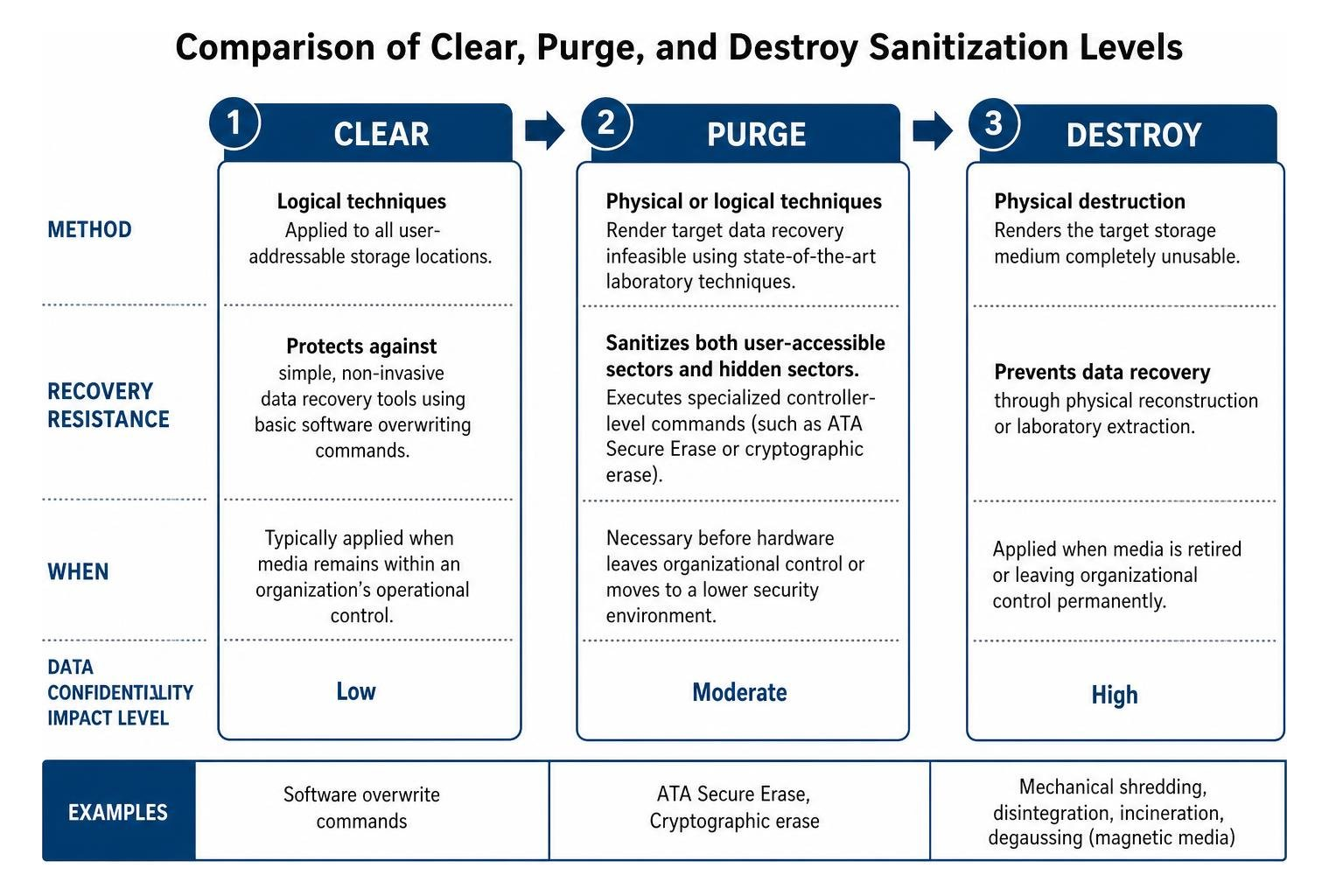
- Clear: Logical techniques applied to all user-addressable storage locations. Clearing protects data against simple, non-invasive data recovery tools using basic software overwriting commands. It is typically applied when media remains within an organization’s operational control.
- Purge: Physical or logical techniques that render target data recovery infeasible using state-of-the-art laboratory techniques. Purging executes specialized controller-level commands (such as ATA Secure Erase or cryptographic erase) to sanitize both user-accessible sectors and hidden sectors. Purging is necessary before hardware leaves organizational control or moves to a lower security environment.
- Destroy: Physical destruction that renders the target storage medium completely unusable and prevents data recovery through physical reconstruction or laboratory extraction. Methods include mechanical shredding, disintegration, incineration, and specialized degaussing for magnetic media.
A critical complexity in modern enterprise storage—especially solid-state drives (SSDs)—involves internal drive architecture. Modern enterprise flash media utilizes overprovisioned storage blocks and automated wear-leveling algorithms. As a result, physical raw storage capacity (such as 1024 GB) often exceeds the user-addressable logical capacity (such as 900 GB).
Because operating system writes cannot directly access overprovisioned or marked bad blocks, standard file-system overwriting fails to reach data retained in these areas. Choosing between logical purging and physical destruction depends heavily on this physical architecture.
| Sanitization Level | Target Media | Effectiveness Against Lab Recovery | Media Reusability | Typical Application |
|---|---|---|---|---|
| Clear | Enterprise HDDs & Basic Storage | Protects against basic software utility recovery | Media remains fully functional and reusable | Internal redeployment between departments |
| Purge | Enterprise SSDs, NVMe, SEDs, HDDs | Protects against advanced lab and forensic recovery | Media remains functional (or keys discarded) | Hardware resale, lease returns, warranty repair |
| Destroy | All storage media (HDDs, SSDs, Tapes) | Completely eliminates recovery feasibility | Media is permanently destroyed (zero residual value) | End-of-life IT asset disposition (ITAD) and recycling |
Core Data Destruction Methods: Logical vs. Physical Sanitization
Selecting an appropriate method depends on media type, data classification, and whether hardware is destined for asset recovery, remarketing, or recycling.
Software Overwriting and Cryptographic Erase (CE)
Logical sanitization allows functional server components and drives to be reused or resold, helping organizations recover value from retired IT infrastructure.
Multi-Pass Software Overwriting replaces existing binary data on addressable sectors with non-sensitive patterns (such as continuous zeros, ones, or pseudorandom binary characters). While historical government specifications once required many overwrite passes, modern standards recognize that a single validated overwrite pass effectively neutralizes data recovery on functional hard disk drives. However, overwriting cannot be executed on damaged, non-rewriteable, or inoperable drives.
For flash memory, understanding wiping an SSD drive requires a controller-level approach. Standard sector overwrites do not touch unmapped or retired wear-leveling blocks. Instead, enterprise SSDs rely on native hardware commands, such as NVMe Secure Erase or ATA Enhanced Secure Erase, which instruct the internal drive controller to purge all storage cells simultaneously. Relying on basic file deletion or consumer disk utilities constitutes one of several common ineffective data destruction methods that leave enterprise records exposed.
Cryptographic Erase (CE) sanitizes data on Self-Encrypting Drives (SEDs) by securely erasing or overwriting the internal media encryption key (MEK). Because the stored data is always encrypted at rest, destroying the decryption key renders the underlying ciphertext permanently unrecoverable.
To execute a compliant Cryptographic Erase:
- The cryptographic algorithm must have a security strength of at least 128 bits (such as AES-128 or AES-256).
- The entropy of random number sources generating keys must match or exceed the bit-length of the cryptographic key.
- The internal key sanitization command must sanitize all backup and cached instances of the key across internal flash sectors.
Physical Hard Drive Shredding, Degaussing, and Disintegration
When storage media reaches its physical end-of-life, fails diagnostics, or contains highly sensitive records that cannot leave an organization intact, physical destruction is mandatory. Knowing physical destruction vs data wiping helps teams decide between hardware remarketing and complete physical disposal.
Mechanical Hard Drive Shredding uses industrial-grade rotary shear shredders to rip server platters, chassis, circuit boards, and memory chips into small fragments. The international standard DIN 66399 classifies physical media destruction based on particle sizes:
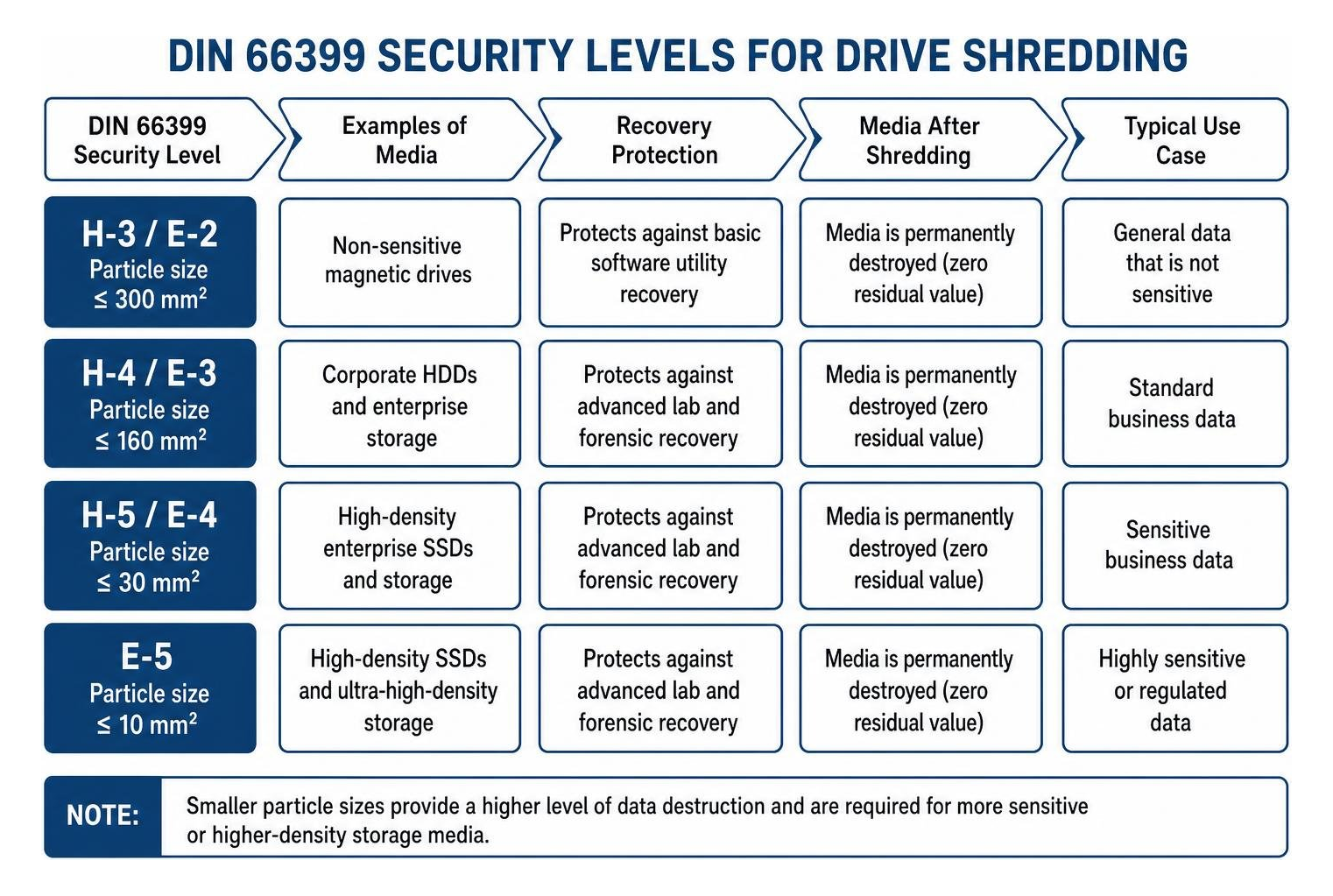
- Level H-3 / E-2: Coarse industrial shredding for non-sensitive magnetic drives (particle size $\le 300\text{ mm}^2$).
- Level H-4 / E-3: Standard commercial shredding for corporate HDDs and enterprise storage (particle size $\le 160\text{ mm}^2$).
- Level H-5 / E-4 / E-5: High-security particle reduction and micro-shredding (particle sizes down to $\le 30\text{ mm}^2$ or $\le 10\text{ mm}^2$). This level is required for high-density enterprise SSDs, where tiny NAND flash memory chips can store vast quantities of corporate data on fragments smaller than a coin.
Understanding what is the importance of hard drive shredding highlights why physical reduction is an effective final step for inoperable media.
Degaussing exposes magnetic media (such as traditional HDDs and backup tapes) to a high-energy magnetic field measured in Oersteds (Oe). This burst disrupts the magnetic domains on the platters, neutralizing the stored data and damaging the factory-written servo tracks, rendering the drive permanently inoperable. You can learn more about data degaussing to see how magnetic discharge functions on legacy spinning disks.
However, degaussing has an important limitation: it is completely ineffective on solid-state drives (SSDs), NVMe cards, or flash memory modules. Because solid-state devices store data using electrical charges within silicon floating-gate or charge-trap NAND cells rather than magnetic polarization, degaussing leaves SSD data intact.
Regulatory Compliance and Data Security Frameworks
Improper IT hardware disposal exposes organizations to regulatory penalties, reputational damage, and legal liabilities. When storage hardware leaves a corporate facility without documented media sanitization, courts and regulatory authorities often classify the event as a reportable data breach.

Regulatory Compliance and Certified Data Destruction Standards
Enterprise data destruction must align with federal and industry standards:
- NIST SP 800-88 Rev. 2: Developed by NIST, this standard defines media sanitization categories across government and enterprise IT. Review the official SP 800-88 Rev. 2, Guidelines for Media Sanitization | CSRC publication for detailed federal frameworks.
- ISO/IEC 27001 (Control A.8.10 & A.8.14): Mandates operational procedures for information deletion and secure disposal of assets containing storage media to protect sensitive corporate assets.
- European Data Protection Board & National Authorities: European regulators enforce strict technical standards for hardware retirement under GDPR Articles 5, 32, and 33. The Belgian Data Protection Authority provides operational sanitization guidance in their published Recommendation on data sanitisation and data medium destruction techniques. Administrative fines under GDPR Article 83 can reach up to €20 million or 4% of total worldwide annual turnover.
- DoD 5220.22-M & National Security Protocols: While historically common, older multi-pass overwrite standards have largely been superseded by NIST SP 800-88. Organizations can explore our guide on how DoD compliant data destruction demystified compares to modern NIST sanitization guidelines.
- CCPA / CPRA & HIPAA: Enforces strict statutory requirements to sanitize consumer and patient records stored on retired servers, clinical workstations, and decommissioned storage arrays.
Understanding why should your business use certified data destruction services for compliance helps leadership establish defensible disposition policies that withstand external audits.
Best Practices for Implementing an Enterprise Data Destruction Policy
Building a secure IT asset retirement program requires clear operational governance:
- Hardware & Data Inventory Classification: Map and categorize all business IT assets prior to retirement. Maintain accurate asset logs matching drive serial numbers to server hostnames.
- Standard Operating Procedures by Media Type: Define specific destruction pathways based on hardware architecture—such as logical purging for operational NVMe server drives intended for remarketing, versus high-security physical shredding for damaged HDDs.
- Chain of Custody & Secure Storage: Store decommissioned drives awaiting processing in locked, tamper-evident security bins with restricted access.
- Vendor SLA & ITAD Management: When partnering with an IT Asset Disposition (ITAD) provider, verify compliance with EPA zero-landfill electronic recycling practices, comprehensive serial tracking, and transparent down-stream material tracing. Learn more about how to ensure certified data destruction for retired devices before releasing hardware to external vendors.
- Evaluating Operations: Weighing internal processing costs against third-party processing is critical. Review in-house data wiping vs professional destruction to determine resource allocation.
- Detailed Audit Records: Require a serialized certificate of destruction for every batch of processed drives, recording the sanitization method, technician identity, timestamps, drive serial numbers, and post-destruction verification logs.
Frequently Asked Questions About Secure Sanitization
Why is standard file deletion or formatting insufficient for corporate data?
Standard file deletion does not remove data from storage media. When an operating system deletes a file or formats a drive, it simply removes the index pointer referencing the data in the file allocation table and marks those sectors as unallocated space.
The original binary patterns remain on the drive platters or NAND cells. Anyone using accessible data recovery or forensic software can scan the unallocated sectors and reconstruct complete files. Corporate data destruction requires overwriting, purging commands, or physical shredding to render the underlying raw data unrecoverable.
Why is degaussing ineffective on modern solid-state drives (SSDs)?
Degaussers generate a powerful magnetic field designed to reset the magnetic orientation of domains on spinning hard drive platters and magnetic tape reels.
Solid-state drives, enterprise flash cards, and NVMe modules store data electronically using integrated circuits and floating-gate NAND flash memory cells. Because SSDs contain no magnetic media or magnetic recording components, passing an SSD through a degausser has no effect on the stored charges, leaving all data readable. SSDs must be sanitized using controller-level cryptographic erasure, secure purge commands, or physical micro-shredding.
What documentation is required to verify legal and regulatory data destruction?
To maintain audit compliance and satisfy data privacy frameworks (such as GDPR, HIPAA, or ISO 27001), organizations must retain a serialized Certificate of Sanitization / Certificate of Destruction.
This document should record:
- Drive make, model, and unique hardware serial number
- Source host system, chassis tag, or asset tracking number
- Specific sanitization method applied (e.g., NIST SP 800-88 Purge, 2mm SSD Micro-Shredding)
- Verification method and tool version used
- Date and timestamp of sanitization
- Name, signature, and organization of the certified technician performing the process
Conclusion
Managing retired IT infrastructure requires the same level of security and oversight as active production environments. Decommissioning enterprise servers, desktop fleets, and storage arrays without certified sanitization introduces significant risks of regulatory non-compliance, legal liability, and unauthorized data exposure. By implementing a media sanitization framework that aligns with NIST SP 800-88 Rev. 2 standards, organizations can protect sensitive business records, maintain regulatory compliance, and support responsible electronic asset recycling.
At Innovative IT Solutions, we help enterprises manage every stage of IT asset disposition. From serialized on-site hard drive shredding and certified data purging to EPA-compliant, zero-landfill electronics recycling and hardware value recovery, our processes deliver verified security and audit-ready documentation.
To review your IT asset disposition strategy or schedule certified media sanitization, explore our comprehensive data destruction services or contact our team today.


