
Data Destruction 101: Understanding EPA and Industry Standards
Why Hard Drive Destruction Standards Matter for Enterprise IT
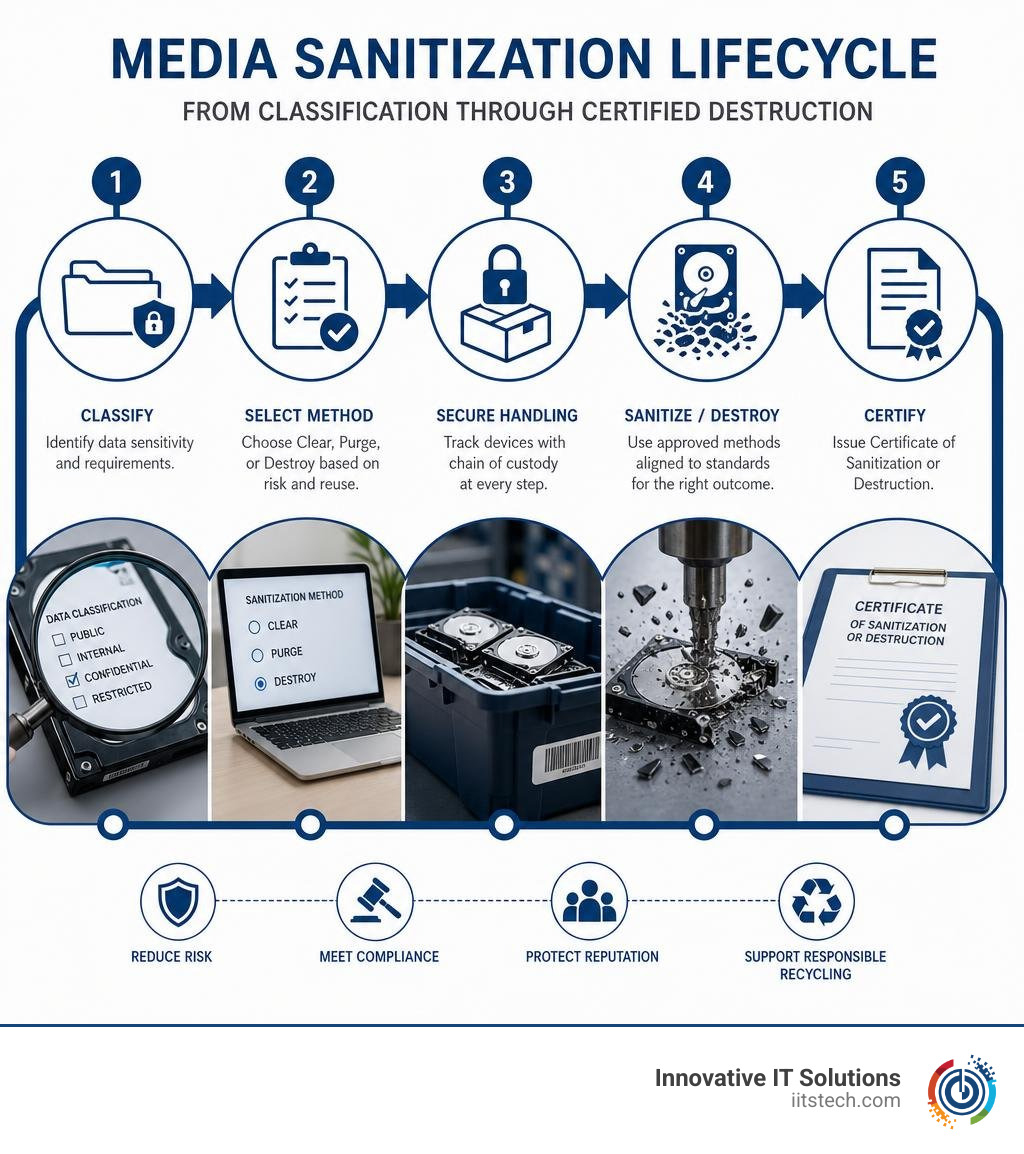
Hard drive destruction standards help organizations choose a defensible way to remove data from retired computers, servers, and storage devices. The practical starting point is simple:
- Classify the data on each device and identify legal, contractual, and retention requirements.
- Use NIST SP 800-88r2 to select Clear, Purge, or Destroy based on risk and whether the device will be reused.
- For high-risk, failed, or non-reusable drives, use verified physical destruction and maintain a complete chain of custody.
- Keep a Certificate of Sanitization or Destruction with asset details, method, date, and verification results.
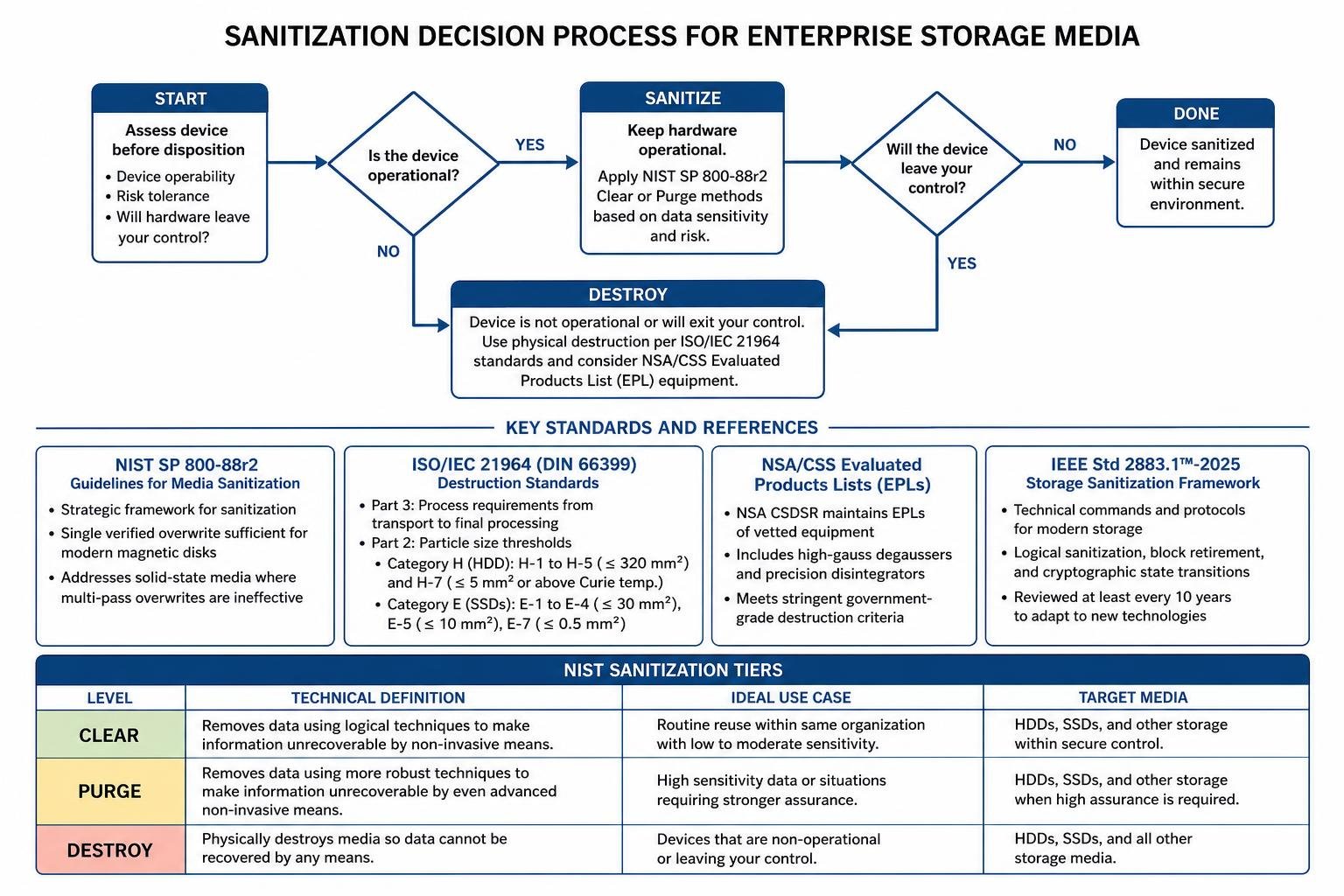
Standards serve different purposes. NIST SP 800-88r2 provides the core U.S. media sanitization framework. ISO/IEC 21964 sets international equipment and destruction-process requirements, including media-specific particle sizes. NSA/CSS Evaluated Products Lists help organizations identify equipment vetted for national-security use. Together, these frameworks reduce the risk that regulated data remains recoverable after IT assets leave your control.
This is not only an IT problem. Improper disposal can expose healthcare, payment, personal, and confidential business data, creating breach-response costs, compliance penalties, and lost trust. It can also complicate responsible electronics recycling, especially when SSDs, embedded storage, and leased multifunction devices are involved.
I am Mike Haden, Founder and Director of Business Development at Innovative IT Solutions. Over 14 years in IT asset disposition and data sanitization, I have helped build documented processes around hard drive destruction standards, secure handling, reuse, recycling, and chain-of-custody accountability.
Common hard drive destruction standards vocab:
Primary Hard Drive Destruction Standards: NIST, ISO, and NSA
When enterprise storage reaches the end of its useful lifecycle, hitting the “format” button or tossing drives into an unmonitored storage closet is a recipe for disaster. Data security across commercial and public sectors relies on strict federal and international governance. The benchmark reference across North America remains the Guidelines for Media Sanitization, which outlines defensible technical actions for rendering target data unrecoverable.
Navigating these standards requires understanding how national regulatory frameworks, international manufacturing baselines, and defense-grade mandates fit together.
NIST SP 800-88r2 vs. DoD 5220.22-M
For decades, the standard IT shorthand for disk wiping was the Department of Defense “DoD 3-pass” or “7-pass” method, formally known as DoD 5220.22-M. While popular in legacy IT lore, the Department of Defense no longer recognizes this specification for modern enterprise media sanitization. Today, understanding DOD compliant data destruction means looking toward the National Institute of Standards and Technology.
The modern reference, detailed in SP 800-88 Rev. 2, Guidelines for Media Sanitization | CSRC, updates media sanitization for high-density storage drives and solid-state media. Unlike the legacy DoD specification—which mandated multiple overwriting passes that strain drive heads and consume excessive time without adding measurable security on modern magnetic platters—NIST SP 800-88r2 establishes that a single, verified overwrite pass is technically sufficient to prevent laboratory reconstruction of target data on modern magnetic disks. More importantly, NIST SP 800-88r2 accounts for solid-state drives, where legacy multi-pass overwrites fail to touch wear-leveled blocks.
ISO/IEC 21964 (DIN 66399) and NSA/CSS Evaluated Products Lists
While NIST provides the strategic framework for what sanitization must accomplish, international and defense standards define the mechanical thresholds for physical destruction.
Originally developed in Germany as DIN 66399, the ISO/IEC 21964-3:2018 standard specifies process-oriented destruction requirements from transport to final processing. Its companion, ISO/IEC 21964-2:2018, establishes exact mechanical particle sizes for shredding machines based on material classifications:
- Category H (Magnetic Hard Drives): Ranges from H-1 (mechanically inoperable) to H-5 (particles $\le$ 320 mm²) and H-7 (particles $\le$ 5 mm² or heated above the Curie temperature).
- Category E (Electronic Data Carriers / SSDs): Ranges from E-1 to E-4 (particles $\le$ 30 mm²), E-5 (particles $\le$ 10 mm²), and E-7 (particles $\le$ 0.5 mm²).
For high-security operations, the National Security Agency’s Center for Storage Device Sanitization Research (CSDSR) maintains Evaluated Products Lists (EPLs). The NSA EPL categorizes vetted vendor equipment (such as high-gauss degaussers and precision disintegrators) meeting stringent government-grade destruction criteria.
IEEE Std 2883.1 Storage Sanitization Framework
Approved by the Cybersecurity and Privacy Standards Committee of the IEEE Computer Society, the IEEE Std 2883.1™-2025, IEEE Recommended Practice for Use of Storage Sanitization Methods represents an updated companion standard to IEEE 2883.
This standard formalizes the technical commands and protocols required to sanitize modern storage technologies. IEEE Std 2883.1 provides granular engineering rules for logical sanitization, physical block retirement, and cryptographic state transitions. Under IEEE’s standard lifecycle, these technical recommendations are reviewed at least every 10 years to adapt to advancing storage architectures and recovery capabilities.
Core Media Sanitization Methods: Clear, Purge, and Destroy
The foundation of secure media disposition rests on three progressive tiers defined by NIST SP 800-88r2: Clear, Purge, and Destroy. Deciding between physical destruction vs data wiping depends entirely on device operability, risk tolerance, and whether the hardware will remain in your secure environment or exit the building.
Logical Sanitization and Cryptographic Erase (CE)
Logical sanitization at the Clear level applies standard software read/write commands to overwrite user-accessible sectors, typically with zeros or pseudo-random patterns. While suitable for internal hardware redeployment, it does not reliably address reallocated sectors or hidden partitions.
For drives destined for surplus sale or external reuse, Purge actions are required. Modern enterprise drives support automated Purge functions directly through controller firmware, such as NVMe Format, SATA Secure Erase, and SCSI Sanitize.
A prominent purge mechanism is Cryptographic Erase (CE). When an enterprise Self-Encrypting Drive (SED) utilizes hardware-based encryption, all data written to the media is automatically encrypted using an internal Media Encryption Key (MEK). Cryptographic Erase works by permanently deleting or overwriting the MEK with a new, randomly generated key. Without the original MEK, data on the drive becomes mathematically impossible to decrypt, effectively rendering the media purged within seconds. However, CE is only valid when verified that encryption was enabled throughout the drive’s entire operating lifecycle with robust key management.
Physical Destruction Techniques: Shredding, Degaussing, and Disintegration
When storage media reaches its final retirement—or when drives fail and can no longer accept software wipe commands—physical destruction becomes mandatory.
- Mechanical Shredding: Heavy-duty industrial shredders use counter-rotating, high-torque cutting shafts to tear enterprise hard drives, circuit boards, and server chassis components into jagged fragments. For magnetic drives, shredding to an ISO H-4 or H-5 standard (shred widths typically under 3/4″ to 3/8″) physically fractures platters, preventing data reconstruction.
- Degaussing: A degausser generates an intense, momentary electromagnetic pulse (often exceeding 10,000 to 20,000+ Gauss) that neutralizes the magnetic orientation of the drive’s platters, eradicating all data and internal factory-written servo tracks. Degaussing leaves magnetic drives permanently unusable. However, as noted in NIST SP 800-88r2, older degaussers may lack sufficient field strength for modern high-coercivity magnetic media, and degaussing is completely ineffective on solid-state media.
- Disintegration / Pulverization: Used for high-security environments, disintegrators utilize high-speed rotary knives and sizing screens to reduce storage media to tiny, sand-like particulate (ISO H-7/E-7 levels $\le$ 0.5 mm).
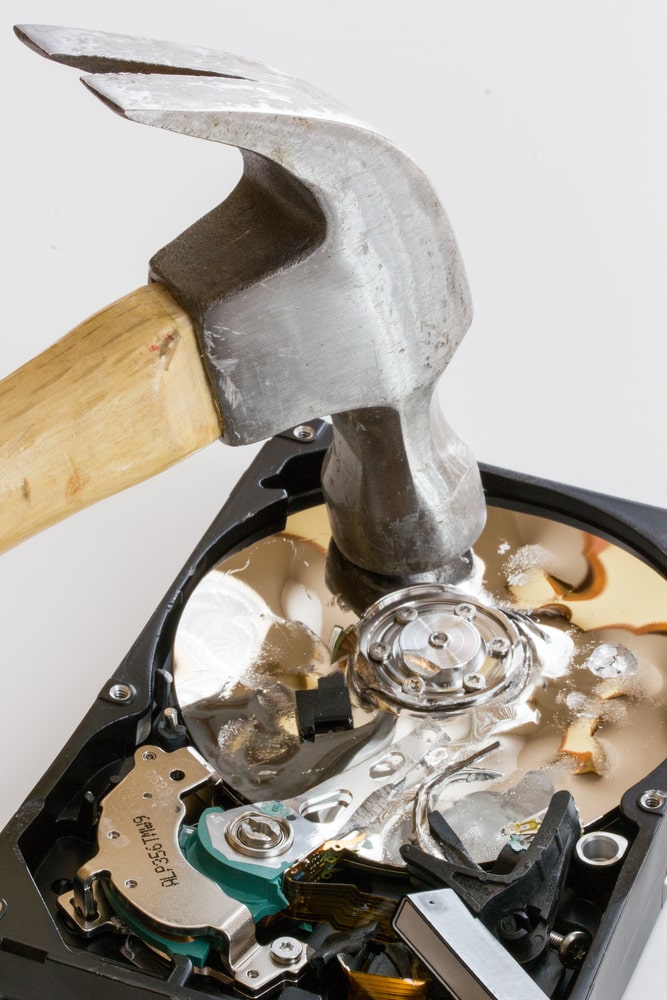
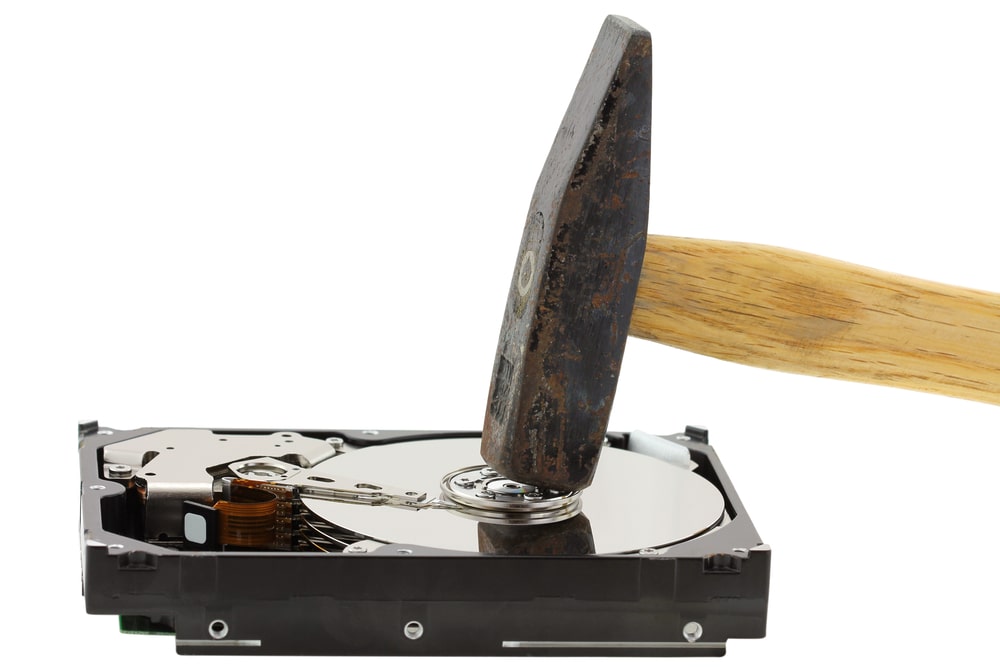
Beware of ineffective data destruction methods like drilling holes, striking drives with hammers, or snapping printed circuit boards. Forensic laboratory tools can recover thousands of intact data blocks from drive fragments the size of a postage stamp.
Sanitizing Solid-State Drives (SSDs) vs. Magnetic Hard Drives (HDDs)
Solid-state drives (SSDs) cannot be sanitized using the same physical or logical workflows as traditional magnetic spinning hard disk drives (HDDs).
When considering wiping an SSD drive, standard magnetic overwrite patterns fail. Flash memory uses a controller-managed wear-leveling algorithm that dynamically distributes writes across the drive to prevent early memory cell degradation. In addition, enterprise SSDs incorporate substantial overprovisioning—allocating unaddressable physical storage blocks (often 10% to 30% beyond user-accessible capacity) to maintain speed and handle bad block retirement.
Because standard OS-level overwrite tools cannot access these overprovisioned blocks, software sanitization must rely on native NVMe/SATA controller purge commands (e.g., Cryptographic Erase or Block Erase). When SSDs are physically destroyed, standard commercial hard drive shredders that leave 3/4-inch pieces are inadequate. An intact NAND flash memory chip measuring only a few millimeters can store terabytes of data; therefore, SSD destruction requires specialized micro-shredders or disintegrators that reduce electronic components to 2mm or smaller particle sizes.
Enterprise Governance, Data Classification, and Specialized Hardware
A defensible media sanitization program connects technical destruction to enterprise governance. Data destruction cannot occur in an organizational silo; it requires systematic risk analysis, chain-of-custody tracking, and integration with the overall IT asset lifecycle.
Aligning Data Classification with Hard Drive Destruction Standards
Under Federal Information Processing Standards (FIPS 199) and organizational risk frameworks, IT assets are evaluated by the potential impact of a confidentiality breach:
- Low Impact: Loss of confidentiality causes limited adverse effect on operations, assets, or individuals. Standard Clear or Purge procedures are appropriate for functional equipment being redeployed or returned to vendor custody.
- Moderate Impact: Unauthorized disclosure causes serious adverse effects, including operational disruption, financial loss, or regulatory non-compliance. Purge or Destroy methods are mandatory.
- High Impact / Restricted: Unauthorized disclosure results in severe or catastrophic consequences, loss of mission capability, or severe regulatory liability. Physical Destroy methods (high-level micro-shredding, disintegration, or thermal destruction) are required, regardless of whether the drive is functional.
By defaulting to treating unclassified enterprise assets as Moderate or High risk until verified, organizations ensure that retired drives are never inadvertently released with residual data.
Managing Leased IT Assets, Enterprise MFPs, and Embedded Storage
Enterprise data risk frequently lurks inside non-traditional computing hardware:
- Leased Servers and Workstations: Returning leased infrastructure without proper sanitization can violate regulatory compliance. Organizations must execute verified Purge commands (such as firmware-level Cryptographic Erase) and document the results prior to shipping units back to leasing companies.
- Multifunction Printers (MFPs) and Scanners: Modern network copiers and enterprise MFPs contain internal hard drives and high-capacity flash memory that cache print spool files, scanned PDFs, faxes, and sensitive credentials. These drives must be purged or removed and physically shredded prior to lease return.
- Embedded Flash and On-Board Storage: Modular enterprise equipment containing soldered eMMC or NVMe chips requires specialized physical decommissioning workflows to ensure embedded chips are destroyed.
- Software De-Licensing: Sanitization workflows must include de-registering licensed enterprise software, proprietary firmware, and cryptographic certificates to prevent software licensing non-compliance.
Regulatory Compliance, Environmental Impact, and Legal Liabilities
Failing to adhere to strict hard drive destruction standards introduces major legal, financial, and environmental exposures. Federal privacy mandates enforce massive monetary penalties and legal actions for data breaches caused by improperly handled IT assets:
- HIPAA (Health Insurance Portability and Accountability Act): Mandates covered entities and business associates permanently destroy Protected Health Information (PHI) to prevent unauthorized access.
- GLBA (Gramm-Leach-Bliley Act): Requires financial institutions to maintain administrative, technical, and physical safeguards for customer financial data disposal.
- FISMA (Federal Information Security Modernization Act): Requires federal agencies and contractors to adhere to NIST SP 800-53 security controls (specifically MP-6 Media Sanitization).
In many jurisdictions, simply losing physical control or chain of custody of storage media containing sensitive data is legally defined as a data breach, triggering mandatory notification requirements and regulatory audits.
EPA Compliance, Zero-Landfill E-Waste, and Regulatory Mandates
Physical hard drive destruction must be balanced with responsible environmental stewardship. Under the Resource Conservation and Recovery Act (RCRA) and Environmental Protection Agency (EPA) regulations, commercial electronics cannot simply be discarded in municipal trash.
Enterprise server drives, circuit boards, and data storage arrays contain toxic heavy metals (such as lead, mercury, and cadmium) alongside valuable, finite materials like copper, aluminum, neodymium magnets, and precious metals. At Innovative IT Solutions, our process is built around EPA-compliant, zero-landfill e-waste recycling. After hard drives are mechanically shredded and verified unrecoverable, the shredded particulate is separated through industrial material recovery streams. Ferrous metals, aluminum platters, and shredded circuit board fractions are smelted and refined into raw commodities for the circular manufacturing economy.
Auditing Compliance: Verifying Hard Drive Destruction Standards
To survive regulatory audits, an organization must prove that data was destroyed. The core documentation artifact is a serialized, legally defensible certificate.
When demystifying the Certificate of Destruction, compliance officers look for specific details. A valid certificate must include:
- Make, model, and individual serial number of every sanitized or shredded drive.
- Specific sanitization standard executed (e.g., NIST SP 800-88r2 Purge, ISO/IEC 21964 H-5 Shredding).
- Equipment used (including machine make/model and calibration tracking).
- Date, time, and facility location of destruction.
- Authorized technician name and signature.
- Complete chain-of-custody tracking records, including tamper-evident transport container seal numbers.
In accordance with institutional standards, organizations should retain all Certificates of Destruction and verification logs for a minimum of three years (or longer if required by contractual, legal, or grant agreements) to support data privacy audits.
Frequently Asked Questions About Media Sanitization
What is the difference between NIST SP 800-88 Clear and Purge?
Clear uses standard software write commands to overwrite user-accessible sectors on a storage device. It protects against basic, non-invasive data recovery using standard system commands. Purge applies low-level firmware instructions (such as Secure Erase, NVMe Format, or Cryptographic Erase) or hardware-level processes that sanitize both user-addressable sectors and hidden, overprovisioned, or reallocated physical storage blocks, making recovery infeasible even using laboratory equipment.
Can degaussing destroy data on Solid-State Drives (SSDs)?
No. Degaussing relies on creating an intense magnetic field to disrupt magnetic domains on traditional hard drive platters and magnetic tapes. Because SSDs, NVMe cards, and flash thumb drives store data as electrical charges inside non-magnetic NAND flash transistors, exposing an SSD to a degausser does not sanitize or destroy the data. Solid-state media must be purged via controller commands or physically shredded using micro-shredders with a $\le$ 2mm particle size.
What critical information must be included on a Certificate of Destruction?
A defensible Certificate of Destruction must contain:
- Exact device metadata (manufacturer, model, and individual scanned serial number).
- The specific standard followed (such as NIST SP 800-88r2 Destroy or ISO/IEC 21964 E-4/H-5).
- The method of destruction (e.g., physical shredding, degaussing, cryptographic erase).
- Date, timestamp, and physical location of the sanitization.
- Identification of the processing technician and authorized supervisory sign-off.
- Documentation of tamper-evident container seals from collection to final processing.
Conclusion
Protecting your organization’s confidential data, intellectual property, and customer records requires a structured, compliant approach to IT asset disposition. Implementing verified hard drive destruction standards eliminates data breach risks, simplifies regulatory audits, and protects your enterprise reputation.
At Innovative IT Solutions, we provide enterprise IT asset disposition and secure data destruction services designed to meet modern security baselines:
- NIST SP 800-88r2 & DoD Compliant Sanitization: High-security physical shredding, degaussing, and cryptographic purge workflows.
- Verifiable Chain of Custody: Serialized scanning, tamper-evident handling, and itemized Certificates of Destruction.
- EPA-Compliant Zero-Landfill Recycling: Environmentally responsible material recovery for all business-grade computer and server hardware.
Protect your enterprise data and maintain compliance by implementing a sustainable electronic recycling program for your business with Innovative IT Solutions today.


