
Trash to Treasure? No, Just Safe Compliant E-Waste Management in OKC
Compliant E-Waste Management OKC for Business IT Hardware
Compliant e-waste management OKC means using a qualified IT asset disposition partner that can securely handle retired business computers, monitors, servers, drives, and related components while documenting what happened to every asset.
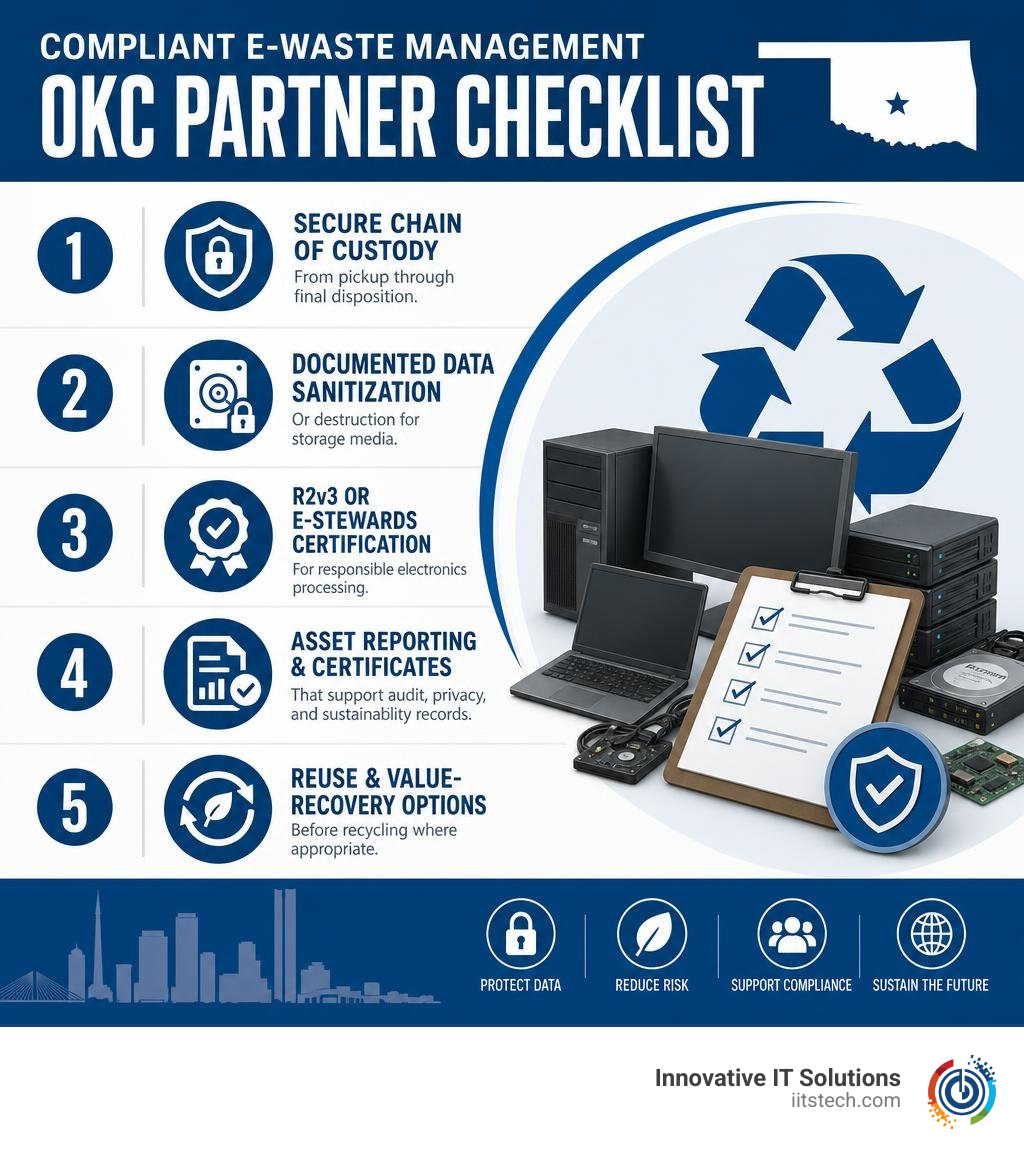
For a mid-sized business, a compliant partner should provide:
- Secure chain of custody from pickup through final disposition.
- Documented data sanitization or destruction for storage media.
- R2v3 or e-Stewards certification for responsible electronics processing.
- Asset reporting and certificates that support audit, privacy, and sustainability records.
- Reuse and value-recovery options before recycling where appropriate.
Oklahoma’s e-waste rules matter, but they do not remove a business’s responsibility to protect sensitive data. Under the Oklahoma Computer Equipment Recovery Act, manufacturers reported collecting 320,460 pounds of covered equipment in 2024. Yet the state program mainly addresses computers and monitors, leaving organizations with broader enterprise hardware, logistics, security, and compliance needs to manage.
Improper disposal can expose data, waste recoverable equipment, and create real safety risks. In 2022, an improperly discarded lithium-ion battery sparked a fire at a Tulsa recycling and transfer facility, causing an 11-month shutdown and damages estimated as high as $12 million.
I am Mike Haden, founder and Director of Business Development at Innovative IT Solutions, an R2v3-certified ITAD company with 14 years of experience in compliant e-waste management OKC and secure enterprise technology disposition. Our work focuses on documented data handling, responsible reuse and recycling, and helping organizations turn retired IT assets into a controlled, audit-ready process.
Compliant e-waste management okc further reading:
Understanding the Oklahoma Computer Equipment Recovery Act (OCERA)
When managing retired enterprise hardware across Oklahoma City, understanding the state statutory framework is an essential first step. The Oklahoma Computer Equipment Recovery Act (OCERA), administered by the Oklahoma Department of Environmental Quality (DEQ), establishes legal requirements for computer equipment manufacturers regarding the recovery and recycling of covered electronics. For state regulatory updates and compliance guidelines, organizations can review the official Oklahoma DEQ Computer Equipment Recycling resources.
While OCERA mandates that major computer manufacturers selling equipment in Oklahoma offer recovery plans, commercial entities must recognize the boundary between public manufacturer compliance and enterprise regulatory duties. OCERA provides a safety net for basic hardware recovery, but business IT hardware disposition requires a far higher standard of data security, specialized logistics, and environmental verification.
Legal Scope and Covered IT Hardware Assets
Under statutory definitions, OCERA covers specific device categories used by commercial entities and organizations:
- Desktop Computer Towers: Standard business workstations, slimline PCs, and corporate desktop units.
- Business Notebooks: Enterprise laptops, ultrabooks, and mobile workstations.
- Computer Monitors: Standalone display screens, cathode-ray tube (CRT) monitors, and modern flat-panel LCD/LED enterprise displays.
However, OCERA explicitly excludes several equipment categories, such as server display terminals integrated into heavy industrial machinery, specialized medical display devices, embedded machinery controllers, and standalone communication infrastructure.
Crucially, OCERA explicitly establishes that data destruction obligations rest on the equipment owner, not the state or manufacturer recovery programs. Businesses discarding servers, storage arrays, or workstations cannot rely on standard manufacturer recovery programs to sanitize internal hard drives or enterprise solid-state drives (SSDs). To understand corporate data liability and secure disposal practices, review our guide on how to properly dispose of electronics in Oklahoma City.
Manufacturer Compliance Metrics and Collection Tonnage
To operate legally in Oklahoma, computer hardware manufacturers selling 50 or more covered devices per calendar year must register with the Oklahoma DEQ, submit annual recovery plans, and pay statutory registration fees. The DEQ classifies manufacturers into minor tiers (51 to 999 devices sold annually) and major tiers (1,000 or more devices sold annually).
In 2024, state records highlighted key benchmarks within the OCERA framework:
- 36 Compliant Manufacturers: 36 equipment manufacturers maintained active, compliant registration status with the Oklahoma DEQ.
- 320,460 Pounds Recovered: Manufacturers directly collected 320,460 pounds of covered electronic hardware across Oklahoma.
- $178,324.01 Fee Revenue Generated: Annual manufacturer registration fees generated $178,324.01 to fund state oversight, compliance monitoring, and community e-waste grants.
State procurement policies mandate that Oklahoma public agencies and institutions only procure computer equipment from compliant manufacturers listed on the official DEQ register. Non-compliant manufacturers face restrictions that bar them from doing business with state institutions.
While these collection totals reflect active regulatory compliance, the total tonnage represents a decrease compared to historical data. In 2022, 30 compliant manufacturers collected 355,488 pounds of e-waste and generated $143,771.98 in annual fee revenues. The steady shift in collection tonnage underscores evolving operational challenges across Oklahoma’s electronic processing ecosystem.
Core Challenges in Commercial Electronic Waste Processing
Managing business e-waste in Oklahoma City involves navigating systemic logistical hurdles, changing technology formats, and critical fire hazards associated with enterprise power systems.

Declining Weight Trends and Passive Collection Models
Since 2016, total annual e-waste collection weights recorded under OCERA have experienced a multi-year decline. Rather than indicating that less IT hardware is reaching end-of-life status, this trend stems from two structural shifts:
- Hardware Miniaturization: Enterprise infrastructure has evolved dramatically. Bulky desktop chassis and heavy CRT monitors have given way to ultra-lightweight business laptops, micro-form-factor PCs, dense blade servers, and lightweight LED displays. Modern server racks deliver ten times the compute density at a fraction of the historical physical weight.
- Passive Manufacturer Programs: Manufacturer participation under OCERA relies heavily on passive mail-back programs. In 2024, zero computer manufacturers hosted direct, in-person e-waste collection events in Oklahoma.
For commercial enterprises managing hundreds of retired workstations, server racks, and network switches, standard mail-back envelopes and individual pre-paid shipping labels are completely impractical. Business IT departments require bulk freight logistics, white-glove palletization, and on-site serial number scanning rather than passive consumer mail-back boxes.
Hazardous Fire Risks and Lithium-Ion Battery Regulations
One of the most dangerous operational challenges in e-waste processing involves improperly discarded lithium-ion batteries and unmanaged server battery backup units (UPS systems). Unlike inert scrap metal, lithium-ion power sources contain high energy density and flammable electrolytes. When subject to physical crushing or thermal runaway inside municipal waste vehicles or standard shredders, these batteries spark aggressive chemical fires.
The real-world consequences of unsafe battery disposal were clearly demonstrated in April 2022, when an improperly disposed lithium-ion battery sparked a catastrophic fire at a recycling and transfer center in Tulsa. The resulting fire caused:
- Up to $12 million in facility damages.
- An 11-month operational halt, disrupting regional recycling logistics.
- Severe environmental emissions and hazardous emergency response demands.
Beyond thermal hazards, unmanaged electronic components contain hazardous heavy metals including lead, cadmium, mercury, hexavalent chromium, and brominated flame retardants. When commercial hardware is dumped illegally or routed to uncertified scrap facilities, these toxic compounds can leach into local soil and aquatic ecosystems. Achieving effective compliant e-waste management OKC demands strict zero-landfill protocols and isolated handling of lithium battery chemistries.
Best Practices for Compliant E-Waste Management OKC in Business Operations
To safeguard proprietary corporate data, adhere to federal privacy mandates (such as HIPAA, GLBA, and FACTA), and uphold corporate sustainability goals, Oklahoma organizations must adopt structured IT Asset Disposition (ITAD) processes. Partnering with a dedicated ITAD provider transforms technology retirement from an operational vulnerability into an organized asset lifecycle workflow. For an in-depth look at regulatory frameworks, read our guide on ITAD compliance.
Certified ITAD Protocols and Data Sanitization Standards
Commercial IT equipment holds sensitive intellectual property, employee records, financial ledgers, and confidential client information. Simply deleting files or reformatting hard drives does not remove data permanently. Compliant ITAD operations mandate rigorous sanitization methodologies:
- NIST SP 800-88 Rev. 1 Guidelines: The recognized gold standard for media sanitization. Compliance requires executing verified Clear, Purge, or Destroy operations tailored to specific storage technology (HDDs, NVMe drives, enterprise SSDs, and tape media).
- Department of Defense (DoD) Overwrite Protocols: Multi-pass overwrite passes designed to obscure magnetic structures on legacy hard drives.
- Physical Hard Drive Shredding: For non-functional or end-of-life magnetic drives, physical industrial destruction ensuring complete particle disintegration.
- Audit Logs & Certificates of Destruction: Every sanitized drive or crushed media unit must be logged by serial number, generating tamper-evident documentation for internal compliance officers and external auditors.
To learn more about physical media shredding standards, explore our article on certified data destruction.
Key Criteria for Compliant E-Waste Management OKC Partners
Selecting the right vendor is critical to protecting your business from regulatory liabilities and data privacy breaches.

When vetting local service providers, ensure they satisfy essential compliance standards outlined in our criteria checklist:
- Certified Environmental Standards: Look for active R2v3 (Responsible Recycling) or e-Stewards credentials, ensuring strict zero-landfill adherence and zero toxic export policies.
- NIST-Compliant Data Destruction: Verification that media processing meets NIST SP 800-88 guidelines with serialized Certificates of Destruction.
- Documented Chain-of-Custody: Secure GPS-tracked transport, sealed bin logistics, and full line-item inventory logging from your loading dock to final processing.
- Value Recovery & Refurbishment Capabilities: Advanced technical capabilities to test, clean, repair, and resell functional server components and enterprise PCs, returning hardware value back to your organization.
To select the ideal vendor for your business, consult our resource on choosing the best secure IT IT equipment recycling partner in Oklahoma.
To better understand how specialized ITAD services differ from basic manufacturer mail-back programs, compare the operational models below:
| Feature / Operational Need | Manufacturer Mail-Back Programs (OCERA) | Certified Enterprise ITAD Partners |
|---|---|---|
| Primary Target Audience | Individual retail buyers & micro-businesses | Enterprise corporations, healthcare, & state entities |
| Hardware Scope | Desktop PCs, laptops, and basic monitors | Enterprise servers, SAN storage, blade chassis, PCs |
| Logistics Handling | Self-packaged boxes & mail drop-off | On-site white-glove pickup, freight, GPS tracking |
| Data Security Verification | User responsibility (No certificate provided) | Serialized NIST 800-88 Certificates of Destruction |
| Audit-Ready Documentation | Basic shipping receipt | Complete chain-of-custody audit logging |
| Financial Return | No asset recovery or resale credit | Asset recovery value returned for operational IT hardware |
State Oversight and Future Legislative Reforms
Regulatory oversight by the Oklahoma DEQ continues to shape the state’s electronics recovery infrastructure, providing financial support to local communities while signaling a clear need for future statutory updates.
Oklahoma DEQ Grants and Community Collection Impact
To bridge the gap left by passive manufacturer collection models, the Oklahoma DEQ reallocates manufacturer registration fee revenues directly into local community programs. These state-funded grants enable municipalities and regional solid waste authorities to organize public hazardous waste collection events.
The real-world impact of this grant allocation in recent years demonstrates significant progress:
- 2024 DEQ Funding: $95,532.60 in OCERA fee revenues was allocated across 8 regional community collection events. These supported events diverted 71,050 pounds of e-waste from municipal landfills.
- 2022 DEQ Funding: $70,000 in fee revenues supported 3 community collection events, recovering 41,804 pounds of municipal and small business electronics.
This funding helps mitigate roadside illegal dumping, which frequently occurs when improper disposal options leave organizations or individuals without accessible collection resources.
How Policy Updates Impact Compliant E-Waste Management OKC
While OCERA established a foundation for state e-waste management when passed in 2009, technological shifts over the past 15+ years have highlighted key statutory gaps. The Oklahoma DEQ and environmental stakeholders have identified several potential policy updates to modernize the state framework:
- Expanding Covered Device Categories: Updating statutory language to include mobile communication devices, server network accessories, desktop printers, and commercial display screens.
- Mandatory Collection Targets: Replacing passive registration rules with enforceable weight or unit collection targets for major manufacturers.
- Manufacturer-Hosted Events: Incentivizing manufacturers to directly fund and execute local hardware collection events rather than relying solely on mail-back kits.
Modernizing state regulations ensures that commercial entities benefit from expanded local recovery channels while maintaining strict compliance standards across Oklahoma City.
Frequently Asked Questions
What commercial equipment is covered under OCERA?
OCERA specifically covers desktop computers, business laptops, notebook PCs, and computer monitors. It explicitly excludes industrial machinery displays, specialized medical display devices, personal digital assistants, and standalone communication hardware. Commercial enterprise infrastructure, such as server racks, storage arrays, and network switches, falls outside OCERA’s basic framework and requires certified enterprise ITAD processing.
Why are state e-waste collection weights declining in Oklahoma?
Collection weights have decreased steadily since 2016 primarily due to device miniaturization. Modern IT hardware uses ultra-lightweight alloys, dense solid-state storage, and thin LED panels, drastically reducing equipment weight compared to legacy CRT monitors and heavy desktop towers. Additionally, manufacturers rely heavily on passive mail-back systems rather than hosting live, local collection events.
How do businesses verify ITAD compliance for retired servers?
Businesses can verify compliance by ensuring their ITAD partner holds recognized third-party certifications, such as R2v3 or e-Stewards. Vendors must maintain a strict, documented chain of custody from pickup to processing, adhere to NIST SP 800-88 standards for data sanitization, and issue comprehensive, serialized Certificates of Destruction for all processed storage drives and server components.
Conclusion
Ensuring compliant e-waste management OKC requires moving past basic disposal options and partnering with a specialized ITAD provider. While state statutes like OCERA maintain manufacturer registration systems and grant programs, businesses handling enterprise laptops, desktop fleets, servers, and sensitive data require certified, fully documented solutions.
Improperly managed IT equipment creates severe organizational risks—ranging from catastrophic data breaches and regulatory non-compliance to hazardous facility fires caused by unmanaged lithium batteries. By establishing certified ITAD protocols, implementing NIST SP 800-88 data destruction, and maintaining full chain-of-custody tracking, your business mitigates legal risk while driving environmental sustainability and maximizing asset value recovery.
At Innovative IT Solutions, we provide zero-landfill, NIST-compliant IT asset disposition tailored to Oklahoma businesses. Contact us today to learn how our secure commercial IT asset recycling services can simplify your technology lifecycle management, protect your data, and keep your corporate technology disposition audit-ready.


