
Why Secure ITAD Services in Oklahoma Are More Critical Than Ever
Finding reliable secure ITAD services in Oklahoma is harder than it should be — and the cost of getting it wrong is high.
Here’s a quick answer for Oklahoma IT managers looking for a certified ITAD partner:
| What You Need | What to Look For |
|---|---|
| Data destruction | NIST 800-88-compliant erasure or physical shredding |
| Certifications | R2v3, RIOS, ISO 14001, ISO 45001 |
| Chain of custody | Serialized tracking from pickup to Certificate of Destruction |
| Environmental compliance | Zero-landfill policy, EPA-compliant recycling |
| Asset recovery | Resale, refurbishment, or buyback programs |
| Documentation | Certificates of Destruction, audit reports, erasure logs |
Every time a company retires a laptop, server, or storage drive without a verified destruction process, that device becomes a liability. Sensitive data — patient records, financial files, employee information — can survive a simple delete or factory reset. In regulated industries like healthcare, finance, and government, that exposure can trigger audits, fines, and breach notifications.
Oklahoma businesses also face growing pressure on the environmental side. Improper e-waste disposal violates federal and state regulations, and the reputational damage from a publicized breach or illegal dump is hard to undo.
The good news: the right ITAD partner handles all of this for you — securely, compliantly, and often at no net cost when asset resale value is applied.
I’m Mike Haden, Founder and Director of Business Development at Innovative IT Solutions, with 14 years of experience helping Oklahoma organizations navigate secure ITAD services in Oklahoma — from certified data destruction to responsible recycling and asset recovery. Over that time, we’ve processed over a million pieces of enterprise IT equipment, built R2v3-certified operations, and developed a reputation for transparency and trust that keeps clients coming back.
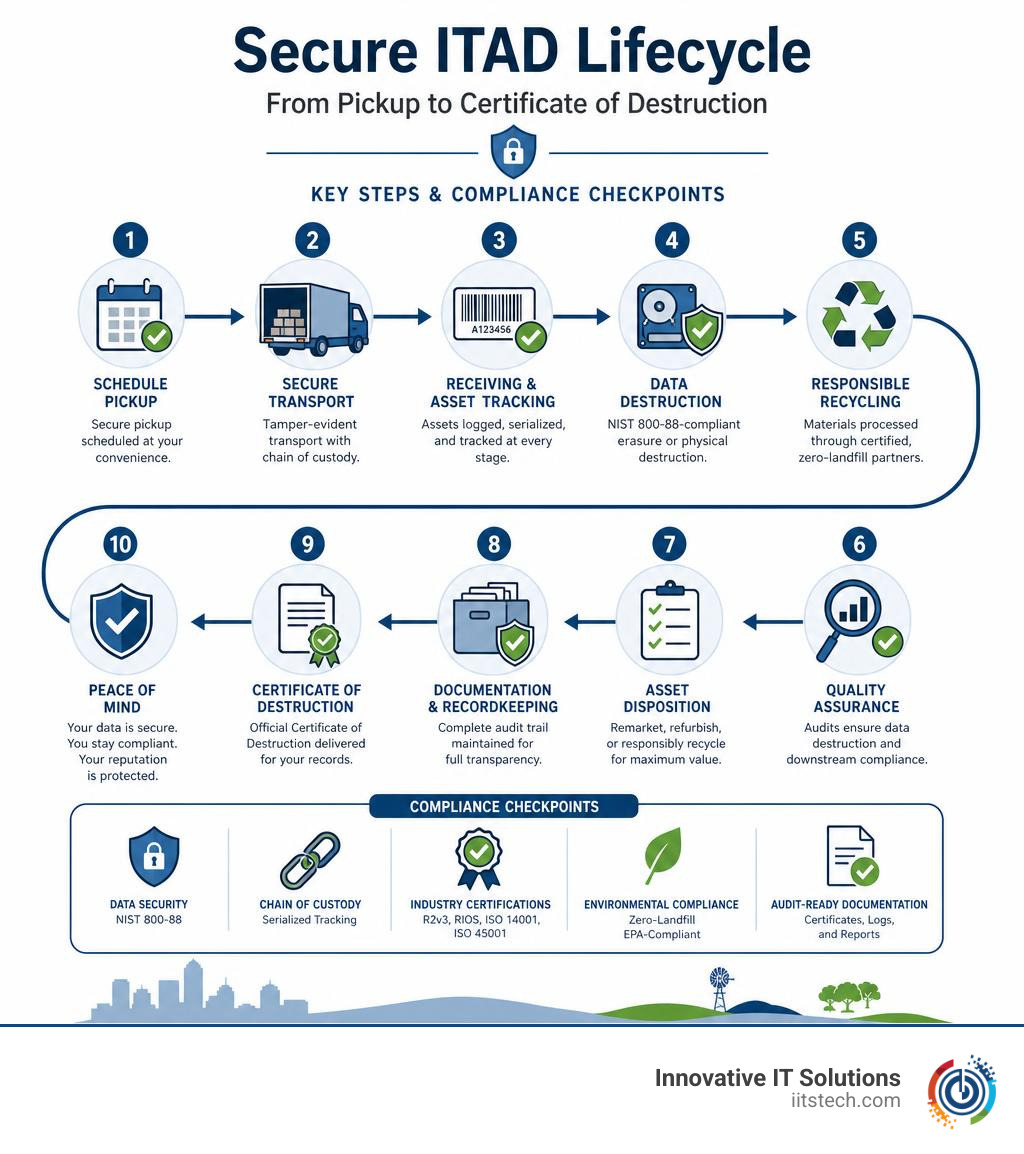
Secure ITAD Services Oklahoma: Use This 10-Point Partner Checklist
Choosing an IT equipment recycling partner is not just about getting old monitors out of the storage closet. It is about protecting your company from data exposure, environmental liability, and lost asset value.
Here is the 10-point checklist we recommend before hiring any secure itad services oklahoma provider:
- Confirm the provider handles full IT asset disposition, not just hauling.
- Require NIST 800-88 or approved physical destruction for data-bearing devices.
- Ask for serialized tracking by asset tag, serial number, or unique ID.
- Verify certifications such as R2v3, RIOS, ISO 14001, or ISO 45001 where applicable.
- Review chain-of-custody procedures from pickup through final disposition.
- Confirm zero-landfill and EPA-compliant recycling practices.
- Ask how resale, refurbishment, or buyback value is calculated.
- Require Certificates of Destruction and recycling documentation.
- Check insurance coverage and downstream vendor controls.
- Make sure reporting is audit-ready, downloadable, and tied to your actual assets.
If you are new to the concept, start with our guide: What is IT Asset Disposition.
What ITAD Means for Oklahoma Businesses
ITAD stands for IT asset disposition. In plain English, it is the secure, documented process for retiring technology your organization no longer uses.
That includes:
- Laptops and desktops
- Servers and storage arrays
- Hard drives and SSDs
- Network switches, routers, and firewalls
- Tablets, phones, and point-of-sale devices
- Backup tapes and removable media
- Monitors, docks, cables, and accessories
A good ITAD program does four things at once: inventories the assets, destroys or sanitizes data, recovers value where possible, and recycles the rest responsibly. That is why we treat ITAD as a business risk function, not a junk removal chore.
For a deeper planning framework, see our ITAD strategy guide.
Why Secure Disposal Is a Cybersecurity Requirement
Cybersecurity does not end when a device is unplugged. Retired equipment can still contain cached credentials, customer records, financial files, HR data, source code, emails, backups, and regulated information.
The biggest mistake we see is assuming a factory reset is enough. It usually is not. Deleted files can often be recovered unless the storage media is properly sanitized or physically destroyed.
Secure ITAD helps reduce:
- Data breach risk from retired drives
- Insider risk during equipment transitions
- Vendor risk from poor handling practices
- Compliance gaps during audits
- Endpoint lifecycle blind spots
In other words, your firewall may be great, but if old drives leave through the back door in an unmarked box, you still have a problem. Learn more in our guide to ITAD and cybersecurity and the role of data destruction in cybersecurity.
How secure itad services oklahoma Support Regulated Industries
Some Oklahoma organizations need stricter controls because the data on their devices is heavily regulated.
Common examples include:
- Healthcare providers handling PHI under HIPAA
- Banks, lenders, and credit unions handling financial data under GLBA
- Retail and payment environments handling PCI-related information
- Public companies managing SOX-sensitive records
- Schools and universities handling student data under FERPA
- Government agencies working with CJIS or confidential public records
- Data centers and SaaS teams managing customer environments
- Oil and gas, legal, and professional services firms with proprietary records
For healthcare-specific concerns, read HIPAA and ITAD. For privacy-focused disposal planning, our guide on GDPR compliance during IT disposal is also useful for organizations with international data obligations.
Verify Certifications, Security Controls, and Vendor Accountability
Certifications do not replace due diligence, but they are a strong starting point. They show that a provider’s processes have been evaluated against recognized standards for data security, recycling, worker safety, environmental management, and operational controls.
| Requirement | What It Helps Prove | What to Ask For |
|---|---|---|
| R2v3 | Responsible reuse, recycling, data security, downstream controls | Current certificate and scope |
| RIOS | Integrated quality, environmental, health, and safety systems | Audit status and covered facilities |
| ISO 14001 | Environmental management | Recycling process documentation |
| ISO 45001 | Occupational health and safety | Safety program evidence |
| Insurance | Financial protection if something goes wrong | Cyber, general liability, workers’ comp |
| Chain of custody | Asset accountability | Serialized pickup and disposition records |
| Downstream controls | Responsible final processing | Approved recycler list and audit policy |
What R2v3 and RIOS Certifications Prove
R2v3 is a leading certification for responsible electronics reuse and recycling. It focuses on data security, environmental controls, legal compliance, reuse standards, and downstream vendor management.
RIOS is an integrated management system standard for recyclers. It supports quality, environmental, health, and safety practices in one framework.
Together, these certifications help show that an ITAD provider is not improvising. They should have documented workflows, audited controls, trained personnel, and repeatable processes for handling your assets.
However, do not stop at seeing a logo. Ask whether the certification applies to the actual facility and services being used for your project.
How to Check Insurance, Facility Security, and Downstream Controls
Before signing, request evidence of:
- Cyber liability or data breach insurance
- General liability coverage
- Workers’ compensation coverage
- Secure facility access controls
- Employee background check policies
- Camera monitoring or restricted processing areas
- Written downstream vendor procedures
- No-landfill and no-improper-export commitments
- Certificate validation processes
Also ask what happens if a downstream recycler fails to follow standards. Your provider should be able to explain how they qualify, monitor, and audit vendors. For more on risk transfer, see ITAD liability insurance.
Questions to Ask secure itad services oklahoma Before Signing
Use these questions before approving a provider:
- Which certifications apply to this exact service?
- Will every data-bearing device be tracked by serial number?
- Do you follow NIST 800-88, DoD-style wiping, physical destruction, or both?
- Can we choose on-site destruction, off-site destruction, or a hybrid model?
- Are subcontractors used at any stage?
- How are exceptions handled if a serial number does not match?
- When will we receive Certificates of Destruction?
- Can we access audit records through a portal?
- What are your service-level timelines?
- What indemnification and insurance protections are included?
For a full compliance checklist, read our ITAD compliance guide.
Compare Data Destruction Methods Before You Recycle Equipment

Not all data destruction methods are equal. The right method depends on the device type, data sensitivity, resale value, and your compliance requirements.
Common options include:
- NIST SP 800-88 software erasure
- DoD-style multi-pass wiping
- Crypto erase
- Degaussing
- Hard drive shredding
- Crushing
- SSD destruction
- Tape destruction
- Mobile on-site shredding
Learn more about our Data destruction services.
NIST 800-88 Erasure for Reusable Devices
The NIST SP 800-88 standard is the primary modern framework for media sanitization. It defines methods such as Clear, Purge, and Destroy.
For reusable equipment, verified erasure is often the best option because it protects data while preserving resale value. A proper erasure process should include:
- Device identification
- Software-based wipe or crypto erase
- Verification results
- Pass-fail logs
- Serial number capture
- Final audit report
This matters because a laptop that can be securely wiped may still have resale value. Shredding everything may feel satisfying, but it can destroy recoverable value faster than a dropped server rack. For compliance guidance, see Certified data destruction.
Degaussing, Shredding, and Crushing for High-Risk Media
For high-risk or failed media, physical destruction may be required.
Degaussing uses a powerful magnetic field to destroy data on magnetic media such as hard drives and tapes. It does not work for SSDs.
Shredding and crushing physically destroy the device. These methods are commonly used for:
- Failed drives that cannot be wiped
- Highly sensitive hard drives
- Backup tapes
- SSDs requiring physical destruction
- Devices under strict internal security policies
On-site destruction is useful when clients need to witness the process. Off-site destruction can be more cost-effective for routine projects when chain-of-custody controls are strong. For more practical guidance, see Hard drive disposal and Shredding the Evidence: Why Oklahoma Businesses Need Certified Data Destruction.
How Providers Prove Data Is Irrecoverable
A provider should prove destruction with documentation, not promises.
Look for:
- Serialized erasure logs
- Destruction certificates
- Tamper-evident containers
- Barcode or UID tracking
- Chain-of-custody records
- QA sampling
- Exception reports
- Photos or video when required
- Asset-level reporting
If a provider says, “Trust us,” that is not a control. That is a campfire story. Ask for evidence. Our article on How to ensure certified data destruction explains what audit-ready proof should look like. You can also review why data destruction is important and the hidden costs of skipping data destruction.
Evaluate Logistics, Chain of Custody, and Service Options
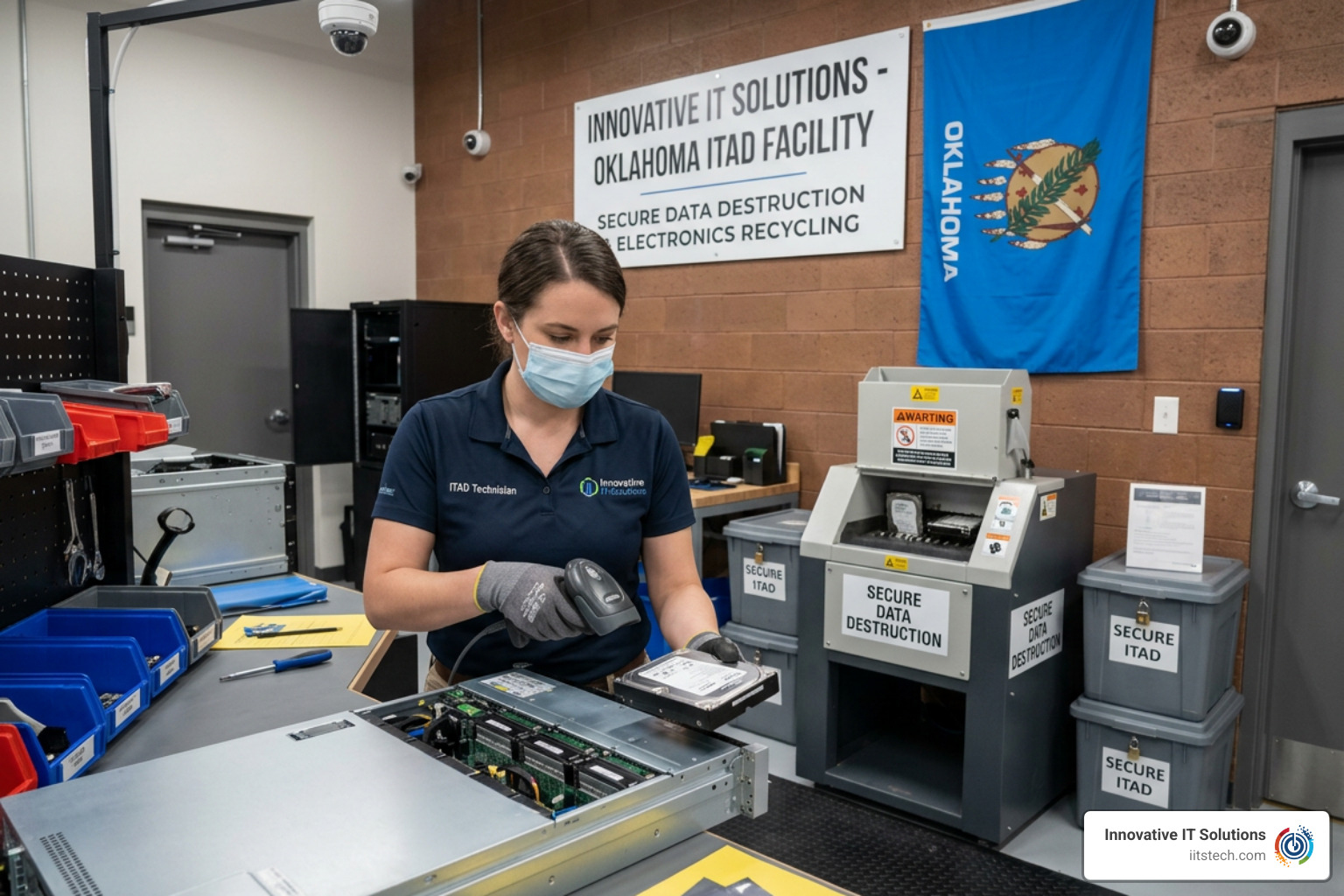
Strong logistics are what keep ITAD secure between your building and final disposition. The most secure data destruction plan in the world is weak if assets are loaded loosely into an untracked vehicle.
A reliable Oklahoma ITAD partner should support:
- Secure pickup
- Sealed containers
- Palletized freight
- Box truck service
- Larger project transport when needed
- Mail-back kits for remote users
- On-site service
- Off-site processing
- Data center decommissioning
- Multi-location coordination
For the basics, read our Chain of custody guide.
On-Site vs. Off-Site ITAD Services
On-site ITAD is best when you need immediate control, witnessed destruction, or minimal data movement. It may include on-site wiping, mobile shredding, or supervised loading.
Off-site ITAD is often better for larger volumes, resale testing, refurbishment, recycling, and cost efficiency. Devices are transported under chain-of-custody controls to a processing facility.
A hybrid model is common. For example, we may physically destroy high-risk drives on-site while transporting non-sensitive peripherals or wiped assets for resale and recycling.
Nationwide and Oklahoma City Logistics Requirements
For Oklahoma City, OKC, South OKC, and Oklahoma-based organizations, logistics planning should cover:
- Pickup location and loading dock access
- Elevator or stair requirements
- Liftgate needs
- Asset tagging before pickup
- Remote employee returns
- Sealed containers or locked gaylords
- Geolocation or timestamped pickup records
- Contact names for custody transfer
- Project schedule and reporting timeline
Remote work has made ITAD more complex. Devices are no longer sitting neatly in one IT closet. They are in home offices, branch locations, and sometimes under someone’s guest bed next to a router from 2014. Our Remote workforce ITAD guide covers how to retrieve those assets securely.
What Strong Chain-of-Custody Tracking Includes
A strong chain of custody should document every handoff.
Look for:
- Pickup inventory
- Serial number capture
- Barcode scans
- Custody transfer signatures
- Sealed container IDs
- Vehicle or route tracking where applicable
- Intake reconciliation
- Exception management
- Final disposition records
- Downloadable reports
The goal is simple: if an auditor asks where a specific laptop went, you should be able to answer without digging through emails from three years ago.
Maximize ROI While Meeting Environmental and Compliance Goals
Secure ITAD is not only about risk reduction. It can also recover value from equipment you no longer need.
The best outcomes balance:
- Data security
- Resale value
- Environmental responsibility
- Compliance documentation
- Operational convenience
How Asset Resale, Refurbishment, and Buyback Programs Work
When equipment still has market value, we evaluate it for reuse before recycling. The process may include:
- Diagnostic testing
- Cosmetic grading
- Component testing
- Data sanitization
- Fair market value review
- Resale channel selection
- Revenue share, credit, or buyback options
- Refurbished hardware placement
This compliance-first approach helps Oklahoma organizations recover value without taking shortcuts on security. Servers, networking gear, business laptops, and enterprise storage equipment may all have residual value if processed correctly.
Sustainability Benefits to Require From Your ITAD Partner
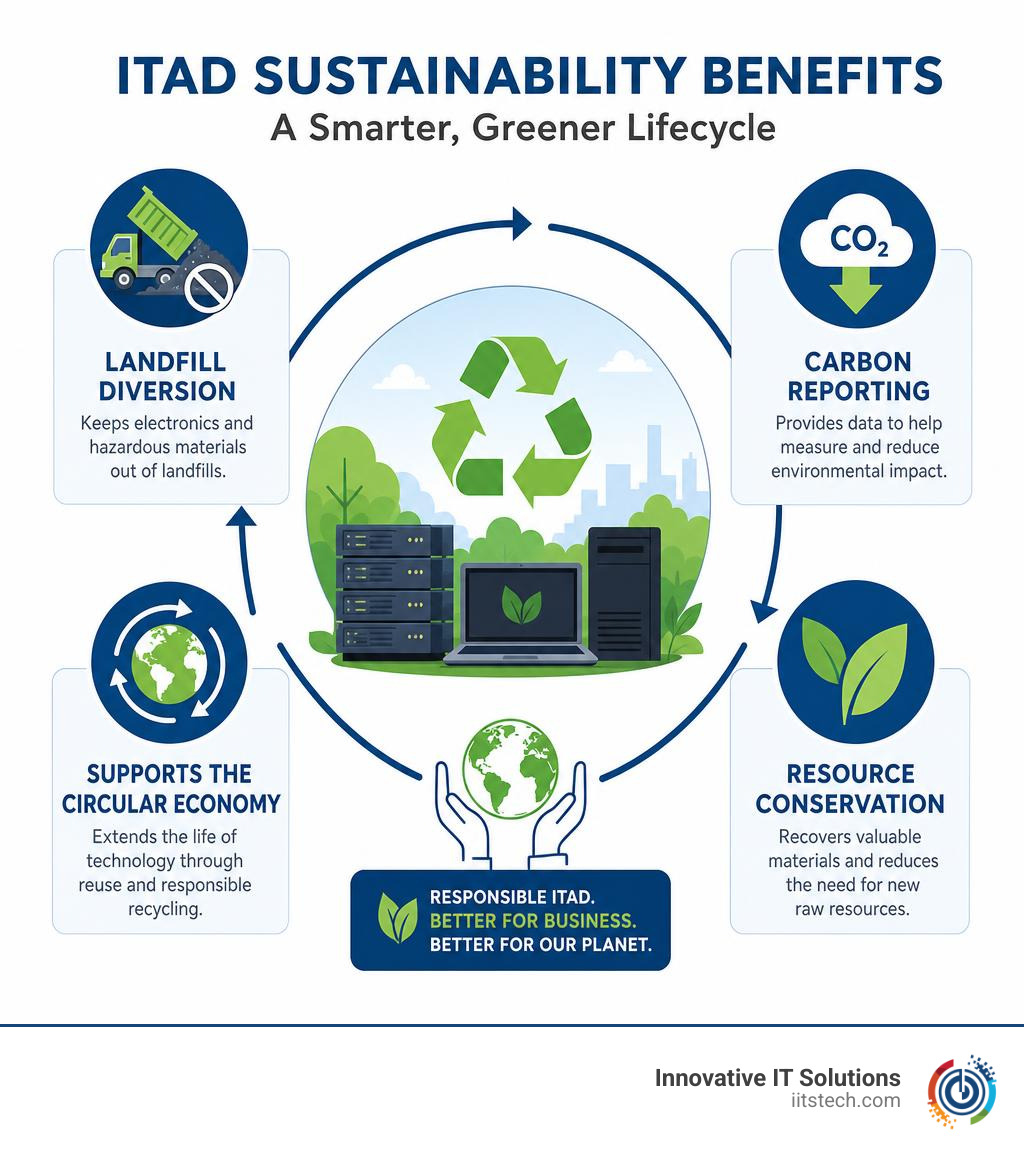
Responsible electronics recycling reduces e-waste, keeps hazardous materials out of landfills, and supports the circular economy.
Ask for:
- Zero-landfill recycling practices
- EPA-compliant processes
- R2-aligned recycling controls
- Landfill diversion reporting
- Environmental impact summaries
- Weight-based recycling reports
- Carbon or CO2 savings estimates when available
- ESG documentation for internal reporting
At Innovative IT Solutions, we focus on zero-landfill and EPA-compliant processes because secure disposal should protect both your data and the environment. For more local guidance, see Electronics disposal in Oklahoma City.
Typical Costs, Turnaround Times, and Service Models
ITAD pricing depends on volume, asset type, location, labor, data destruction method, and resale value.
Common cost factors include:
- Pickup fees
- Pallet or weight-based recycling charges
- Per-drive wiping or shredding
- Mobile shredding fees
- Mail-back kit costs
- Labor for deinstallation
- Freight requirements
- Reporting and documentation requirements
Resale value can offset some or all costs when equipment has market demand. In some cases, clients receive value back through buyback, revenue share, or service credits.
Typical service models include:
- One-time cleanouts
- Scheduled recurring pickups
- Data center decommissioning
- Remote employee mail-back
- On-site mobile destruction
- Off-site processing
- Emergency destruction projects
Turnaround varies by project size. Small pickups may be completed quickly, while large resale and reporting projects take longer because testing, grading, and reconciliation must be done correctly.
Frequently Asked Questions About Secure ITAD Services in Oklahoma
What Documents Should an Oklahoma ITAD Provider Deliver?
You should expect documentation that proves what happened to every asset, especially data-bearing devices.
Important records include:
- Certificates of Destruction
- Certificates of Recycling
- Serialized audit reports
- NIST erasure logs
- Asset disposition reports
- Environmental impact summaries
- Weight tickets
- Photos or video evidence when required
- Exception reports
- Final settlement or resale reports
These documents support HIPAA, GLBA, PCI, SOX, FERPA, CJIS, cybersecurity, ESG, and internal audit requirements.
Which Oklahoma Industries Need the Strictest ITAD Controls?
The strictest controls usually apply to organizations handling sensitive personal, financial, medical, legal, government, or customer data.
That includes:
- Hospitals and clinics
- Banks and credit unions
- Data centers
- Schools and universities
- Municipal and state agencies
- Defense-related contractors
- SaaS and technology firms
- Legal and accounting firms
- Energy and oil and gas companies
- Retail and payment-processing environments
If a device stored PHI, PII, payment data, credentials, confidential contracts, or regulated records, treat it as high risk until it is securely sanitized or destroyed.
How Fast Can Secure ITAD Projects Be Completed?
Speed depends on the service type.
A small one-time pickup may be straightforward. Emergency destruction can often be prioritized. Mail-back programs depend on shipping time. Mobile shredding requires scheduling equipment and technicians. Large decommissioning projects need planning, inventory, secure loading, processing, testing, and reporting.
Ask your provider for separate timelines for:
- Pickup
- Data destruction
- Certificate delivery
- Recycling completion
- Resale testing
- Final value recovery
Fast is good. Fast and documented is better.
Conclusion
Choosing the right secure IT equipment recycling partner in Oklahoma comes down to proof.
You want a provider that can protect your data, document every custody transfer, recycle responsibly, recover maximum value, and give your compliance team the records they need without chasing anyone down.
At Innovative IT Solutions, we help Oklahoma City, OKC, South OKC, and Oklahoma organizations with secure ITAD, NIST/DoD-compliant data destruction, zero-landfill recycling, EPA-compliant processes, asset recovery, resale, and full documentation.
If you are ready to retire equipment without adding risk, we can help you build an audit-ready disposal process from pickup to final certificate.
Start here: Get help with Oklahoma electronics recycling


