
The Complete Guide to Finding Reliable Used Cisco Equipment
Why Used Cisco Equipment Belongs in Your IT Procurement Strategy
Used Cisco equipment is enterprise-grade network hardware — switches, routers, servers, and more — that has been previously owned, and is available to buy at a significant discount compared to new. Here’s what you need to know at a glance:
- What it is: Pre-owned or remanufactured Cisco hardware, including switches, routers, and UCS servers
- Who sells it: Cisco directly (via the Cisco Refresh program), authorized partners, and independent third-party refurbishers
- Key benefit: Savings of up to 50% or more compared to new hardware, with faster delivery
- Warranty: Cisco Refresh products carry the same OEM warranty as new hardware; third-party refurbishers vary
- Sustainability: Buying or returning used gear supports circular economy goals and reduces e-waste
- Risk to watch: Software licensing, data sanitization, and chain-of-custody are critical considerations
IT budgets are under pressure. Lead times on new hardware can stretch for months. And sustainability requirements are landing on more procurement checklists every year.
For IT managers at mid-sized enterprises, those three pressures are colliding right now — and used Cisco equipment sits squarely at the intersection of all three.
Whether you’re trying to stretch a capital budget, hit a deployment deadline, or responsibly decommission aging network gear, the secondary Cisco hardware market offers real, practical options. But it also comes with real risks if you don’t know what to look for.
This guide breaks down everything you need to know — from Cisco’s own certified remanufacturing program to third-party refurbishers, software licensing pitfalls, secure disposal, and how to recover value from hardware you’re retiring.
I’m Mike Haden, Founder and Director of Business Development at Innovative IT Solutions. Over the past 14 years, I’ve built an R2v3-certified ITAD operation that has processed and remarketed over a million pieces of enterprise IT equipment — including a significant volume of used Cisco equipment — helping organizations recover value, stay compliant, and reduce e-waste. This guide draws directly on that hands-on experience so you can make smarter, safer procurement and disposition decisions.
Understanding the Market for Used Cisco Equipment
The secondary market for enterprise networking hardware is massive, and Cisco equipment occupies the largest share of it. When organizations upgrade their data centers, downsize, or migrate to the cloud, perfectly functional switches, routers, and servers enter the secondary market.
Navigating this market requires an understanding of how hardware lifecycles work. A piece of networking gear doesn’t become obsolete just because a newer generation is released. Many enterprise-grade switches are built to run continuously for a decade or more, yet they are often decommissioned after just three to five years due to corporate lease cycles or standardized upgrade schedules.
By tapping into this secondary market, businesses can acquire robust, reliable hardware at a fraction of the original cost. To weigh the benefits and risks of this approach, it is highly beneficial to explore the pros of used Cisco equipment to see how pre-owned gear fits into a modern IT procurement strategy.
Certified Remanufactured vs. Third-Party Used Cisco Equipment
As you explore options for acquiring used Cisco equipment, you will encounter two main categories: OEM-certified remanufactured hardware (Cisco Refresh) and independent, third-party refurbished hardware.
- Cisco Refresh (OEM Certified): This hardware is remanufactured directly by Cisco. It undergoes proprietary diagnostics, receives official firmware updates, and is packaged with original accessories. Crucially, it comes with a genuine OEM warranty and is immediately eligible for Cisco Smart Net support contracts.
- Third-Party Refurbished: This hardware is sourced, tested, and cleaned by independent IT asset disposition (ITAD) vendors or secondary market brokers. While it does not carry an official Cisco warranty, reputable vendors provide their own robust warranties (often matching or exceeding the OEM’s duration) and perform rigorous multi-point testing to ensure reliability.
To help you decide which route is best for your specific project, we have put together a comparison table outlining the key differences:
| Feature | Cisco Refresh (OEM Certified) | Independent Third-Party Refurbished |
|---|---|---|
| Source | Remanufactured directly by Cisco | Sourced and processed by independent vendors |
| Pricing | Moderate savings (typically 30% to 50% off list) | High savings (often 50% to 85%+ off list) |
| OEM Warranty | Yes, identical to brand-new products | No (vendor-backed warranty instead) |
| Smart Net Eligible | Yes, guaranteed eligibility | Conditional (requires re-licensing/inspection fee) |
| Firmware Updates | Shipped with licensed, up-to-date firmware | Shipped as-is (buyer must handle licensing) |
| Packaging | Official Cisco Refresh packaging | Vendor-provided secure packaging |
Licensing and Software Support for Used Cisco Equipment
One of the most common pitfalls when purchasing used Cisco equipment from the open market is software licensing.
Historically, hardware and software were tightly coupled. Today, Cisco utilizes a subscription-based software model (such as Cisco ONE or DNA licensing). When you purchase a used switch or router from a third party, the software license does not automatically transfer to you. Cisco’s end-user license agreements (EULAs) generally state that software licenses are non-transferable.
If you purchase independent third-party hardware, you may need to purchase a new software license directly from Cisco to remain compliant and access software updates. Additionally, if you plan to cover the hardware under a Smart Net contract, Cisco may require an inspection fee or a re-licensing fee before they will approve the device for coverage.
If you are on the selling side of this equation, understanding these nuances will help you set realistic expectations for your asset values. You can learn how to sell your used Cisco equipment easily by understanding what buyers look for regarding licensing, original accessories, and clean configurations.
What is the Cisco Refresh Program?
For organizations that want the savings of pre-owned hardware but require the absolute peace of mind that comes with OEM certification, Cisco offers its own proprietary solution: the Cisco Refresh program.
Formerly known as Cisco Certified Refurbished Equipment (CCRE), Cisco Refresh Program is an official channel through which Cisco remanufactures and resells pre-owned hardware. This program is designed to help organizations optimize their IT budgets without compromising on the quality, performance, or support structure associated with brand-new Cisco products.
Because these products are officially certified by the OEM, they are treated exactly like new products in terms of software licensing, warranty coverage, and technical support eligibility.
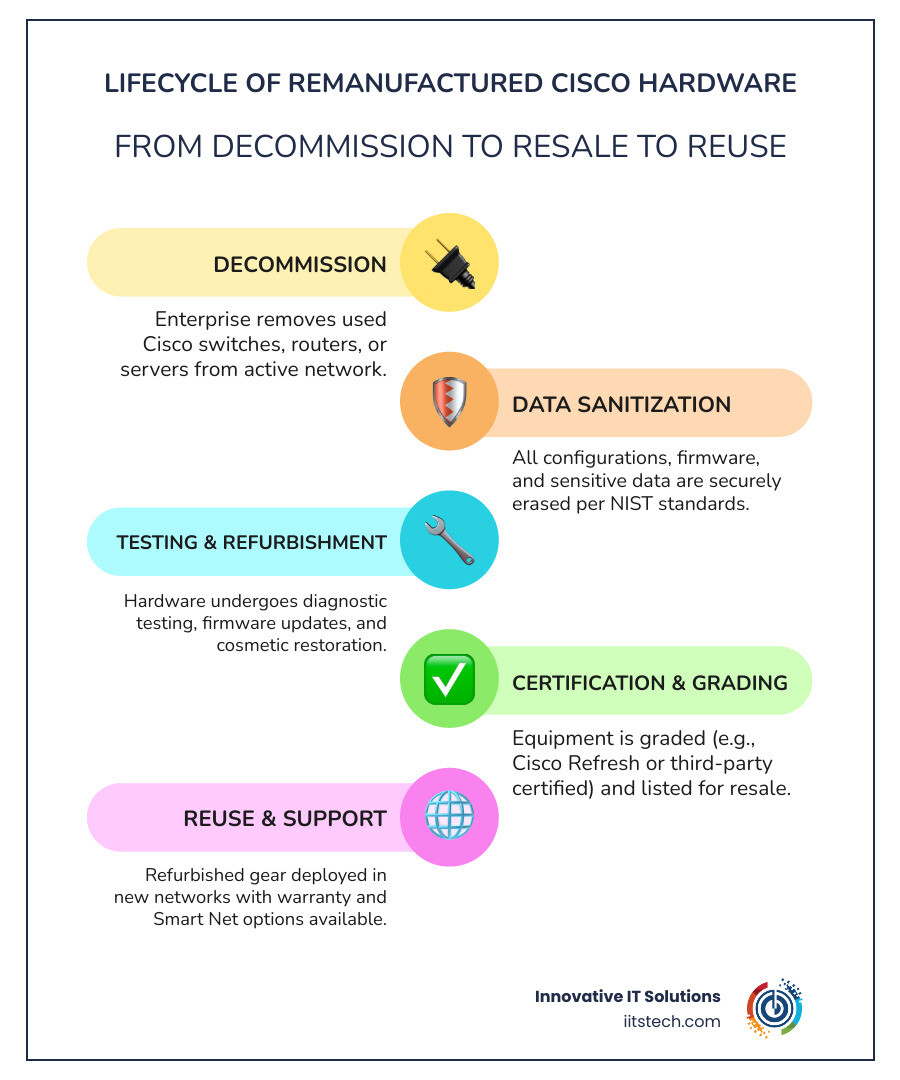
How the Remanufacturing Process Works
Cisco’s remanufacturing process is incredibly thorough, transforming returned or decommissioned hardware back to a state that is functionally identical to a brand-new unit.
The process follows these strict phases:
- De-manufacturing & Inspection: Units are disassembled, and every internal component is inspected for physical integrity.
- Proprietary Testing: Hardware is subjected to the exact same rigorous diagnostic tests used during the original manufacturing process.
- Firmware & Software Upgrades: The hardware is updated with the latest authorized firmware releases and clean software builds.
- Cosmetic Restoration: Chasis are cleaned, repainted if necessary, and fitted with new faceplates or bezels to ensure they look brand new.
- Re-packaging: The product is shipped in dedicated Cisco Refresh packaging, complete with all standard power cords, mounting brackets, and documentation.
Product Availability in the Refresh Portfolio
The Cisco Refresh inventory is dynamic, fluctuating based on what equipment is returned through trade-ins, off-lease programs, and internal demonstrations. However, the portfolio is vast and regularly includes:
- Catalyst and Nexus Switches: From access-layer switches to high-density data center core switches.
- Integrated Services Routers (ISR): Branch office and enterprise-edge routing platforms.
- Unified Computing System (UCS) Servers: Blade and rack servers designed for high-performance virtualization.
- Transceiver Modules and Accessories: SFP modules, power supplies, and expansion cards.
Because inventory depends on market supply, working with an authorized partner is essential to track down specific part numbers.
Key Benefits of Choosing Certified Remanufactured Cisco Hardware
Opting for certified remanufactured Cisco hardware is a highly strategic business move. It allows your organization to bypass the premium price tag of brand-new units while completely avoiding the operational risks associated with uncertified secondary market hardware.
When you purchase certified remanufactured gear, you are essentially getting new-product reliability and support at a pre-owned price point. This financial flexibility can be a game-changer, especially when upgrading large networks or expanding data center footprints. For a broader look at how asset recovery and smart procurement impact your bottom line, consider exploring the business benefits of selling your used IT equipment to understand the full financial lifecycle of corporate hardware.
OEM Warranty and Smart Net Support
The single greatest differentiator for Cisco Refresh products is the support ecosystem.
Every Cisco Refresh device comes with the exact same warranty as its brand-new counterpart (such as the Cisco Enhanced Limited Lifetime Warranty). If a switch fails, you are covered under the same replacement terms as if you had bought it new.
Furthermore, these devices are fully eligible for Cisco Smart Net Total Care support. This means you can immediately add them to your existing enterprise support contracts, giving your network administration team direct access to the Cisco Technical Assistance Center (TAC) and 24/7 rapid hardware replacement services.
Comparing Cost and Delivery Times with New Hardware
Beyond direct financial savings, procurement speed is a massive benefit of the pre-owned market.
- Cost Savings: Cisco Refresh units typically cost 30% to 50% less than new hardware. If you opt for independent third-party refurbished gear, those savings can climb as high as 80% or more.
- Lead Times: Brand-new enterprise hardware can sometimes face lengthy manufacturing lead times, particularly during global supply chain disruptions. Because remanufactured and used inventory is already built and sitting in warehouses, shipping times are often down to days rather than months.
Supporting Sustainability and the Circular Economy
Modern IT procurement is no longer just about performance and price. Corporate social responsibility (CSR) and environmental sustainability are now board-level priorities.
Buying used Cisco equipment is one of the most effective ways an IT department can support the circular economy. Manufacturing high-performance networking gear requires significant energy, rare earth elements, and raw materials. By extending the operational life of existing hardware, we directly reduce the demand for new manufacturing resources and prevent functional IT hardware from prematurely entering the waste stream.
For official guidance on sustainable material practices, the EPA Sustainable Materials Management program highlights how reusing existing products represents a massive win for environmental conservation. If you are looking to align your local operations with these principles, our guide on 5 essential tips to recycle your used Cisco equipment offers actionable steps for managing your end-of-life hardware responsibly.
The Cisco Takeback and Reuse Program
To facilitate this circular lifecycle, Cisco operates the Takeback and Reuse Program. This initiative allows organizations to return decommissioned Cisco hardware directly to the OEM at no cost.
Cisco processes these returns to determine the best environmental path:
- Remanufacturing: If the hardware is a current, viable model, it is directed into the Cisco Refresh pipeline.
- Harvesting: Older or partially damaged units are harvested for spare parts.
- Responsible Recycling: Hardware that has reached true end-of-life is broken down and recycled in compliance with strict environmental regulations, ensuring that 99% of the materials are diverted from landfills.
To help weigh your options when retiring old assets, you can read our analysis on whether is it better to recycle or resell old IT equipment to maximize both your financial return and your environmental compliance.
Reducing E-Waste in Enterprise IT
E-waste is the fastest-growing waste stream in the world. Enterprise IT departments have a unique responsibility to manage this challenge.
Implementing a robust IT Asset Disposition (ITAD) strategy ensures that every switch, router, and server decommissioned from your network is tracked, cleared of data, and either resold or recycled. To understand why this process is so critical for modern businesses, read our comprehensive guide on what is IT asset disposition ITAD and why it matters in 2025 to see how professional ITAD services protect both your data security and the planet.
How to Safely Buy and Sell Pre-Owned Network Hardware
Whether you are looking to acquire pre-owned hardware to expand your network, or you are looking to decommission an existing data center to recover capital, safety and security must be your top priorities.
The secondary market can be highly profitable and efficient, but it also contains risks like counterfeit components, poorly refurbished hardware, and data security breaches. Knowing how to sell used IT equipment without getting burned is essential for protecting your organization’s reputation and bottom line.
Preparing Hardware for Resale or Disposal
Before any piece of networking hardware leaves your facility, it must undergo thorough data destruction and configuration clearing.
Enterprise switches and routers contain sensitive network configurations, IP addresses, security certificates, and sometimes even local user credentials. Leaving this data on retired hardware presents a severe security risk.
To ensure your data is completely unrecoverable, follow our how to prepare IT equipment for secure disposal a step by step guide. At a minimum, this involves:
- Performing a full factory reset of the device’s NVRAM.
- Physically removing any local flash storage cards or hard drives that cannot be securely wiped.
- Documenting serial numbers and maintaining a strict chain-of-custody log.
Navigating the Decommissioning Process
Decommissioning a data center or upgrading a large office network is a complex undertaking. If your business is currently restructuring, migrating to the cloud, or downsizing, managing the physical infrastructure can feel overwhelming.
Our guide on what to do with old IT equipment when your business closes or downsizes outlines how to systematically audit, value, and de-install your hardware assets. To ensure you do not leave money on the table during this process, consult our sell used IT equipment A-Z guide to learn how to prepare your inventory lists, obtain accurate valuations, and partner with a certified ITAD provider to handle the heavy lifting.
Frequently Asked Questions about Used Cisco Hardware
Does used Cisco equipment come with a warranty?
Yes, but the coverage depends entirely on where you buy it. If you purchase through the official Cisco Refresh program, the hardware comes with the exact same OEM warranty as a brand-new unit. If you purchase independent third-party used Cisco equipment, the warranty is provided by the vendor. Reputable ITAD providers and refurbishers typically offer their own warranties, ranging from 90 days to lifetime coverage. Always verify the warranty terms in writing before purchasing.
Can I get Cisco Smart Net support on refurbished items?
If you purchase official Cisco Refresh equipment, it is 100% guaranteed to be eligible for Smart Net support and TAC access immediately. If you purchase independent, third-party refurbished Cisco gear, it is not automatically eligible. To put third-party gear under Smart Net, Cisco may require an inspection and a re-licensing fee.
How do I safely dispose of non-functional Cisco gear?
Non-functional Cisco hardware should never be thrown into standard waste bins. It should be processed through a certified ITAD provider that follows R2v3 or e-Stewards standards, ensuring EPA-compliant, zero-landfill recycling. Alternatively, you can utilize the Cisco Takeback and Reuse Program to return the hardware directly to Cisco for responsible material recovery.
Conclusion
Navigating the secondary market for enterprise networking hardware doesn’t have to be a gamble. Whether you choose to leverage the official Cisco Refresh program for OEM-guaranteed support, or work with a trusted independent partner to maximize your cost savings, used Cisco equipment represents a highly viable, reliable, and sustainable choice for modern IT organizations.
At Innovative IT Solutions, based right here in Oklahoma City, we specialize in helping businesses navigate this entire hardware lifecycle. From secure, NIST-compliant data destruction and certified asset recovery to helping you responsibly recycle end-of-life gear, we ensure your ITAD processes are seamless, compliant, and highly profitable.
If you are ready to explore how pre-owned hardware or professional asset recovery can optimize your IT strategy, read more about the pros of used Cisco equipment or contact our team today to get a certified valuation on the assets you are ready to retire.


