
Equipment Recovery Services for Retired IT Hardware
Equipment recovery services help businesses systematically retire obsolete computers, workstations, data center racks, and server components while protecting the sensitive data stored within them and recovering financial value whenever secondary market resale is possible. A well-designed recovery initiative tracks every serialized hardware asset, sanitizes or destroys underlying digital storage media, and channels functional components into global secondary resale channels while diverting unusable materials to responsible, zero-landfill downstream recyclers. This disciplined methodology enables enterprise IT departments and data center facilities managers to reclaim floor space, eliminate storage overhead, and maintain ironclad data privacy compliance without sacrificing financial returns.
I’m Mike Haden, founder of Innovative IT Solutions, and I have spent over 14 years helping commercial organizations navigate surplus technology lifecycle management through professional equipment recovery services. Our R2v3-certified processing facility has tested, sanitized, and remarketed more than a million units of enterprise servers, commercial laptops, and network appliances. Below, I outline what an audit-ready, high-yield recovery program requires.
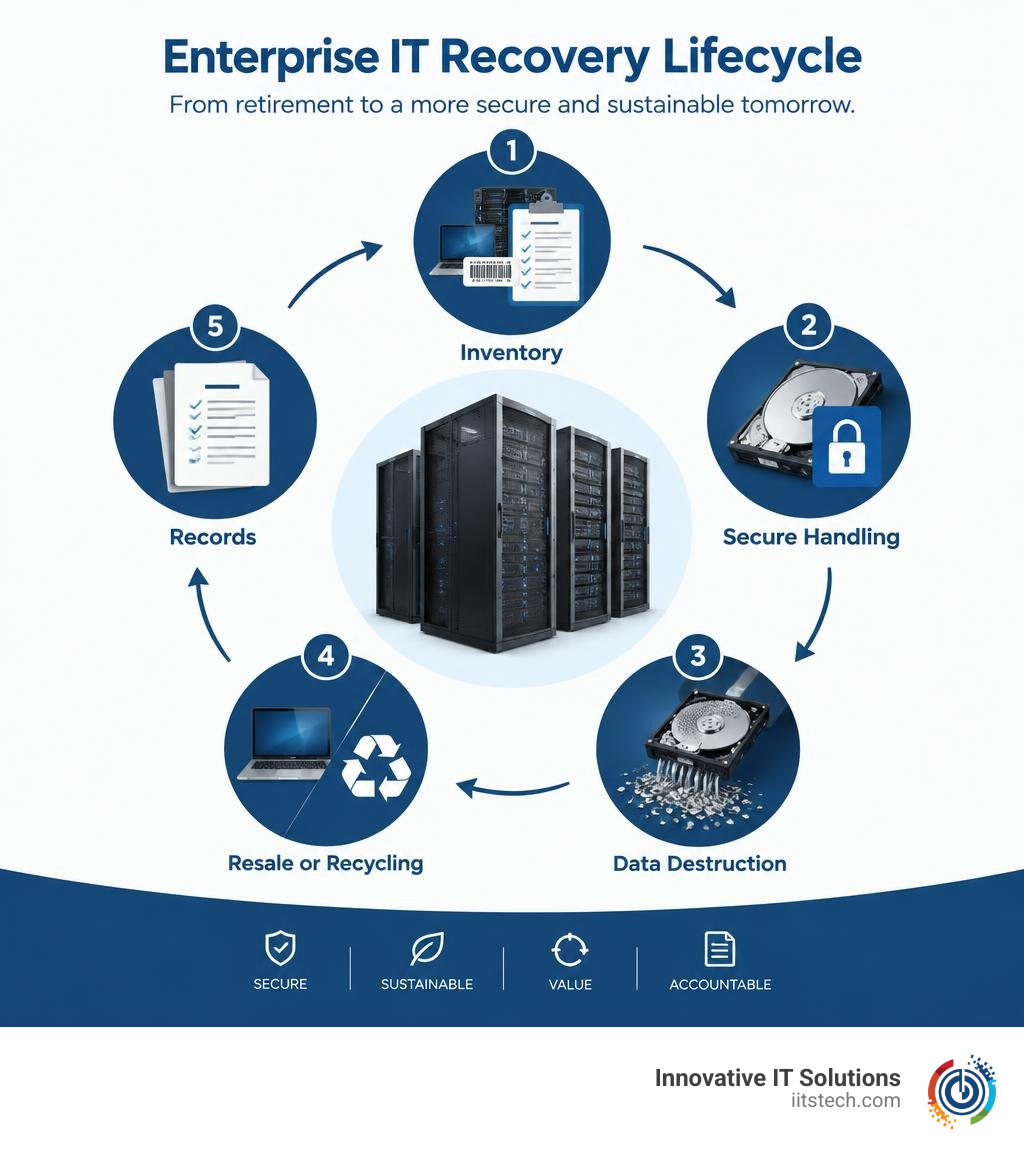
Equipment recovery services vocab to learn:
Understanding Equipment Recovery Services for Enterprise IT Hardware
When enterprise systems outlive their initial operational deployment, businesses face an important financial and logistical decision. Rather than allowing obsolete server clusters, storage arrays, and corporate workstations to accumulate dust inside costly storage facilities, engaging specialized equipment recovery services allows organizations to reclaim working capital while eliminating data security risks.
In modern data centers and corporate offices, decommissioning obsolete hardware requires far more than uncoupling power cords and loading loose chassis onto wooden pallets. A structured asset recovery process guarantees that every serialized device is inventoried, evaluated for functional viability, purged of proprietary corporate information, and channeled toward its highest financial return.
| Recovery Method | Typical Timeframe | Upfront Cash Yield | Best Suited For |
|---|---|---|---|
| Direct Buyout | 3 to 10 Business Days | Immediate, guaranteed payment | High-demand enterprise hardware, fast facility clear-outs |
| Consignment Remarketing | 30 to 90 Days | Maximum market-rate return | High-spec blade servers, specialized networking hardware |
| Certified Electronics Recycling | 5 to 15 Business Days | Salvage/commodity material value | Non-functional units, obsolete storage media, legacy components |
Key Differences Between Equipment Recovery and Liquidation
Many organizations mistakenly equate strategic equipment recovery with basic bulk liquidation. While liquidation primarily focuses on dumping commercial hardware as quickly as possible—frequently accepting rock-bottom wholesale prices from opportunistic scrap dealers—equipment recovery operates as a value-maximizing engineering and remarketing discipline.
Strategic recovery analyzes secondary enterprise market demand, individual component valuations, and historical price curves across secondary technology exchanges. By timing disposition correctly and executing diagnostic testing, component harvesting, cleaning, and firmware updates, recovery specialists generate significantly higher net returns. Organizations focused on maximizing value from obsolete IT equipment discover that methodical refurbishment converts idle server infrastructure into substantial capital rather than an operational loss.
Recoverable Business-Grade IT Assets and Components
Almost every piece of business-grade IT equipment retains measurable residual value if extracted and remarketed prior to complete generational obsolescence. Enterprise processor architectures, high-density server memory modules, enterprise storage arrays, and high-throughput network switches maintain persistent global demand across secondary corporate environments.
Key recoverable enterprise hardware categories include:
- Compute Infrastructure: 1U to 4U rackmount enterprise servers, modular blade chassis, multi-socket system boards, and high-core-count Intel Xeon and AMD EPYC enterprise processors.
- Enterprise Storage Systems: Storage Area Network (SAN) disk arrays, Network Attached Storage (NAS) appliances, high-speed host bus adapters (HBAs), and high-capacity SAS hard disk drives.
- Core Networking Gear: Managed layer-2 and layer-3 switches, modular edge routers, high-throughput network firewalls, and intelligent rack power distribution units (ePDUs).
- High-Density Server Components: Multi-gigabit Network Interface Cards (NICs), redundant hot-swap power supplies, and enterprise-grade solid-state drives (NVMe/SATA/SAS SSDs).
Enterprise technology leaders can transform idle server racks into working budget by identifying these high-value components early in the decommissioning lifecycle.
The End-to-End IT Equipment Recovery Process
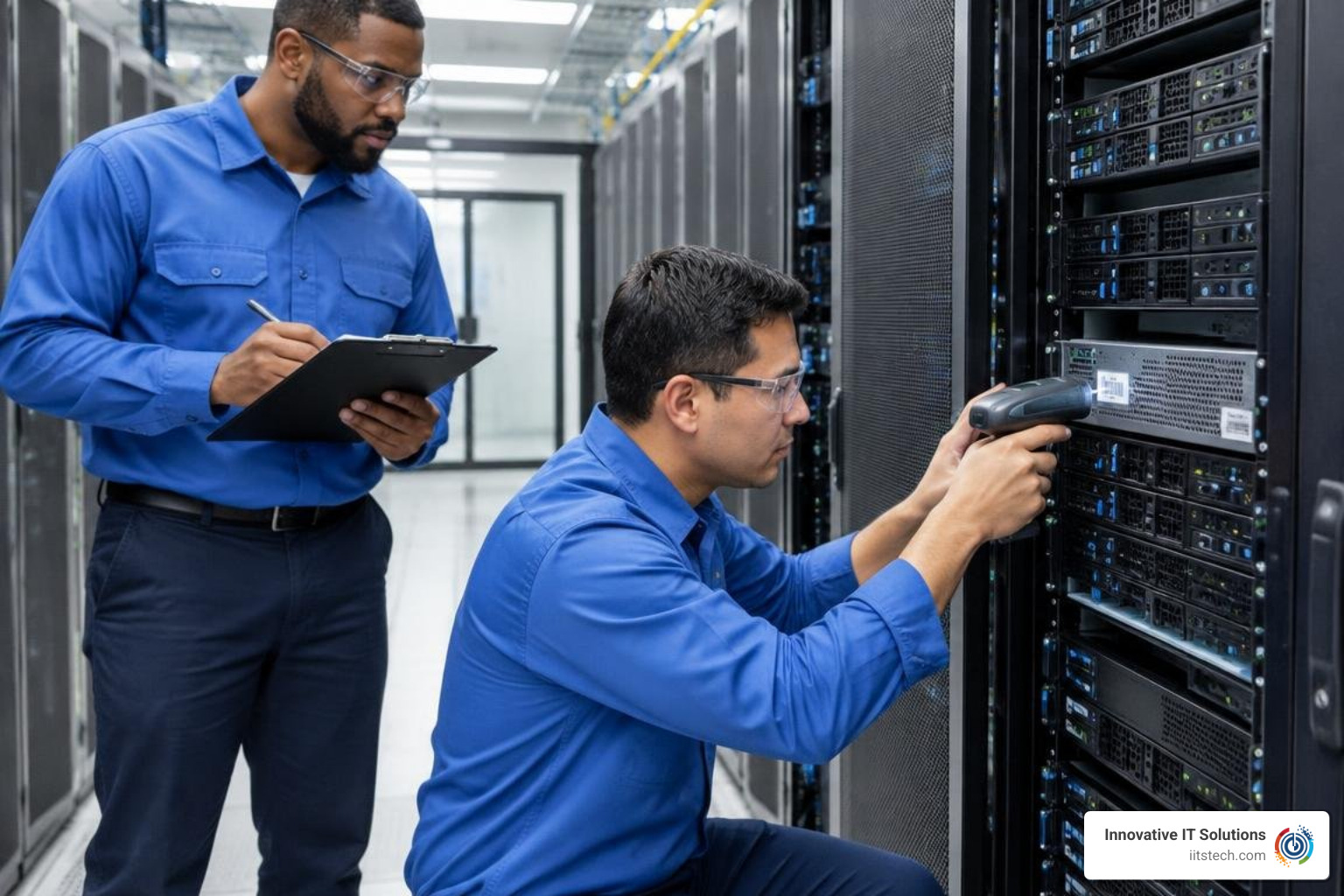
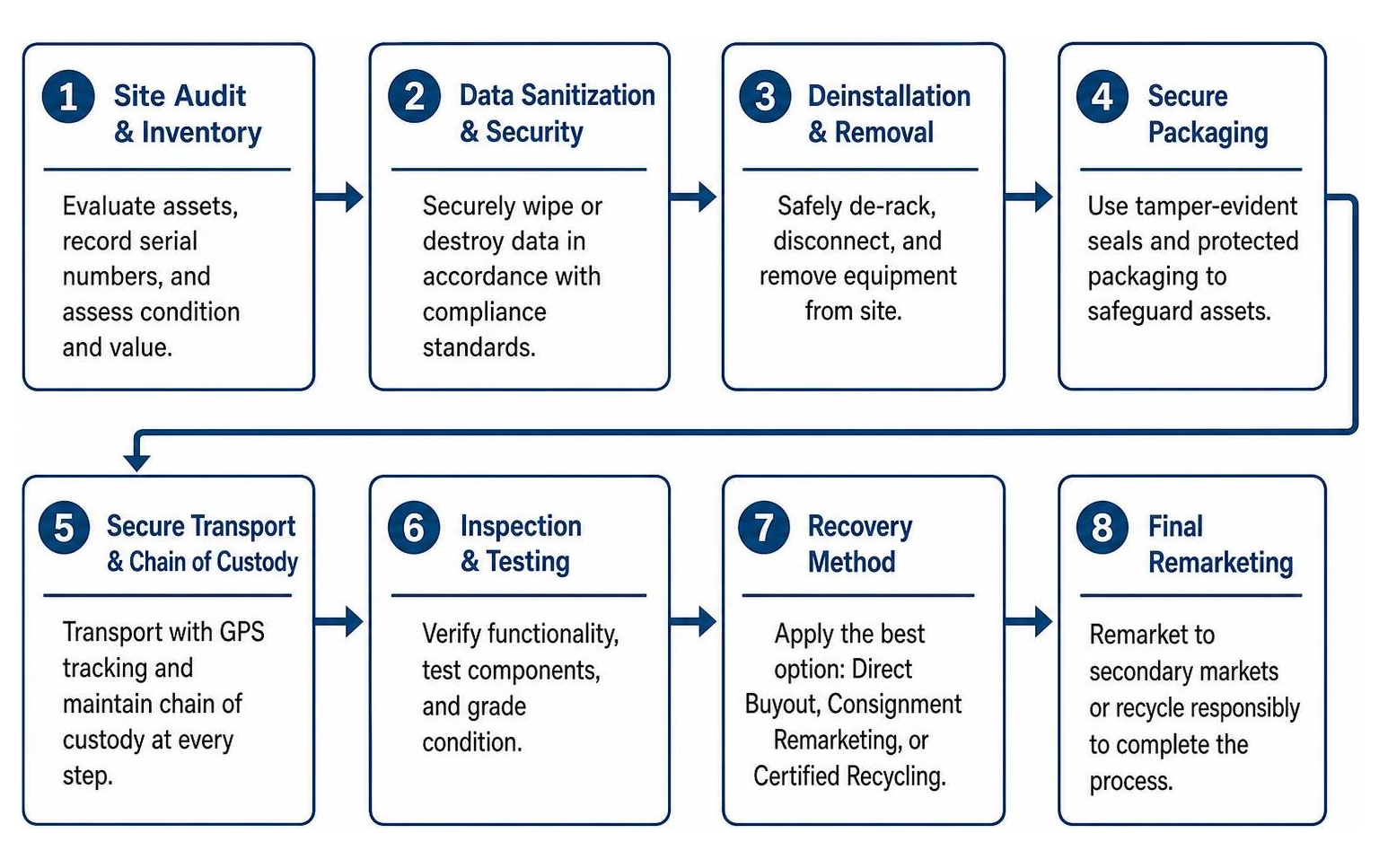
Executing an efficient hardware recovery campaign requires rigorous asset tracking, methodical on-site de-installation, and unbroken chain of custody management. Understanding the chain of custody in ITAD is essential for preserving data security and passing corporate compliance audits.
How Equipment Recovery Services Handle Logistics and Chain of Custody
The physical transit of retired enterprise computers, storage systems, and server racks carries significant liability if managed without specialized oversight. Professional recovery providers deploy dedicated logistics teams and secure vehicles equipped with GPS monitoring, tamper-evident security seals, and locked transit containers to safeguard hardware throughout every transfer.
To ensure sensitive enterprise hardware arrives without physical damage, professional handling teams utilize custom palletizing, specialized shock-absorbing packing, and heavy-duty crating built for dense server racks and storage arrays. By enforcing strict security procedures during transit, organizations can avoid ITAD risks with a secure chain of custody while preserving equipment integrity and safeguarding corporate records.
Sanitization and Certified Data Destruction Protocols
Data privacy remains the most critical mandate during enterprise IT asset disposition. Sanitizing enterprise solid-state drives, hard drives, and array controllers requires rigorous, certified procedures that align with NIST SP 800-88 Rev. 1 Clear and Purge standards, as well as DoD 5220.22-M multi-pass overwriting standards.
For defective drives, legacy magnetic media, or drives designated for complete destruction, industrial shredders physically pulverize platters and flash memory modules into tiny fragments. Following data destruction, providers issue detailed serialized compliance documentation. Reviewing secure data destruction methods helps IT directors select proper wiping or physical shredding methods, while obtaining an audit-ready certificate of destruction ensures corporate compliance teams maintain verifiable records.
Key Factors Determining Enterprise Equipment Valuation and ROI
The overall financial return on investment generated through commercial equipment recovery depends on a variety of operational, generational, and secondary market dynamics:
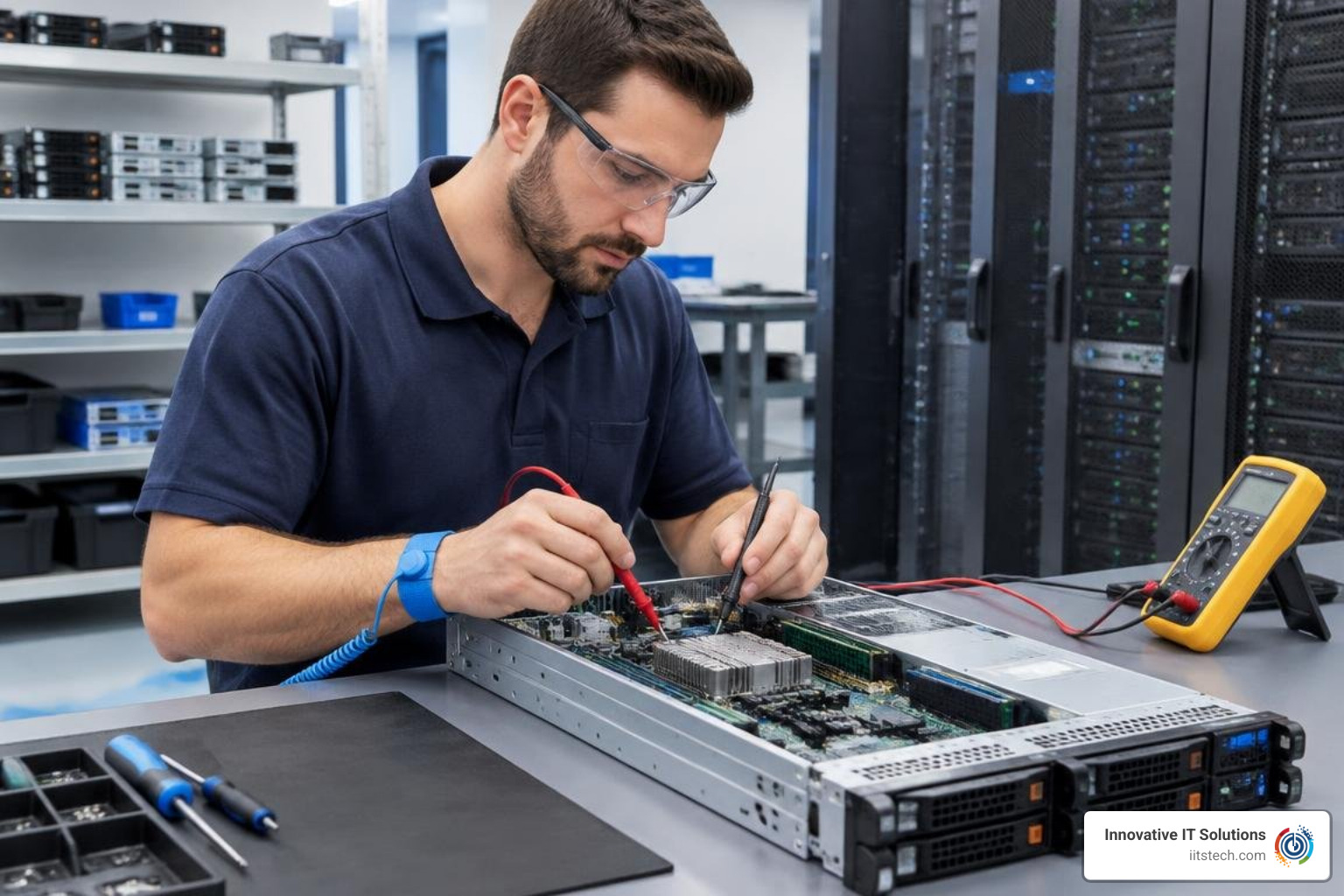
- Equipment Age and Generational Cycle: Enterprise computers, networking hardware, and servers follow a 3-to-5-year enterprise lifecycle. Hardware recovered within this active replacement window commands maximum resale value on global secondary markets.
- Component Specification and Density: Server systems configured with high-density ECC RAM, high-tier multi-core processors, redundant power modules, and enterprise SSDs capture much stronger resale margins than entry-level configurations.
- Physical and Functional Asset Health: Server racks, blade enclosures, and workstations operated in climate-controlled data centers with comprehensive service records yield higher recovery pricing.
- Market Demand and Component Scarcity: Supply chain bottlenecks and enterprise demand for legacy enterprise parts frequently increase the residual value of refurbished replacement hardware.
Consulting best practices for selling used IT equipment enables enterprise IT leadership to evaluate secondary hardware values before launching a scheduled infrastructure refresh.
Optimizing Residual Value Across Resale Channels
Depending on capital requirements and timeline objectives, organizations can structure asset disposition through direct buyouts or consignment remarketing programs. Direct cash buyouts provide immediate liquidity within days, whereas managed revenue-share consignment maximizes long-term returns across broad secondary corporate networks. Selecting the right remarketing structure helps IT managers turn decommissioned server hardware into active capital that offsets new technology investments.
Selecting Certified Providers for Equipment Recovery Services
Choosing an enterprise recovery provider requires thorough evaluation of environmental certifications and security practices. Reputable vendors hold R2v3 certifications, ISO 14001 environmental management accreditations, ISO 45001 occupational health credentials, and ISO 9001 quality management systems.
Knowing how to choose the right ITAD vendor prevents corporate liabilities, data breaches, and regulatory penalties. Furthermore, organizations operating within Oklahoma must verify that their recovery partners comply fully with the Oklahoma Computer Equipment Recovery Act (OCERA) to ensure lawful, compliant e-waste handling.
Frequently Asked Questions About IT Equipment Recovery
How quickly can enterprise IT equipment recovery be completed?
Most commercial recovery projects dispatch on-site logistics crews within 24 to 72 hours of contract execution. Decommissioning, serialized asset tagging, and secure loading typically take 1 to 3 days depending on total rack count and equipment density. Hardware testing, NIST SP 800-88 data sanitization, component grading, and audit reporting are generally completed within 5 to 10 business days following intake at the processing facility.
What compliance documentation is required after IT recovery?
A fully compliant disposition file must include:
- Detailed chain of custody transfer manifests with matching serial numbers.
- NIST SP 800-88 compliant certificates of data sanitization.
- Certificates of Destruction for physically shredded hard drives and storage media.
- Zero-landfill environmental compliance and material recycling certificates.
Reviewing comprehensive ITAD compliance standards ensures your compliance department maintains complete audit trails for internal stakeholders and regulatory authorities.
How does equipment recovery differ from standard electronics recycling?
While commodity electronics recycling shreds obsolete assets down to raw materials like copper, aluminum, and plastics, equipment recovery prioritizes component-level testing, repair, and resale. This remarketing approach delivers substantial financial returns to the enterprise while adhering to zero-landfill environmental goals. To learn more about this strategy, explore how smart IT equipment recycling turns surplus assets into business value.
Conclusion
Decommissioning obsolete enterprise servers, commercial PCs, and networking hardware does not need to introduce operational complexity or cybersecurity vulnerabilities. By partnering with certified specialists for systematic equipment recovery, your enterprise can protect proprietary data, fulfill environmental sustainability mandates, and recover capital from retired technology assets.
At Innovative IT Solutions, we deliver NIST SP 800-88 compliant, R2v3-certified, zero-landfill disposition services engineered for business-grade computers, enterprise networking equipment, and data center servers. Contact our team today to evaluate your surplus technology infrastructure and execute a secure, high-yield asset recovery strategy.


