
Why Your Office Needs a Certified Electronics Recycling Center
Why Every Office Needs a Certified Electronics Recycling Center
A certified electronics recycling center is a facility that has passed independent, third-party audits proving it meets strict environmental, data security, and worker safety standards — specifically under either the R2 (Responsible Recycling) or e-Stewards certification standard.
Here’s what that means for your business at a glance:
| What You Need | What Certification Provides |
|---|---|
| Proof of secure data destruction | Audited data sanitization standards |
| Compliance support (HIPAA, GDPR, PCI) | Documented chain of custody and reporting |
| Responsible disposal of decommissioned IT hardware | Zero-landfill and downstream tracking requirements |
| Value recovery from retired assets | Certified remarketing and asset recovery services |
| Vendor accountability | Ongoing third-party audits and oversight by ANAB |
If your company is decommissioning servers, workstations, or networking gear, choosing a non-certified vendor is a serious risk — to your data, your compliance standing, and your organization’s reputation.
Simply deleting files from a hard drive is not enough. Standard deletion doesn’t fully remove data from device memory. And without a certified partner, there’s no audited proof that your hardware was handled correctly — which matters enormously when regulators come asking.
I’m Mike Haden, Founder and Director of Business Development at Innovative IT Solutions, where I’ve spent 14 years building an R2v3-certified IT Asset Disposition company that helps businesses responsibly manage decommissioned technology through secure, compliant, and value-driven processes — including operating as a certified electronics recycling center for enterprise clients. In that time, we’ve processed over a million pieces of corporate IT equipment, and I’ve seen what separates compliant, trustworthy recycling from the alternatives.
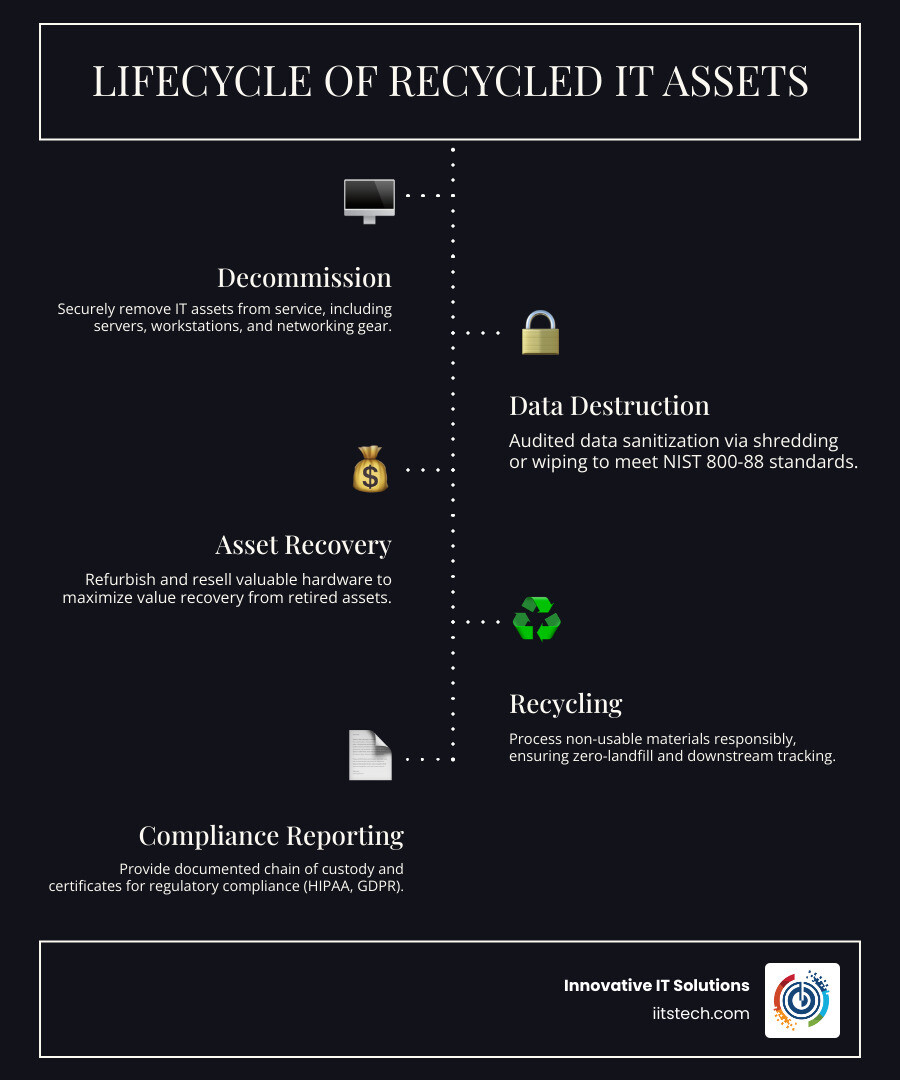
Certified electronics recycling center terms to know:
What is a Certified Electronics Recycling Center?
When your business decides to upgrade its server infrastructure or replace hundreds of employee laptops, you cannot simply toss the old gear into a dumpster. Doing so violates federal regulations, risks massive data breaches, and damages the environment. This is where a certified electronics recycling center becomes an essential business partner.
Unlike standard scrap yards or uncertified local waste collectors, a certified recycling facility operates under a strict, legally binding framework of international standards. These centers don’t just dump or shred items indiscriminately. They are dedicated to the sustainable, secure, and fully documented processing of retired technology.
Through rigorous third-party audits, these facilities prove they have the physical security, technical expertise, and environmental policies necessary to handle sensitive corporate hardware. When we talk about recycling in the corporate world, we are referring to a highly controlled industrial process.
To earn and maintain their status, certified facilities must prove to independent auditors that they:
- Maintain a documented, secure chain of custody for all incoming IT assets.
- Adhere to strict data sanitization and destruction protocols (such as NIST SP 800-88 R1).
- Enforce a zero-landfill policy for hazardous electronic waste.
- Ensure safe, healthy working conditions for their employees.
- Responsibly manage downstream vendors to ensure that components sent elsewhere are also handled ethically.
Understanding the details of electronic recycling reveals that true certification is not just a sticker on a website; it is an active, audited commitment to operational excellence.
R2 vs. e-Stewards: Understanding the Core Certification Standards
In the United States, and specifically for businesses operating throughout Oklahoma City and South OKC, there are two primary, accredited standards that define a legitimate, high-performing recycler: R2 (Responsible Recycling) and e-Stewards.
Both of these standards are recognized by the EPA and accredited by the ANSI-ASQ National Accreditation Board. They provide a blueprint for how a recycling center must handle data, protect workers, and process materials.
| Feature / Standard | R2 (Responsible Recycling) Standard | e-Stewards Standard |
|---|---|---|
| Primary Focus | Market-driven resource recovery, reuse, and safe downstream management | Strict environmental justice, toxic reduction, and global trade ethics |
| Overseen By | SERI (Sustainable Electronics Recycling International) | Basel Action Network (BAN) |
| Data Security | Mandatory NIST 800-88 or DoD-compliant sanitization | Mandatory high-level data destruction and sanitization |
| Landfill Ban | Strict controls on materials requiring focus (FMs) | Absolute ban on landfilling and incineration of e-waste |
| International Export | Allowed under strict, verified legal and environmental conditions | Severely restricted, explicitly aligning with the Basel Convention |
For a complete list of federally recognized options, you can review the EPA Certified Electronics Recyclers directory. For Oklahoma businesses looking to build a long-term IT strategy, reading our r2 certified itad provider guide 2026 is a great next step to understanding how these standards protect your brand.
Key Differences for Corporate IT Asset Disposition
For corporate IT asset disposition (ITAD), the choice between R2 and e-Stewards often comes down to your internal corporate social responsibility (CSR) policies and specific compliance mandates.
R2 places a heavy emphasis on the “hierarchy of responsible reuse.” It pushes recyclers to refurbish and resell functioning business-grade hardware whenever possible. This is highly beneficial for companies looking to recover value from their retired server components or enterprise computers. It ensures that it equipment recycling actually supports a circular economy.
On the other hand, e-Stewards is historically more restrictive regarding international trade and downstream processing. It was founded by the Basel Action Network with a sharp focus on preventing the export of hazardous electronic waste to developing countries.
Regardless of which standard your provider holds, avoiding the top 5 mistakes companies make when recycling electronics starts with verifying that your partner holds at least one of these two major certifications. Working with an uncertified middleman is the single biggest risk an enterprise can take.
How the Certification Process Works and Who Oversees It
Earning a certification is not a one-time paper application. It is a grueling, multi-month process overseen by the ANAB Accreditation Board and executed by accredited third-party auditing firms.
- Stage 1 Audit (Document Review): Auditing bodies review the recycler’s written policies, environmental management plans, and data security procedures to ensure they align with R2 or e-Stewards requirements.
- Stage 2 Audit (On-Site Verification): Auditors visit the facility in person. They inspect physical security (cameras, badge access, secure cages), interview employees, watch data destruction processes in real-time, and trace downstream shipping records.
- Annual Surveillance Audits: To maintain certification, facilities must undergo annual surveillance audits, proving they continue to follow the steps of electronic recycling safely and legally.
- Recertification: Every three years, the entire system is fully re-evaluated from top to bottom.
Essential Services Offered by Certified Recyclers
A professional certified electronics recycling center does far more than crush old computer towers. For businesses in Oklahoma City, we act as complete IT Asset Disposition (ITAD) partners. We offer a full suite of logistics, security, and financial recovery services designed to make corporate hardware transitions seamless.
Using e-waste recycling services the smart way to dispose of electronics means leveraging a vendor that handles everything from the initial de-installation in your server room to the final compliance reporting.
By utilizing smart it equipment recycling for businesses turning e-waste into opportunity, enterprises can transform what used to be an expensive waste-management problem into a secure, organized, and sometimes even profitable corporate workflow.
Secure Data Destruction at a Certified Electronics Recycling Center
The absolute highest priority for any business disposing of IT hardware is data security. When server hard drives, solid-state drives (SSDs), and network switches leave your office, they carry proprietary business data, financial records, and employee personal information.

Certified centers utilize industrial-grade sanitization and physical destruction methods that comply with NIST SP 800-88 R1 (National Institute of Standards and Technology) and Department of Defense (DoD) standards.
- Software-Based Drive Wiping: For drives that will be reused, certified centers use advanced overwriting software that writes patterns of meaningless data across all sectors of the drive, rendering the original data completely unrecoverable.
- Physical Shredding: For drives that are damaged or destined for scrap, heavy-duty industrial shredders slice the drives into tiny, unrecognizable fragments.
Before handing over any equipment, it is wise to review shred it or save it a guide to computer recycling and disposal to determine which method fits your compliance needs. Additionally, understanding ways to prepare your computer prior to recycling will help your internal IT team establish a safe internal protocol before our logistics team arrives for pickup.
IT Asset Disposition (ITAD) and Hardware Resale
Not all retired corporate hardware is junk. In fact, many enterprise-grade servers, switches, and business laptops still hold significant market value when they reach the end of their initial three-to-five-year corporate lease.
Through professional ITAD services, a certified recycler can clean, test, refurbish, and remarket this equipment. This process of value recovery allows businesses to recoup a portion of their original IT investment.
To learn more about how this process works behind the scenes, read our guide on computer recycling services what happens to your old tech. Discovering what are the benefits of old it equipment recycling will show your executive team that choosing a certified partner is as good for your bottom line as it is for your security.
Environmental and Compliance Benefits of Certified Recycling
The environmental impact of corporate electronic waste is staggering. Business-grade hardware is packed with valuable resources like gold, copper, silver, and palladium. However, it also contains highly toxic substances.

By partnering with an R2 or e-Stewards certified provider, your business guarantees a strict zero-landfill policy. This ensures that no hazardous electronic waste ends up in municipal landfills, preventing heavy metals from leaching into local soil and water tables.
To understand why this is a critical regulatory shield for your business, look at our breakdown of trash talk and how to avoid it with the epa zero landfill policy. When done correctly, the compliance documentation provided by a certified vendor proves your company has achieved the environmental impact of itad done right.
Preventing E-Waste Hazards and Meeting State Regulations
Enterprise electronics contain a cocktail of toxic materials, including lead, cadmium, mercury, and brominated flame retardants. If these materials are crushed or burned in uncertified facilities, they pose severe threats to both human health and local ecosystems.
- Lead: Found in older CRT monitors and solder, lead can cause severe neurological damage.
- Mercury: Used in backlights of older LCD monitors, mercury exposure leads to cognitive and sensory impairment.
- Cadmium: Commonly found in chip resistors and older batteries, cadmium is a known carcinogen that damages kidney function.
Understanding the health effects of e-waste a complete detail highlights why regulators are so strict about enforcement. Beyond health, the ecological damage is massive; read about what are the effects of e wastes on the environment and the wider environmental impact of corporate electronic waste to see why compliance is a non-negotiable part of modern business operations.
Choosing a Certified Electronics Recycling Center Near You
If your business is located in Oklahoma City, South OKC, or the surrounding Oklahoma areas, you need a local partner who can handle high-volume commercial pickups, provide secure transport, and supply certified documentation.
While there are many options listed in consumer directories, enterprise-grade hardware requires a higher level of service than a standard public drop-off site. You can explore the best electronics recycling locations near you or view our specific list of oklahoma city electronics recycling 7 local centers to try to find a convenient, secure solution for your business.
Frequently Asked Questions About Business E-Waste
What business-grade IT hardware is accepted at certified centers?
Certified ITAD and electronics recycling centers specialize in commercial-grade technology. This includes:
- Enterprise Servers & Storage: Blade servers, rack-mount servers, SAN/NAS storage arrays, and hard drive enclosures.
- Networking Gear: Enterprise switches, routers, firewalls, and access points.
- Workstations & Laptops: Corporate desktop computers, laptops, monitors, docks, and business-grade tablets.
- Telecom Systems: VoIP office phones, PBX systems, and conference room hardware.
For a detailed breakdown of commercial IT assets, read e-waste recycling for businesses what you can and cant recycle.
How do state programs like California’s CEW relate to R2 or e-Stewards?
State programs like California’s Covered Electronic Waste (CEW) program under CalRecycle focus primarily on public-facing recycling fees and state-regulated drop-off networks. While these programs ensure basic environmental compliance within their respective states, they do not replace the rigorous, data-centric security audits of national standards like R2v3 or e-Stewards.
For business-grade IT asset disposition, relying solely on basic state-level public recycling programs is rarely enough to meet federal data privacy laws (like HIPAA or GLBA). To understand the limitations of trying to manage this process internally, read can i recycle my office electronics myself.
What items are typically not accepted by certified ITAD vendors?
Certified ITAD providers focus strictly on information technology and computing infrastructure. They generally do not accept:
- Non-IT Office Equipment: Office furniture, lighting fixtures, and non-electronic facility waste.
- Hazardous Chemicals: Loose industrial batteries (non-IT), mercury thermostats, or biohazardous materials.
- General Facility Waste: Non-computing breakroom appliances or general office trash.
If your office has a mix of IT and non-IT waste, check out dont throw that tech away a guide to disposing of it equipment safely for proper sorting and disposal strategies.
Conclusion
Managing decommissioned IT assets does not have to be a source of stress or compliance risk for your business. By partnering with a certified electronics recycling center, you protect your sensitive corporate data, meet strict environmental regulations, and potentially recover significant capital from your retired hardware.
At Innovative IT Solutions, we provide fully certified, R2v3-compliant IT Asset Disposition (ITAD) services right here in Oklahoma City. From secure, on-site data destruction to zero-landfill environmental compliance, we handle every step of the process with full documentation and maximum financial returns for your business.
Ready to secure your retired hardware and simplify your IT lifecycle? Set up a certified electronic recycling program for your business with us today.


