
Why a Verifiable Data Destruction Certificate Matters
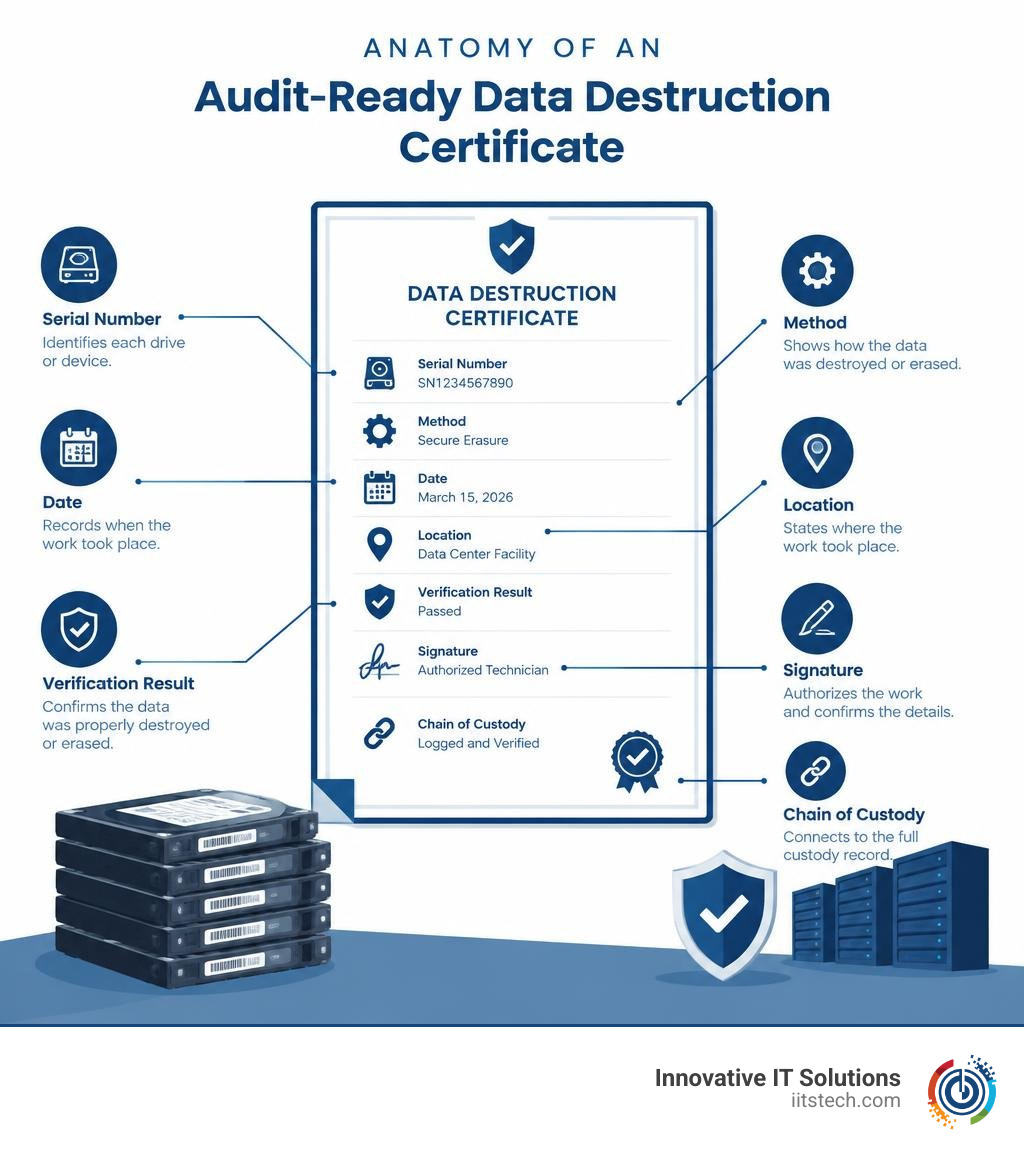
A data destruction certificate is a record showing what happened to data on retired hardware. For an audit, it should identify each drive by serial number, state the destruction or erasure method, record when and where the work took place, and include the verification result and authorized signature. It should also connect to a chain-of-custody record. A certificate alone does not prove that every step was done correctly, but these details let you check the claim against the devices and work logs.
I’m Mike Haden, founder and director of business development at Innovative IT Solutions. For 14 years, I’ve worked with enterprise IT asset disposition and secure data handling, where a data destruction certificate needs to stand up to a practical question: Can you show what happened to this drive?
The Legal and Operational Necessity of Disposal Documentation
Every year, organizations face massive regulatory penalties and legal exposure not because they failed to sanitize their retired business-grade hardware, but because they could not legally prove they did it. In enterprise IT asset disposition (ITAD), unverified claims do not survive an audit. When retiring high-density rack servers, enterprise SAN arrays, or corporate workstations, the burden of proof rests entirely on your organization’s records.

From an operational standpoint, disposal documentation serves as your primary defense against downstream liability. When retired computer hardware leaves your secure data center or office facility, it carries corporate records, proprietary source code, employee records, and confidential customer databases. Recognizing the role of data destruction in cybersecurity highlights that endpoint security does not end when hardware is powered down; it extends through physical decommissioning.
Failing to secure verifiable proof introduces immense risk. Reviewing the hidden costs of skipping data destruction services makes it clear that cutting corners on certified disposal exposes businesses to catastrophic data breach penalties, brand erosion, and non-compliance fines. A verifiable certificate bridges physical operations and legal defense, confirming that chain of custody was maintained from rack removal to permanent sanitization.
Essential Components of a Valid Data Destruction Certificate
A generic, fill-in-the-blank piece of paper stating “drives destroyed” is functionally useless in a regulatory inquiry. To satisfy strict corporate governance and external auditors, a valid document must contain specific, unalterable technical data points. Understanding certified data destruction for retired devices requires knowing exactly what fields must be present.
A defensible document must capture:
- Exact execution timestamps recording when the sanitization or physical destruction started and completed
- Facility location where the processing occurred (specifying on-site at your data center or off-site at a dedicated ITAD facility)
- Specific media sanitization methods applied to the drives
- Full identity and attribution of the certified technician who executed the process
- Authorized witness signatures validating the chain of custody
- Formal alignment with recognized guidelines, such as the Data Security Standard | Oklahoma.gov for public and private sector compliance
Serialized Hardware Tracking and Media Specifications
Business-grade IT infrastructure is complex. Enterprise servers house dozens of data-bearing components, including SAS hard disk drives, NVMe solid-state drives, boot arrays, and storage controller caches. A valid certificate must itemize every single storage component individually.
The certificate must document:
- Component serial number (read directly from firmware or scanned via hardware barcode)
- Drive make, manufacturer, and exact model number
- Storage capacity (such as 1.92TB, 8TB, or 16TB enterprise drives)
- Corporate asset tag numbers mapping back to your internal Configuration Management Database (CMDB)
- Media classification (e.g., magnetic platter hard disk drive vs. solid-state NAND flash)
If a certificate groups twenty server drives into a single general line item without individual serial numbers, an auditor cannot tie the documentation to your retired server assets.
Documenting Sanitization Standards and Firmware Verification
Not all data wiping methods are created equal. The certificate must explicitly state the standard used to sanitize the media. For enterprise data sanitization, referencing our detailed guide to secure data destruction methods helps clarify why modern protocols must match media physics.
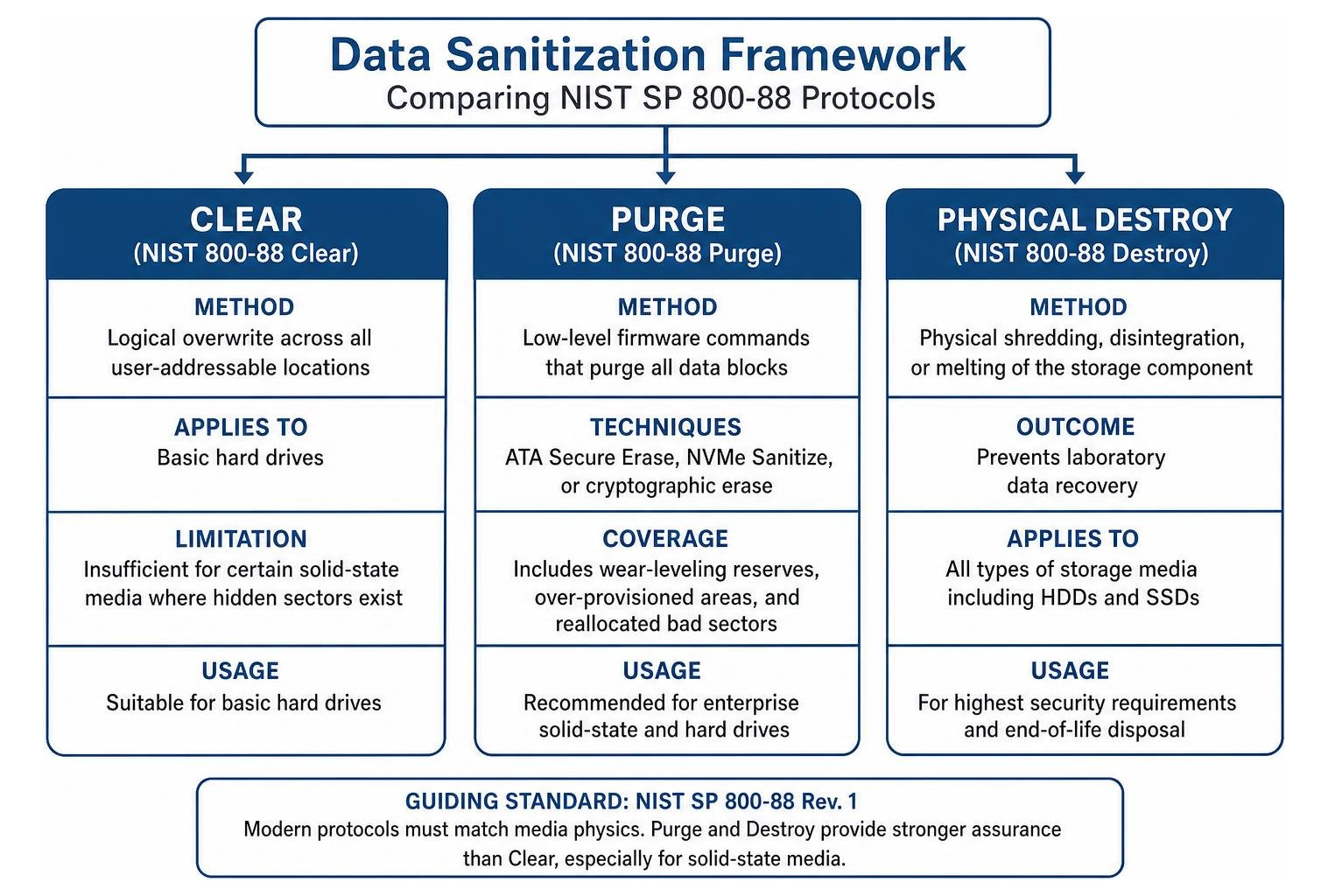
Legacy frameworks like DoD 5220.22-M were designed for magnetic media. While understanding DoD 5220.22-M standards provides valuable historical context, contemporary enterprise solid-state media requires modern standards like NIST SP 800-88 Rev. 1:
- NIST 800-88 Clear: Applies logical overwrite techniques across all user-addressable storage locations. Suitable for basic hard drives, but insufficient for certain solid-state media where hidden sectors exist.
- NIST 800-88 Purge: Executes low-level firmware commands—such as ATA Secure Erase, NVMe Sanitize, or cryptographic erase—that purge all data blocks, including wear-leveling reserves, over-provisioned areas, and reallocated bad sectors.
- NIST 800-88 Destroy: Involves physical shredding, disintegration, or melting of the storage component to prevent laboratory data recovery.
When sanitizing enterprise SSDs, standard multi-pass overwriting can bypass over-provisioned flash blocks managed by the drive controller. The certificate must document the specific firmware-level sanitization command utilized along with post-wipe verification metrics showing 100% of readable sectors were validated.
Why Every Asset Needs an Individual Data Destruction Certificate
Enterprise data environments cannot rely on generalized bulk disposal statements. While an overarching manifest can summarize an entire decommissioning project, each physical drive must have an itemized, verifiable outcome. Evaluating a certificate of destruction for your business demonstrates why serialized documentation is non-negotiable.
When a server node is pulled from a data cluster, its individual drives may experience different disposition paths. One drive might complete a NIST Purge sanitization successfully for hardware resale and value recovery, while an adjacent drive with bad sectors might fail firmware wiping and require immediate physical shredding. A single consolidated certificate lacking asset-level logs cannot accurately account for these divergent outcomes, leaving dangerous blind spots in your compliance records.
Tamper-Proof Authentication: Manual vs. Automated Certification
The method used to generate a data destruction certificate directly dictates its legal strength. In modern enterprise compliance, hand-written forms or editable word processor templates no longer satisfy rigorous third-party audits.
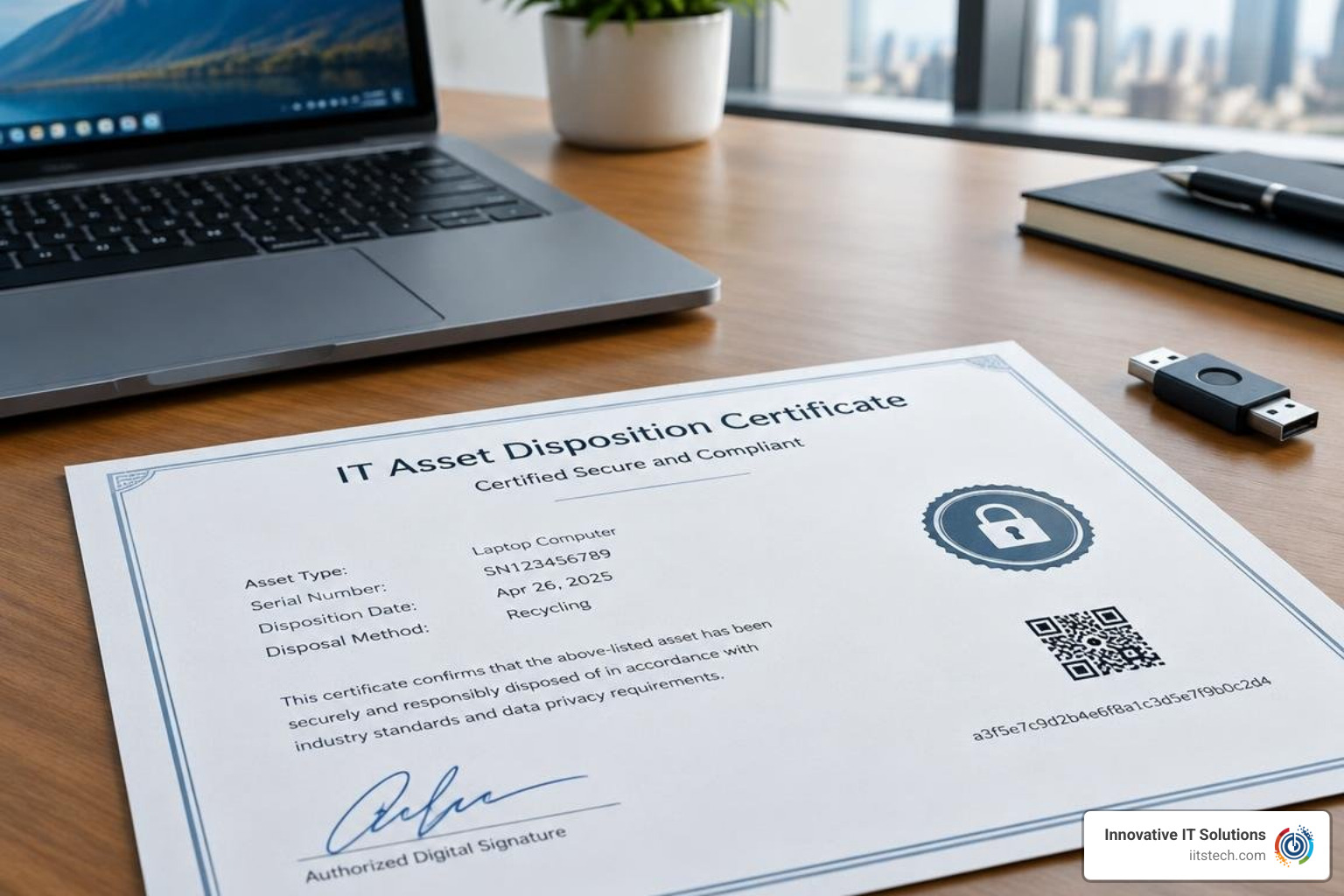
Software-Generated vs. Self-Generated Data Destruction Certificate Formats
Organizations must understand the critical differences between manual self-generated certificates and automated, software-generated documentation from certified ITAD providers. While public reference templates like the Delaware Department of Technology and Information Certificate of Data Destruction establish essential administrative structures, the underlying execution data must be machine-verified.
| Feature / Criteria | Self-Generated Manual Certificate | Software-Generated ITAD Certificate |
|---|---|---|
| Data Capture | Manual manual entry (prone to typos) | Automated hardware query via drive controller |
| Serial Number Validation | Visual inspection of external drive labels | Direct programmatic extraction from drive firmware |
| Tamper Resistance | Low; easily edited or forged in standard office apps | High; cryptographically sealed and digitally signed |
| Verification Evidence | Manual checkmark or operator note | Automated sector verification log and read-back checksum |
| Cost / Complexity | Free template, high administrative time | Integrated into professional ITAD services ($8–$30 single-drive standalone license equivalent) |
| Audit Defensibility | Weak for enterprise and regulated sectors | Gold standard for HIPAA, SOX, PCI DSS, and CMMC |
Cryptographic Signatures and Machine-Verified Audit Trails
Software-generated certificates utilize secure erasure platforms that communicate directly with drive controllers. When sanitization completes, the software runs an automated read-back verification across the drive, computes a cryptographic hash of the audit log, and seals the document with a digital signature.
This automated process guarantees that:
- Drive serial numbers, sector counts, and firmware revisions cannot be altered after the fact.
- Any attempt to modify the certificate invalidates the cryptographic hash.
- Sanitization logs integrate seamlessly with enterprise asset management consoles and CMDB systems via secure APIs.
Regulatory Compliance and Mandatory Record Retention Periods
Federal and international data protection regulations mandate that businesses maintain strict accountability over their data-bearing assets throughout their entire lifecycle. Understanding certified data destruction services for compliance emphasizes how documentation serves as your frontline defense against regulatory enforcement.
Framework Requirements: HIPAA, SOX, PCI DSS, and CMMC
Different regulatory frameworks impose specific rules on how long disposal documentation must be preserved and what technical details it must contain. Following a framework for certified data-bearing destruction in enterprise IT ensures your business adheres to all relevant legal retention schedules:
- HIPAA (45 CFR 164.310(d)(2)(i)): Requires covered healthcare entities and business associates to maintain policies and procedures for the final disposition of electronic protected health information (ePHI) and hardware. Destruction records and compliance certificates must be retained for a minimum of six years.
- Sarbanes-Oxley Act (SOX Section 802): Governs corporate financial records and IT systems storing financial reporting data. To prove internal controls over financial infrastructure, data destruction records must be archived for seven years.
- PCI DSS v4.0 (Requirement 9.4.6): Mandates that all hard-copy and electronic media containing cardholder data be destroyed when no longer needed. Sanitization logs and certificates must be retained through the current audit period plus at least one year.
- CMMC and NIST SP 800-171: Defense contractors handling Controlled Unclassified Information (CUI) must enforce media sanitization using NIST 800-88 Purge or Destroy guidelines, requiring verifiable audit logs for all retired server components and workstation drives.
Audit Pitfalls: Common Documentation Errors That Invalidate Proof
During an audit, regulatory investigators scrutinize disposal logs for discrepancies. The most common errors that invalidate destruction certificates include:
- Missing Serial Numbers: Recording only a drive count (e.g., “50 enterprise SAS drives destroyed”) rather than unique serialized identifiers makes it impossible to prove a specific server array was sanitized.
- Vague Methodology Descriptions: Using generic phrases like “drives wiped” without specifying the technical standard (e.g., NIST 800-88 Rev. 1 Purge via NVMe Sanitize) fails compliance reviews.
- Omitted Verification Passes: Failing to document that an independent verification read-back confirmed zero readable data sectors remaining on the media.
- Chain of Custody Discrepancies: Gaps between the date hardware was uninstalled from the server rack and the date it was physically sanitized or shredded.
- Missing Dual Signatures: Lacking the signature of the technician who performed the work or the authorized corporate witness who verified the process.
Frequently Asked Questions About Data Destruction Certificates
How long must enterprise data destruction records be retained?
Enterprise data destruction records should be retained according to the strictest regulation governing your industry, with a general best-practice standard of seven years. While PCI DSS requires records for the current period plus one year, HIPAA mandates six years for ePHI records, and SOX Section 802 requires seven years for financial IT infrastructure. Maintaining a centralized seven-year archive ensures comprehensive compliance coverage across all regulatory bodies.
Can a single certificate cover bulk server drive sanitization?
Yes, provided the certificate includes a serialized, itemized parent-child manifest. When decommissioning large enterprise server environments, an ITAD vendor can issue an overarching certificate of destruction backed by an attached master inventory table. This table must list the individual serial number, make, model, capacity, sanitization standard, and pass/fail verification result for every single drive processed.
Does a certificate of destruction eliminate all data breach liability?
A certificate of destruction does not grant absolute legal immunity, but it establishes a legally defensible standard of due diligence. Under corporate negligence laws and regulatory enforcement actions, possessing a verifiable, software-generated, NIST-compliant certificate proves that your organization took all reasonable, industry-standard precautions to sanitize and secure confidential data upon hardware retirement.
Conclusion
A data destruction certificate is far more than a routine administrative sign-off—it is the legal backbone of your enterprise IT asset disposition strategy. When retiring business-grade servers, storage arrays, and corporate computer hardware, relying on unverified claims or informal paperwork exposes your organization to severe regulatory penalties, catastrophic data breaches, and audit failures.
At Innovative IT Solutions, we provide enterprise-grade ITAD solutions, business hardware recycling, and certified data sanitization throughout Oklahoma City and the broader region. Our secure, zero-landfill, EPA-compliant processes adhere strictly to NIST SP 800-88 and DoD sanitization standards. We deliver fully serialized, tamper-proof, machine-verified documentation for every asset we process, protecting your business from liability while maximizing your hardware value recovery.
Ensure your retired hardware and enterprise data remain completely protected. Explore our secure destruction processes for enterprise physical and digital assets to establish an airtight, audit-ready disposition program for your corporate IT infrastructure today.


