
Why Computer Asset Disposal Is One of the Biggest Hidden Risks in IT Management
Computer asset disposal is the process of securely retiring end-of-life IT equipment — covering data destruction, regulatory compliance, environmental responsibility, and financial value recovery.
Here’s a quick breakdown of your main options:
| Disposal Method | Best For | Key Benefit |
|---|---|---|
| Certified ITAD | All data-bearing devices | Full compliance + audit trail |
| Remarketing/Refurbishment | Functional hardware (3-5 yrs old) | Recover up to 65% of new hardware costs |
| Certified Recycling | Non-functional or obsolete gear | Zero-landfill, environmental compliance |
| On-site Shredding | High-security environments | Data never leaves your premises intact |
| Secure Data Wiping | Devices with resale value | NIST 800-88 compliant, cost-effective |
If you manage IT at a mid-sized company, decommissioned hardware is probably piling up faster than you can deal with it. Old laptops in storage closets. Retired servers gathering dust. And somewhere in that pile — sensitive data that could still be accessed if the wrong person gets hold of a drive.
The stakes are real. Discarded technology accounts for nearly 70% of all toxic chemicals found in landfills globally. And that’s before you factor in the legal exposure from HIPAA, GDPR, or SOX violations tied to improper disposal.
This guide cuts through the noise. We’ll walk you through every dimension of responsible computer asset disposal — from data destruction standards and regulatory compliance to recovering financial value from hardware you’d otherwise write off.
The Strategic Importance of Computer Asset Disposal
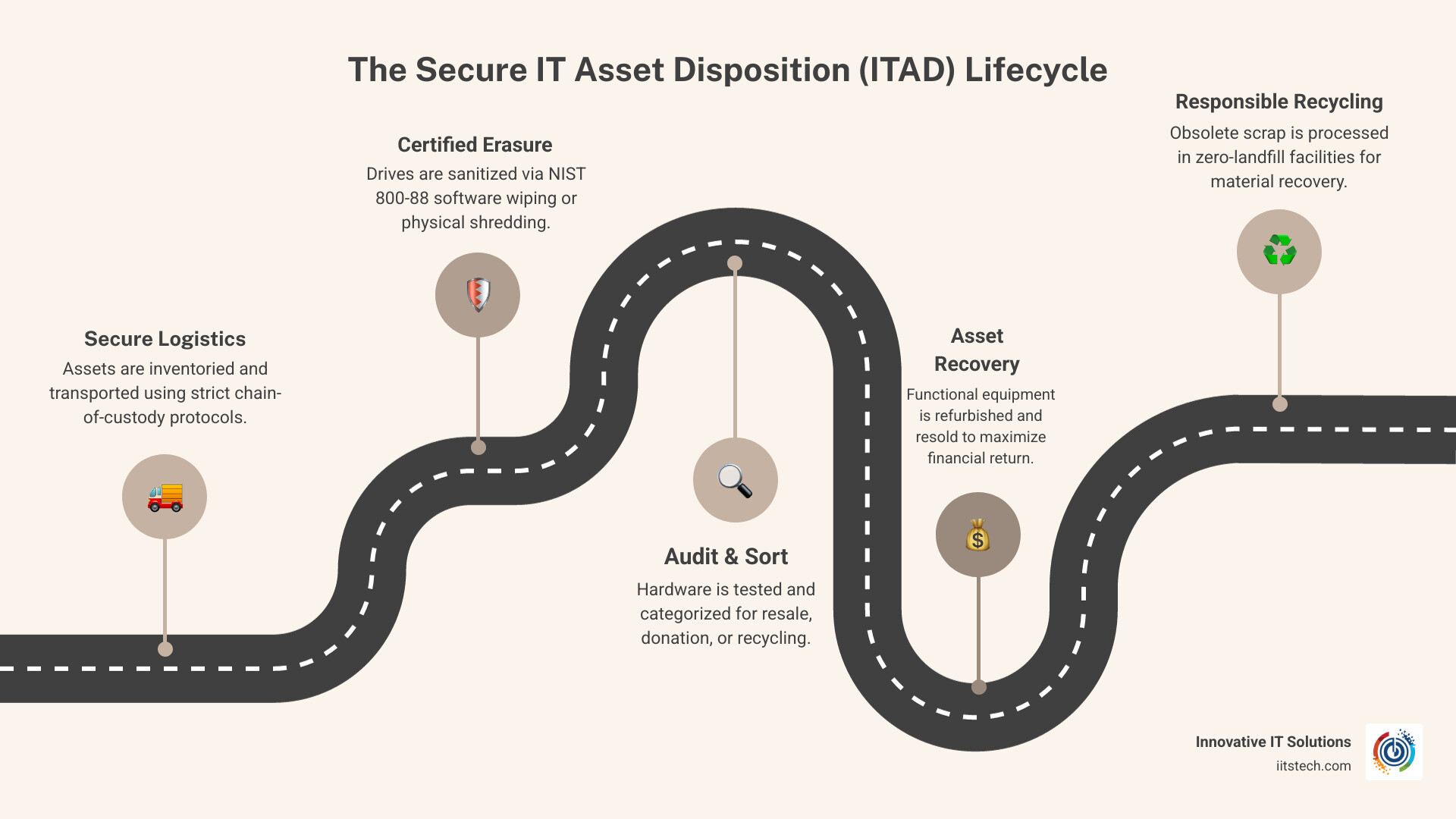
When most people think of “disposal,” they think of a trash can. But in enterprise technology, throwing a laptop in a bin isn’t just a bad idea—it’s a massive liability. This is where IT Asset Disposition (ITAD) comes into play.
While simple disposal is just getting rid of an item, ITAD is a comprehensive lifecycle management strategy. It ensures that every device, from the moment it is unplugged to the moment it is either shredded or resold, follows a documented, secure, and environmentally sound path. Understanding what is IT Asset Disposition (ITAD) and why it matters in 2025 is the first step in moving from a “reactive” IT department to a “strategic” one.
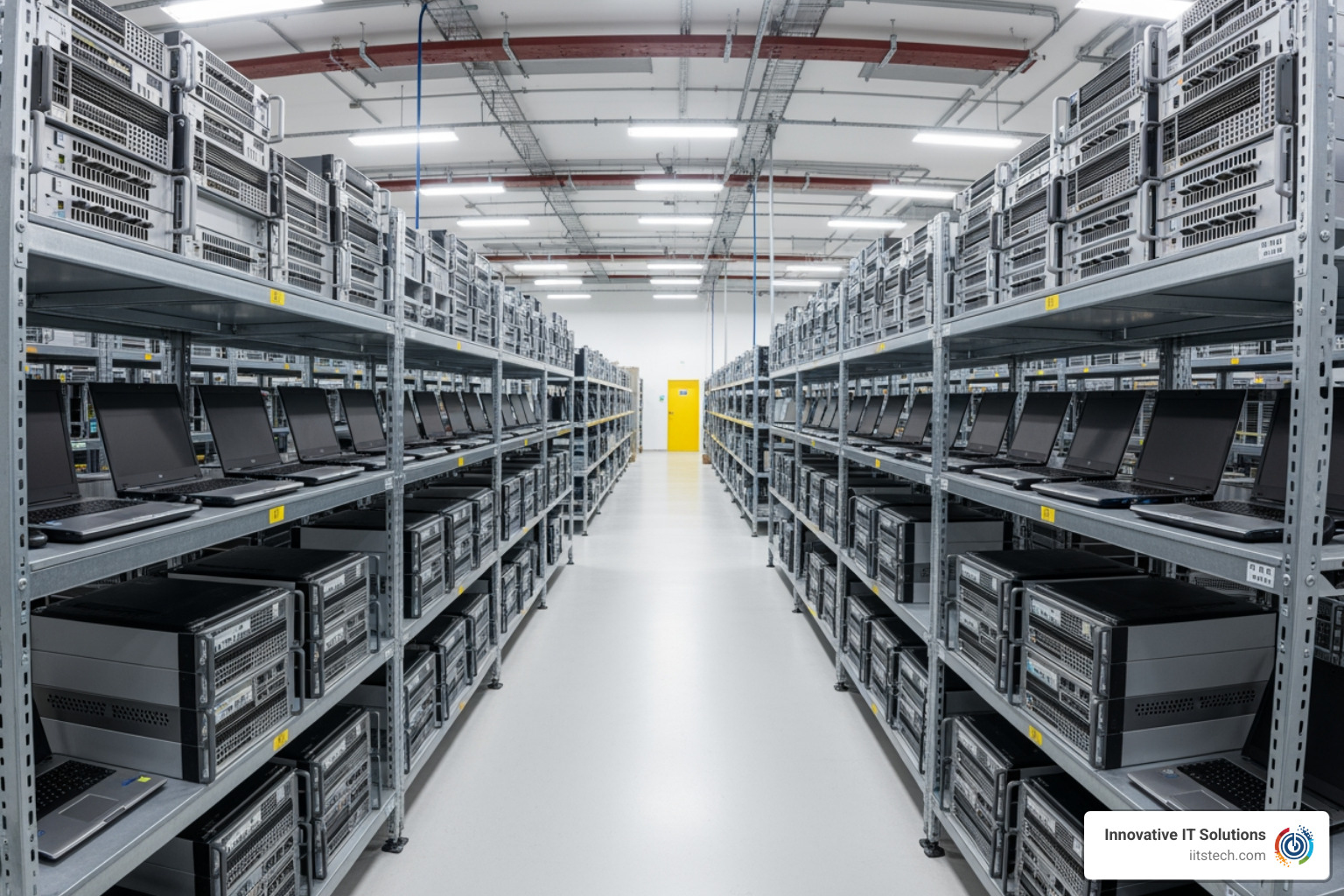
Consider the scale of the problem: if all the desktop computers, laptops, and servers currently in use worldwide were lined up, they would circle the Earth 25 times. That is a staggering amount of hardware that eventually needs a home. Without a formal program, your business faces “stockpiling risk”—where old devices sit in unlocked closets, becoming easy targets for internal theft or accidental data exposure.
By treating computer asset disposal as a core business process, we help you transform a potential cost center into a risk-mitigation engine.
Security Risks and Regulatory Compliance
In May 2026, data is more than just information; it is a regulated asset. If your business operates in Oklahoma or across the United States, you are subject to a web of laws that dictate how you handle “data-bearing assets.”
- HIPAA (Health Insurance Portability and Accountability Act): For our partners in the healthcare sector, a single lost hard drive containing Patient Health Information (PHI) can result in millions of dollars in fines.
- GDPR (General Data Protection Regulation): Even if you are based in South OKC, if you handle data for EU citizens, your disposal methods must meet these stringent privacy standards.
- SOX (Sarbanes-Oxley Act): For public companies, ITAD is a matter of financial transparency and internal control.
The Oklahoma Department of Environmental Quality also provides guidelines on electronics recycling to prevent toxic materials from leaching into our local soil and water.
Regulatory Requirements for Data-Bearing Assets
| Regulation | Primary Focus | Required Disposal Proof |
|---|---|---|
| HIPAA | Patient Privacy | Legally defensible destruction records |
| GDPR | Personal Data Rights | Right to erasure / Verified sanitization |
| SOX | Corporate Accountability | Auditable chain of custody |
| GLBA | Financial Data | Secure disposal of consumer info |
Improperly disposing of equipment isn’t just an “oops” moment. Large corporations have been fined upwards of $35 million by the SEC for failing to oversee the disposal of hard drives properly. When you choose a partner, you aren’t just paying for a truck to pick up boxes; you are paying for a “Liability Shield.”
Data Destruction Standards and Audit Readiness
To be truly secure, “deleting” a file isn’t enough. Professional computer asset disposal requires sanitization that meets the highest industry standards.
The gold standard we follow is NIST 800-88. This Special Publication by the National Institute of Standards and Technology defines three levels of sanitization:
- Clear: Standard software-based overwriting.
- Purge: More advanced methods (like degaussing) that make data recovery impossible even with laboratory tools.
- Destroy: Physical destruction, such as shredding, that renders the media unusable.
Another common benchmark is DoD 5220.22-M, the legacy Department of Defense standard. While NIST 800-88 is now the preferred modern framework, both ensure that your data is gone for good.
The most critical document you will receive at the end of this process is the Certificate of Destruction (COD). This is your “Get Out of Jail Free” card for audits. It ties every individual asset (by serial number) to a specific date and method of destruction. Without a COD, you have no proof for regulators that the data was actually destroyed. For more on these requirements, you can explore industry standards for lifecycle management.
Best Practices for Secure Computer Asset Disposal
To ensure your program is airtight, we recommend these four pillars:
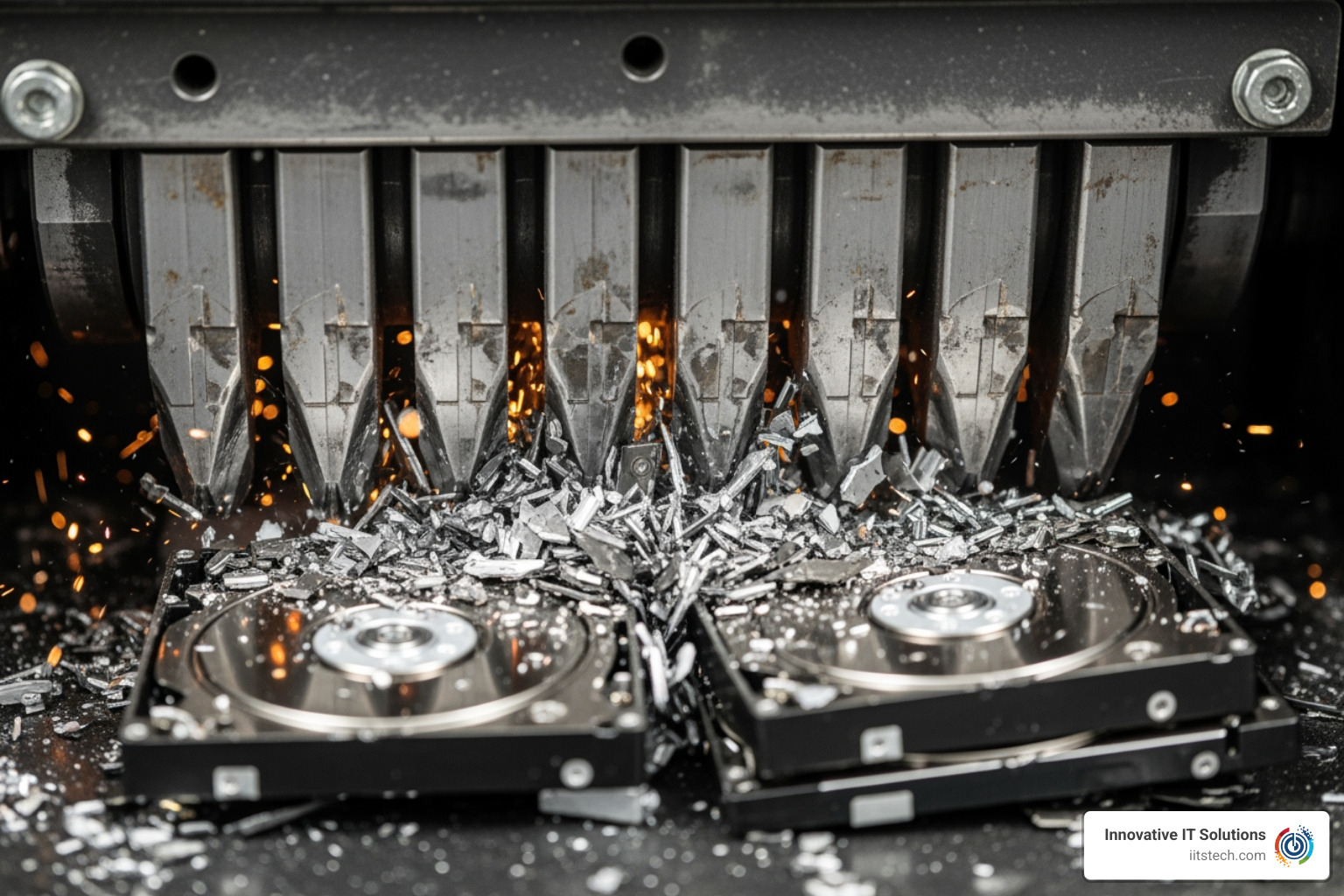
- On-site Shredding: If your data is too sensitive to even leave the building, we bring the shredder to you. Seeing the drives turn into confetti provides ultimate peace of mind.
- Software Wiping: For devices with resale value, we use NIST-compliant software that overwrites every sector of the drive, allowing the hardware to be reused without any trace of your data.
- Serialized Tracking: Every item should be scanned at the point of pickup and tracked through every stage of the journey.
- Secure Chain of Custody: Assets should be transported in locked, GPS-tracked containers to prevent “leakage” during transit.
Financial Recovery and Remarketing
Here is the good news: computer asset disposal doesn’t have to be a pure expense. In fact, it can often be a revenue generator.
Many enterprise-grade laptops and servers that are 3 to 5 years old still have significant value on the secondary market. Through asset remarketing, we can refurbish your retired gear—cleaning it, repairing it, and upgrading components—to sell it to new users.
The results are impressive. Some programs report a total reuse rate of up to 89% for collected units. By remarketing your hardware, you can often offset up to 65% of the cost of your new hardware refresh. This turns a logistics headache into a budget-friendly win.
However, holding onto equipment for too long is a mistake. The real cost of holding on to old IT equipment includes lost resale value, the cost of storage space, and the increased risk of data theft. The longer a laptop sits in a drawer, the less it’s worth and the more dangerous it becomes.
Logistics, Sustainability, and ESG Goals
Sustainability is no longer a “nice to have” for corporate PR; it’s a core requirement. Modern employees and investors care deeply about environmental, social, and governance (ESG) goals. Statistics show that 76% of U.S. employees say sustainability at the workplace is more important than ever.
When you partner with a certified ITAD provider, you ensure that your e-waste doesn’t end up in a landfill in a developing nation. We look for certifications like R2v3 (Responsible Recycling) and e-Stewards, which are the highest global standards for environmental and data security compliance.
A proper program supports the Circular Economy. Instead of a “take-make-waste” model, we prioritize refurbishment and reuse. When an item truly cannot be fixed, it is broken down into raw materials—metals, plastics, and glass—to be used in new manufacturing. This is vital, considering that discarded technology accounts for 70% of the toxic chemicals found in landfills.
By participating in a formal program, you get more than just a clean closet; you get an Environmental Benefits Report that quantifies your CO2 reduction and landfill diversion, which you can proudly include in your annual CSR (Corporate Social Responsibility) report. Want to know more? Check out what happens to your equipment after ITAD.
Managing Specialized Hardware in Computer Asset Disposal
It’s not just about laptops. A comprehensive computer asset disposal strategy must account for:
- Servers and Storage: These require specialized decommissioning, especially in live data center environments where you can’t afford to accidentally unplug the wrong rack.
- Networking Gear: Switches and routers often store configuration data and passwords that must be wiped.
- Mobile Devices: Tablets and smartphones are the fastest-growing category of e-waste and require specific wiping protocols for mobile operating systems.
If you are planning a move, use an end of life IT equipment checklist for office moves and closures to ensure nothing gets left behind or tossed in a standard dumpster during the chaos.
Frequently Asked Questions about Computer Disposal
What is the difference between ITAD and simple recycling?
Simple recycling focuses on breaking a device down into its raw commodities (like copper and plastic). ITAD (IT Asset Disposition) is a broader process that includes secure data destruction, legal compliance, and financial recovery through remarketing. Recycling is just one possible “end” for an asset within an ITAD program.
Why is a Certificate of Destruction essential for audits?
A Certificate of Destruction (COD) is a legally defensible document that proves you have met your regulatory obligations. If an auditor asks where the data from 500 retired laptops went, the COD provides the serial-number-level proof that the data was destroyed according to NIST or DoD standards.
How can my business recover value from old technology?
By choosing a partner that offers remarketing services. We evaluate your equipment’s condition and market demand. If the hardware is functional and relatively modern, we can refurbish and resell it, sharing the proceeds with your company or applying them as a credit toward your disposal fees.
Conclusion
In the world of 2026, computer asset disposal is a critical function of any responsible IT department. Between the skyrocketing risks of data breaches and the urgent need for environmental sustainability, you cannot afford to leave your end-of-life hardware to chance.
At Innovative IT Solutions, we provide a turnkey, “no-nonsense” approach to ITAD. Whether you are in Oklahoma City, South OKC, or anywhere across the state, we offer NIST/DoD-compliant data destruction, zero-landfill recycling, and maximum financial returns on your retired assets.
Don’t let your old equipment become a liability. Protect your brand, your data, and the planet by choosing a partner that handles the entire process with transparency and integrity.
Ready to clear out the clutter and secure your data? Start your electronic recycling program today and let us help you turn your old IT assets into a strategic advantage.


