
Core Methods of Physical Hard Drive Destruction Compared
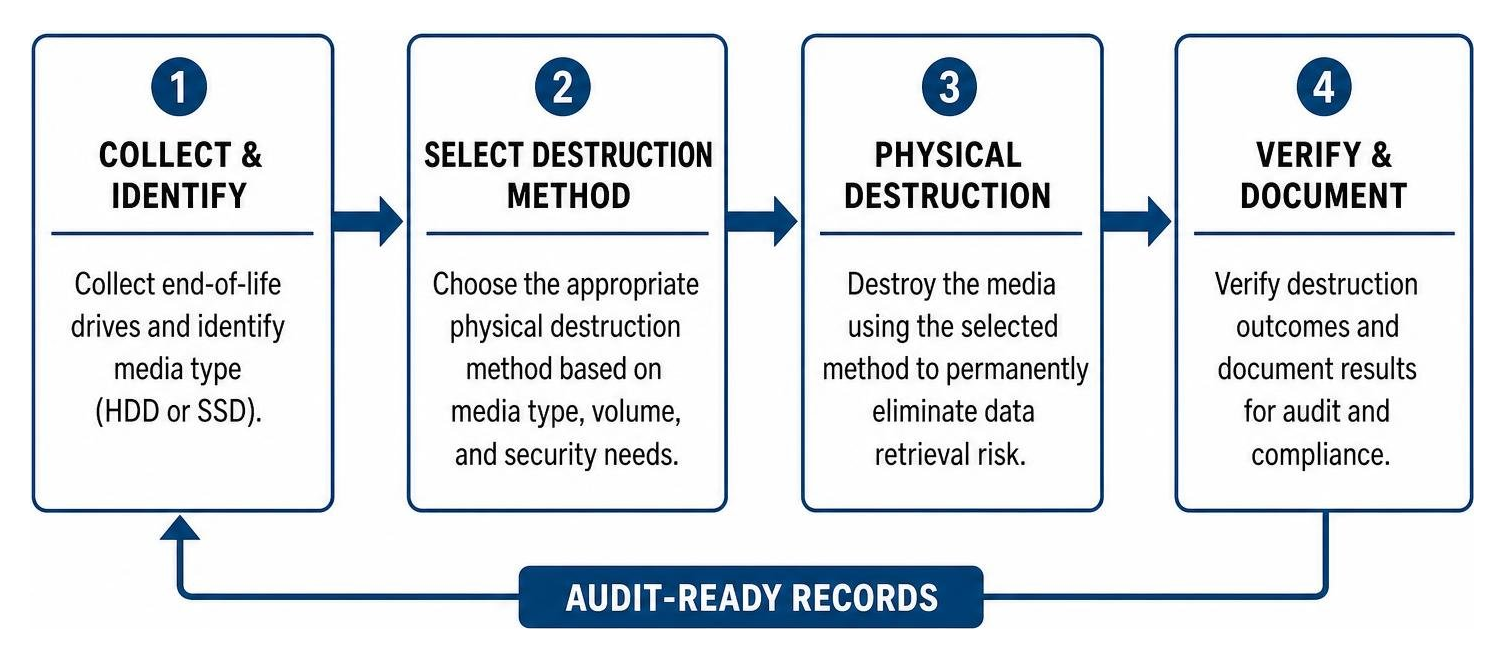
To destroy hard drives securely, start by logging each drive’s serial number, then select a verified physical method: mechanical shredding for high-volume HDD and SSD disposal, magnetic degaussing for magnetic HDDs only, hydraulic crushing for on-site structural destruction, or abrasive grinding for maximum particulate reduction. Complete the process by obtaining a serialized Certificate of Destruction. When decommissioning business-grade IT infrastructure in 2026, relying on standard software deletion is simply not enough. True sanitization requires methods engineered to permanently eliminate data retrieval risks. Depending on whether your data center is decommissioning traditional rotational hard drives (HDDs) or solid-state media (SSDs), different physical destruction approaches offer varying balances of throughput, cost, and security validation.
Understanding the differences between these approaches ensures you select the correct process for your risk profile. Exploring a detailed guide to secure data destruction methods can clarify how different operational environments handle these media types. Furthermore, determining when physical destruction versus data wiping is required helps enterprise IT teams balance asset value recovery against absolute data eradication.
1. Mechanical Shredding
Industrial media shredders use high-torque counter-rotating cutting blades to rip hard drives, server blades, and circuit boards into small, irregular fragments.
- Security Profile: Highly effective for high-volume enterprise decommissioning. Standard industrial shred widths range from 1.5 inches down to 0.75 inches for HDDs, and down to 2mm micro-shreds for SSD flash chips.
- Media Compatibility: Universal. Destroys magnetic platters, SSD NAND flash chips, server arrays, optical media, and circuit boards.
- Throughput: Extremely high (hundreds to thousands of drives per hour).
2. Magnetic Degaussing
Degaussers generate powerful, concentrated electromagnetic pulses (measured in Gauss or Oersteds) that neutralize the magnetic domains across an HDD’s platters, eradicating all stored binary data and formatting tracks instantly.
- Security Profile: Permanently neutralizes magnetic data. Approved by national security bodies for magnetic media sanitization.
- Media Compatibility: Restricted to magnetic storage (HDDs, magnetic tape). Degaussing has zero sanitizing effect on non-magnetic media such as SSDs.
- Throughput: High (typically 1 to 4 drives per charge cycle, taking 10 to 45 seconds).
3. Hydraulic Crushing and Bending
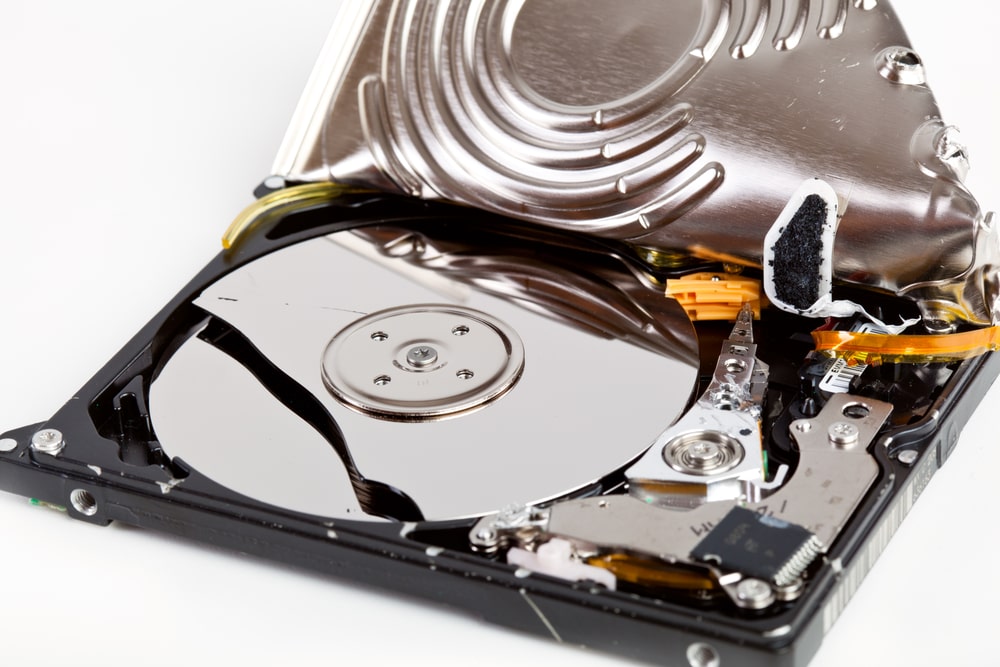
Hydraulic crushers use immense mechanical pressure to drive a hardened steel wedge or anvil directly through the chassis of a drive, bending platters, breaking spindle motors, and fracturing internal electronics.
- Security Profile: High physical destruction that prevents normal drive mounting or read-head alignment.
- Media Compatibility: Magnetic HDDs, hybrid drives, and optical discs. Standard crushing points may leave SSD NAND flash chips intact if the wedge misses the specific microchip locations.
- Throughput: Moderate (60 to 120 drives per hour).
4. Abrasive Grinding
Micro-particle grinding uses high-speed abrasive wheels to mechanically grind storage devices down into fine dust and tiny particulate matter.
- Security Profile: Maximum security. By eliminating physical magnetic or silicon continuity entirely, reconstruction is physically impossible.
- Media Compatibility: Enterprise HDDs, SSDs, server circuit boards, and storage arrays.
- Throughput: Low-to-moderate per machine, but unmatched in forensic finality.
| Destruction Method | Primary Media Supported | Security Level | Processing Speed | Best Operational Fit |
|---|---|---|---|---|
| Mechanical Shredding | HDDs, SSDs, Circuit Boards, Tape | Very High (NIST SP 800-88 Purge/Destroy) | 200 – 1,000+ drives/hr | Enterprise bulk disposal & ITAD processing |
| Magnetic Degaussing | HDDs, Magnetic Tapes Only | High (Magnetic data wiped permanently) | 100 – 300 drives/hr | Secure data centers prior to physical scrapping |
| Hydraulic Crushing | HDDs, Server Storage Drives | High (Severe structural deformation) | 60 – 120 drives/hr | On-site server rooms & low-noise office areas |
| Abrasive Grinding | HDDs, SSDs, Flash Media, Boards | Maximum (Reduced to micro-particulate) | 20 – 60 drives/hr | Highly classified, high-security lab environments |
High-Throughput Equipment for Enterprise Sanitization
Selecting commercial-grade equipment requires balancing destruction throughput with operational realities such as workspace constraints, electrical infrastructure, noise pollution, and hazardous particulate containment. In modern enterprise environments, complying with DoD compliant data destruction standards demands precision hardware designed specifically for server drives.
Automated and Rackmount Hard Drive Destruction Systems
For high-density server environments and colocation data centers, deploying freestanding industrial machinery is rarely practical due to floor space and power limits. Specialized solutions like the MediaVise Rackmount HDD Destroyer (MVR-HDD) solve this challenge by integrating commercial-grade destruction directly into a standard data center server rack.
- Form Factor and Power Integration: Operating within a compact 9 rack unit (9RU) footprint—compared to traditional standalone units taking up 17RU or dedicated floor footprints—rackmount destroyers allow on-site physical destruction immediately after unmounting drives from blade servers.
- Destructive Force: Incorporating heavy-duty hydraulic rams that deliver 20 tons (40,000 lbs) of crushing force, these units crush, warp, and mangle platters, read heads, and internal controller boards in under 30 seconds.
- Throughput & Longevity: Rated for a throughput of up to 120 enterprise drives per hour, these systems feature heavy-duty components boasting lifecycles of up to 50,000 continuous cycles without requiring blade replacements or sharpening.
- Environmental & Acoustic Controls: Unlike industrial outdoor shredders, rackmount units operate at an ultra-quiet 65 dB (well below the OSHA workplace noise threshold of 85 dB). Integrated HEPA air filtration captures airborne particulate, while locked collection drawers (holding up to 25 standard 3.5-inch enterprise drives or 50 compact 2.5-inch enterprise drives) protect technicians from sharp debris.
- Regulatory Approval: Evaluated under NSA specifications and compliant with CE and EPA guidelines, these systems provide certified sanitization right at the rack.
Manual and Field-Ready Hard Drive Destruction Devices
Not every disposal scenario occurs within a fully powered modern data center. In field operations, emergency branch closures, or remote installations where power is unavailable, manual equipment becomes essential.
The MHDD-N Manual Hard Drive Destroyer serves this exact operational need:
- Electricity-Free Reliability: Powered entirely by a manual hand-crank mechanism (with an optional motorized upgrade for 100–250 VAC), the system requires zero electricity, rendering it immune to local power failures or field infrastructure limitations.
- Cycle Speed: An operator can completely bend and warp an enterprise hard drive in 8 seconds or less by cranking the drive assembly, delivering an operational throughput of approximately 200 drives per hour.
- Structural Destruction: The internal mechanism bends the internal magnetic platters past 90 degrees, physically shattering ceramic/glass substrate platters or permanently stretching aluminum substrates while shearing internal spindle assemblies and controller boards.
- Portability: Weighing approximately 35 pounds (with a compact footprint of 7.25″ W x 9.25″ D x 16″ H), the MHDD-N is deployed by national security teams, defense agencies, and mobile IT technicians worldwide for field sanitization.
Micro-Particle Mechanical Grinding Technology
When organizations require data security that eliminates even microscopic recovery attempts, abrasive grinding represents the pinnacle of physical destruction.
Detailed in systems such as US Patent 8251303, this mechanical engineering method bypasses the limitations of traditional shredding. While industrial shredders might leave intact platter fragments measuring several centimeters, an abrasive grinding system uses a rotatable abrasive grind wheel paired with a controlled hydraulic or pneumatic pressure arm.
The rotating grinding wheel mechanically abrades the drive chassis, platters, and silicon chips layer by layer, turning the physical media into fine particulate dust. This process completely eliminates any magnetic media continuity, making it physically impossible for forensic laboratories to read remnant magnetic flux patterns. Advanced configurations include automated pre-destruction imaging cameras and micro-particulate collection receptacles to support strict GLBA and HIPAA disposal documentation.
Regulatory Standards, Environmental Controls, and Chain of Custody
Physical media destruction must always occur alongside rigorous administrative controls. Destroying a drive physically provides no regulatory protection if your organization cannot prove which drive was destroyed, when, and by whom.
Core Regulatory Standards
Enterprise data disposal strategies must adhere to key government and industry sanitization frameworks:
- NIST SP 800-88 Rev. 1 (Guidelines for Media Sanitization): The gold standard across enterprise computing, defining three sanitization levels: Clear (logical overwriting), Purge (degaussing or low-level firmware sanitization), and Destroy (physical shredding, grinding, or incineration).
- NSA/CSS Storage Device Declassification Manual: Dictates exact parameters for high-security sanitization, including strict particle-size thresholds for physical shredding and crushing mechanisms.
- Department of Defense (DoD) Guidelines: Define baseline compliance for media handling across defense-contracted infrastructure.
Following the blueprint for certified data-bearing destruction in enterprise IT ensures every tier of compliance is fully satisfied before retired drives leave your custody.
Maintaining an Unbroken Chain of Custody
To eliminate risk during asset disposition, enterprise organizations should implement a structured chain of custody:
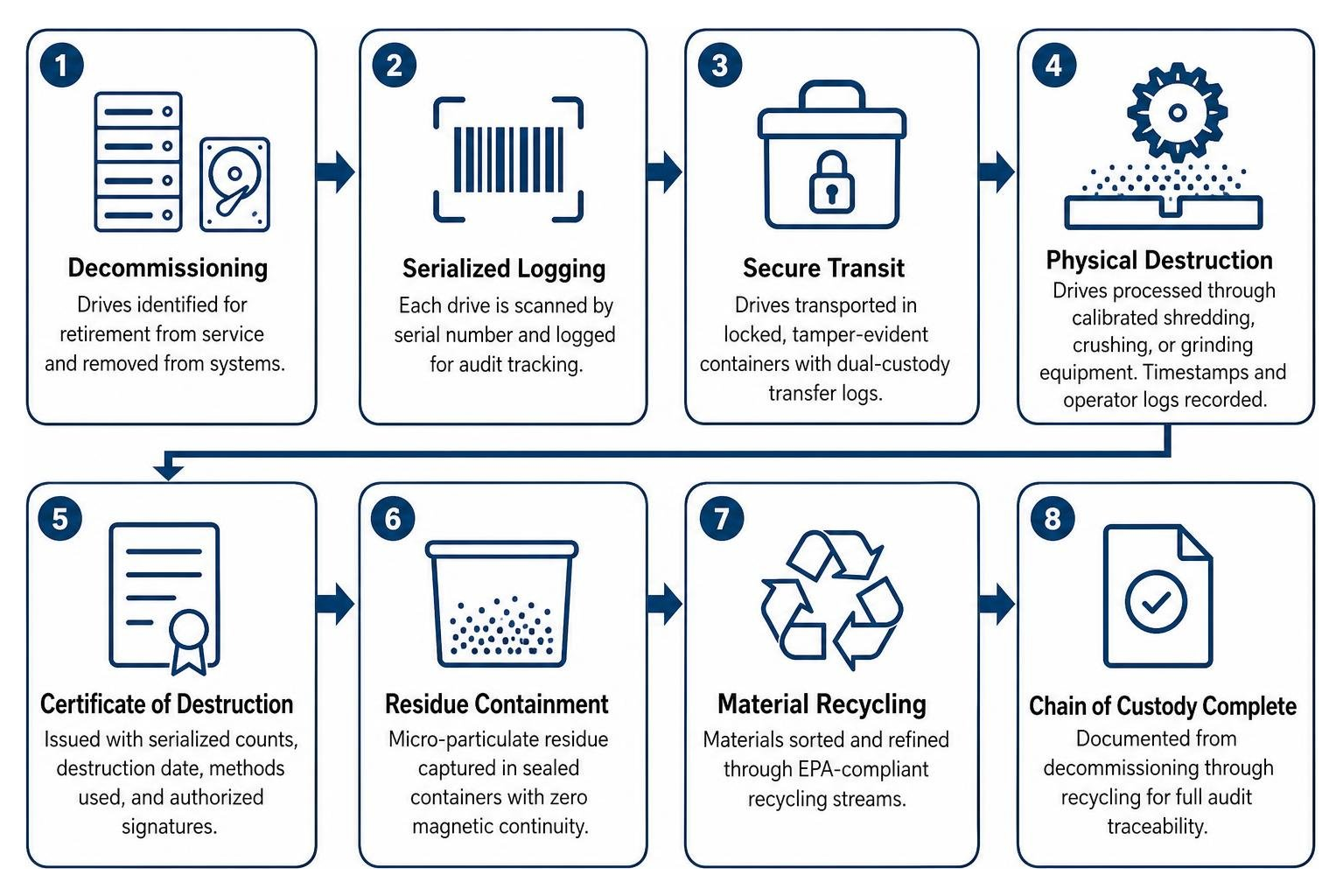
- Serialized Logging: Every hard drive, server blade, and enterprise SSD must be scanned by its unique manufacturer serial number prior to unmounting or physical processing.
- Tamper-Evident Transit: If hardware is moved off-site for processing, it must travel in locked, tamper-evident security containers with dual-custody transfer logs.
- Audited Sanitization: Drives are processed through calibrated shredding, crushing, or grinding equipment with timestamps and operator logs recorded.
- Certificate of Destruction (COD): The process finishes by obtaining a certified Certificate of Destruction that records serialized device counts, exact destruction dates, compliance methods used, and authorized personnel signatures.
Environmental Responsibility & Zero-Landfill ITAD
Physical drive destruction generates complex e-waste containing aluminum, steel, rare-earth neodymium magnets, silicon, and copper. Responsible IT asset disposition processes enforce strict zero-landfill protocols. Debris collected from industrial shredders or crushing collection bins must be sorted, refined, and recycled through EPA-compliant metallurgical refining streams rather than discarded into municipal waste systems.
Choosing the Right Sanitization Strategy for Business Hardware
Deciding on an optimal destruction strategy depends on your physical facility constraints, media formats, and compliance requirements. Adopting essential hard drive shredding practices while following secure business hard drive disposal guidelines ensures your organization avoids costly regulatory liabilities.
- Evaluate Media Types: If your storage fleet contains enterprise SSDs or NVMe arrays, magnetic degaussing is ineffective. Use high-torque mechanical shredders with appropriate screen sizing or abrasive grinding to ensure all NAND silicon dies are fractured.
- Assess Operational Volume: Data centers decommissioning thousands of drives annually benefit from integrated 9RU rackmount crushers or continuous high-throughput off-site shredding services. Low-volume remote facilities or emergency response kits are best served by rugged manual-crank systems.
- Account for Power and Space: When deploying sanitization hardware within live server rooms, prioritize low-decibel systems (under 65 dB) equipped with closed HEPA filtration systems to maintain indoor air quality and worker safety.
Frequently Asked Questions about Hard Drive Destruction
Can data be recovered from crushed or bent hard drive platters?
For traditional hard drives, bending aluminum platters beyond 90 degrees or fracturing ceramic-glass platters with 20 tons of hydraulic force creates catastrophic structural damage. The read-and-write head assembly, spindle motor, and controller electronics are broken, and the platter surface is physically distorted. While high-end laboratories might theoretically access isolated magnetic fragments using magnetic force microscopy if flat sections survive, complete file reconstruction becomes practically impossible. For absolute military-grade security, combining crushing with secondary shredding or micro-particle grinding completely removes any microscopic recovery vector.
What certifications verify that physical media destruction meets national security standards?
Physical media destruction devices are evaluated and listed by agencies such as the National Security Agency (NSA/CSS Evaluated Products List) to verify they meet rigorous sanitization standards. In enterprise sectors, compliance is verified by following NIST SP 800-88 Rev. 1 guidelines, along with CE electrical safety standards, EPA e-waste protocols, and third-party ITAD certifications that audit security and environmental responsibility.
Why is degaussing ineffective for solid-state drives and modern enterprise flash storage?
Degaussing works by generating an intense magnetic pulse that disrupts the microscopic magnetic polarities used to store data on magnetic platters and tapes. Solid-state drives (SSDs), NVMe arrays, and enterprise PCIe flash storage do not rely on magnetic domains; they store data using electrical charges within non-volatile floating-gate transistors and NAND flash cells. Because magnetic fields have zero effect on electrical charges in silicon chips, degaussing leaves solid-state data completely untouched. SSDs require physical shredding down to 2mm particle sizes or micro-abrasive grinding to be destroyed.
Conclusion
Managing retired enterprise storage hardware requires clear processes, technical understanding, and careful documentation. Whether your infrastructure team utilizes high-force rackmount crushers, field-ready manual systems, or bulk industrial shredding, physical destruction remains the ultimate guarantee against corporate data breaches.
At Innovative IT Solutions, we provide enterprise-grade, NIST- and DoD-compliant asset disposition and zero-landfill e-waste solutions. Discover our trusted approach to certified hard drive destruction and ITAD solutions to safeguard your data assets, maintain verifiable compliance records, and streamline your hardware decommissioning workflows.


