
What Happens When You Audit Every IT Asset in Your Enterprise
Why IT Asset Audit Services Matter Before Hardware Leaves Your Control
IT asset audit services give enterprises a verified record of their computers, servers, and server components: what exists, where it is, who owns it, what condition it is in, and whether its records match reality. Before a hardware refresh, merger, compliance review, or decommissioning project, an audit helps IT teams find missing, duplicate, idle, and unmanaged assets before they become a security, budget, or disposal problem.
A strong audit combines automated discovery with physical verification. It reconciles serial numbers, locations, ownership, lifecycle status, and related records, then flags gaps that need action. This matters because cloud sprawl and shadow IT can hide costs and risk; research suggests many organizations lack accurate visibility into cloud instances and cloud-deployed licenses.
For retired enterprise hardware, the stakes are higher. An accurate audit creates the starting point for secure chain of custody, data sanitization, compliant disposition, and asset recovery. You cannot confidently destroy, resell, recycle, or redeploy a server if you cannot prove what it is and where it has been.
I am Mike Haden, Founder and Director of Business Development at Innovative IT Solutions, with 14 years of experience in secure enterprise hardware processing, auditing, data sanitization, resale, and responsible IT asset disposition. Our work with IT asset audit services is built around clear records, documented procedures, and secure handling from inventory through final disposition.
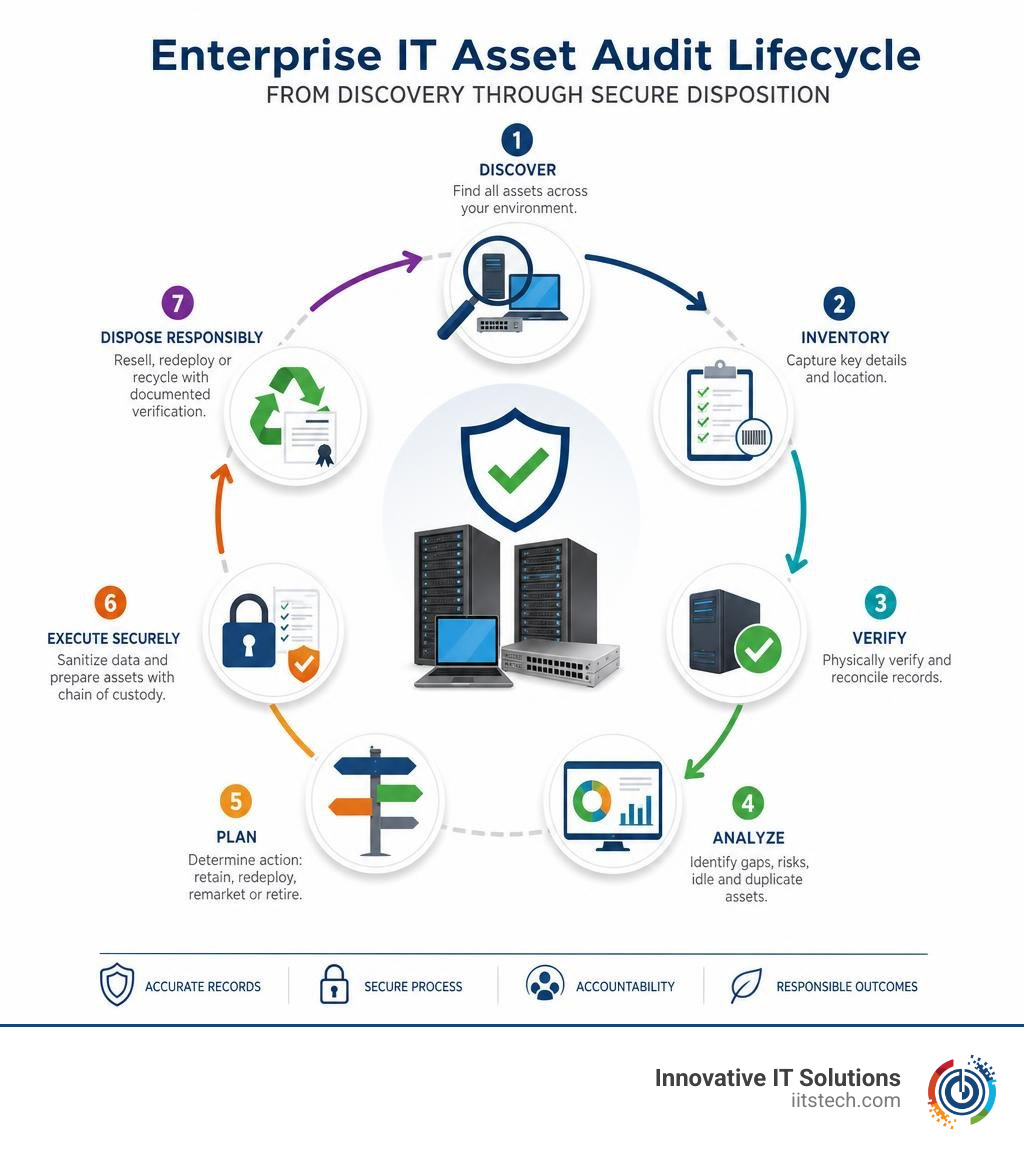
It asset audit services terms made easy:
What Is an IT Asset Audit and Why Is It Essential?
An IT asset audit is a structured evaluation of an organization’s physical and digital technology infrastructure. It evaluates hardware specifications, exact locations, ownership assignments, operational health, maintenance agreements, and license allocations.
In enterprise environments with sprawling data centers, distributed branch offices, and multi-cloud architectures, IT assets multiply rapidly. Without continuous oversight, physical servers, storage arrays, networking appliances, and corporate workstations drift away from centralized records. This drift creates “ghost assets”—items appearing on balance sheets that no longer physically exist—and “zombie assets”—active, power-consuming hardware performing no functional business task.
Auditing every asset establishes a single source of truth. As detailed in the essential guide to IT asset management and disposal, aligning operational inventories with financial ledgers prevents over-purchasing, uncovers obsolete equipment, and mitigates compliance failures.
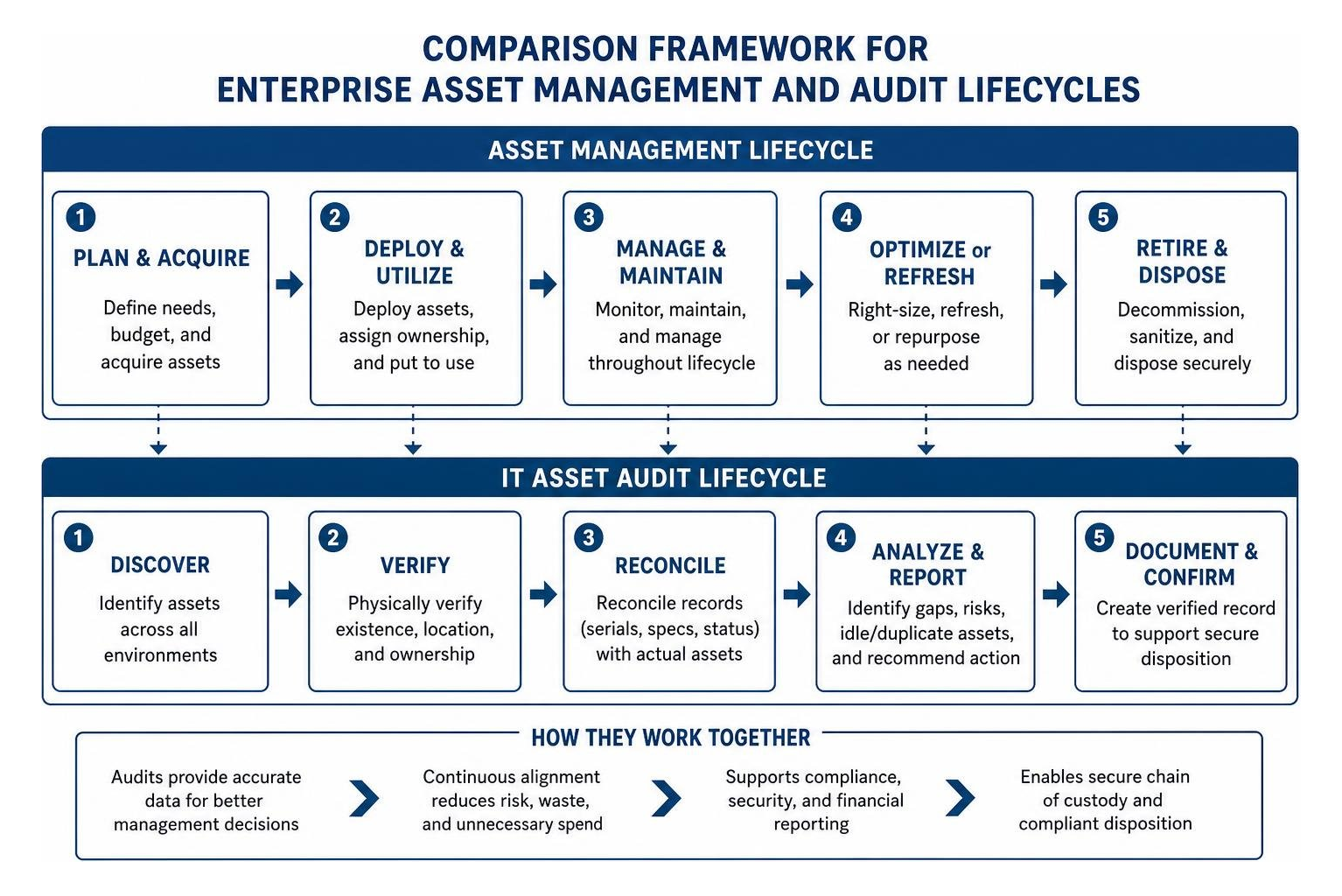
Internal vs. External IT Asset Audits
Enterprises must determine whether an audit should be handled by an internal team or an objective third-party provider. Both methods serve vital roles in organizational governance, but they offer different scopes and operational advantages.
| Factor | Internal IT Asset Audit | External IT Asset Audit Services |
|---|---|---|
| Primary Objective | Day-to-day operational visibility, routine maintenance, local inventory hygiene | Objective verification, regulatory compliance, financial validation, M&A prep |
| Execution Team | In-house IT, systems administrators, internal compliance officers | Specialized third-party auditors, certified ITAD engineers |
| Bias & Objectivity | Prone to operational blind spots, legacy assumptions, and departmental bias | 100% objective, independent data capture and ledger verification |
| Audit Preparation Speed | Often manual and fragmented across departmental spreadsheets | Unified platforms delivering up to 40% faster audit preparation |
| Tools & Technology | Basic inventory scanners, endpoint management tools, internal CMDBs | Advanced automated network scanners, RFID, immutable ledgers, AI analytics |
| Compliance Readiness | Moderate; may miss niche regulatory nuances | Provides ~45% higher audit-readiness and compliance accuracy |
| Resource Impact | Diverts internal IT staff from core business projects and tickets | Fully turnkey; minimal disruption to internal daily operations |
The Step-by-Step Enterprise IT Asset Audit Process
Conducting an enterprise-grade hardware audit requires a systematic approach combining automated network telemetry with on-the-ground physical inspection.

State and regional organizations often publish clear ITAM frameworks, such as the IT asset management standards from Oklahoma.gov, highlighting the importance of systematic tracking across agencies. A comprehensive audit process follows three distinct phases:
Phase 1: Automated Discovery and Baseline Mapping
Auditors deploy agentless and agent-based discovery tools to scan enterprise subnets, cloud environments, and hybrid endpoints. Modern scanning engines can map over 12,800 assets into a unified discovery topology.
- Network & Subnet Scans: Passive and active network scans catalog every device communicating via IP address, identifying switches, host machines, blade chassis, and connected peripherals.
- Cloud & Virtualized Topology Ingestion: Automated connectors hook into AWS, Azure, and private hypervisors to identify active compute instances, storage buckets, and virtual networking gateways.
- Shadow IT Identification: Automated scanning uncovers unmanaged endpoints—often discovering that up to 60% of active network assets were previously unknown or untracked by centralized IT.
Phase 2: Physical Inventory and Hardware Verification
Automated discovery cannot reveal if a physical server has a failing drive bay, sits unbolted in an unmonitored rack, or has been physically removed from a facility. Physical verification bridges this gap:
- On-Site Floor Audits: Technicians walk data centers, server rooms, and office suites, physically validating serial numbers, asset tags, rack units, and equipment condition.
- Barcode and RFID Serialization: Barcode scanning and RFID tagging create permanent, tamper-evident identifiers for every workstation, server blade, power supply unit, and storage array.
- Hardware Lifecycle Assessment: Technicians evaluate equipment wear, thermal performance, and physical integrity—critical data when reviewing what IT managers need to know before a hardware refresh.
Phase 3: Reconciliation, Licensing, and Deliverable Reporting
The final phase merges physical observations with digital discoveries and financial records:
- Discrepancy Analysis: The audit team flags gaps where physical hardware exists without an active software record, or where an active financial lease pays for non-existent machinery.
- Software & License Matching: Installed software signatures are matched against purchased entitlements.
- Audit-Ready Ledger Delivery: The audit concludes with a comprehensive, immutable digital ledger detailing every asset’s serial number, specifications, physical location, operational health, and immediate risk profile.
Core Benefits of Professional IT Asset Audit Services
Executing a comprehensive enterprise hardware audit delivers immediate operational, financial, and regulatory returns:
- 10–15% Annual IT Cost Optimization: Eliminating ghost assets, redundant server components, and unused software maintenance agreements delivers immediate capital savings.
- 30–40% Reduction in Manual Reconciliation: Automated audit platforms eliminate hundreds of hours spent updating spreadsheets across disparate enterprise departments.
- 98% Compliance Alignment: Rigorous documentation aligns IT architectures with strict data security mandates, detailed in our guide to keeping your business audit-ready and secure through ITAD compliance.
- Accurate Capital Forecasting: Engineering leaders can plan 3- to 5-year hardware upgrade cycles using real performance and age data rather than rough estimates.
How IT Asset Audit Services Uncover Shadow IT and Cloud Sprawl
Industry surveys reveal that 50% of organizations do not have accurate visibility into their active cloud instances, and only 27% maintain true visibility over licenses deployed in the cloud. Furthermore, 45% of enterprise executives identify shadow IT and unmanaged resources as primary drivers of massive technology budget overruns.
When departments deploy unauthorized servers, test environments, or cloud workloads without IT oversight, they create security vulnerabilities and run up compounding expenses. Comprehensive asset audits identify these rogue environments, bringing them back under security monitoring and financial control.
Mitigating Security Risks and Regulatory Non-Compliance
Unmonitored servers and legacy computers represent significant enterprise breach risks. Devices that miss regular patching schedules because they are omitted from the centralized inventory leave open doors for network intrusions.
During an audit, every data-bearing device is cataloged and evaluated against NIST SP 800-88 and DoD sanitization standards. This step ensures that when hardware reaches end-of-life, it transitions seamlessly into verified disposition channels. As explored in our analysis of why ITAD should be part of your cybersecurity strategy, data security does not end when a device is unplugged; it requires continuous verification until final data destruction is complete.
Turning Audit Findings into Value Through IT Asset Disposition
Once an audit identifies idle, redundant, or end-of-life servers and computers, organizations face a critical decision: allow obsolete hardware to collect dust in storage rooms or capture its remaining market value.

Retaining retired enterprise equipment creates ongoing storage costs, inventory overhead, and security liabilities. A comprehensive audit categorizes hardware by its remaining economic life:
- Internal Redeployment: High-spec components (CPUs, high-density RAM, enterprise SSDs) are harvested to upgrade existing operational infrastructure.
- Remarketing and Value Recovery: Modern servers, networking switches, and enterprise workstations are sanitized, tested, and resold on secondary markets, allowing businesses to transform idle server racks and enterprise hardware into working budget.
- Sustainable Electronics Recycling: Completely obsolete or damaged hardware undergoes certified recycling, extracting base metals while adhering to zero-landfill and EPA guidelines.
Selecting the Best IT Asset Audit Services for Enterprise Environments
Choosing an audit and ITAD partner requires evaluating technical capabilities, compliance certifications, and security practices. When reviewing service providers, verify the following criteria:
- Industry Certifications: Look for R2v3, ISO 9001, ISO 14001, and ISO 45001 certifications to verify responsible recycling and data protection standards.
- Strict Data Sanitization Procedures: Ensure the provider adheres strictly to NIST SP 800-88 Rev. 1 and DoD 5220.22-M guidelines for physical shredding and cryptographic wiping.
- Chain of Custody Tracking: The provider must offer serialized tracking from the moment hardware is scanned on-site to its final remarketing or downstream destruction.
- Transparent Service Level Agreements (SLAs): Ensure the vendor provides clear turnaround times for audit deliverables, reconciliation reports, and Certificates of Destruction.
For a broader evaluation framework, read our guide on how to choose the right ITAD vendor for your business.
Frequently Asked Questions About IT Asset Audits
What is included in a final IT asset audit report?
A comprehensive IT asset audit deliverable includes:
- Master Hardware Inventory: Serial numbers, asset tag IDs, make, model, form factor, processor specifications, RAM capacity, and drive configurations.
- Physical Location & Rack Maps: Detailed site, room, rack unit, and desk assignments for every verified unit.
- Lifecycle & Health Ratings: Operational condition, age, warranty status, and expected remaining useful life.
- Licensing Reconciliation: Installed operating systems and enterprise applications mapped against purchasing records.
- Risk & Remediation Matrix: A prioritized list of unmanaged endpoints, end-of-life operating systems, missing patches, and unallocated hardware recommended for immediate redeployment or retirement.
How often should enterprises conduct comprehensive IT asset audits?
Enterprises should conduct a full, end-to-end IT asset audit at least once per year. In addition, targeted audits should be triggered during specific organizational events:
- Prior to major data center migrations or hardware refreshes.
- During corporate mergers, acquisitions, or divestitures.
- Ahead of major third-party regulatory compliance or financial accounting reviews.
- On a quarterly basis for high-churn assets like remote workforce laptops.
How does an asset audit support hardware decommissioning and data destruction?
An audit establishes the baseline registry required for secure decommissioning. By recording serial numbers before hardware is unmounted, IT managers can track every data-bearing hard drive and solid-state disk throughout the data wiping or physical shredding process.
Once destroyed, serial numbers are matched against the audit log to generate a serialized Certificate of Destruction, as outlined in our overview of understanding EPA and industry standards for data destruction.
Conclusion
Auditing every IT asset across your enterprise changes IT operations from a reactive guessing game into a predictable, optimized engine. Gaining complete visibility into your computers, server racks, and storage infrastructure lowers operating expenses, strengthens cybersecurity postures, and ensures total regulatory compliance.
At Innovative IT Solutions, based in Oklahoma City, Oklahoma, we help enterprises bridge the gap between complex hardware inventory audits and profitable, secure IT asset disposition. Whether you need on-site physical auditing, NIST-compliant data sanitization, zero-landfill e-waste recycling, or maximum value recovery on retired server fleets, our team delivers transparent, certified results.
Unlock hidden capital in your enterprise hardware today—explore our turnkey solutions for enterprise asset recovery and take complete control of your IT lifecycle.


