
Why Understanding What Is the Environmental Impact of E-Waste Matters for Your Business
What is the environmental impact of e-waste? Here is a quick answer:
| Environmental Impact | What Happens |
|---|---|
| Soil contamination | Heavy metals like lead and cadmium leach from discarded hardware into the ground |
| Water pollution | Toxic substances seep into groundwater and drinking water supplies |
| Air pollution | Open burning releases dioxins, furans, and carcinogenic particulate matter |
| Human health | Exposure causes neurological damage, developmental disorders, and DNA damage |
| Climate impact | Manufacturing and improper disposal release significant greenhouse gas emissions |
Every time a company decommissions a server rack or retires a fleet of business PCs, those devices carry a hidden environmental cost. The world generated 62 million metric tonnes of e-waste in 2022 — and less than a quarter of it was formally recycled. The rest? Largely dumped, burned, or exported to countries with little capacity to handle it safely.
For IT managers, this is not just an abstract global problem. The servers, motherboards, and power supply units sitting in your storage room right now contain lead, mercury, cadmium, and brominated flame retardants. How they are disposed of determines whether those substances stay contained — or end up in soil, water, and air.
I’m Mike Haden, Founder and Director of Business Development at Innovative IT Solutions, where I have spent 14 years helping enterprises responsibly manage decommissioned IT hardware through certified ITAD practices — directly addressing what is the environmental impact of e-waste at the business level. In that time, we have processed over a million pieces of enterprise equipment, keeping hazardous materials out of landfills while recovering value for our clients.
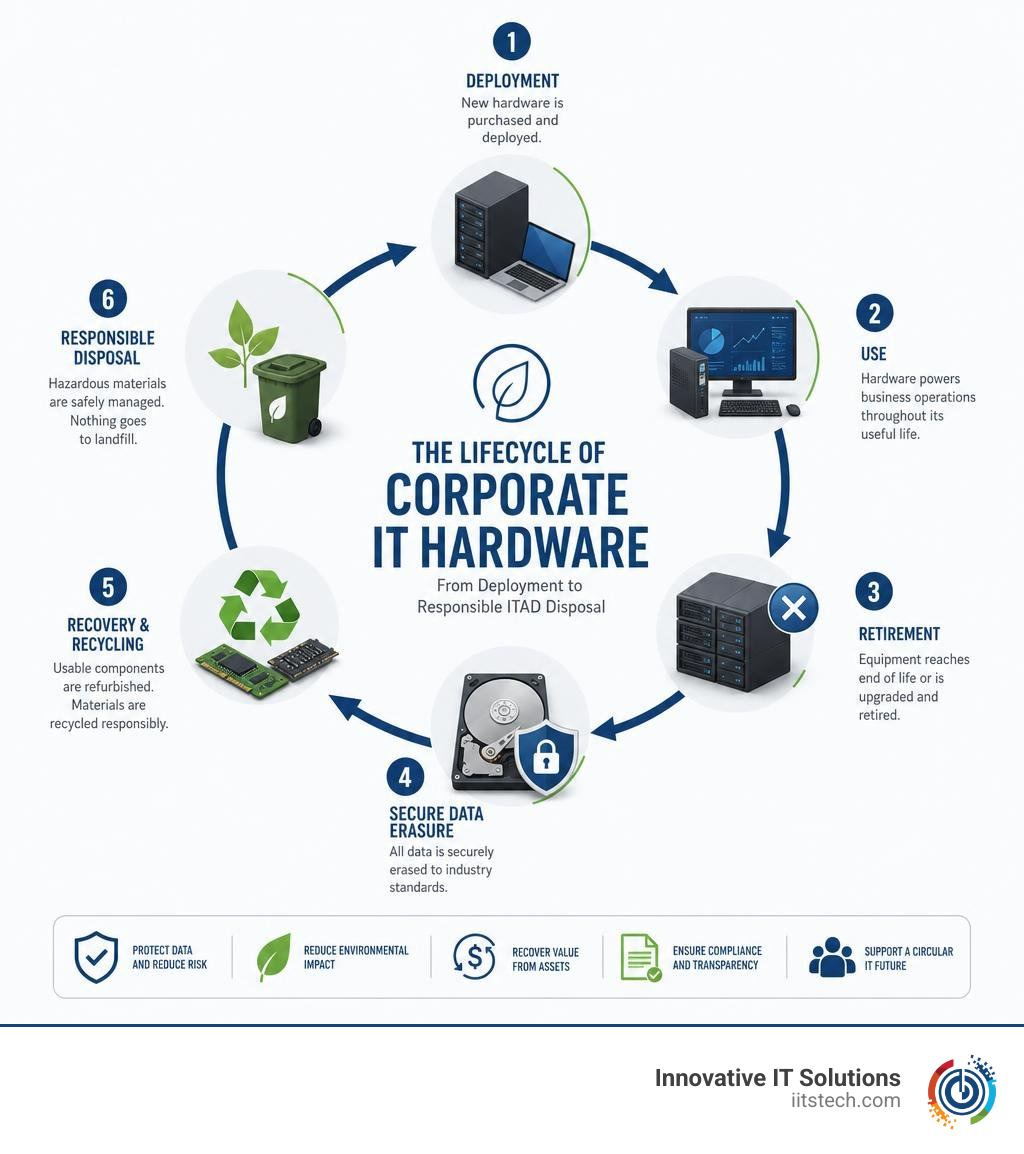
Understanding the Corporate E-Waste Crisis
Modern enterprise operations rely on massive computing power. From high-performance data centers to employee workstations, corporate IT infrastructure is the backbone of daily business. However, this reliance has created an unprecedented environmental challenge: the corporate e-waste crisis.
When we look at the lifecycle of enterprise equipment, the timeline is surprisingly short. Enterprise servers, storage arrays, and network switches are typically designed for a corporate lifecycle of three to five years before they are replaced with faster, more energy-efficient models.
This rapid turnover is driven by software upgrades, escalating security demands, and the continuous push for higher processing speeds. Unfortunately, keeping older hardware running beyond its optimal operational window can also lead to hidden operational drains, as detailed in our guide on The Hidden Environmental Cost of Keeping Old IT Equipment.
When companies treat hardware as disposable, the volume of electronic debris swells. According to The Global E-waste Monitor 2024, e-waste generation is growing nearly five times faster than documented formal recycling rates. This gap leaves millions of tons of heavy metals and plastics unaccounted for, presenting a severe risk to ecosystems worldwide.
The Rapid Growth of Enterprise IT Hardware Waste
The sheer scale of enterprise-level hardware consumption is immense. Consider a standard corporate data center: a single server rack contains dozens of server blades, power distribution units, backup batteries, and miles of cabling. When a data center undergoes a refresh, thousands of pounds of high-density hardware are decommissioned simultaneously.
Business PCs, laptops, and enterprise monitors also contribute heavily to this volume. Corporate deployments involve hundreds or thousands of identical units being retired in single blocks, creating concentrated volumes of waste. The Environmental Impact of Corporate Electronic Waste is profound because corporate hardware contains highly concentrated amounts of engineering plastics, flame retardants, and valuable yet toxic metals that require specialized processing to recover safely.
Global E-Waste Statistics and the 2026 Landscape
As we navigate through 2026, the global footprint of electronic waste has reached staggering proportions. In 2022, the world generated 62 million metric tonnes (MMT) of e-waste, which amounts to roughly 7.8 kg per person globally. Of this massive volume, only 22.3% was formally documented as collected and recycled in an environmentally sound manner.
The trajectory shows no signs of slowing down. Analysts predict that global e-waste generation will surge to 82 million metric tonnes by 2030.
For a closer look at these trends, The Environmental Impact of E-Waste | Earth.Org notes that the gap between what we produce and what we safely recycle is widening. This massive disparity means that millions of tons of enterprise-grade equipment end up in landfills or informal processing yards, where toxic components slowly degrade and escape into the wild.
What Is the Environmental Impact of E-Waste?
To truly grasp what is the environmental impact of e-waste, we must look at how these complex machines interact with the natural world once they are discarded. Unlike organic waste, corporate electronics do not biodegrade. Instead, they undergo photo-degradation and chemical weathering, breaking down into microplastics and releasing hazardous chemicals.
When enterprise hardware is dumped into landfills or processed using crude, informal methods, it triggers a chain reaction of environmental degradation. Toxic chemicals leach into the ground, wash into waterways, and evaporate or drift into the atmosphere. For a comprehensive overview of these destructive pathways, explore our article on What Are the Effects of E-Wastes on the Environment?.
Soil Contamination and Heavy Metal Leaching
Soil is often the first environmental compartment to absorb the impact of improper e-waste disposal. Server motherboards, central processing units (CPUs), and memory modules are held together by complex solders and platings containing heavy metals like lead and cadmium.

When left exposed to rainwater and acidic landfill conditions, these metals oxidize and dissolve. They seep into the surrounding soil, altering its pH, killing essential microbial communities, and reducing agricultural viability. Over time, plants absorb these heavy metals through their root systems, introducing toxins into local agricultural food chains and threatening biodiversity.
Water Pollution and Groundwater Seepage
The contamination does not stop at the soil. Once heavy metals and persistent organic pollutants leach through the topsoil, they migrate downward into groundwater aquifers. This seepage poses a direct threat to municipal and rural drinking water supplies.
In informal recycling communities outside the United States, crude extraction processes like “acid baths” are used to strip gold and copper from high-grade circuit boards. The highly acidic waste solutions, saturated with dissolved heavy metals like mercury and copper, are routinely dumped directly into local streams and rivers.
As highlighted in The Environmental Impact of Electronic Waste: A Closer Look, this water toxification destroys aquatic ecosystems, kills fish populations, and leaves local human communities without clean drinking water.
Air Pollution from Open Burning and Heating
Air pollution is another devastating consequence of informal e-waste management. In many developing nations, workers burn piles of insulated cables and plastic server casings in the open air to extract the valuable copper wires and metal frames inside.
This combustion releases high concentrations of fine particulate matter, dioxins, and furans into the atmosphere. These airborne toxins do not simply disappear; they travel significant distances on wind currents before settling back onto the earth through atmospheric deposition, contaminating crops, soil, and open water reservoirs miles away from the burn sites.
Toxic Substances in Business IT Hardware and Their Pathways
Enterprise-grade IT hardware is incredibly complex, containing over 1,000 different chemical substances, both hazardous and non-hazardous. Inside a server motherboard, a power supply unit (PSU), or an enterprise storage array, these materials are safely bound and pose no threat during normal operation.
However, when these units are crushed, burned, or chemically dissolved, those protective barriers fail. As the Electronic waste (e-waste) fact sheet from the World Health Organization notes, improper handling of these materials releases a cocktail of neurotoxins and carcinogens directly into the environment.
Heavy Metals in Server Components and Motherboards
Enterprise servers are dense packages of advanced engineering, but they rely on several highly toxic heavy metals to function:
- Lead: Found in older solder on circuit boards and in the glass of cathode-ray tubes (CRTs). Lead is a potent neurotoxin that can cause cognitive impairment and developmental delays.
- Cadmium: Used in chip resistors, infrared detectors, and older semiconductor coatings. Cadmium is highly toxic to soil microbes and accumulates in human kidneys.
- Mercury: Used in switches, relays, and the backlighting of older flat-panel displays. Mercury releases highly toxic vapors when heated and bioaccumulates in aquatic food chains as methylmercury.
- Beryllium Copper: Often used in connectors and spring contacts due to its high conductivity. Inhaling beryllium dust during shredding can lead to chronic beryllium disease (berylliosis), a severe lung condition.
Persistent Organic Pollutants and Flame Retardants
To meet strict fire safety standards, corporate IT equipment—particularly server chassis, plastic casings, and cable insulation—is treated with Brominated Flame Retardants (BFRs) and Polychlorinated Biphenyls (PCBs).
While these chemicals prevent server rooms from catching fire, they are highly resistant to environmental degradation. When discarded in landfills, BFRs slowly leach into the surrounding ecosystem. If burned, they release highly toxic brominated dioxins and furans. These compounds are notorious for bioaccumulating in animal tissues, moving up the food chain, and causing severe endocrine and reproductive disruption in wildlife and humans alike.
Human Health Risks Associated with E-Waste Exposure
The environmental damage caused by e-waste is directly linked to severe human health crises. Because heavy metals and organic pollutants persist in the environment, they find their way into human bodies through inhalation, dermal contact, and dietary ingestion.
For a comprehensive breakdown of how these materials interact with human biology, refer to our detailed analysis of the Health Effects of E-Waste: A Complete Detail.
Occupational Exposure in Informal Recycling Sectors
In many low- and middle-income countries, informal e-waste recycling is a primary economic driver. Workers—often lacking basic personal protective equipment (PPE)—manually dismantle enterprise computers, smash server cases, and use open acid pools to extract precious metals.
These workers face extreme occupational exposure. Inhaling toxic dust from shredding and fumes from open burning leads to chronic respiratory diseases, asthma, and severe lung damage. Direct skin contact with corrosive acids and heavy metal dust causes chronic dermatitis, chemical burns, and systemic poisoning, which can lead to permanent neurological damage and kidney failure.
How What Is the Environmental Impact of E-Waste Affects Vulnerable Populations
The health consequences of e-waste are not distributed equally. Children and pregnant women living near informal recycling sites are by far the most vulnerable. Children absorb heavy metals more readily than adults, and their developing brains and organs are highly sensitive to toxic interference.
According to a comprehensive study in Embracing sustainability: reducing ecological and human health risks from e-waste exposure through adoption of safer management approaches, chronic exposure to e-waste pollutants is directly linked to:
- Adverse Pregnancy Outcomes: Elevated rates of spontaneous abortion, stillbirth, reduced birth weight, and decreased head circumference.
- Neurodevelopmental Disorders: Lowered IQ, cognitive deficits, sensory processing difficulties, and increased rates of Attention Deficit Hyperactivity Disorder (ADHD).
- Cellular and Immune Damage: DNA lesions, telomere shortening, elevated oxidative stress, and impaired vaccine response in growing children.
The Global Recycling Gap: Formal vs. Informal ITAD
Addressing the environmental and human toll of e-waste requires a clear distinction between formal, certified IT Asset Disposition (ITAD) and informal recycling. The global recycling gap exists because the vast majority of decommissioned corporate hardware bypasses certified channels, entering an informal shadow economy.
| Operational Feature | Formal Certified ITAD (Innovative IT Solutions) | Informal Recycling Sectors |
|---|---|---|
| E-Waste Destination | Zero-landfill facilities; fully documented processing | Open landfills, burn pits, or illegal export |
| Data Security | NIST 800-88 / DoD-compliant sanitization | No data destruction; high risk of data breaches |
| Environmental Safety | EPA-compliant emission controls and material capture | Open-air burning, acid leaching, direct dumping |
| Worker Protection | Managed facilities with strict PPE and safety protocols | Zero protection; high exposure to neurotoxins |
| Resource Recovery | High-efficiency mechanical sorting and refining | Inefficient manual recovery (loses rare materials) |
Why Global E-Waste Recycling Rates Remain Low
With so much valuable gold, silver, copper, and palladium locked inside server circuit boards, you might wonder why the global recycling rate remains stuck at just 22.3%.
The primary barrier is the high cost of formal recycling infrastructure. Safely shredding, sorting, and refining enterprise electronics requires advanced, expensive machinery and strict environmental compliance measures.
Furthermore, as discussed in Few Amazing Facts You Should Know About E-Waste Recycling, recovering critical rare earth elements is incredibly difficult. Currently, less than 1% of the global demand for rare earth elements is met through recycling because the technology to extract them from complex corporate circuitry is still scaling and remains economically challenging compared to virgin mining.
Transboundary Flows and the Basel Convention
The economics of waste have driven a massive transboundary flow of electronic scrap from wealthy, developed nations to developing countries in Asia and Africa. It is often far cheaper for businesses in developed countries to export mixed electronic scrap under the guise of “used goods” than to pay for certified domestic recycling.
The Basel Convention and its Ban Amendment were designed to halt this flow by prohibiting the transboundary movement of hazardous waste, including e-waste, to developing countries. However, enforcement remains a major global challenge.
Exporters exploit regulatory loopholes by labeling non-functional enterprise servers and computers as “donations” or “tested working equipment” to bypass customs, leaving receiving nations to deal with the toxic aftermath.
Sustainable Solutions: Mitigating the Environmental Impact of E-Waste
Transitioning away from this linear “take-make-waste” model requires businesses to adopt circular economy principles. By keeping IT assets in use for as long as possible and recycling them responsibly at end-of-life, we can close the loop on corporate hardware.
To see how this works in practice, explore our guide on The Environmental Impact of ITAD Done Right.
The Role of IT Asset Disposition (ITAD) in Resource Recovery
Professional IT Asset Disposition (ITAD) is the bridge between enterprise operations and the circular economy. Rather than treating retired servers as trash, a certified ITAD partner like Innovative IT Solutions evaluates every asset for its highest and best reuse.
Through secure data destruction (fully compliant with NIST SP 800-88 and DoD standards), we wipe corporate data, allowing functional servers and business PCs to be refurbished, upgraded, and resold. This asset recovery process extends the lifespan of the equipment, reduces the demand for virgin raw materials, and maximizes the financial return for your business.
To learn more about how to unlock this value, check out Smart IT Equipment Recycling for Businesses: Turning E-Waste into Opportunity.
How Businesses Can Reduce What Is the Environmental Impact of E-Waste
For corporate IT departments and procurement managers, taking control of your electronic footprint involves several concrete steps:
- Partner with Certified ITAD Providers: Ensure your provider holds recognized environmental and security certifications, operates zero-landfill facilities, and provides full downstream tracking documentation.
- Implement a Zero-Landfill Policy: Commit your organization to keeping all electronic components out of municipal waste streams.
- Extend Hardware Lifecycles: Instead of automatically replacing servers every three years, consider extending their service life through targeted component upgrades or utilizing refurbished hardware for non-critical workloads.
- Prioritize Recyclability in Procurement: Purchase hardware from manufacturers that design for easy disassembly, use recycled plastics, and avoid hazardous substances.
Adopting these practices does more than just protect the planet—it also delivers tangible business benefits, as outlined in our article on What Are the Benefits of Old IT Equipment Recycling?.
Frequently Asked Questions about E-Waste
What are the main toxic chemicals found in server components?
Enterprise server components contain several hazardous substances. The primary culprits are lead (used in solder on circuit boards), cadmium (found in chip resistors and semiconductors), mercury (used in older relays and display backlights), and beryllium (often alloyed with copper in high-performance connectors).
Additionally, the plastic casings and circuit boards are treated with brominated flame retardants (BFRs) to prevent electrical fires.
How does corporate e-waste contribute to climate change?
Corporate e-waste contributes to climate change in two major ways: manufacturing emissions and improper disposal. The production of high-performance enterprise electronics is incredibly energy-intensive; manufacturing a single ton of laptops can emit up to 10 tons of CO2.
When functional hardware is discarded prematurely, we must extract and refine virgin metals to replace it—a process that consumes up to ten times more energy than using recycled metals.
By recycling and extending the life of your hardware, your business directly lowers its carbon footprint, as explained in The Benefits of IT Recycling You Should Be Aware Of.
What is the EPA Zero Landfill Policy for businesses?
The EPA Zero Landfill Policy is a voluntary environmental framework where businesses commit to diverting 100% of their electronic waste away from municipal landfills.
By partnering with a certified ITAD provider that guarantees zero-landfill processing, your business ensures that all decommissioned hardware is either safely refurbished for resale or broken down into raw commodity streams (metals, plastics, glass) for manufacturing.
This process guarantees compliance with state and federal environmental regulations while protecting your company from costly environmental liabilities. For details on implementing this, read Trash Talk and How to Avoid It with the EPA Zero Landfill Policy.
Conclusion
Managing what is the environmental impact of e-waste is one of the defining corporate responsibilities of our digital age. Every server, business PC, and network switch your company retires represents a choice: will it become toxic landfill waste, or will it be transformed into a valuable secondary resource?
At Innovative IT Solutions, we help businesses in Oklahoma City, South OKC, and throughout Oklahoma navigate this transition. Our NIST-compliant data destruction, EPA-compliant processes, and zero-landfill guarantee ensure that your corporate hardware is retired safely, securely, and sustainably—while returning maximum value to your bottom line.
Ready to secure your data and protect our environment? Schedule a consultation with Innovative IT Solutions today to build a sustainable ITAD strategy for your business.


