
How to Sell Used Memory Without Wasting Its Value
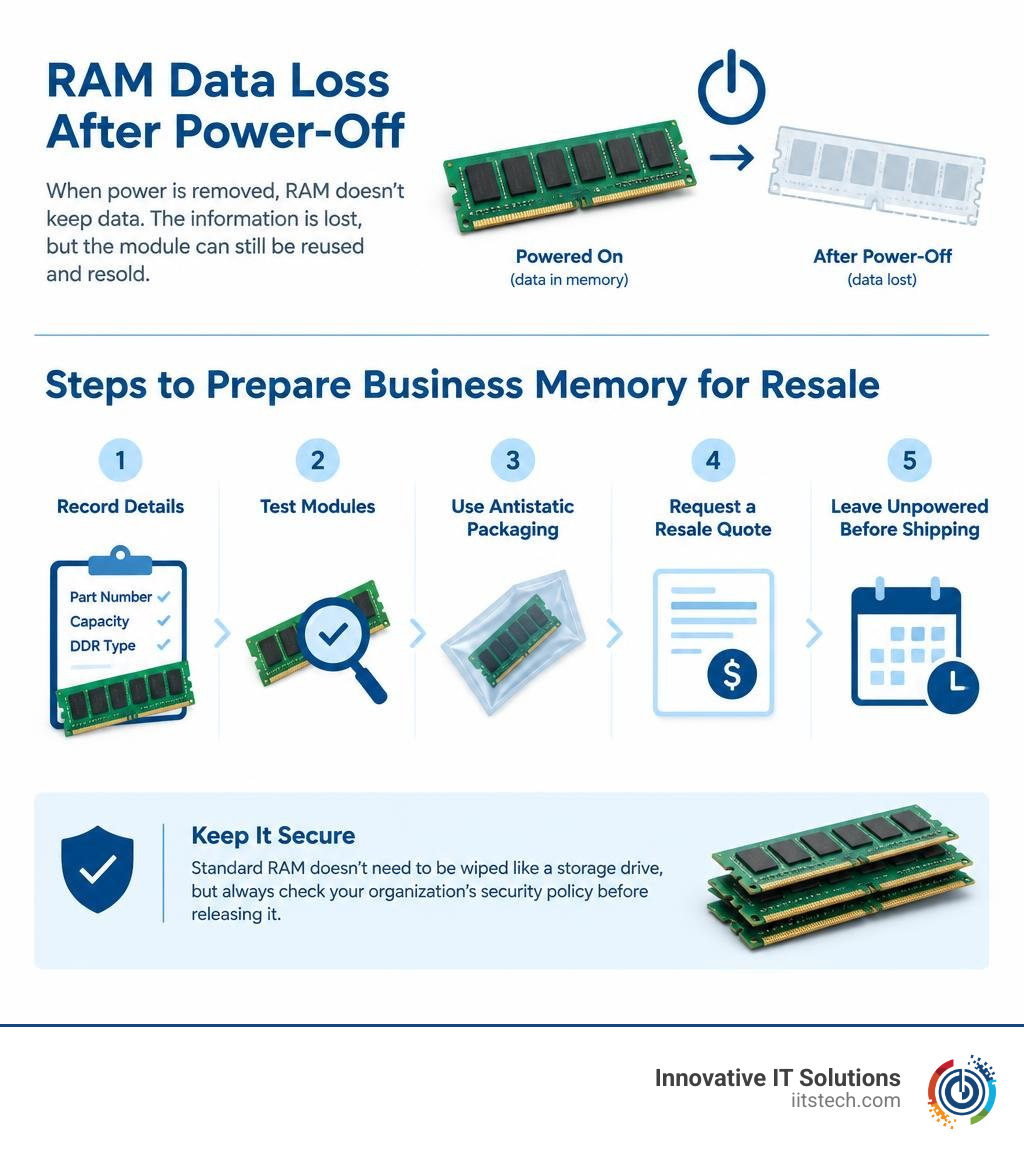
To sell used memory from business computers or servers, record each module’s part number, capacity, and DDR type. Test the modules, pack them in antistatic material, and request a resale quote. Leave them unpowered for a few days before shipping. Standard RAM does not need to be wiped like a storage drive, but check your organization’s security policy before releasing it.
Working server memory may still have resale value. Clear inventory records and test results help buyers assess what you have.
I’m Mike Haden, founder and director of business development at Innovative IT Solutions. For 14 years, I’ve helped businesses sell used memory and other surplus IT hardware through responsible asset recovery.
Basic sell used memory terms:
How to Sell Used Memory for the Best Return
Memory is one of the easiest parts to resell after a server refresh. It is small, light, and easy to ship. It also holds value when it is sorted properly. The catch is that buyers pay for certainty. A box of mystery sticks gets a mystery price.
Here is what drives the value of used server memory:
- Module type. Buyers want to know if a module is RDIMM, LRDIMM, UDIMM, or SODIMM. These types are not interchangeable, and servers are picky about which they accept.
- DDR generation. DDR3, DDR4, and DDR5 use different slots and voltages. Newer generations usually draw more demand, but older server memory still sells because plenty of companies keep legacy systems running.
- Capacity and speed. Capacity per module, speed rating, and rank all matter for matching.
- Compatibility. Server memory is often tied to specific platforms. A clear list of the systems your modules came from helps buyers match them to their needs.
- Condition. Tested, clean, undamaged modules earn more than untested ones.
- Quantity. Matched sets and larger lots are more attractive than a handful of odd pieces.
Grading helps too. A simple scheme works: tested and working, tested with minor cosmetic wear, and untested or failed. Failed modules should not be mixed into working lots, since that is a fast way to lose a buyer’s trust.
If you want the full process from start to finish, our sell used IT equipment A-Z guide walks through it for every type of hardware.
How can businesses sell used memory for maximum value?
Think of it as presenting a product, not clearing out a closet. A few habits make a real difference:
- Build an inventory. List the manufacturer, model number, part number, capacity, speed, and quantity. Photos of labels help.
- Keep your test results. A pass report tells buyers the modules work. It can lift your quote and cut back-and-forth questions.
- Group by model. Matched modules with identical part numbers sell more easily than mixed piles.
- Sell in bulk lots. Larger lots attract serious buyers and spread the handling cost across more units.
- Check the buyer. Ask how they test, how they grade, how fast they pay, and what happens if their count differs from yours.
- Do not wait too long. Memory prices move with the market, and each new generation pushes older parts down. Surplus modules sitting in a cabinet rarely gain value.
Our guide on maximizing value from obsolete IT equipment and asset recovery goes deeper on timing and bundling memory with other retired hardware.
Where should you sell used memory modules?
You have a few options, and they trade off effort, speed, and security:
- ITAD buyers. An IT asset disposition provider can take memory along with servers, networking gear, and drives, and pay you for what has value. This is usually the simplest path for businesses with more than a few modules.
- Resale channels. Online marketplaces can work for small quantities, but you handle listings, questions, returns, and shipping yourself.
- Direct sales to other businesses. If you know a company running the same platform, a direct sale can work, but it is rare and slow.
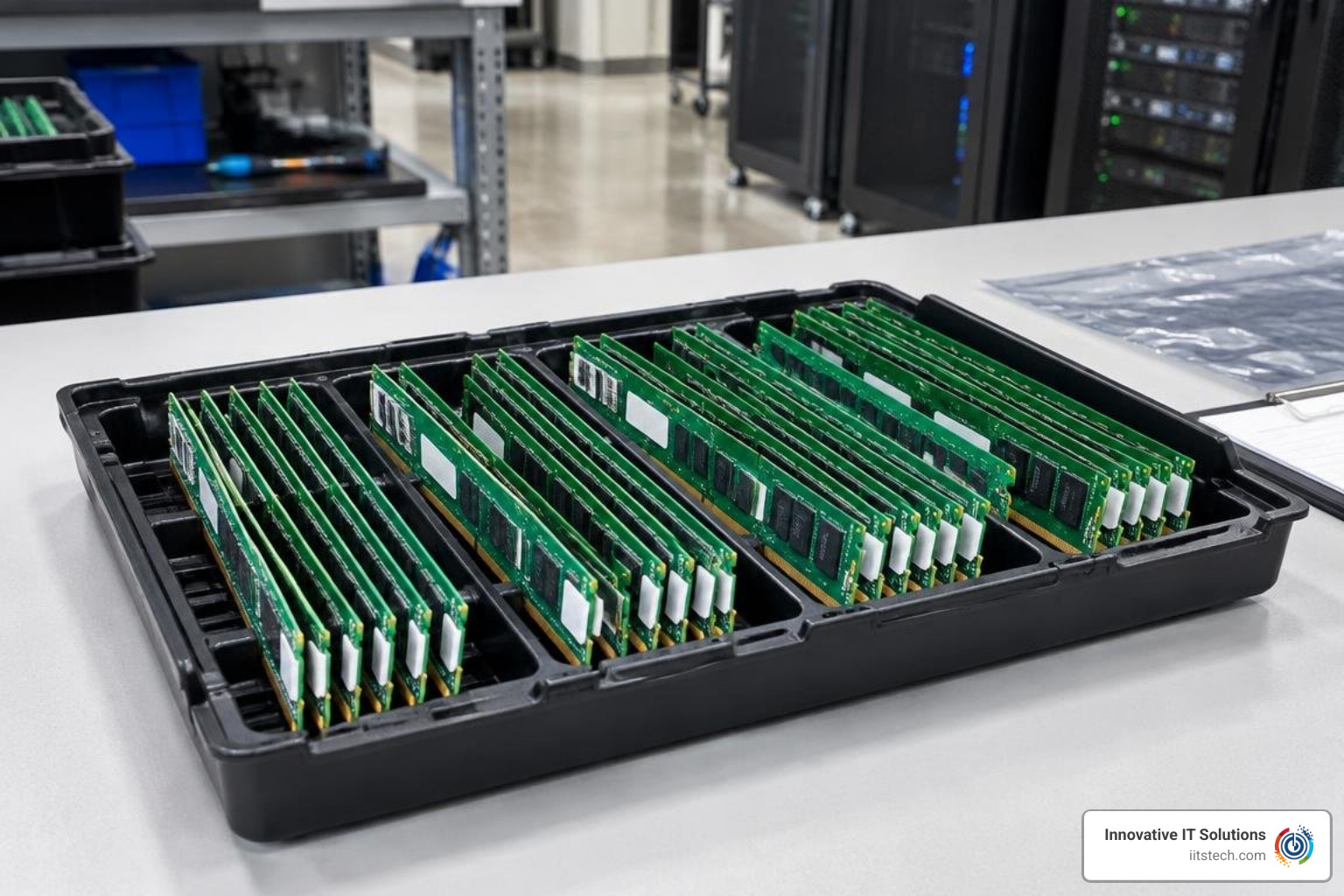
For most organizations, an equipment quote from an ITAD partner is the cleanest route. You send a list, receive an offer, then ship or schedule pickup. Pack modules in antistatic bags or trays, add padding, and use a sturdy box so nothing flexes in transit. If you are in the Oklahoma City area, local pickup can also save you shipping headaches.
Is RAM Safe to Sell Without Wiping It?
For ordinary business use, yes. RAM is volatile memory, which means it needs constant power to hold its data. When the power goes away, the contents fade. That is the opposite of a hard drive or SSD, which keeps data for years with no power at all.
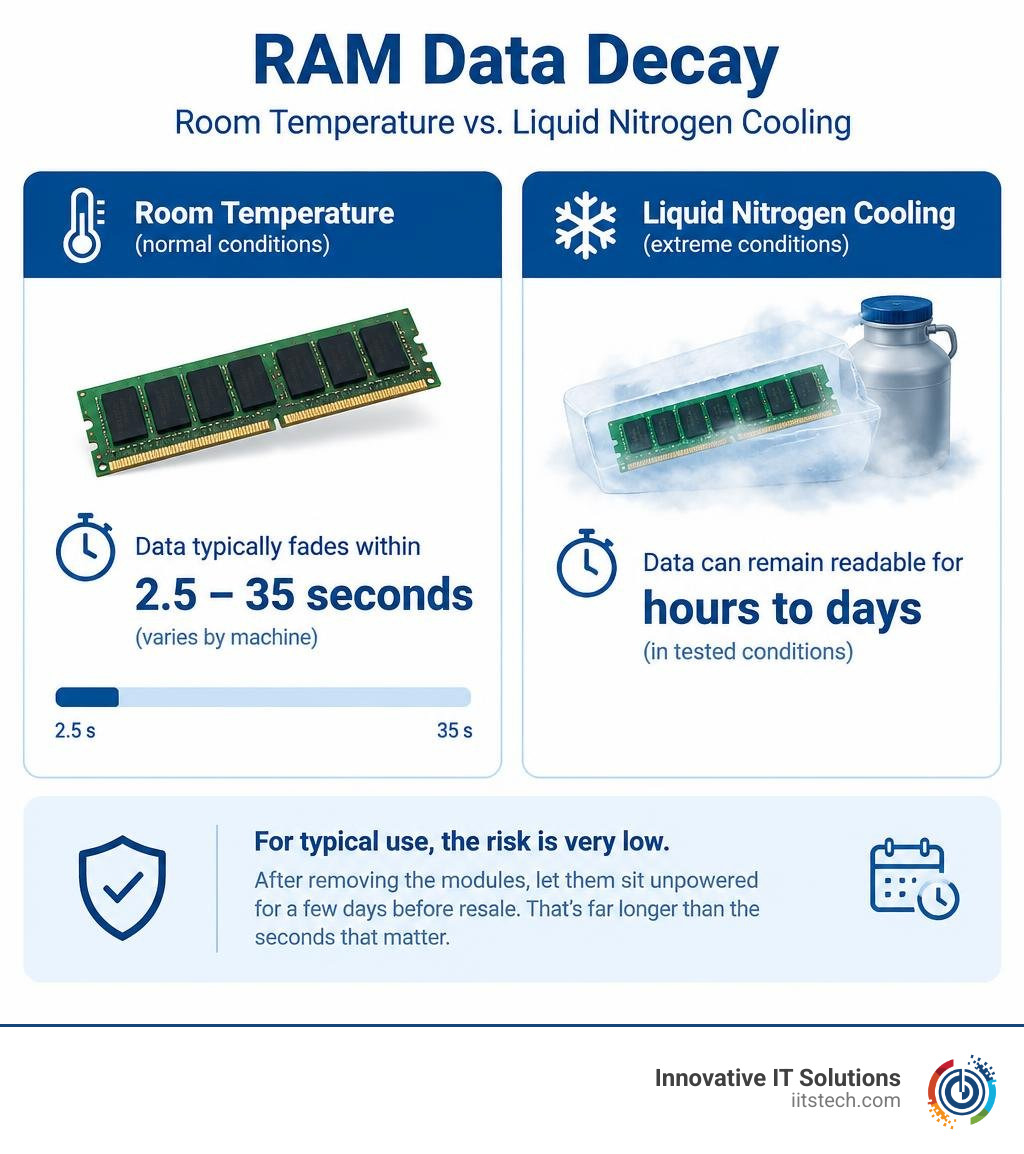
This is why you do not run a wipe tool or reformat RAM. There is no file system to erase, and there is nothing you can overwrite in a meaningful way after the fact. Under normal temperatures, data in RAM lasts for up to about 35 seconds after power is removed. On the fastest machines tested, it vanished in roughly 2.5 seconds. Decay time varies from one machine to another, but all of it is measured in seconds, not days.
Because of that, the chance of anyone recovering useful information from a module that has been pulled and set aside is very low. Researchers have studied the topic closely. You can read the scientific research on DRAM cold boot attacks from Princeton University if you want the technical details.
How long does data remain on RAM after power is removed?
At normal room temperature, the answer is short. Think of RAM like a row of tiny buckets that slowly leak. Without power to keep topping them up, the charge drains and the bits turn into noise. The leak is a bit slower in some chips and a bit faster in others, which is why results differ between machines.
A simple habit adds a wide safety margin. After you pull the modules, let them sit unpowered in a drawer, cabinet, or storage bin for a few days before you ship them. That is far longer than the seconds that matter, and it costs nothing. Anyone who wants data from a module that has been sitting that long would be chasing something that, for practical purposes, is no longer there.
Under what extreme conditions could RAM data be recovered?
The one real exception is a cold boot attack. Researchers showed that cooling memory dramatically slows the decay. In one experiment, a module was chilled with canned air, powered off, then submerged in liquid nitrogen for 60 minutes. Afterward, only about 14,000 bit errors showed up in a 1 MB test region, which is roughly 0.17% decay. With that level of cooling, data can remain readable for hours, and potentially days.
The main worry is encryption keys. If a machine is running with disk encryption active, keys can sit in memory, and a cold boot attack could try to capture them. That is a real research finding, but look at what it requires:
- Physical access to the machine or module
- The module being cooled to extreme temperatures within moments of losing power
- Specialized tools and know-how
- A target worth the effort
None of that matches a module that was pulled, left in a drawer for days, and sold. Still, if your servers handled highly sensitive workloads, such as regulated records or key material, it is reasonable to apply a stricter policy. In that case, hold the memory for longer or send it through a documented process.
How to Prepare Used Memory for Resale
Preparation is mostly about care and records, not about erasing anything. Here is the sequence we recommend:
- Power down and remove the modules. Shut the system down fully and unplug it. Remove the memory when you have time to handle it carefully.
- Identify specs. Read the label on each module and record the part number, capacity, speed, type, and generation.
- Test functionality. Run a memory test to catch errors. Even a module that looks perfect can fail under load.
- Inspect condition. Look for bent contacts, cracks, residue, or missing components. Note any cosmetic wear.
- Use ESD protection. Static electricity can damage memory without any visible sign. Handle modules by the edges, work on a grounded surface or wear a wrist strap, and avoid touching the gold contacts.
- Pack in antistatic packaging. Use antistatic bags or foam trays, then a rigid outer box with padding.
- Store unpowered. Keep them in a dry, cool spot for a few days before shipping.

Selling hardware always involves some trust, so it helps to read up on how to sell used IT equipment without getting burned before you agree to a deal.
What should businesses check before listing RAM?
Before you send a list to buyers, run through these checks:
- Server compatibility. Confirm the module type and generation match the systems you are describing. Mixing up RDIMM and UDIMM in a listing leads to returns.
- Error testing. Keep proof that the modules passed.
- Accurate descriptions. Use the exact part number and list any flaws. Honest listings avoid disputes.
- Serial tracking. If your organization tracks assets by serial number, record the serials of modules leaving your site.
- Data sensitivity. Decide whether the systems that used this memory handled sensitive data, and follow your policy.
- Compliance records. Keep the paperwork, including the transfer record and any certificates, so you can show where the equipment went.
Good records are a core part of asset recovery, and they protect you if questions come up months later.
Frequently Asked Questions About Selling Used Memory
Should RAM be destroyed instead of resold for security reasons?
For ordinary resale, no. Destroying working memory throws away value and creates e-waste, and the volatility of RAM already does most of the security work. Pulling the modules and letting them sit unpowered for a few days is a sensible approach for typical business equipment.
High-sensitivity environments are different. If your policy, contract, or regulator requires every component to be destroyed, follow it. Some organizations choose documented destruction for memory from systems that held classified or highly regulated data, because a written policy is simpler than a case-by-case argument. The research behind the low-risk view is also written mostly with individual resale in mind, so businesses should weigh their own obligations, not just the technical odds.
Does RAM need to be wiped or reformatted before resale?
No. Volatile memory has no standard wipe procedure because it does not keep data once power is gone. Reformatting would accomplish nothing.
Storage is a different story. Hard drives keep data magnetically for years, so they need verified overwriting or physical destruction. SSDs store data in flash cells and need their own sanitization methods, since ordinary overwriting may miss areas of the drive. If you are retiring servers, treat the drives as the real security task and the memory as the easy part. Our sell your gear process handles both in one pickup.
When should an organization use documented ITAD services?
Use them whenever you need proof, not just good intentions. That includes:
- Compliance needs. Healthcare, finance, government contractors, and others often must show how equipment was handled.
- Chain of custody. If you must track equipment from your door to its final destination, documentation is how you do it.
- Mixed equipment. A server rack includes drives, memory, and other components, and a single provider can handle all of it.
- Secure disposition. When memory or other parts are not worth reselling, they should be recycled responsibly, not tossed in a dumpster.
At Innovative IT Solutions, our NIST and DoD-aligned processes come with full documentation, and we follow EPA-compliant, zero-landfill practices. That means you get paid for what has value and a paper trail for everything else.
Conclusion
Used RAM is one of the friendliest items to resell. Volatile memory loses its data within seconds at normal temperatures, so you can resell reusable server memory without wiping it. The only realistic exception is a cold boot attack, which takes extreme cooling, quick physical access, and a motivated attacker. Letting modules remain unpowered for several days before shipping adds a comfortable margin.
The real choice is between resale and documented disposition, and your data sensitivity should decide it. Typical business servers can go straight to resale. Highly sensitive environments may call for a stricter policy.
Either way, Innovative IT Solutions can help. We test, grade, and buy surplus memory, and we provide documentation when you need it. Ready to turn spare modules into cash? Sell your business IT gear with us today.


