
What IT Managers Need to Know Before They Sell Used Tape Media
If your organization needs to sell used tape media from a decommissioned data center or storage refresh, here is the fastest path forward:
- Inventory your tapes — record tape type (LTO generation, IBM 3592, etc.), quantity, and physical condition.
- Choose a certified ITAD partner — look for R2v3 and RIOS certifications to ensure secure, compliant handling.
- Request a quote — submit your inventory list for a valuation based on tape generation, capacity, and market demand.
- Arrange secure logistics — your ITAD partner should provide chain-of-custody documentation from pickup to processing.
- Get paid and receive documentation — a Certificate of Data Destruction confirms your compliance obligations are met.
Many IT managers are surprised to learn that decommissioned enterprise tape media still holds real market value. Modern LTO tapes — especially LTO-8 through LTO-10 — store up to 30 TB natively per cartridge, which means active demand exists in the secondary market for these formats. But the process is not as simple as boxing up old cartridges and shipping them out. Data security, compliance, and proper valuation all need to be handled correctly before a single tape leaves your facility.
The stakes are high. Tape media can retain sensitive data long after the systems that wrote it are retired. A misstep in the disposal process can expose your organization to serious regulatory and reputational risk — whether you operate under HIPAA, GDPR, or PCI-DSS.
I’m Mike Haden, Founder and Director of Business Development at Innovative IT Solutions, and over the past 14 years I’ve helped enterprises securely sell used tape media and other decommissioned IT assets through a compliant, audited disposition process. In this guide, I’ll walk you through everything you need to know to recover value from your tape inventory without cutting corners on security or compliance.
Understanding Enterprise Data Tapes and Storage Media
In the enterprise world, magnetic tape is the backbone of modern, high-capacity archival storage. Enterprise data tapes are engineered for extreme density, speed, and long-term data integrity.
Enterprise storage environments and large-scale data centers rely on two primary tape formats:
- Linear Tape-Open (LTO) Ultrium: This is the open-format industry standard. Developed jointly by HP, IBM, and Quantum, LTO technology has progressed through multiple generations. It is widely used for backup, disaster recovery, and high-capacity archiving due to its low cost-per-gigabyte and long physical lifespan (often rated for up to 30 years under optimal conditions).
- IBM 3592 Enterprise Tape: This proprietary, highly advanced format is designed for demanding enterprise mainframes and high-throughput environments. IBM 3592 cartridges are heavily utilized in Hierarchical Storage Management (HSM) frameworks, where automated robotic libraries shift inactive data from expensive solid-state drives (SSDs) to cost-effective, high-density magnetic media.
At Innovative IT Solutions, we focus strictly on business-grade IT hardware and enterprise storage media. If your organization is decommissioning server racks, upgrading storage arrays, or migrating physical archives to the cloud, you are dealing with enterprise-grade LTO or IBM 3592 media—and that is exactly where we can help you recover significant value.
Key Factors That Determine Value When You Sell Used Tape
Before you request a buyback quote for your surplus media, it is helpful to understand how secondary market pricing is calculated. When we evaluate an inventory list to sell used tape cartridges, several critical factors dictate the final valuation:
- Tape Generation: The generation of your tape media is the single most influential factor. Older generations like LTO-4 or LTO-5 have virtually no resale value because their capacities are too small for modern enterprise workloads (though they can still be recycled responsibly). Conversely, LTO-8, LTO-9, and the latest LTO-10 cartridges command premium prices.
- Cartridge Capacity: As data demands skyrocket, secondary market buyers prioritize high-capacity media. For example, LTO-10 tapes support a staggering native capacity of up to 30 TB (and up to 75 TB compressed), making them highly sought after by organizations expanding their air-gapped ransomware protection or AI/ML training archives.
- Physical Condition: Cartridges must be structurally sound. Cracked casings, damaged write-protect switches, or torn labels reduce value.
- Storage History: Magnetic tape is highly sensitive to environmental conditions. Tapes stored in climate-controlled data centers retain their structural integrity far better than those left in damp basements, hot warehouses, or dusty storage sheds. High humidity and extreme temperature fluctuations degrade the magnetic binder, leading to tape degradation and loss of value.
To give you an idea of how capacity and performance scale across modern enterprise tape generations, review the table below:
| Tape Generation | Native Capacity | Compressed Capacity (2.5:1) | Native Transfer Rate | Key Features |
|---|---|---|---|---|
| LTO-7 | 6.0 TB | 15.0 TB | 300 MB/s | WORM support, AES-256 encryption |
| LTO-8 | 12.0 TB | 300 MB/s | 360 MB/s | Barium Ferrite (BaFe) particles |
| LTO-9 | 18.0 TB | 45.0 TB | 400 MB/s | Optimized data rate matching |
| LTO-10 | 30.0 TB | 75.0 TB | 400 MB/s | Post-quantum encryption readiness |
How to Sell Used Tape in Bulk Quantities
If your organization is managing a major data center decommissioning or a complete storage system overhaul, you are likely dealing with thousands of tape cartridges. Managing bulk quantities requires a specialized logistical approach to preserve the physical security of the media and maximize your financial returns.
When preparing a bulk shipment, do not simply dump loose cartridges into cardboard boxes. Rough handling during transit can cause internal tape alignment issues or damage the precise cartridge shell. Instead, bulk inventory should be carefully packed into specialized, padded ITAD transit cases or stacked on pallets with protective foam spacers.
By working with a professional partner to manage your bulk assets, you can offset decommissioning costs, free up valuable physical floor space, and support a more circular economy. To learn more about how to structure these projects for maximum efficiency, check out our guide on The Business Benefits of Selling Your Used IT Equipment.
Secure Data Sanitization and Compliance Standards
Data security is the most critical phase when you sell used tape media. Your tapes contain years of historical business operations, intellectual property, proprietary source code, or personally identifiable information (PII). Simply deleting files or reformatting the tape partition does not actually remove the underlying magnetic patterns; a skilled bad actor with specialized equipment can easily recover data from improperly wiped media.
To guarantee that your data is completely unrecoverable, we utilize three distinct levels of data sanitization based on your organization’s security posture and compliance mandates:
- Clear (Overwriting): This process involves writing a standardized, non-sensitive data pattern across all tracks of the tape. It is suitable for lower-security environments where the media will be reused internally.
- Purge (Degaussing/Advanced Erasure): Degaussing subjects the tape to a powerful, controlled electromagnetic field that completely disrupts the magnetic domains on the media. This process sanitizes the tape to the point where even laboratory-grade recovery techniques cannot retrieve any data. For modern LTO tapes, degaussing also destroys the factory-written servo tracks, rendering the cartridge physically unusable but completely safe for raw material recycling.
- Destroy (Physical Shredding): For highly regulated industries, physical destruction is the gold standard. Tapes are fed into industrial shredders that reduce the magnetic film and plastic casings to tiny, unreadable fragments.
We strictly adhere to recognized federal standards, including NIST SP 800-88 Rev. 1 (Guidelines for Media Sanitization) and DoD 5220.22-M. Once the sanitization process is complete, we issue a formal Certificate of Data Destruction. This document is your legal shield, proving to auditors, stakeholders, and regulatory bodies that your data was handled in complete compliance with environmental and privacy laws. For a deeper dive into protecting your business during this transition, read our article on How to Sell Used IT Equipment Without Getting Burned.
Choosing a Certified Partner to Sell Used Tape Safely
You should never trust your organization’s sensitive data storage media to an uncertified scrapper or a random online buyer. When evaluating ITAD (IT Asset Disposition) vendors, always verify their certifications. These credentials guarantee that the provider is regularly audited by independent third parties to ensure compliance with strict environmental, safety, and security standards.
Key certifications to look for include:
- R2v3 (Responsible Recycling): The premier global standard for the electronics recycling industry. An R2v3 certified facility must maintain rigorous controls over data security, environmental protection, and worker safety.
- RIOS (Recycling Industry Operating Standard): An ANSI-accredited standard that integrates quality, environmental, and occupational health and safety management systems into a single cohesive framework.
- ISO 14001 & ISO 9001: These international standards govern environmental management and quality management systems, ensuring consistent, eco-friendly operational processes.
Working with an audited, certified partner ensures a secure, documented chain of custody. This means your high-value storage media is tracked at every stage—from the moment it is loaded into secure transport cases at your facility in the Oklahoma City metro area to its final processing at our secure facility. Learn more about our audited processes on our Asset Recovery page.
Step-by-Step Process for Enterprise Tape Buyback
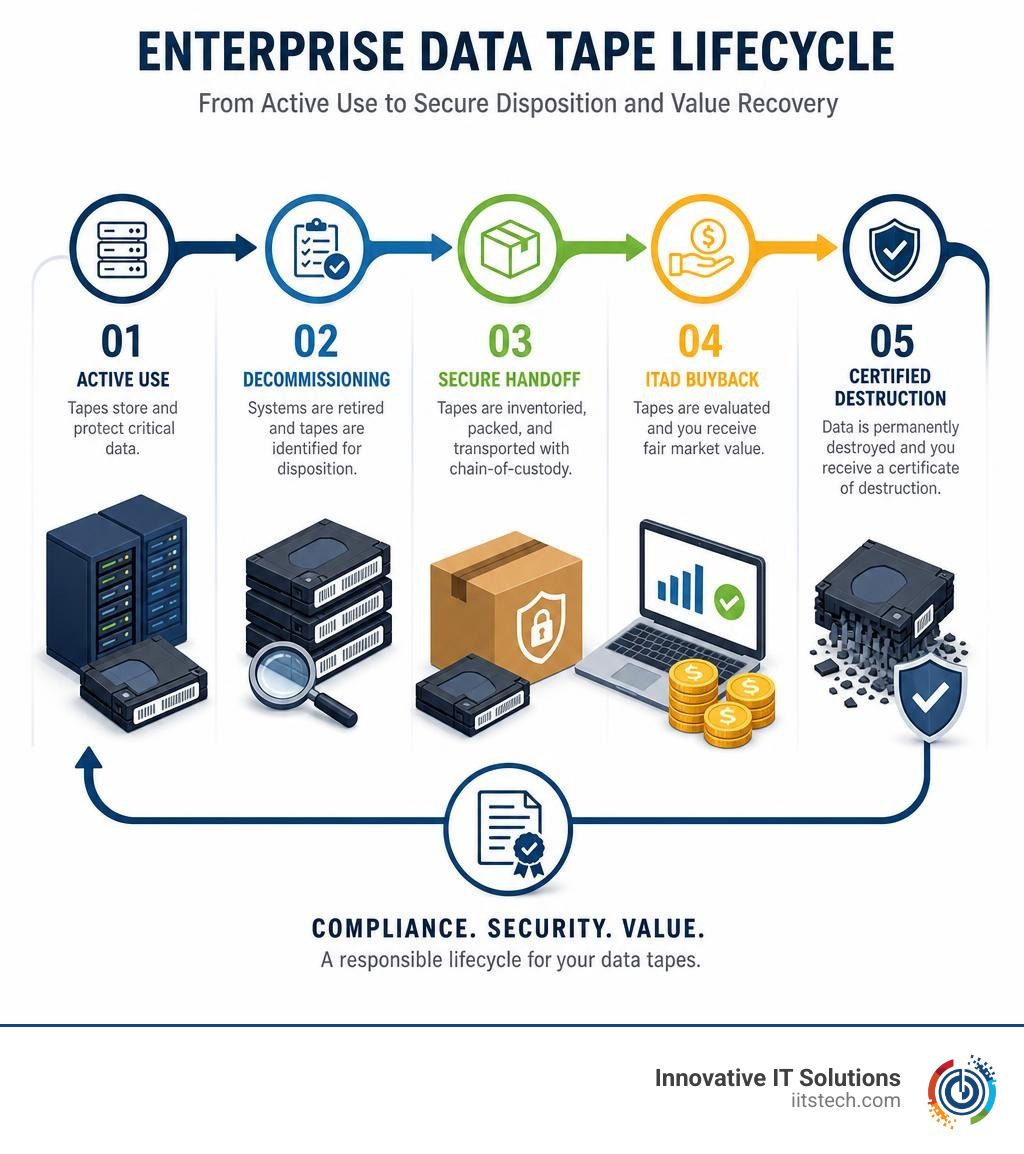
We have designed our enterprise tape buyback program to be as simple, secure, and profitable as possible for busy IT directors. Here is exactly how the process works when you partner with us:
- Submit Your Inventory: Send us a detailed list of your surplus tape media. Include the generation (e.g., LTO-8, LTO-9), brand, estimated quantity, and whether they are brand new in original packaging or used.
- Expert Review & Offer: Our asset recovery specialists analyze current secondary market demand to provide you with a highly competitive, transparent quote.
- Secure Logistics: Once you accept our offer, we coordinate the logistics. We can provide heavy-duty, lockable transit cases to protect your media during shipment, maintaining a strict chain of custody from your facility to ours.
- Certified Data Sanitization: Upon arrival at our facility, your tapes undergo certified data erasure or physical destruction in accordance with NIST SP 800-88 standards.
- Payment and Documentation: We issue your payment alongside a comprehensive serialized audit report and your official Certificate of Data Destruction.

Frequently Asked Questions about Enterprise Tape Resale
What types of enterprise data tapes have the highest resale value?
Currently, LTO-8, LTO-9, and LTO-10 cartridges command the highest resale value on the secondary market. These generations offer the high capacities and rapid transfer speeds required for modern enterprise archival and ransomware protection. Select high-capacity IBM 3592 cartridges also retain excellent value. Older formats like LTO-5 and below generally have no resale market value due to their limited capacity, though we can still assist with their secure destruction and responsible recycling.
Is data completely unrecoverable after professional tape degaussing?
Yes. Professional degaussing uses an incredibly strong magnetic field that completely neutralizes the magnetic particles on the tape. This alters the physical state of the media, erasing all data, formatting, and servo tracks. Once a modern tape is degaussed, it is completely blank and physically impossible to read or write to ever again, ensuring 100% data security.
What happens to data tapes that have no remaining market value?
If your older tapes (such as LTO-4 or LTO-5) have no remaining commercial value, we process them through our zero-landfill, EPA-compliant e-waste recycling program. The plastic shells are shredded and separated, and the magnetic tape film is processed responsibly, ensuring that none of your retired IT media ends up in an Oklahoma landfill.
Conclusion
Decommissioning old storage systems does not have to be a headache or a security liability. When you choose to sell used tape media through a certified ITAD process, you can recover valuable capital to fund your next infrastructure upgrade while ensuring total regulatory compliance.
At Innovative IT Solutions, we are proud to serve enterprises, data centers, and public institutions across Oklahoma City, OKC, South OKC, and the wider Oklahoma region. Our NIST-compliant, zero-landfill, and certified processes guarantee that your data is permanently destroyed, your environmental footprint is minimized, and your financial return is maximized.
Ready to clear out your server room and turn your retired storage media into revenue? Contact our team today at Sell Your Gear to request a fast, secure, and hassle-free valuation of your tape inventory.


