
Corporate Electronics Buyback Programs: Secure Disposal Meets ROI
Why a Corporate Electronics Buyback Program Belongs in Your IT Strategy
A corporate electronics buyback program is a structured process where businesses sell or trade in decommissioned IT hardware — such as servers, laptops, and networking equipment — to recover capital, ensure secure data destruction, and stay compliant with regulations like HIPAA, GDPR, and PCI DSS.
Here’s what you need to know at a glance:
- What it is — A B2B service that buys back retired enterprise hardware for cash or credit
- Who it’s for — IT managers and organizations refreshing device fleets or decommissioning data center equipment
- What you get — Capital recovery, certified data destruction, and compliant e-waste disposal
- Key hardware accepted — Servers, enterprise laptops, desktops, switches, and routers
- How payment works — Instant credit for smaller orders, or post-purchase evaluation payouts for bulk lots
- Core requirement — Devices must be owned outright, powered on, and factory reset before submission
When you’re managing dozens — or hundreds — of decommissioned devices, the stakes are high. A single unsanitized hard drive can trigger a data breach. Improper disposal can violate e-waste regulations. And without a buyback strategy, your retired hardware just bleeds value sitting in a storage room.
The right program turns that liability into a recoverable asset.
I’m Mike Haden, Founder and Director of Business Development at Innovative IT Solutions, where I’ve spent 14 years building an R2v3-certified ITAD operation that has processed over a million pieces of enterprise IT equipment through responsible corporate electronics buyback programs. That hands-on experience across data sanitization, hardware remarketing, and secure logistics is what shapes every insight in this guide.
Corporate electronics buyback program basics:
What is a Corporate Electronics Buyback Program?
At its core, a corporate electronics buyback program is a formalized framework designed to help enterprise organizations monetize their end-of-life or surplus IT assets. Instead of allowing decommissioned server racks, enterprise laptops, and core switches to collect dust in an IT closet—where they lose residual value every single month—a corporate buyback allows you to liquidate those physical assets safely.
When an organization undergoes a technology refresh or downsizes its physical footprint, hardware retirement quickly becomes an operational hurdle. Left unmanaged, surplus hardware consumes expensive floor space and creates massive compliance hazards. By establishing a dedicated enterprise asset recovery pipeline, your business transforms hardware retirement into a proactive financial strategy. You get capital returned directly to your IT budget, verifiable compliance records for risk management, and the peace of mind that comes with sustainable e-waste practices.
Corporate Electronics Buyback Program vs. Consumer Trade-Ins
Many business leaders wonder how a B2B buyback program differs from a consumer trade-in offer. While consumer trade-in portals at retail stores might yield a small gift card, enterprise asset recovery operates on a completely different scale with much higher stakes.
Understanding the business benefits of selling your used it equipment begins with recognizing these structural differences:
- Custom B2B Financial Terms: Retail consumer programs usually limit payouts to store credit, eGiftCards, or instant discounts capped at personal transaction limits. In contrast, corporate programs offer direct cash disbursements, wire transfers, flexible corporate invoicing, or post-purchase credit terms tailored to enterprise procurement cycles.
- Bulk Hardware Processing: Consumer trade-in portals handle individual devices one at a time. Corporate buybacks are built for scale, processing palletized shipments containing hundreds of rack servers, enterprise workstations, or entire server fleets in a single workflow.
- Enterprise Data Security & Compliance: Retail trade-in options rely on basic user factory resets. Corporate IT asset disposition (ITAD) requires rigorous, certified data destruction adhering to NIST SP 800-88 and DoD sanitization standards, complete with serialized Certificates of Data Destruction for auditing.
- Multi-Vendor Flexibility: Direct manufacturer trade-in initiatives—such as the Samsung Business US | Samsung Trade In for Business | Device Trade In | Samsung Business channel—often incentivize trading old equipment for their own brand’s ecosystem. A comprehensive corporate ITAD buyback partner like us evaluates and purchases heterogeneous fleets containing mixed OEM hardware across Dell, HP, Cisco, Lenovo, and Apple simultaneously.
Eligible Hardware: Servers, Laptops, and Networking Equipment
When participating in a enterprise corporate electronics buyback program, it helps to know which asset categories hold strong secondary market value. Enterprise buyers and refurbishers actively seek enterprise-grade hardware built for reliability and modular upgrades.

Key eligible categories include:
- Enterprise Servers & Storage: Rack, tower, and blade servers (Dell PowerEdge, HPE ProLiant, Lenovo ThinkSystem), storage area networks (SAN), and network-attached storage (NAS) arrays. Server components like high-density RAM modules, RAID controllers, and enterprise SSDs/HDDs retain high resale yield.
- Corporate Laptops & Workstations: Enterprise-tier laptops (Lenovo ThinkPad, Dell Latitude/Precision, HP EliteBook/ZBook, and Apple MacBook Pro) designed for corporate deployment. Their durable chassis and standardized components make them prime candidates for remarketing.
- Networking & Infrastructure Equipment: Managed switches, enterprise routers, firewalls, and wireless access points from vendors like Cisco, Juniper, Arista, and Meraki.
- Business Desktops & Displays: Small form factor (SFF) corporate desktops and professional-grade multi-monitor setups.
Determining is it better to recycle or resell old it equipment comes down to asset age and functional condition. While 3-to-5-year-old enterprise servers and core laptops yield significant cash back, obsolete or non-functional items are processed through zero-landfill e-waste recycling channels.
How a Corporate Electronics Buyback Program Works
Executing a successful enterprise buyback is a seamless process when backed by an experienced ITAD provider. The primary goal is to minimize administrative friction for your internal IT team while providing absolute chain-of-custody tracking from your loading dock to our processing facility.
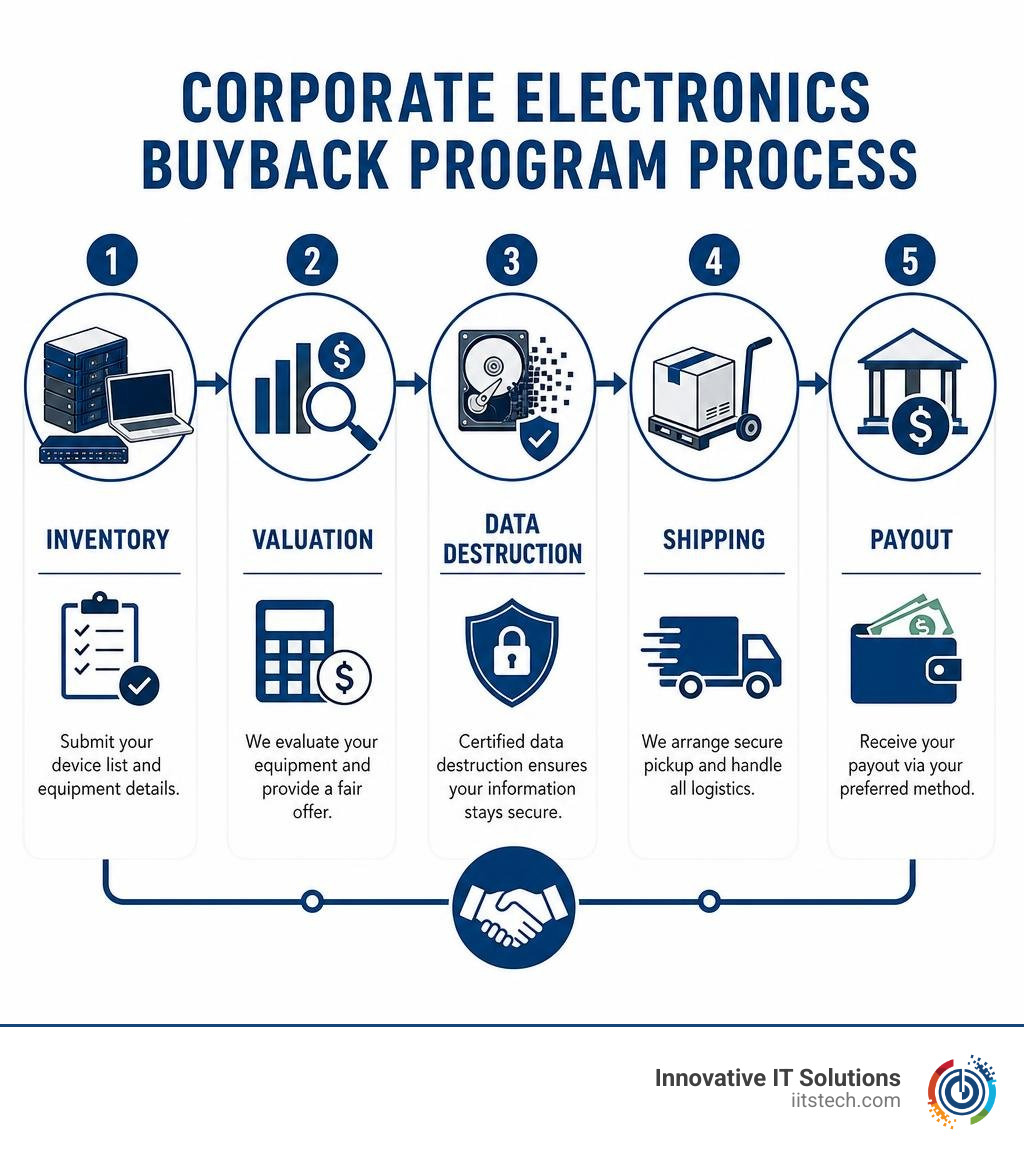
Key Steps to Launching a Corporate Electronics Buyback Program
Setting up an efficient hardware buyback workflow involves four main phases. Following a structured sell used it equipment a z guide ensures your company maximizes financial yield without exposing enterprise data to risk.
- Asset Inventory & Reporting: Your IT department generates an initial inventory list detailing asset quantities, model numbers, processor specs, RAM, drive configurations, and general cosmetic condition.
- Valuation & Preliminary Quote: We assess real-time global market demand, hardware specs, and historical resale data to issue a competitive preliminary valuation proposal.
- Logistics & Secure Transit: Once approved, freight logistics are scheduled. Equipment is securely packed, palletized, and transported directly to our audit facility with full chain-of-custody tracking.
- Testing, Data Sanitization, & Final Settlement: Upon arrival, assets undergo physical testing, component verification, and NIST-compliant data sanitization. A finalized audit report is generated, and payment or credit is issued immediately.
Valuation Factors, Device Grading, and Variance Handling
How do buyback providers calculate the exact monetary value of your retired equipment? Resale market dynamics shift based on supply, demand, and microchip generation cycles. However, four core factors dictate every quote:
- Processor & Architecture Generation: Enterprise hardware value relies heavily on CPU specs. For example, Intel Xeon Scalable or AMD EPYC servers command significantly higher market value than older Intel Xeon E5 platforms.
- Functional Status: Hardware that powers on, successfully posts to BIOS, holds standard thermal controls, and passes memory/diagnostic tests yields top-tier pricing.
- Cosmetic Condition Grading: Equipment is graded on standard scales (Grade A: like-new/minimal wear; Grade B: minor surface scuffs; Grade C: notable cosmetic blemishes or minor casing dents; Grade D/F: non-functional or severe physical damage).
- Component Completeness: Missing power supplies, drive caddies, server rails, or laptop AC adapters can adjust final quotes slightly.
Handling Evaluation Variances: If an initial quote was based on assumed specifications, but physical testing uncovers secondary variances—such as a cracked screen, undisclosed liquid exposure, or missing memory modules—a detailed reconciliation report is issued. Transparent ITAD providers provide line-item serialized tracking showing exactly why an individual asset was re-graded, ensuring your finance team has full visibility into adjusted settlement totals.
Logistics, Security Compliance, and Asset Recovery Protocols

When transporting decommissioned hardware offsite, physical security and data protection are paramount. Shipping dozens of servers containing sensitive customer databases or proprietary corporate IP requires strict adherence to security protocols.
Enterprise Data Destruction and Chain of Custody
Data security is non-negotiable. Merely reformatting a hard drive or relying on a standard operating system reset leaves sensitive enterprise data recoverable through basic software tools.
To eliminate risk, our corporate electronics buyback program incorporates certified data sanitization protocols matching NIST SP 800-88 Rev 1 guidelines and Department of Defense (DoD 5220.22-M) standards. Learning how to sell used it equipment without getting burned comes down to ensuring your provider executes verifiable, air-gapped data overwriting or physical drive shredding.
Furthermore, before devices enter the destruction or testing pipeline, all corporate management software—such as Mobile Device Management (MDM) profiles, Apple Business Manager (ABM) enrollments, Google Workspace enterprise locks, and BIOS passwords—must be fully removed. Unlocking these management layers ensures the hardware can be safely repurposed.
Once sanitization is complete, we issue a serialized Certificate of Data Destruction, providing an audit-ready compliance document for your legal and risk-management departments.
Packaging, Shipping, and Bulk Logistics Requirements
Improper packaging during freight transit is one of the leading causes of physical damage and value loss for returned IT assets. To safeguard hardware during shipping, enterprise bulk shipments must adhere to professional palletization protocols:
- Heavy Duty Palletization: Rack servers, heavy uninterruptible power supplies (UPS), and desktop towers should be centered on sturdy 48×40 wooden pallets, keeping weight balanced and avoiding overhang.
- Anti-Static & Shock Protection: Sensitive server blades, networking cards, and enterprise laptops must be wrapped individually in anti-static bubble wrap or housed in custom foam inserts.
- Strapping and Stretch Wrapping: Secure entire pallet loads with high-gauge stretch film (minimum 3-5 layers) and heavy-duty poly strapping to prevent shifting during LTL (Less-Than-Truckload) freight transit.
For organizations located in the Oklahoma City metro area, local municipal resource management like the Reuse and Repurpose | City of OKC program offers general waste guidance, but dedicated enterprise IT facilities require specialized ITAD logistics. We handle direct dock-to-dock logistics for enterprise clients across Oklahoma City, South OKC, and surrounding regions, ensuring your hardware remains in a closed-loop chain of custody.
Payout Structures, Volume Limits, and Hardware Refresh Options
A major consideration for finance leaders and IT managers evaluating a corporate electronics buyback program is how financial returns are processed and disbursed.
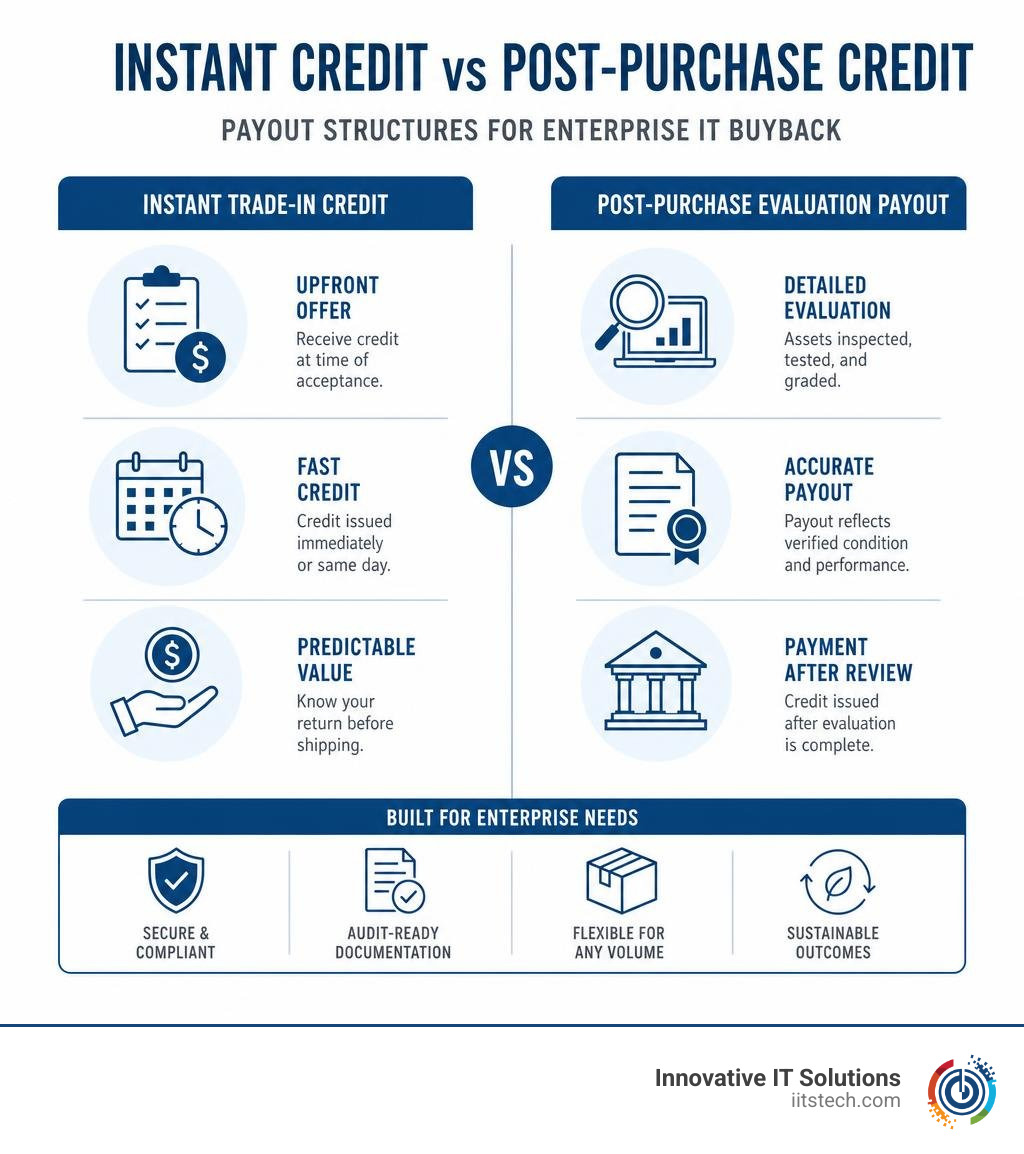
Instant Credit vs. Post-Purchase Evaluation Payouts
Depending on transaction size and hardware type, payouts are handled through two main structures: upfront instant credit or post-purchase evaluation credit.
| Feature / Metric | Instant Trade-In Credit | Post-Purchase Evaluation Payout |
|---|---|---|
| Primary Target Market | Small fleets, lower unit counts (< 30 units) | Enterprise bulk orders, data center liquidations (30+ units) |
| Payout Timeline | Applied instantly at checkout/procurement | Processed within 5-10 business days post-audit |
| Financial Flexibility | Direct discount on new equipment purchases | Direct cash payout via ACH/Wire, check, or corporate account credit |
| Audit Verification | Upfront estimate with hardware locks pre-removed | Detailed serialized bench testing & physical component verification |
| Best For | Routine laptop refreshes for small offices | Fleet modernization, rack server decommissionings, corporate downsizing |
Understanding what it managers need to know before a hardware refresh helps align buyback payouts directly with budget planning.
For smaller purchases, instant credit provides an immediate discount on new hardware orders. For instance, commercial manufacturer programs often limit instant trade-in credits to 29 qualifying purchases at point-of-sale; larger bulk quantities transition to post-purchase valuation processing. For enterprise-scale deployments, post-purchase evaluation payouts give your organization maximum flexibility—allowing you to route cash back into general operating budgets or offset upcoming infrastructure upgrades.
Frequently Asked Questions About Corporate Buybacks
How long is a buyback quote valid and how is status tracked?
Because secondary market prices for microprocessors, memory, and enterprise hardware fluctuate based on global supply chains, buyback quotes carry a defined validity window—typically 14 to 30 calendar days. Shipping your assets within this window guarantees the locked-in price quote.
To monitor your hardware once it leaves your facility, our ITAD management portal provides serialized tracking. You can log in at any time to verify freight arrival, track real-time bench testing progress, view data sanitization logs, and download audit certificates.
What happens if an asset evaluation differs from the initial quote?
If physical testing reveals discrepancies from the initial self-reported inventory—such as hidden motherboard defects, unlisted processor specs, liquid damage, or cosmetic dents—we issue a revised evaluation report.
This line-item summary clearly explains the grading adjustment for each affected serial number. If your team disagrees with a specific revised evaluation, transparent buyback agreements allow you to request the un-sanitized asset be safely shipped back to your facility.
What functional requirements must enterprise IT equipment meet?
To qualify for maximum secondary market resale value under a corporate electronics buyback program, equipment must satisfy core physical and operational baseline standards:
- Power & Boot Verification: Hardware must reliably power on, complete standard POST (Power-On Self-Test) sequences, and boot into BIOS/UEFI.
- Structural & Screen Integrity: Laptop displays and server chassis must be free of major structural cracks, severe frame warping, or display dead-zones.
- Zero Liquid Damage: Internal components must show no signs of corrosion or liquid contamination.
- Clean Ownership & Lock Removal: Hardware must be owned outright (free of active lease agreements or carrier contracts) with all enterprise management software (MDM, firmware locks, iCloud, ABM) permanently disabled.
Conclusion
A well-executed corporate electronics buyback program balances robust enterprise security with optimal financial recovery. By replacing casual hardware storage or ad-hoc recycling with a structured IT Asset Disposition workflow, your organization safeguards proprietary data, maintains strict regulatory compliance, and recovers significant capital to fund future technology refreshes.
At Innovative IT Solutions, based right here in Oklahoma City, we specialize in helping enterprise organizations transform retired hardware into maximum ROI. Whether you’re decommissioning a local data center or upgrading hundreds of corporate laptops across your enterprise, our NIST/DoD-compliant data destruction, zero-landfill e-waste commitment, and transparent valuation protocols ensure your business is fully protected.
Ready to liquidate your surplus enterprise IT hardware and boost your technology budget?
Maximize Value with Professional Enterprise Asset Recovery and schedule a comprehensive quote with our ITAD specialists today!


