
Finding a Local Option for Retired Business IT
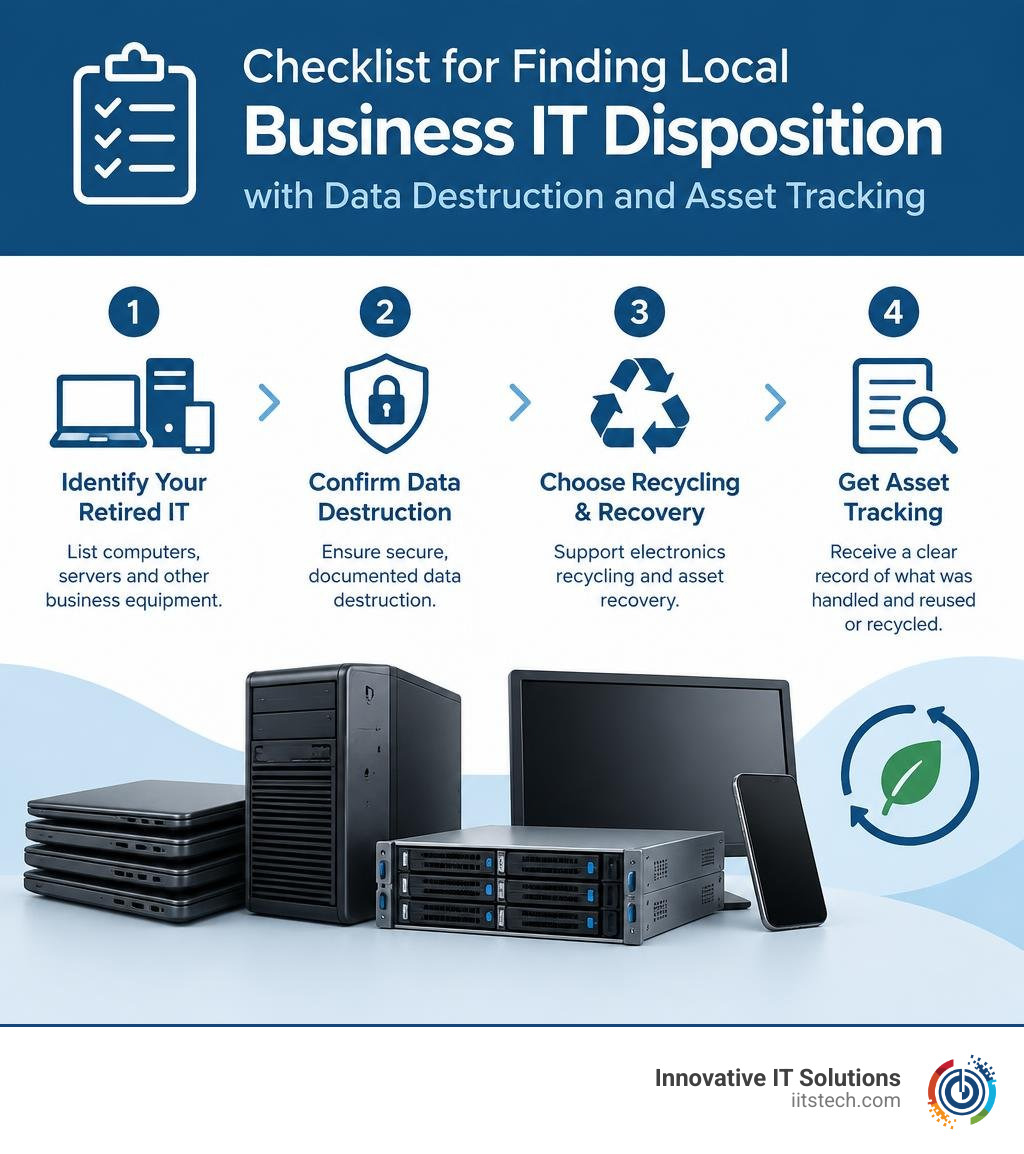
If your search for cell phone donation near me is part of a larger office cleanout, start by listing the retired business computers and server components you need to clear. For local cell phone donation, contact nearby nonprofit refurbishers or municipal e-waste depots first, confirm they accept business devices, and ask for a receipt or data-wipe record before handing anything over. Then ask Innovative IT Solutions about documented data destruction, electronics recycling, and asset recovery before those systems leave your control.
Stashing old hardware may feel easier, but it leaves stored data and usable equipment in limbo. A planned disposition process gives your team a record of what was handled and helps identify equipment that can be reused or resold.
I’m Mike Haden, founder and director of business development at Innovative IT Solutions, and I’ve spent 14 years helping organizations manage surplus technology. If cell phone donation near me brought you here, this guide will help you take the next step for business computers and server components.
Cell phone donation near me helpful reading:
The Top Reasons to Responsibly Retire Business Computers and Server Components
Every enterprise reaches a point where legacy servers, enterprise desktops, and rack-mounted infrastructure outlive their active operational life. In October 2026, corporate IT refresh cycles move faster than ever, leaving IT closets and storage rooms packed with retired enterprise hardware. While locking these assets in a back room might seem harmless, equipment hoarding poses major compliance, financial, and environmental hazards.
When enterprise computers, hard drives, and server blades sit indefinitely, several complications arise:
- Preventing Improper Disposal: Business computers and server racks contain toxic heavy metals and complex circuitry that cannot be discarded in standard municipal waste streams. Safe disposal prevents environmental contamination and ensures complete adherence to federal and local environmental protection mandates.
- Recovering Valuable Materials: Enterprise hardware contains high-grade precious metals, rare earth elements, copper, and reusable semiconductor components. Certified recycling extracts these commodities back into industrial supply chains, reducing the ecological footprint of raw material mining.
- Extending Hardware Life Through Resale or Refurbishment: Many off-lease enterprise desktops, workstation units, and enterprise servers still possess substantial computing utility. Refurbishing and remarketing this hardware allows growing organizations to access reliable enterprise computing power without the manufacturing overhead of brand-new machines.
- Protecting Sensitive Data: Stashed hardware is a data breach waiting to happen. Corporate hard drives, solid-state arrays, and server cache modules hold proprietary IP, employee records, financial ledgers, and confidential client information. Professional disposition eliminates security vulnerabilities by sanitizing or destroying media before it leaves enterprise custody.
- Corporate Sustainability: Modern Environmental, Social, and Governance (ESG) guidelines require companies to demonstrate transparent, responsible supply chain management. Proper IT asset disposition (ITAD) delivers auditable metrics showing that obsolete computing infrastructure avoids landfills.
Before offloading hardware, review these 5 questions to ask before donating old IT equipment to confirm your organization is choosing an auditable, legally compliant path.
How to Choose a Responsible IT Asset Disposition Service
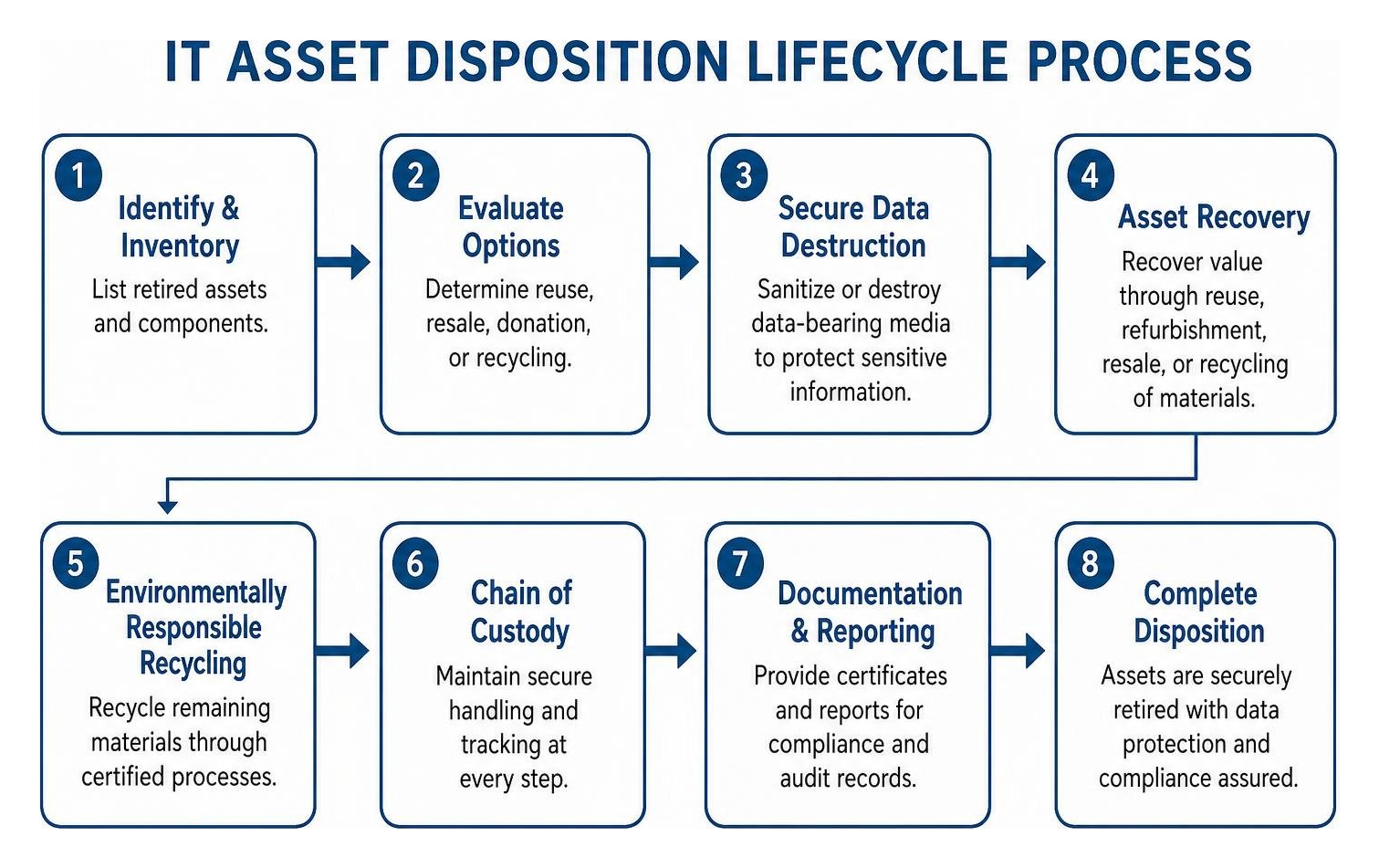
Selecting an ITAD partner requires evaluating operational rigor, compliance standards, and reporting mechanisms. Enterprise hardware cannot simply be handed off to unverified logistics carriers; your disposition provider must act as a trusted extension of your corporate compliance and information security teams.
A qualified ITAD provider offers verifiable chain-of-custody protocols, documented data destruction certificates, zero-landfill guarantees, and comprehensive asset recovery reporting.
| Disposition Outcome | Applicable Equipment | Data Security Measures | Environmental & Financial Impact |
|---|---|---|---|
| Direct Hardware Resale | Functional workstations, late-generation servers, high-capacity enterprise SSDs/RAM | NIST 800-88 compliant logical sanitization with serialization logs | High capital recovery value; extends hardware lifecycle within circular economy |
| Component Harvesting & Refurbishing | Modular server blades, enterprise power supplies, processors, motherboards | Purge-level wiping of storage controllers and embedded memory | Moderate financial return; supplies maintenance parts for secondary infrastructure |
| Material Recycling | Damaged motherboards, legacy server chassis, physically shredded hard drives | Physical destruction (degaussing, crushing, or cross-cut shredding) | Zero-landfill compliance; reclaims industrial metals (gold, copper, aluminum) |
At Innovative IT Solutions, our operations in Oklahoma City, South OKC, and across Oklahoma provide full-scale logistics, on-site data destruction, and thorough reporting to ensure your enterprise hardware transition remains seamless and secure.
Supporting Community Access Through Responsible Hardware Reuse
Corporate IT refreshes generate vast volumes of high-performance business computers that remain exceptionally capable for administrative, educational, and workforce development uses. Instead of scrapping functioning devices, responsible resale and reuse initiatives provide refurbished business computers with a second operational life.
Extending the usable lifespan of commercial-grade technology directly supports corporate circularity goals. When enterprise workstations and servers are responsibly refurbished and reintroduced to secondary markets, businesses simultaneously offset their total cost of hardware ownership and reduce the demand for new resource extraction. Every device processed through a structured disposition pathway carries full serialization documentation, ensuring absolute transparency from retirement to redeployment.
Secure Data Destruction and Responsible Recycling
Data-bearing components inside enterprise servers, SAN storage arrays, and business PCs require specialized sanitization protocols. Simply dragging files to the trash or running a standard operating system reset leaves deep data layers fully recoverable using forensic utilities.
To maintain stringent compliance across regional and federal regulatory landscapes, enterprise disposition workflows must include:
- Serialized Asset Tracking: Logging every asset tag, chassis serial number, and drive identifier into a centralized chain-of-custody database.
- Standard-Compliant Sanitization: Performing multi-pass data wipes compliant with NIST Special Publication 800-88 standards to eradicate confidential corporate data.
- Physical Media Destruction: Subjecting non-functional, legacy, or highly sensitive magnetic and solid-state storage drives to industrial shredders that reduce media to unrecoverable fragments.
- Certificate of Destruction Issuance: Delivering detailed audit certificates that verify the exact method, date, and technician responsible for sanitizing each serialized drive.
If you are coordinating a facility update or office closure, consult our guide on where to drop off tech locally to understand the baseline security measures required for commercial-grade electronics.
Business IT Asset Recovery and Sustainability
IT asset recovery is the strategic process of maximizing the residual value of retired technology assets while minimizing organizational liability. High-grade server components—such as enterprise Xeon or EPYC processors, ECC memory modules, enterprise-grade GPUs, and host bus adapters—frequently retain strong market value even after an enterprise system migration.
Through meticulous testing, cleaning, and diagnostic benchmarking, disposition specialists identify components suitable for resale in secondary markets. The proceeds from these recovered assets can offset the costs of secure logistics and physical recycling. Simultaneously, this model drives digital inclusion by providing affordable, commercial-grade hardware to organizations needing robust computing power on limited budgets.
How to Handle Broken Computers, Server Components, and Bulk IT Equipment

Enterprise data centers and IT offices frequently house a mixture of fully functional hardware, obsolete legacy devices, and non-working or physically damaged components. Handling these mixed inventories in bulk requires an organized triage strategy.
When managing mixed and damaged IT loads:
- Triage Working vs. Non-Working Units: Sort systems based on structural integrity and power-on self-test (POST) status. Functional units should be routed toward diagnostic evaluation and asset recovery.
- Harvest Usable Parts: Non-working computers and servers frequently contain undamaged modular subcomponents. Technicians can harvest functional power supplies, cooling modules, expansion cards, and memory sticks before retiring the host chassis.
- Route Unrecoverable Assets to E-Waste Streams: Completely non-functional motherboards, cracked circuit boards, and stripped server enclosures must be processed through certified e-waste recovery channels where metals and plastics are separated for clean industrial recycling.
- Coordinate Secure Bulk Pickup: Never attempt to transport loose server racks or heavy computer pallets in unsecure commercial transport. Certified ITAD providers offer white-glove logistics, providing palletizing, shrink-wrapping, GPS-tracked transportation, and secure locked bins directly from your server room or loading dock.
When deciding the best path forward for your decommissioned fleet, evaluating factors such as device age, architectural relevance, and repair costs will help your team determine the optimal balance of deciding whether to recycle or resell used equipment.
Essential Steps to Prepare Business IT Equipment for Disposition
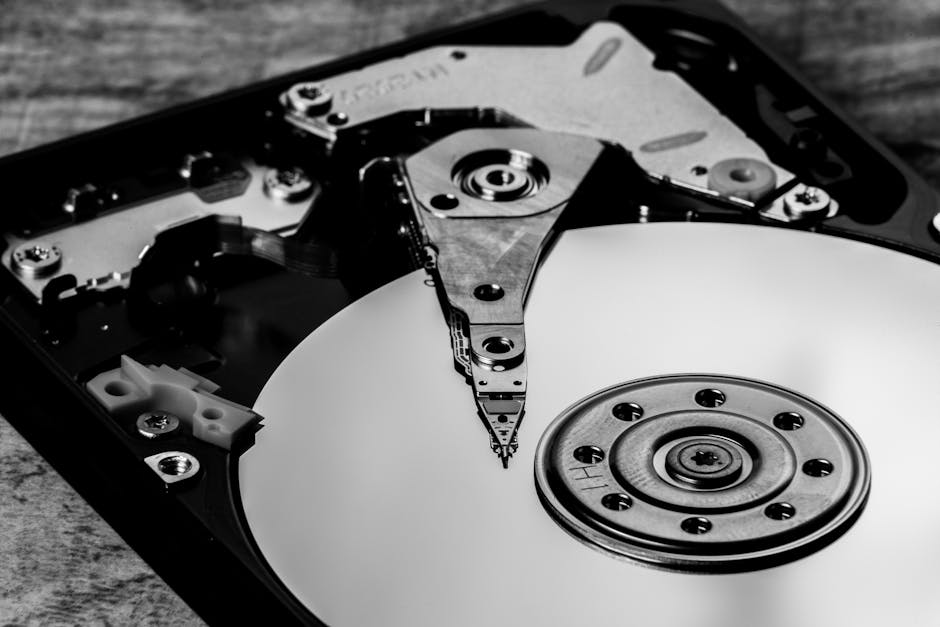
Properly preparing business IT assets before handover streamlines logistics, eliminates security oversights, and accelerates asset recovery payouts. Disposition readiness requires cross-departmental coordination between IT management, facilities personnel, and data security officers.
Before scheduling equipment transport, follow these foundational preparation steps:
- Conduct a Comprehensive Asset Inventory: Document all outgoing systems, including model numbers, serial numbers, enterprise asset tags, and physical server locations.
- Separate Storage Media: Clearly identify drives containing proprietary or classified corporate records that require physical destruction rather than software sanitization.
- Organize Server Accessories and Mounting Hardware: Keep modular drive caddies, power distribution units (PDUs), rails, and interconnect cables grouped with their corresponding chassis to maximize potential asset recovery returns.
- Coordinate Facility Logistics: Ensure loading bays, freight elevators, and secure staging areas are cleared and accessible for logistics teams.
For official guidance on sanitizing commercial and public-sector IT assets, consult the federal guidelines on Media Sanitization Considerations for Federal Electronics at End-of-Life.
Preparing Business Computers and Server Components for Secure Disposition
To maintain strict regulatory adherence, corporate IT departments must implement clear operational workflows for all retiring systems. Applying the NIST 800-88 standard ensures that all logical drives, embedded flash memory, and RAID array configurations undergo comprehensive sanitization before hardware changes ownership.
For organizations managing large-scale equipment updates, reviewing the definitive guide to electronics recycling drop-off locations ensures your team understands the regulatory expectations surrounding commercial electronics handling and chain-of-custody transfer.
Frequently Asked Questions About Business IT Asset Disposition
What happens to data on retired business computers and server components?
All data-bearing business hardware undergoes systematic sanitization following strict NIST 800-88 guidelines. During this process, enterprise-grade wiping software overwrites all addressable storage sectors with random binary patterns to ensure complete data unrecoverability.
If a hard drive or solid-state drive is physically damaged, unreadable, or classified under strict data-security mandates, it is transferred directly to industrial shredders or degaussers. The client receives a comprehensive, serialized Certificate of Data Destruction for auditing and compliance verification.
Can broken computers and server components still be recovered or recycled?
Yes. Non-functional computers, failed server blades, and damaged components still contain high intrinsic value. Skilled disposition technicians test internal parts to recover working enterprise processors, memory modules, and specialized expansion cards.
Components that cannot be repaired or remarketed are dismantled into clean material streams—including aluminum heat sinks, copper wiring, steel chassis, and printed circuit boards—ensuring that all materials are reclaimed without contributing to landfill waste.
How can organizations manage bulk computer and server equipment disposition?
Managing bulk enterprise disposition requires structured project planning:
- Audit and Catalog: Compile a centralized inventory of all computers, server racks, network switches, and peripheral hardware scheduled for retirement.
- Coordinate Facilities: Establish secure holding zones within your data center or warehouse with restricted employee badge access.
- Engage a Certified ITAD Partner: Schedule specialized logistics that include secure packing, GPS-tracked transportation, on-site or off-site data destruction, and downstream asset recovery.
- Receive Final Documentation: Retain all certificates of destruction, recycling manifests, and asset recovery financial reports for your corporate accounting and ESG compliance records.
Conclusion
Retiring business computers, enterprise servers, and data center components requires a structured, secure, and environmentally responsible approach. Simply storing obsolete hardware in valuable office space exposes organizations to data security risks, inventory depreciation, and regulatory non-compliance. By embracing certified IT asset disposition, your enterprise safeguards sensitive digital intelligence, supports the circular technology economy, and captures residual asset value.
At Innovative IT Solutions, we provide full-service IT asset disposition across Oklahoma City, South OKC, and throughout Oklahoma. Our NIST- and DoD-compliant sanitization processes, zero-landfill electronic recycling, and expert asset recovery services ensure your commercial hardware retirement is fully documented, secure, and profitable. Explore our Innovative IT Solutions Electronics Recycling Services today to schedule your corporate IT pickup and secure your retired infrastructure.


