
Transform Idle Server Racks and Enterprise Hardware into Working Budget
Turn Retired Data Center Hardware Into Working Budget
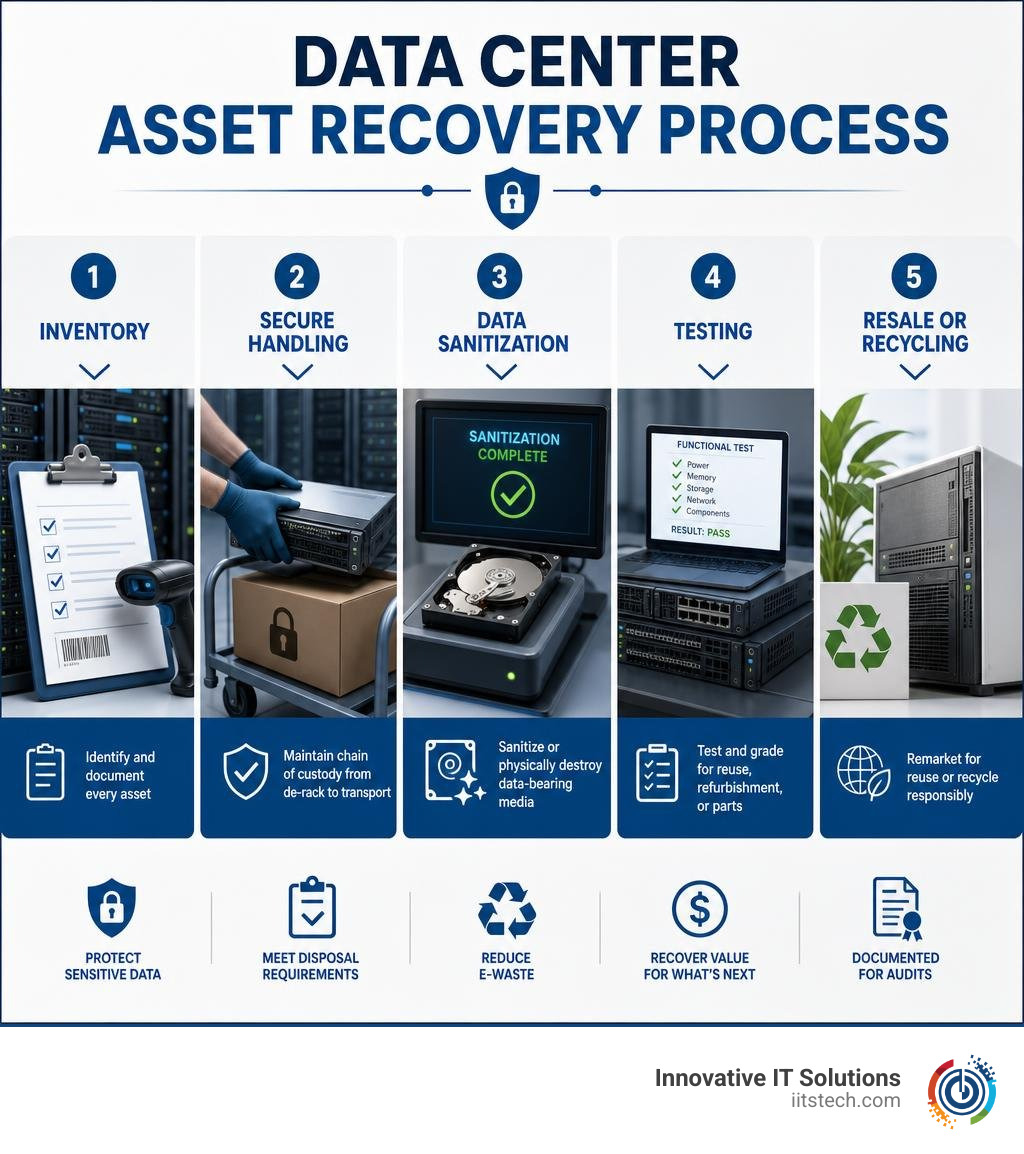
Data center asset recovery is the secure process of identifying, removing, sanitizing, testing, and remarketing retired servers, storage, networking equipment, and components. It helps IT teams protect sensitive data, meet disposal requirements, reduce e-waste, and recover value that can support the next infrastructure upgrade.
A practical starting point is simple:
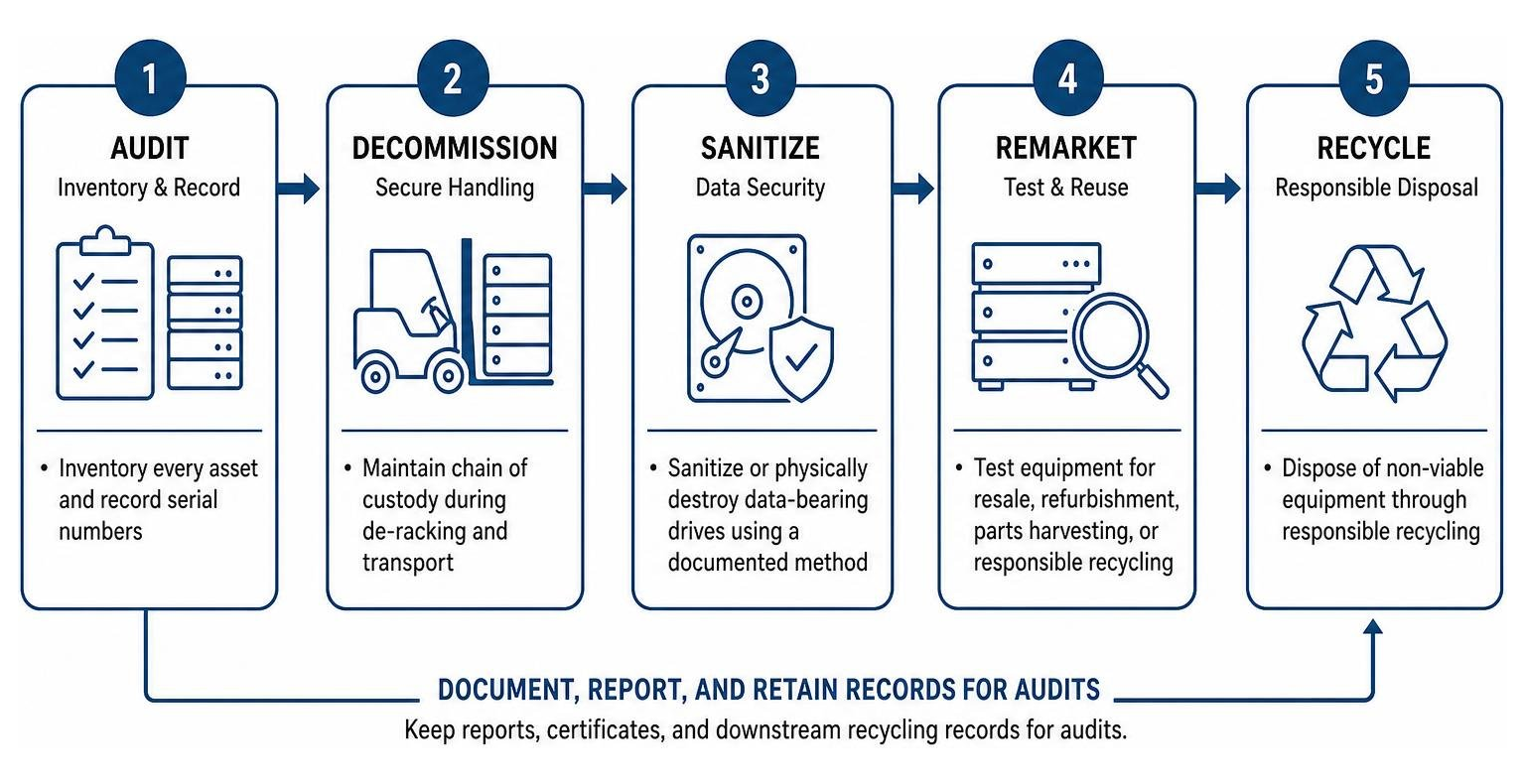
- Inventory every asset and record serial numbers.
- Maintain chain of custody during de-racking and transport.
- Sanitize or physically destroy data-bearing drives using a documented method.
- Test equipment for resale, refurbishment, parts harvesting, or responsible recycling.
- Keep reports, certificates, and downstream recycling records for audits.
Idle racks are not just taking up floor space. They can carry data-breach risk, ongoing storage costs, and residual market value. With the right process, organizations can turn surplus enterprise hardware into recovered budget while keeping security, HIPAA, GDPR, PCI, and e-waste responsibilities in view.
I am Mike Haden, Founder and Director of Business Development at Innovative IT Solutions, with 14 years of experience in secure data center asset recovery, IT asset disposition, enterprise hardware remarketing, and data destruction. Our team has processed and resold more than one million pieces of corporate and enterprise IT equipment through documented, responsible recovery practices.
Data center asset recovery word list:
What Is Data Center Asset Recovery and Why It Matters
Every year, enterprise facilities cycle out thousands of server blades, SAN arrays, core switches, and power distribution units. Historically, these decommissioned systems were shoved into backroom storage cages or paid off as scrap hauling expenses. In 2026, treating enterprise hardware as junk is a major strategic misstep. Understanding what is IT asset disposition (ITAD) and why it matters in 2025 and beyond is the foundation of transforming your legacy gear into liquidity.
The global data center asset recovery market is projected to reach $12.5 billion by 2028, expanding at an 8.2% CAGR from 2023. This explosive growth reflects a clear financial truth: enterprise IT equipment holds massive residual value long after it finishes its primary compute lifecycle. Data centers can recover up to 95% of the value of retired IT assets through systematic testing, parts harvesting, and multi-channel remarketing.
When hardware sits powered down inside expensive floor space, depreciation eats into your margins every day. We frequently talk about the real cost of holding on to old IT equipment—not only do these systems lose value on the secondary market each month, but they also trigger unnecessary maintenance fees, storage overhead, and security liabilities. A deliberate asset recovery program counters this slide, slashing the total cost of ownership (TCO) for enterprise data center infrastructure by 30% to 40%.
The Step-by-Step Data Center Asset Recovery Process
Transforming heavy, complex server racks into usable budget requires a rigorous, multi-stage operational framework. Here is how that process flows from initial discovery to financial return:
Auditing, Decommissioning, and Chain of Custody in Data Center Asset Recovery
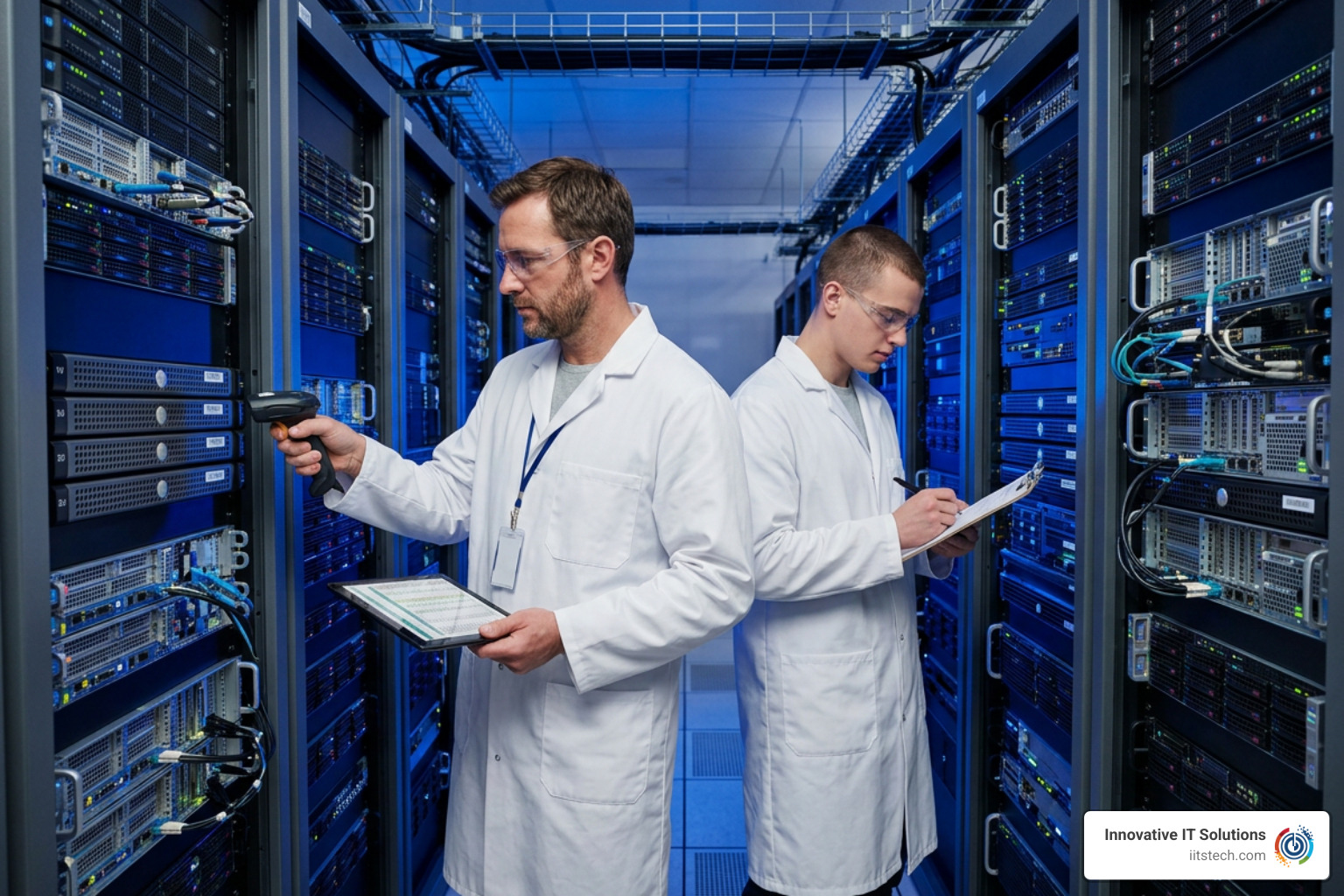
The recovery cycle begins on the white floor with a complete physical and logical infrastructure audit. Every chassis, server blade, daughter card, and power supply unit (PSU) must be accounted for against your data center infrastructure management (DCIM) database.
Proper de-installation requires seasoned engineers who know how to safely de-rack high-density blade enclosures, disconnect industrial 3-phase power, and package sensitive components without causing physical damage. During this transition, maintaining unbroken tracking is non-negotiable. Enterprise IT leaders must understand what is chain of custody in ITAD and why it matters to protect against loss and compliance violations. Knowing how to prepare IT equipment for secure disposal a step-by-step guide ensures that tamper-evident seals, serialized transit logs, and GPS-tracked logistics are in place from your server room to our processing facility.
Sanitization, Testing, and Component Harvesting
Once assets are secured in our processing center, data security takes priority over everything else. Modern enterprise arrays often hold sensitive customer records, proprietary software, or classified operational data. Vulnerabilities detailed across industry benchmarks, such as [자료] OWASP Top 10: Real-World Examples, highlight the catastrophic damage that unmanaged data access and configuration oversights can unleash.
Every data-bearing drive undergoes certified data destruction compliant with NIST SP 800-88 Rev. 1 and DoD 5220.22-M guidelines. Depending on your corporate governance policies, we assess physical destruction vs data wiping when each method is required. High-capacity NVMe and SAS enterprise drives that successfully pass multi-pass overwriting can be recertified for resale, while failing or restricted drives are shredded down to tiny fragments.
After sanitization, technicians test CPU processors, enterprise DDR4/DDR5 registered ECC RAM, motherboard chipsets, host bus adapters (HBAs), and fiber channel transceivers for performance stability.
Maximizing ROI: Resale, Refurbishment, and Component Liquidation
Not all retired hardware has to be sold as whole systems. In fact, dismantling complex server blades into modular enterprise components frequently yields substantially higher financial returns.
Evaluating Resale vs. Recycling in Data Center Asset Recovery
Approximately 80% of data center assets are eligible for resale or reuse, significantly reducing e-waste generation. Discovering the business benefits of selling your used IT equipment gives finance and infrastructure leaders the capital they need to fund edge computing, cloud migrations, and AI-accelerated cluster deployments.
When maximizing value from obsolete IT equipment and asset recovery, our remarketing specialists cross-reference real-time enterprise secondary market demand. Enterprise switching gear, high-throughput routers, and security appliances retain incredible liquidity. For example, infrastructure teams can learn how to sell your used Cisco equipment easily to recapture enterprise capital from decommissioned switch fabrics and edge routers.
Component Harvesting and Enterprise Hardware Refurbishment
Secondary markets prize modularity. When buyers evaluate refurbished vs new IT equipment making the smart procurement choice, they often seek tested enterprise parts to keep their existing production arrays running without paying brand-new OEM premiums.
| Enterprise Component | Value Retention Potential | Primary Secondary Market Demand Driver |
|---|---|---|
| Enterprise Server CPUs | High to Very High | Multi-core compute nodes, virtualization expansion |
| ECC Registered Server RAM | Very High | Memory-intensive database and AI server scaling |
| NVMe / Enterprise SAS SSDs | Moderate to High | High-IOPS storage tier expansion (sanitized) |
| Enterprise Core Switches | High | Secondary network fabric buildouts and lab setups |
| Server Motherboards & PSUs | Moderate | Direct replacement parts for legacy chassis fleets |
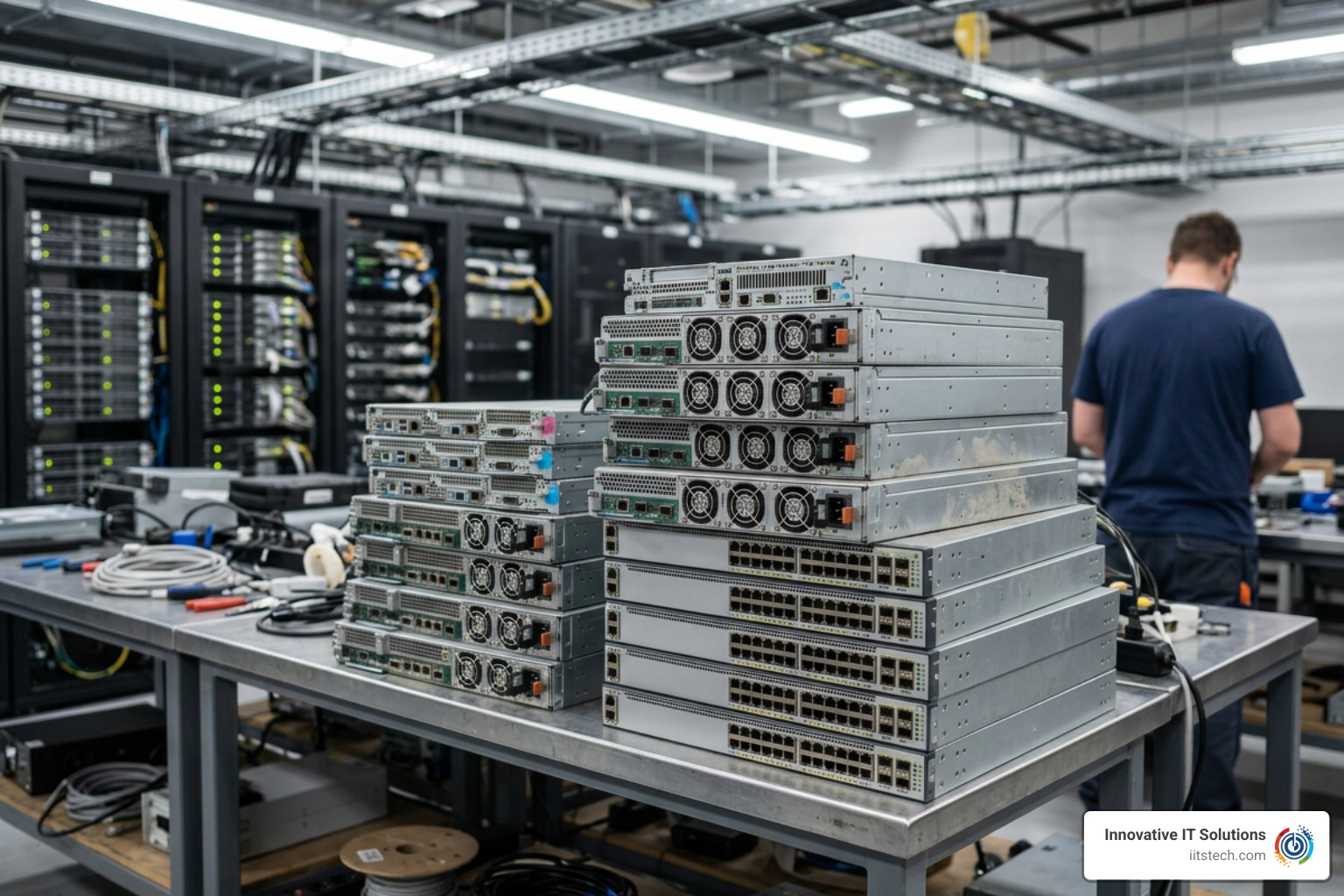
Harvesting these components yields immediate liquidity while providing reliable, certified spare parts for private clouds and enterprise legacy environments.
Security, Compliance, and Environmental Sustainability
Data center decommissioning is governed by strict regulatory frameworks. Failing to follow these rules can lead to expensive fines, lawsuits, and brand damage.
Enterprises handling sensitive records must ensure their decommissioning partners stay aligned with ITAD compliance how to keep your business audit-ready and secure. Whether your facility is bound by HIPAA, GDPR, PCI-DSS, or SOX, every processed drive and motherboard must generate a serialized Certificate of Sanitization and Destruction. Regional resources like Oklahoma City Data Recovery Service Hard Drive, RAID, SSD … remind us how easily data can linger on damaged media if it is not completely sanitized by certified specialists.
At the same time, environmental sustainability has shifted from an optional talking point to a mandatory corporate governance standard. Over 50 million metric tons of e-waste is generated globally every year, with data centers contributing roughly 5% of that massive total. By focusing on reuse and clean material reclamation, organizations achieve the environmental impact of ITAD done right.
Partnering with an R2 certified ITAD provider guide 2026 guarantees that non-marketable circuit boards, rare earth metals, and copper wiring are processed through zero-landfill, EPA-compliant channels.
Frequently Asked Questions About Data Center Asset Recovery
How much value can an enterprise recover from retired data center equipment?
Enterprises can recover up to 95% of the value of retired IT hardware by deploying structured asset recovery and remarketing strategies. The return depends directly on equipment age, density, component health, and market timing. Decommissioning server fleets right after a 3- to 5-year refresh cycle—rather than letting them sit in storage for years—maximizes residual yields and lowers enterprise hardware TCO by 30% to 40%.
What is the difference between standard ITAD and data center asset recovery?
Standard IT asset disposition often focuses on end-user endpoints like office desktop towers, enterprise laptops, and basic peripherals. Data center asset recovery deals exclusively with high-density compute architecture, complex modular SAN arrays, rack enclosures, enterprise switches, and server components. It demands specialized industrial rigging, deep understanding of enterprise component testing, and advanced bulk data sanitization protocols.
How do certified providers guarantee compliance and prevent data breaches?
Certified providers use end-to-end chain-of-custody protocols, including tamper-evident locking transit containers, real-time GPS transport tracking, and secure processing labs. All data-bearing devices are sanitized in alignment with NIST SP 800-88 Rev. 1 or physically shredded. Every processed item is mapped to its unique serial number on an official Certificate of Data Destruction for audits.
Conclusion
Idle server racks and retired enterprise hardware do not belong in costly storage space or unverified salvage piles. With the right strategy, your retired infrastructure can fuel your next innovation cycle. Innovative IT Solutions helps businesses reclaim capital, protect enterprise data, and support corporate sustainability goals with end-to-end enterprise data center asset recovery. Connect with our team today to turn your surplus infrastructure into working budget.


