
Why a Secure Chain of Custody in ITAD Can Make or Break Your Compliance Program
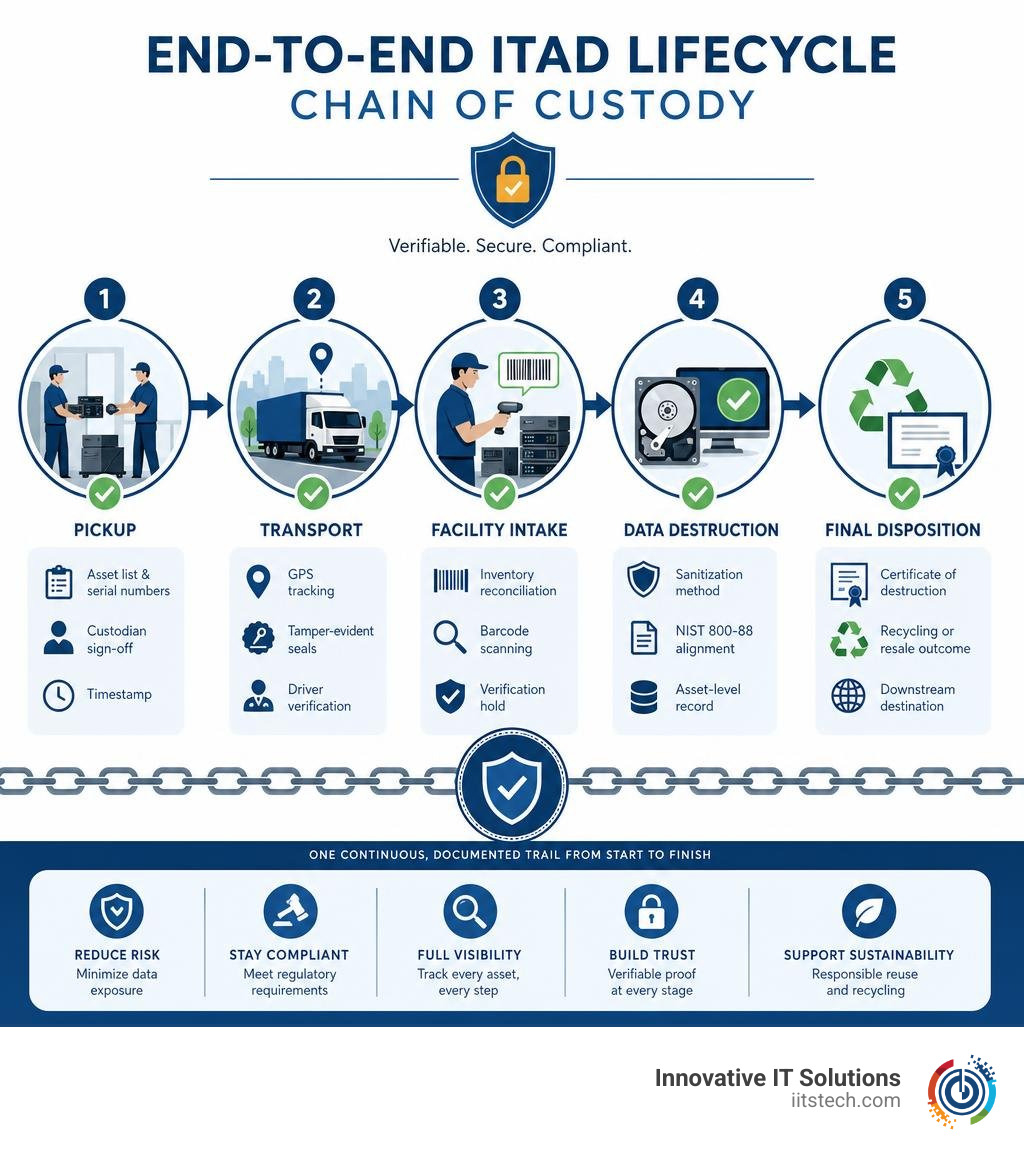
Secure chain of custody in ITAD is the documented, verifiable trail that tracks every retired IT asset — from the moment it leaves your facility through transport, processing, data destruction, and final disposition.
Here is what a secure chain of custody covers at a glance:
| Stage | What Gets Documented |
|---|---|
| Pickup | Asset list, serial numbers, custodian sign-off, timestamp |
| Transport | GPS tracking, tamper-evident seals, driver verification |
| Facility intake | Inventory reconciliation, barcode scanning, verification hold |
| Data destruction | Sanitization method, NIST 800-88 alignment, asset-level record |
| Final disposition | Certificate of destruction, recycling or resale outcome, downstream destination |
Most organizations focus on data destruction as the finish line. But the risk window starts the moment a device goes offline — not when it reaches a shredder.
A single gap in the process can expose your organization to real consequences. The global average cost of a data breach exceeded $4.45 million in 2023. And regulatory bodies like HIPAA, GDPR, and the SEC do not require proof of a breach to act — missing documentation alone can trigger fines, audits, and reputational damage.
Consider what happened to Coca-Cola: stolen laptops with inadequate disposition controls exposed the personally identifiable information of 74,000 employees. The breach did not happen because of a cyberattack. It happened because the chain of custody broke down.
If you manage decommissioned enterprise computers, servers, or other business-grade hardware, this guide is built for you.
I’m Mike Haden, Founder and Director of Business Development at Innovative IT Solutions. Over 14 years of building and operating an R2v3-certified ITAD company, I have helped hundreds of organizations implement secure chain of custody ITAD programs that protect sensitive data, satisfy auditors, and recover real value from retired assets. The sections below give you an honest, practical roadmap for getting it right.
Terms related to secure chain of custody itad:
What is Chain of Custody in ITAD and Why It Matters
When we talk about a secure chain of custody ITAD strategy, we are talking about a continuous, unbroken thread of accountability. Think of it as a birth-to-burial certificate for your retired business-grade hardware. It is the chronological record of who had physical possession of an asset, where it was stored, when custody was transferred, and how its data was ultimately destroyed.
Many IT managers treat asset disposition as a straightforward logistics task: you box up some old servers, load them onto a truck, and cross your fingers that they reach their destination. However, in modern cybersecurity, retired devices are not just heavy pieces of metal—they are physical containers of highly sensitive company IP, proprietary software, and client records. Understanding What is Chain of Custody in ITAD and Why it Matters? is the first step toward closing the gap between active network security and end-of-life physical security.
When you decommission high-density server storage or enterprise-grade laptops, those units remain active risk vectors until they are systematically sanitized. A strong physical security protocol is the only way to ensure that those drives are not accessed by unauthorized parties before they undergo sanitization. This is why a secure chain of custody is so vital: it ensures that your assets are protected at every single step, eliminating the physical “blind spots” in your compliance strategy. For a deeper look at how this fits into your broader defense posture, read about Why ITAD Should Be Part of Your Cybersecurity Strategy.
Why a Secure Chain of Custody ITAD Strategy Prevents Data Breaches
It is a common misconception that data breaches only happen via sophisticated cyberattacks or remote network hacks. In reality, physical asset loss during the disposition phase is a massive contributor to data exposure. According to industry research, approximately 20% of all corporate data breaches involve failures during the disposal phase.
A prominent real-world example of this risk is the Coca-Cola data breach. A former employee stole several laptops containing the unencrypted personally identifiable information (PII) of 74,000 current and former employees. The laptops were slated for disposal but were not properly tracked or secured, allowing them to walk out the door unnoticed. This devastating exposure could have been entirely prevented with a strict, serialized checkout process and a secure chain of custody.
When drive arrays and high-capacity server components leave an office or data center in Oklahoma City without serialized tracking, they are highly vulnerable. If those drives are handed over to a general shipping courier or stored in an unlocked warehouse, they can easily be stolen, misplaced, or skimmed. A robust, documented process ensures that every single serial number is scanned, verified, and signed off at every transition point, making physical theft or loss virtually impossible to go unnoticed. To learn more about this crucial link, explore What is Chain of Custody, & Why is it important for ITADs?.
The Strategic Business and Legal Risks of Broken Custody
When your chain of custody breaks, the consequences extend far beyond the immediate risk of a physical data breach. From a legal and regulatory standpoint, a broken chain of custody is often treated by auditors and regulators as if a breach has already occurred.
Under frameworks like HIPAA, GDPR, and the SEC material incident disclosure rules, organizations must be able to prove they have maintained continuous control over sensitive data-bearing devices. If you cannot produce a serialized audit trail showing exactly how a retired server drive traveled from your South OKC facility to the shredder, you are out of compliance. For example:
- HIPAA Compliance: Requires strict, documented physical safeguards for media containing patient data. Failing to provide a clear chain of custody can result in massive fines during an audit, even if no data was actually leaked.
- SEC Requirements: Public companies must disclose material security incidents within four business days. A batch of missing hard drives with unknown status can trigger this reporting requirement, causing immediate reputational damage and stock volatility.
- ISO 27001 Certification: Jeopardizing your information security management system (ISMS) certification is a real threat when asset tracking documentation is incomplete.
Furthermore, a broken chain of custody can void your corporate cybersecurity insurance policies, leaving your business to pay for remediation, notification, and legal fees entirely out of pocket. To protect your business from these hidden liabilities, it is crucial to understand how Can Old IT Equipment Create Liability After Disposal?.
The Core Pillars of a Secure Chain of Custody ITAD Process
Building a reliable, audit-ready chain of custody requires a multi-layered security approach. You cannot rely on a single document or a vendor’s promise. Instead, you must build a system based on physical controls, specialized logistics, and strict operational workflows.

Maintaining these standards requires a commitment to process-driven execution. If you are wondering how to keep these workflows tight, read our guide on How to Keep Your ITAD Chain of Custody Unbroken and Compliant.
Secure Logistics and Transport Protocols
The journey from your facility to the processing center is the most vulnerable phase of the ITAD lifecycle. Standard shipping methods or general freight couriers are simply not equipped to handle highly sensitive data-bearing hardware.
To maintain a secure chain of custody, we utilize dedicated, secure logistics protocols:
- GPS-Tracked Vehicles: Transport vehicles must be equipped with active GPS tracking systems, allowing real-time monitoring of the exact route and transport times.
- Tamper-Evident Seals: Before the transport vehicle leaves your dock, secure, numbered tamper-evident seals are applied to the cargo doors. The unique seal numbers are documented on the Bill of Lading (BOL). Upon arrival at our facility, our intake team verifies and photographs these seals to ensure the load was not opened or tampered with during transit.
- Security-Vetted, Background-Checked Drivers: Every driver handling your equipment must be a direct, background-checked employee—never an unvetted third-party contractor. They must wear company uniforms and carry visible photo identification.
- Segregated Cargo Space: Your assets should never be mixed with loads from other companies during transport. This prevents accidental cross-contamination or unauthorized handling of your devices.
These transport standards ensure that your data remains protected from the moment it leaves your loading dock until it is safely inside our facility.
Facility Controls and Processing Security
Once your assets arrive at the ITAD processing facility, the physical security measures must remain just as tight. A secure facility must act as a fortress for your retired hardware.
At Innovative IT Solutions, we enforce strict, multi-layered facility controls:
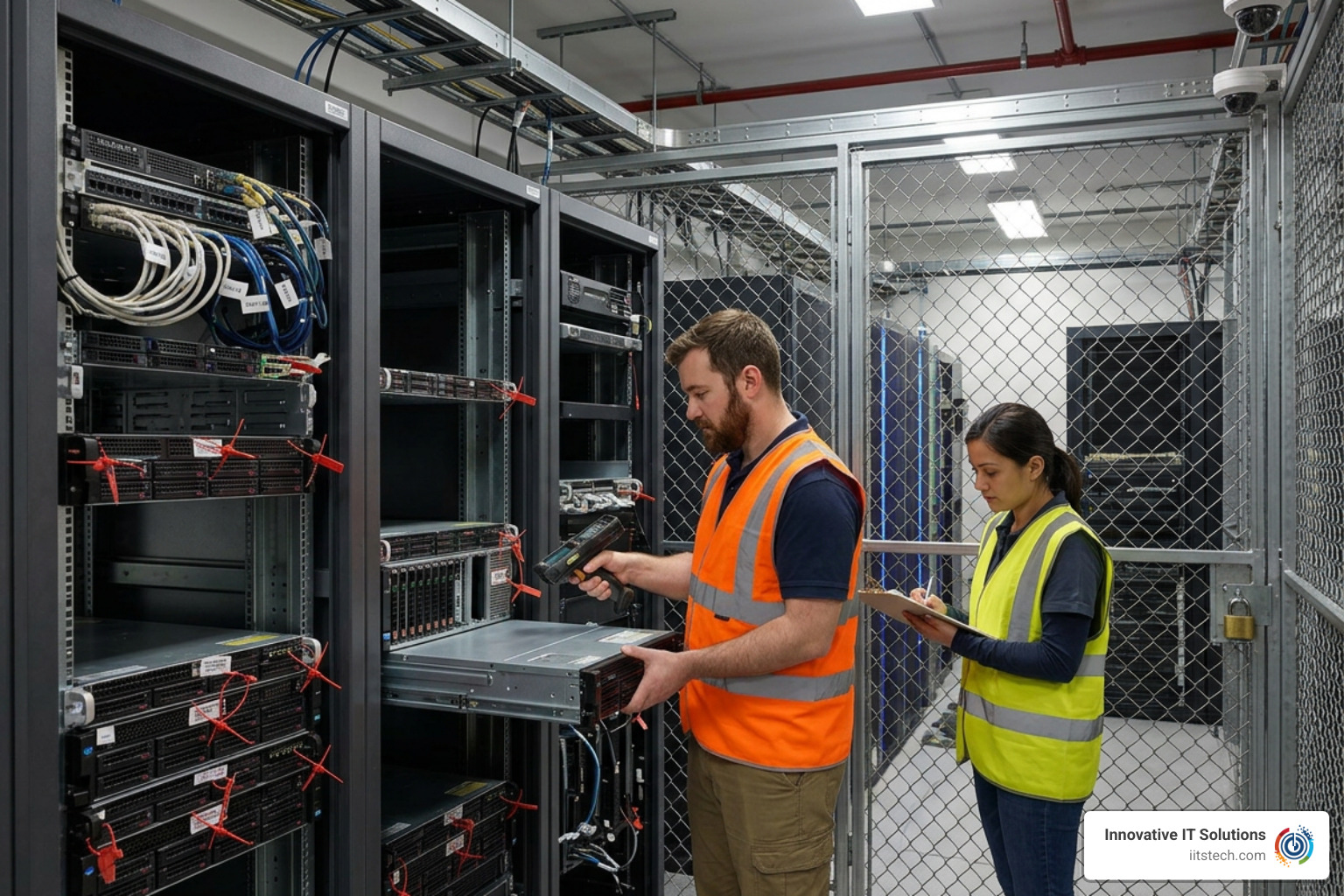
- Access Control Systems: All entry and exit points must be controlled by electronic badge systems. Only authorized, security-cleared personnel are allowed inside the active processing and storage zones.
- 24/7 Video Surveillance: Continuous high-definition video monitoring must cover all processing areas, storage cages, and loading docks. These video archives are retained for audit verification.
- Segregation of Duties: The team members responsible for receiving and inventorying the equipment must operate independently from the team performing the data sanitization and physical shredding. This dual-control environment ensures objective verification.
- Secure Storage Cages: Before devices undergo data destruction, they must be stored in locked, physical steel cages to prevent any unauthorized internal access.
How to Document, Track, and Verify Assets Throughout Disposition
To survive a corporate audit or regulatory review, your ITAD documentation must be flawless. Many organizations still rely on paper-based logs or generic “box-level” receipts. These outdated methods leave massive gaps that auditors will quickly flag.
| Tracking Metric | Paper-Based Tracking | Digital Serialized Tracking |
|---|---|---|
| Accuracy | High risk of manual entry errors and skipped serial numbers | Near-zero error rate using direct barcode/RFID scanning |
| Traceability | Difficult to search; easily lost or altered | Real-time, central database with secure digital audit trail |
| Audit Readiness | Takes days or weeks to compile and reconcile | Instantly retrievable within minutes |
| Granularity | Bulk counts (e.g., “Box of 20 hard drives”) | Asset-level details (serial, model, capacity, sanitization log) |
Transitioning to a digital, serialized approach is the only way to protect your business. Learn how to align your documentation with modern standards in our guide on ITAD Compliance: How to Keep Your Business Audit-Ready and Secure.
Serialized Asset Tracking at the Source
The golden rule of secure chain of custody ITAD is simple: Capture serial numbers at the source, before the assets ever leave your floor.
If you wait until the equipment arrives at an ITAD facility to scan serial numbers, you have created an accountability black hole during transport. If a server hard drive goes missing during transit, you won’t even know it is gone because it was never logged in the first place.
Before any hardware is loaded onto a truck, our team performs on-site serialized scanning. Every computer, server, and individual storage component is logged by its unique manufacturer serial number and assigned a secure tracking barcode. This establishes a baseline inventory manifest. Every downstream step—including transport, facility intake, and eventual data sanitization—is mapped directly back to these specific serial numbers, aligning with the rigorous requirements of NIST SP 800-88 Rev. 1.
Verification Holds and Discrepancy Resolution
Even with the best processes, discrepancies can occasionally happen during large-scale data center decommissions. A mismatch between your internal active asset register and the physical items scanned at pickup is a common challenge.
To handle this, we implement a strict Verification Hold protocol. When a shipment arrives at our facility, our intake team performs an independent physical scan of every item. This scan is programmatically reconciled against the pre-pickup manifest.
If any discrepancy is found—such as an extra drive or a missing serial number—the entire batch is immediately placed on a secure physical hold. No processing or data destruction occurs until a secondary audit is conducted. Remarkably, 99% of inventory discrepancies in ITAD can be resolved with a second look when proper verification holds and dual sign-off procedures are in place. This prevents the accidental destruction of active units and ensures complete accuracy.
Audit-Ready Reporting and Compliance Verification
When an auditor walks into your office, they aren’t going to take your word for it that your data was destroyed securely. They want hard, indisputable evidence. In the ITAD world, “audit-ready” means you can produce a complete, serialized history for any retired asset within 10 minutes.
This level of verification is critical for proving compliance with frameworks like ISO 27001, SOC 2, and HIPAA. To understand how certified workflows support this, read our article on How to Ensure Certified Data Destruction for Retired Devices.
Demystifying the Certificate of Destruction
Many IT professionals believe that having a Certificate of Destruction (CoD) is all they need to be fully compliant. This is a dangerous misconception. A bulk Certificate of Destruction that simply states “Destroyed 50 hard drives on October 12th” is essentially just a receipt—it does not prove which specific drives were destroyed, how they were destroyed, or who had custody of them beforehand.
An audit-ready Certificate of Destruction must be directly linked to a serialized tracking report. It should include:
- The unique serial number and asset ID of each individual device.
- The exact method of destruction (e.g., physical shredding to 20mm, or software-based sanitization conforming to NIST 800-88 standards).
- The names and signatures of the technicians who performed and verified the destruction.
- The exact date, time, and location of the destruction event.
Without these specific details, a CoD will not hold up under regulatory scrutiny. Learn more about these requirements in Demystifying the Certificate of Destruction for Your Business and explore The Role of Data Destruction in Cybersecurity.
Downstream Partner Auditing and Liability Protection
Your liability for corporate data and environmental compliance does not end when your ITAD vendor processes your equipment. Under federal and state laws, you are legally responsible for the final disposition of your assets through the entire downstream chain. If your ITAD provider hands your hardware off to an unvetted subcontractor who dumps it in a landfill or exports it illegally, your company faces the fines and reputational fallout.
This is why we maintain rigorous, proactive oversight:
- Downstream Auditing: We thoroughly vet and audit every single downstream partner to ensure they maintain the same high standards for security and environmental safety that we do. For more context on why this is non-negotiable, read Why Your ITAD Provider’s Downstream Partners Matter.
- Liability Insurance: A reputable ITAD provider must carry substantial, specialized insurance coverage. This includes both general equipment liability and high-limit Errors & Omissions (E&O) / Cyber Liability insurance to protect your organization in the highly unlikely event of a data breach or vendor failure. Learn about how this protects your bottom line in ITAD Liability Insurance: Protecting Your Business When Vendors Fail.
How to Evaluate and Select the Right ITAD Partner
Choosing an ITAD vendor is one of the most critical security decisions your organization will make. You are handing over the keys to your retired data kingdoms, so you must perform thorough due diligence to ensure regional and national standards are maintained.
When evaluating vendors, look for industry-recognized, third-party certifications. An R2v3 (Responsible Recycling) or e-Stewards certification ensures that the provider adheres to strict, audited standards for data security, physical safety, and environmentally friendly, zero-landfill, EPA-compliant processes.
How to Evaluate a Secure Chain of Custody ITAD Vendor
Use this practical checklist when vetting potential ITAD partners to ensure they can deliver a truly secure chain of custody:
- [ ] Employee Vetting: Do they perform comprehensive background checks and regular drug screenings on all employees, including drivers and warehouse staff?
- [ ] Direct Logistics: Do they use their own branded, GPS-tracked fleet and direct employees, or do they outsource transport to third-party couriers?
- [ ] On-Site Capabilities: Can they perform serialized scanning, barcode tagging, and physical data destruction on-site at your facility before transport?
- [ ] Facility Security: Are their processing facilities protected by 24/7 video surveillance, electronic access controls, and secure storage cages?
- [ ] Audit Trail Integration: Do they provide a centralized, searchable digital portal where you can track the real-time status and serialized history of every asset?
- [ ] Downstream Transparency: Can they provide documented proof of their downstream recycling partners and final material destinations?
- [ ] Insurance Coverage: Do they carry comprehensive cyber liability and professional E&O insurance with coverage limits that match your risk profile?
Frequently Asked Questions about ITAD Chain of Custody
What is the difference between a pickup receipt and a chain of custody document?
A pickup receipt is simply a basic, load-level document. It acts like a shipping receipt, proving that a carrier took possession of a certain number of boxes or pallets (e.g., “3 wrapped pallets of IT equipment”). It does not verify what is actually inside those boxes.
A secure chain of custody ITAD document is a granular, serialized, birth-to-burial record. It tracks every individual asset by its unique serial number, documenting every handoff, storage location, and processing event from the moment it leaves your facility until its final destruction or remarketing.
How long should our organization retain ITAD chain of custody records?
For routine operational and compliance evidence, organizations should retain ITAD chain of custody documentation and Certificates of Destruction for 3 to 7 years. However, if your organization is subject to specific legal holds, government contracts, or highly stringent industry regulations, you may be required to retain these records indefinitely. Always store these records in a centralized, searchable digital repository so they are readily accessible during unexpected audits.
Can missing chain of custody documentation be treated as a data breach?
Yes. Under modern data privacy laws like HIPAA and GDPR, the inability to prove that a data-bearing asset was handled securely is often treated with the same severity as an actual, confirmed data breach.
For instance, HIPAA’s breach notification rule requires notification within 60 days of discovering a potential compromise. If you cannot produce a serialized chain of custody proving a retired server drive was destroyed, regulators may assume the data was exposed, triggering mandatory notifications, audits, and heavy compliance penalties.
Conclusion
When it comes to disposing of retired enterprise servers, computers, and storage drives, hope is not a security strategy. A single missing drive or a broken link in your logistics chain can quickly turn into a multi-million dollar compliance nightmare.
By partnering with Innovative IT Solutions, you get more than just an IT recycler. You get an experienced, R2v3-certified team committed to protecting your brand, your data, and your bottom line. We provide fully compliant, zero-landfill, NIST-compliant data destruction and secure logistics that keep your chain of custody unbroken from start to finish.
Let us take the stress out of your next hardware refresh or data center decommission. Contact us today to learn more about our Secure Asset Recovery Services and request a custom, secure ITAD plan for your organization.