
IT Disposal Companies: Everything You Need to Know
Why Choosing the Right IT Disposal Company Matters for Your Business
IT disposal companies help businesses securely retire old hardware — protecting sensitive data, staying compliant, and keeping e-waste out of landfills.
Here’s a quick overview of what to look for when choosing one:
| What to Look For | Why It Matters |
|---|---|
| R2v3, NAID AAA, or e-Stewards certification | Proves responsible recycling and secure data destruction |
| NIST 800-88 compliant data wiping or shredding | Meets federal data sanitization standards |
| Certificate of Destruction (CoD) | Provides audit-ready proof for HIPAA, GDPR, PCI |
| Chain-of-custody documentation | Tracks every asset from pickup to final processing |
| Value recovery / remarketing program | Offsets disposal costs through resale of reusable hardware |
| Zero-landfill policy | Keeps toxic materials out of the environment |
Every business eventually faces the same problem: what do you do with old computers, servers, and devices when it’s time to upgrade? The answer matters more than most people think.
Simply deleting files or dropping equipment at a generic recycling bin isn’t enough. Sensitive data can survive a basic wipe. Regulatory agencies like HIPAA and GDPR hold organizations responsible for what happens to their hardware — even after it leaves the building.
The stakes are real. Electronic waste makes up only 2% of landfill waste, but accounts for nearly 70% of all toxic waste due to concentrated levels of lead, mercury, and other harmful substances. And a single HIPAA violation from improper disposal can cost an organization up to $50,000.
I’m Mike Haden, Founder and Director of Business Development at Innovative IT Solutions — and over the past 14 years, I’ve helped businesses of all sizes navigate IT disposal companies, building an R2v3-certified operation that has processed and remarketed over a million pieces of enterprise IT equipment. In this guide, I’ll walk you through everything you need to know to make the right call for your organization.
What is IT Asset Disposal (ITAD) and Why Does It Matter?
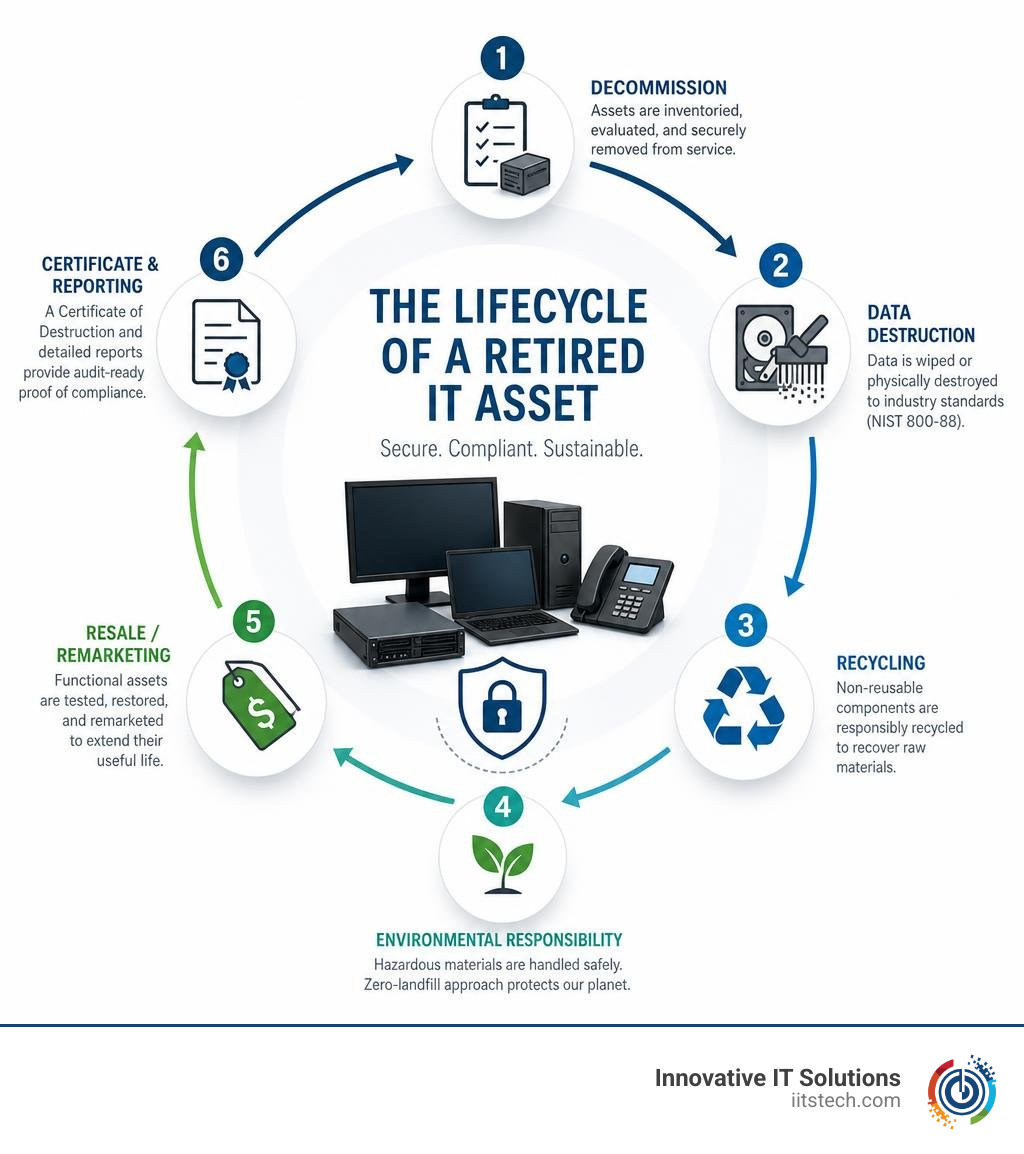
IT Asset Disposition (ITAD) is the formal, secure process of decommissioning, recycling, or reselling retired corporate hardware. Unlike simply tossing a broken monitor into the trash, ITAD is a highly structured discipline designed to protect corporate data, ensure compliance with federal and state laws, and minimize environmental impact.
As technology lifecycles shrink, businesses face a constant stream of obsolete laptops, desktops, servers, and networking gear. Properly retiring these assets is not just an administrative task; it is a critical component of modern corporate risk management. When we look at corporate sustainability and cybersecurity in 2026, managing these assets responsibly is paramount. For a deeper dive into the strategic importance of this process, check out our resource on What is IT Asset Disposition (ITAD) and Why It Matters in 2025.
ITAD vs. Basic E-Waste Recycling
Many businesses make the mistake of assuming that basic e-waste recycling is the same as professional ITAD. This misunderstanding can lead to catastrophic security gaps.
Basic e-waste recycling is primarily concerned with material reclamation. They take your old computers, shred them down to raw metals and plastics, and sell those materials back into the manufacturing supply chain. While this is great for the environment, basic recyclers rarely provide the robust asset tracking, chain-of-custody documentation, and certified data sanitization that modern businesses require.
By contrast, professional ITAD services treat your retired hardware as a liability first and a physical asset second. They prioritize data destruction, track every device by its unique serial number, and provide legally defensible documentation to prove compliance.
| Feature | Basic E-Waste Recycling | Professional ITAD Services |
|---|---|---|
| Primary Focus | Material reclamation & raw recycling | Data security, compliance, & value recovery |
| Asset Tracking | Bulk weight tracking only | Serialized, item-level tracking |
| Data Sanitization | Basic physical destruction (shredding) | NIST 800-88 compliant wiping, degaussing, or shredding |
| Documentation | General recycling receipt | Serialized Certificate of Destruction & audit logs |
| Value Recovery | None (often costs money) | Revenue sharing or offset via asset remarketing |
| Compliance Proof | Rarely audit-ready | Fully audit-ready for HIPAA, PCI-DSS, SOC 2 |
Why Businesses Need Specialized IT Disposal Companies
When you work with specialized it disposal companies, you are not just paying for someone to haul away heavy boxes. You are investing in corporate liability protection.
Every hard drive, solid-state drive (SSD), and backup tape leaving your facility is a potential data breach waiting to happen. If those devices are lost in transit or sold on the secondary market with residual data intact, your organization is legally and financially responsible. Specialized ITAD providers mitigate this corporate liability by offering guaranteed data sanitization, secure logistics, and comprehensive insurance coverage. If you are wondering when the right time is to bring in the professionals, read our guide on When Should You Consider IT Asset Disposal Services?.
The Major Risks of Improper IT Asset Disposal
The path of improper disposal is paved with good intentions—and massive liabilities. When organizations cut corners by donating un-wiped computers or hiring uncertified local junk haulers, they expose themselves to severe operational and financial dangers. Understanding these risks is the first step toward building a secure retirement strategy. To learn more about building a bulletproof defense, read about IT Asset Disposition: Why Every Business Needs a Secure ITAD Strategy.
Data Breaches and Cybersecurity Threats
The most immediate threat of improper disposal is a data breach. Simply deleting files, emptying the recycle bin, or even formatting a hard drive does not actually erase the underlying data. Forensic software can easily recover sensitive client information, proprietary source code, employee records, or intellectual property from discarded drives.
For healthcare providers in Oklahoma City, a single lost hard drive containing protected health information (PHI) can trigger devastating HIPAA violations. Noncompliance with HIPAA can cost an organization up to $50,000 per violation. Beyond the financial penalties, the reputational damage from a highly publicized data breach can destroy client trust overnight. To protect your business if a vendor fails to perform, it is critical to understand the role of specialized insurance, which we discuss in ITAD Liability Insurance: Protecting Your Business When Vendors Fail.
Environmental Hazards and Landfill Impact
Aside from cybersecurity threats, improper disposal carries severe environmental consequences. Electronic waste contains a cocktail of toxic chemicals, including lead, mercury, cadmium, and beryllium. When electronics are sent to standard municipal landfills, these hazardous materials can leach into local soil and water tables.
Consider these sobering statistics:
- The EPA estimates that 60 million metric tons of electronic waste are thrown out globally each year, with the US accounting for a massive share of that total.
- Though electronic waste makes up only 2% of all waste in landfills, it accounts for nearly 70% of all toxic waste.
- Every year, 14,000,000 cell phones are thrown out in the United States, which translates to roughly 80,000 lbs of lead leaching into the environment.
By working with certified IT disposal companies that enforce strict zero-landfill policies, your business ensures these toxins are safely processed and kept out of our local ecosystems. For more information on federal guidelines, you can consult the EPA: Electronics Donation and Recycling.
Key Steps to Take Before Disposing of Your IT Assets
Before you hand over your retired hardware to an ITAD provider, your internal team must take several preparatory steps. Proper preparation ensures that the transition is seamless, no critical data is lost, and your organization maintains a clear chain of custody from day one. If your business is currently transitioning, downsizing, or closing, check out our checklist on What to Do with Old IT Equipment When Your Business Closes or Downsizes.
Creating an Asset Inventory
You cannot securely dispose of what you do not track. Before scheduling a pickup, compile a comprehensive asset inventory that logs every device slated for retirement.
At a minimum, your inventory should include:
- The unique manufacturer serial number.
- The asset tag number (if your company uses them).
- The device type (laptop, server, switch, etc.).
- The physical location of the device.
- The presence of any data-bearing components (hard drives, SSDs).
This internal log acts as your baseline. When the ITAD vendor processes your equipment, their serialized report should match your internal inventory perfectly, leaving no room for missing devices. For a step-by-step breakdown of this process, consult The No-Nonsense Guide to Computer Asset Disposal.
Backing Up Critical Business Data
Once hardware leaves your facility, it should be treated as gone forever. It is absolutely vital to verify that all business-critical data has been backed up and verified before the decommissioning process begins.
We recommend utilizing redundant backup methods:
- Onsite Backup: Save complete system images to secure external drives using built-in tools like File History or Time Machine.
- Offsite/Cloud Backup: Ensure all active files are synced to secure enterprise cloud platforms such as Google Drive, OneDrive, or Dropbox.
In Oklahoma, businesses can also explore local resources for equipment reuse before choosing final recycling pathways; check out the Reuse and Repurpose | City of OKC program for local sustainability initiatives.
Data Destruction Standards and Compliance Certifications
To guarantee that your data is completely unrecoverable, professional IT disposal companies must adhere to strict, internationally recognized data destruction standards. Relying on a vendor’s “word” is a major compliance risk; you must demand independent certifications and verified sanitization methods. To keep your business audit-ready, read our guide on ITAD Compliance: How to Keep Your Business Audit-Ready and Secure.
NIST 800-88 and DoD Data Sanitization Methods
The gold standard for data sanitization is the NIST Special Publication 800-88 (Guidelines for Media Sanitization). Developed by the National Institute of Standards and Technology, this standard outlines three primary methods for handling data-bearing media:
- Clear: Sanitizing data using logical techniques on user-accessible storage locations (e.g., standard overwriting).
- Purge: Applying physical or logical techniques that render target data recovery impossible using advanced laboratory techniques (e.g., cryptographic erasure or degaussing for magnetic media).
- Destroy: Physical destruction of the media itself, such as industrial shredding, disintegrating, or incinerating.
For high-security industries, physical shredding of hard drives remains the preferred choice. For an in-depth comparison of these secure methods, see How to Ensure Certified Data Destruction for Retired Devices.
Industry Certifications to Look For in IT Disposal Companies
When vetting it disposal companies, always ask to see their third-party certifications. These certifications are awarded by independent auditing bodies and prove that the vendor adheres to the highest standards of environmental safety and data security:
- R2v3 (Responsible Recycling): The leading standard for the electronics recycling industry, focusing on environmental performance, worker health, and downstream vendor management.
- NAID AAA: Administered by the International Secure Information Destruction Association, this certification verifies that the provider meets strict physical security, employee screening, and operational standards during data destruction.
- ISO 27001: An international standard for information security management systems, ensuring the ITAD provider manages your data with enterprise-grade security protocols.
To understand why these credentials are essential for shielding your organization from liability, read Why Should Your Business Use Certified Data Destruction Services for Compliance?.
Essential Documentation: Certificates of Destruction
At the conclusion of any ITAD project, your provider must issue a formal Certificate of Destruction (CoD). This document acts as your legal shield in the event of an audit or regulatory inquiry.
A compliant CoD should contain:
- The unique serial number of each data-bearing device processed.
- The specific method of destruction used (e.g., physical shredding or NIST-compliant wipe).
- The date, time, and location of the destruction.
- The signature of the technician who performed the work.
Having this documentation readily available is a best practice utilized by major public entities, as demonstrated by the State of Oklahoma IT disposal program saves taxpayer dollars … initiative, which highlights how structured asset retirement protects public funds and enhances state-level cybersecurity efforts.
How to Choose and Maximize Value with IT Disposal Companies
While security and compliance are paramount, a well-executed ITAD strategy can also be financially rewarding. Many retired corporate assets still hold significant market value. By working with the right partner, you can recover a portion of your initial technology investment. To learn how to select the ideal vendor, read our guide on How to Choose the Right ITAD Vendor for Your Business.
Maximizing Value Recovery and Refurbishment
The greenest computer is the one that already exists. Whenever possible, we prioritize refurbishment and remarketing over raw recycling.
If your retired laptops or servers are less than five years old, they likely still hold resale value. After undergoing certified NIST-compliant data sanitization, these devices can be professionally refurbished, cleaned, and resold on the secondary market. The revenue generated from these sales can be returned to your business, helping to offset the overall costs of your IT upgrade.

This circular economy approach is highly efficient. By purchasing or reselling refurbished hardware, you help save the 530 lbs of fossil fuels, 48 lbs of chemicals, and 1.5 tons of water needed to manufacture a single new computer.
Key Factors for Selecting a Reputable Provider
When comparing it disposal companies in Oklahoma, look for a partner that offers end-to-end logistics and secure transport. The moment your hardware leaves your building, the chain of custody must remain unbroken. Ask potential vendors if they use GPS-tracked vehicles, sealed security bins, and background-checked driving crews.

Additionally, ensure they maintain a strict zero-landfill policy and are fully compliant with EPA regulations. For regional businesses looking for reliable, large-scale processing, partnering with an experienced provider ensures the kind of robust infrastructure needed to handle enterprise-level e-waste responsibly.
Frequently Asked Questions about IT Asset Disposal
What is the difference between ITAD and e-waste recycling?
While basic e-waste recycling focuses simply on breaking down hardware to recover raw materials (like copper and aluminum), ITAD (IT Asset Disposition) is a comprehensive lifecycle management service. ITAD prioritizes secure data sanitization, serialized asset tracking, regulatory compliance (such as HIPAA and GDPR), and maximizing financial returns through asset refurbishment and remarketing.
How do IT disposal companies ensure data security?
Reputable IT disposal companies protect your data by establishing a secure chain of custody from the moment of pickup. They utilize GPS-tracked vehicles, background-checked technicians, and secure, locked bins. Once at the facility, all data-bearing devices undergo certified sanitization following NIST 800-88 or DoD standards, backed by a serialized Certificate of Destruction.
What certifications should I look for in an ITAD vendor?
You should look for vendors holding R2v3 (Responsible Recycling) or e-Stewards certifications for environmental responsibility, NAID AAA for secure data destruction, and ISO 27001 for information security management. These third-party audits ensure the vendor operates under the highest global standards.
Conclusion
Retiring your business’s old technology doesn’t have to be a stressful, high-risk chore. By partnering with certified it disposal companies, you can protect your sensitive corporate data, meet strict federal and state compliance mandates, and keep toxic e-waste out of our Oklahoma landfills.
At Innovative IT Solutions, we provide secure, EPA-compliant ITAD services right here in Oklahoma City. From NIST/DoD-compliant data destruction to responsible electronics recycling and value recovery, we handle the entire lifecycle of your retired hardware with full documentation and a strict zero-landfill policy. Ready to secure your business and maximize your returns? Read more about why your business needs a secure strategy by visiting IT Asset Disposition: Why Every Business Needs a Secure ITAD Strategy and contact us today to schedule your secure pickup.


