
The Ultimate Guide to Safe Computer Hard Drive Disposal
The Environmental and Business Importance of Hard Drive Recycling
Corporate IT infrastructure moves at a breakneck pace. As enterprise data storage needs expand toward an estimated 394 Zettabytes generated globally by 2028, businesses frequently refresh server racks, storage arrays, and workstation fleets. This rapid lifecycle creates a massive volume of retired hardware that requires systematic, high-level management.
Proper hard drive recycling is crucial for bridging corporate sustainability goals with strict electronic waste compliance. When businesses throw enterprise storage drives into general waste streams or send them to uncertified scrap yards, heavy metals like lead and toxic chemical compounds risk contaminating local ecosystems and water tables. Diverting server storage from landfills keeps high-grade raw materials in the economic loop, directly supporting a sustainable circular economy. To learn more about setting up an enterprise-grade protocol, review our guide on Hard Drive Disposal for Businesses: Secure, Compliant, and Hassle-Free.
Environmental Benefits of Hard Drive Recycling
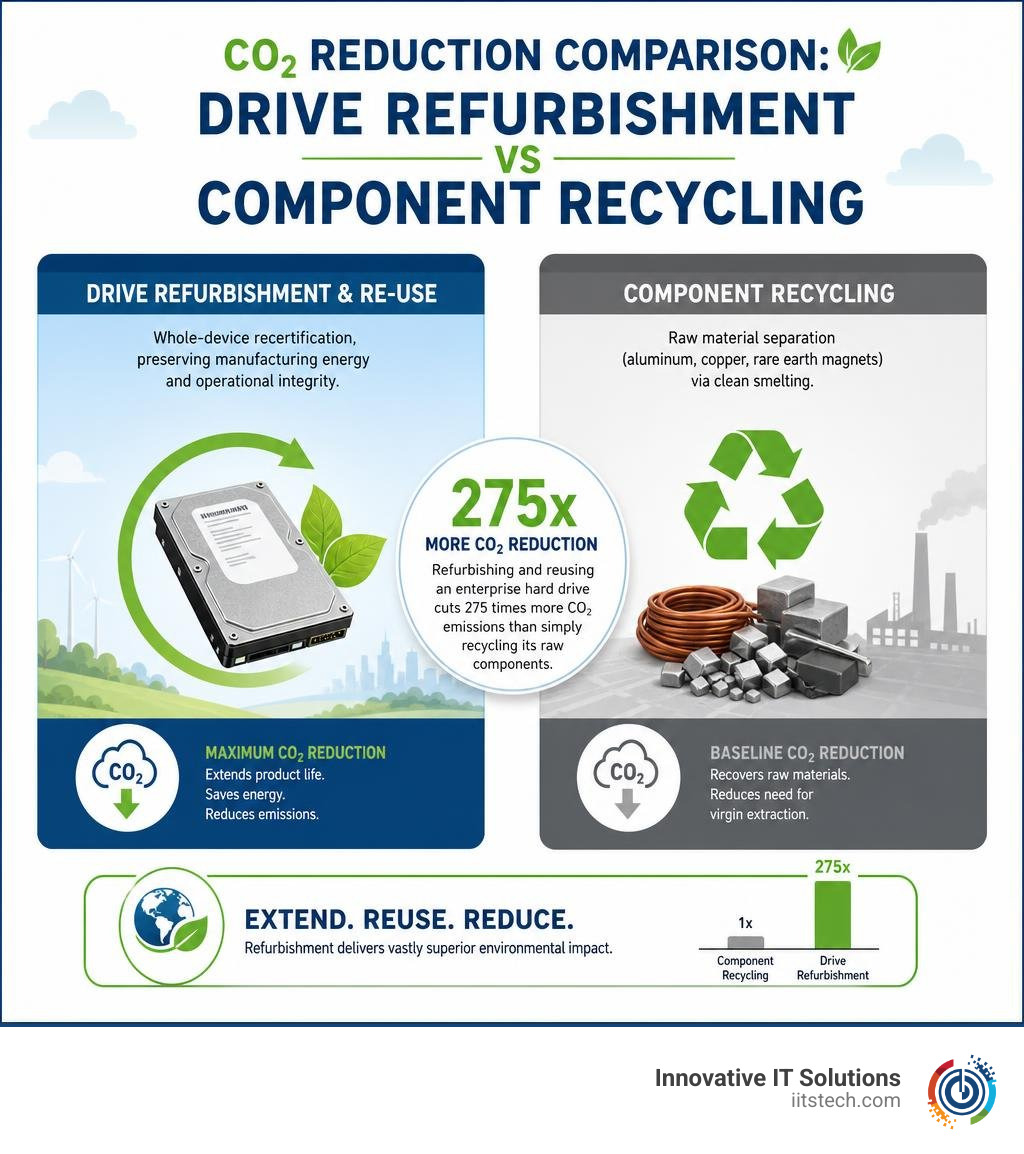
While component-level material recovery is valuable, extending the lifespan of whole enterprise drives delivers vastly superior carbon reduction across the technology supply chain.
Refurbishing and reusing an enterprise hard drive cuts 275 times more CO₂ emissions than simply melting down and recycling its raw components alone. Manufacturing complex server media requires energy-intensive chemical processing, raw rare-earth element extraction, and global logistics. Extending device longevity mitigates these upstream carbon costs entirely. In FY2024, industry leaders like Seagate returned over 1.8 million hard drives and solid-state drives (SSDs) back to service through repair, refurbishment, and material recovery programs.
| Handling Strategy | Primary Environmental Impact | Relative CO₂ Efficiency |
|---|---|---|
| Component Recycling | Raw material separation (aluminum, copper, rare earth magnets) via clean smelting. | Baseline emission savings |
| Drive Refurbishment & Re-use | Whole-device recertification, preserving manufacturing energy and operational integrity. | 275x higher CO₂ reduction |
By choosing refurbishing over immediate destruction, enterprise organizations significantly reduce corporate carbon footprints while supporting global Circularity initiatives.
The Difference Between Recycling, Donating, and Refurbishing Enterprise Storage
Understanding the distinction between asset processing paths is essential for corporate IT asset management and ESG audit integrity:
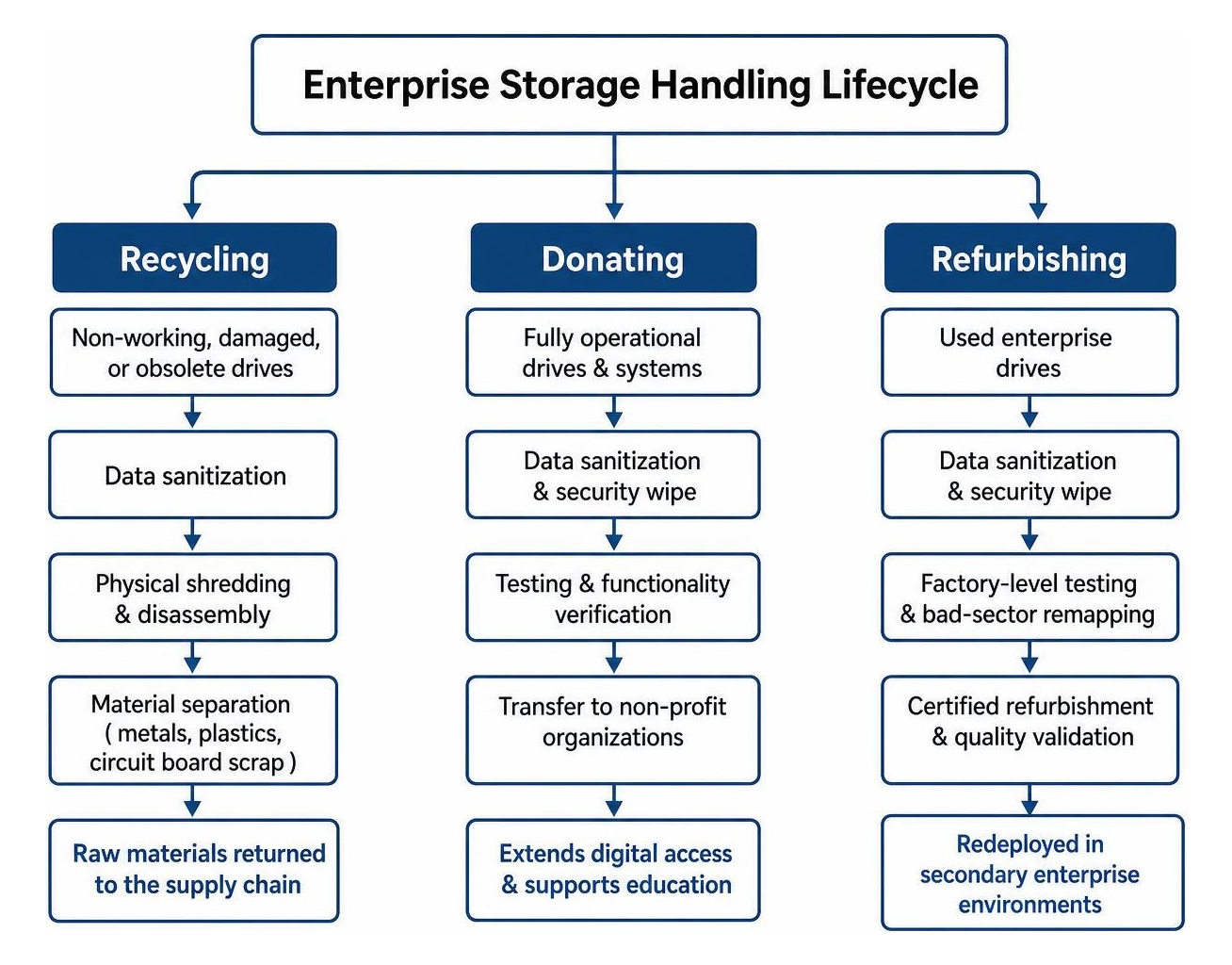
- Recycling: Non-working, physically damaged, or completely obsolete hardware is shredded and processed down to base commodities (aluminum casings, copper wire, circuit board scrap).
- Donating: Fully operational desktop, laptop, and server hardware is sanitized, tested, and transferred to educational institutions or non-profit organizations. Donating corporate IT equipment supports digital equity and STEM education—where over 58% of all STEM jobs are in computer science, despite 500,000+ current unfilled U.S. positions.
- Refurbishing: High-capacity enterprise hard drives undergo factory-level testing, bad-sector remapping, and certified sanitization to be redeployed into secondary enterprise environments, capturing maximum residual financial value.
Secure Data Destruction Methods Before Storage Recycling
Data security remains the single biggest operational barrier preventing businesses from recycling or refurbishing storage hardware. Over 200 million hard drives are physically shredded every year globally, largely due to corporate fears of data leakage and regulatory penalties. However, implementing certified data destruction eliminates liability while keeping functioning hardware viable for recycling or resale. Read more on Why Should You Destroy Electronics Hard Drives? to evaluate corporate risk mitigation.
Logical Sanitization vs. Physical Shredding
Organizations often assume that physical destruction is the only safe option for storage equipment. However, modern logical sanitization methods provide equal or superior security without destroying high-value hardware assets.
- Logical Sanitization: Overwrites data across all addressable and non-addressable storage blocks, including hidden system areas like Device Configuration Overlay (DCO) and Host Protected Area (HPA). Advanced techniques include Cryptographic Erase (sanitizing encryption keys on Self-Encrypting Drives) and Instant Secure Erase (ISE), rendering stored data unrecoverable in seconds. Some advanced enterprise storage architectures even utilize Autonomous Drive Regeneration (ADR) to self-heal minor sector errors during reformatting routines.
- Physical Shredding: Heavy industrial shredders crush drives into tiny metal fragments. While highly effective for unreadable or non-functional devices, physical shredding eliminates any remaining chance of hardware refurbishment or asset value recovery.
Review these operational guidelines on the Dos and Don’ts of Hard Drive Disposal to select the right approach for your organization’s storage fleet.
NIST 800-88 and DoD Sanitization Standards
To ensure full compliance with federal and industry privacy mandates (such as HIPAA, FACTA, PCI-DSS, or GDPR), businesses must adhere to recognized sanitization frameworks:
- NIST SP 800-88 Rev. 1: The modern gold standard for enterprise data destruction. It outlines specific requirements for Clear, Purge, and Destroy actions across magnetic disks, solid-state media, enterprise NVMe drives, and storage arrays.
- DoD 5220.22-M: The classic multi-pass overwrite standard historically required by federal agencies, requiring structured write patterns across all sectors.
Proper execution demands complete serial-number tracking, tamper-evident chain of custody, and a signed, legal Certificate of Data Destruction for audit defense. Learn More About Proper Hard Drive Destruction to ensure your organization holds up under strict compliance audits.
Business Options for Enterprise Hard Drive Disposal
When decommissioning server infrastructure, network storage units, or corporate computer fleets, businesses need structured processing channels that guarantee security while maximizing return on original capital investment. A clear disposal plan also helps finance, compliance, and IT teams align on which assets should be wiped for reuse, which should be destroyed, and which should move directly into certified commodity recycling.
Commercial IT Asset Disposition (ITAD)
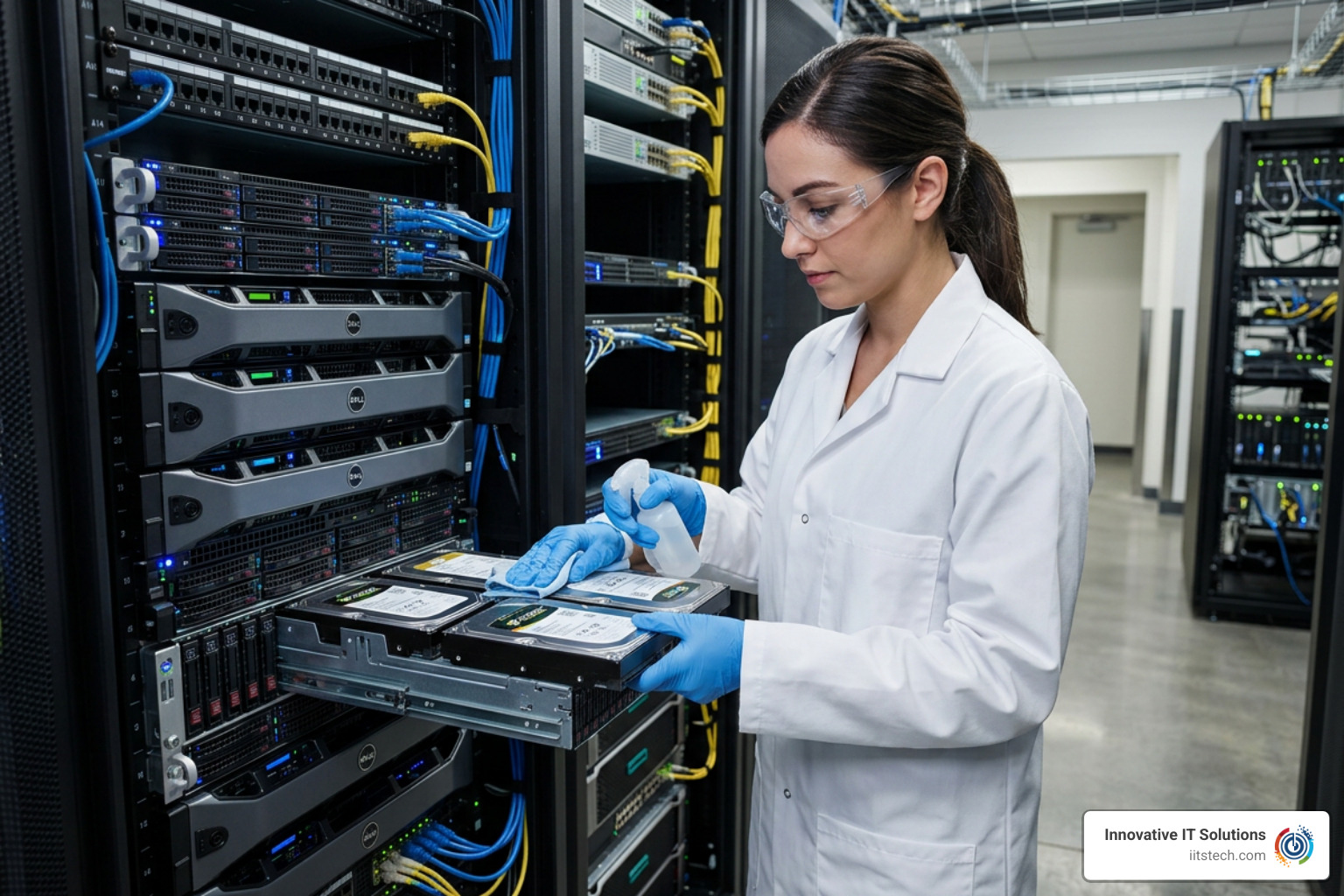
Engaging a certified ITAD partner is the most secure and scalable method for commercial enterprise e-waste management. Certified ITAD providers manage logistics, securely transport hardware in locked bins, perform NIST-compliant wipe passes, track serial numbers, and enforce zero-landfill processing protocols.
Look for providers holding R2v3 (Responsible Recycling) or ISO 14001 certifications. These international standards ensure that every electronic component is handled under strict environmental safety and physical security measures. Discover how our commercial IT Equipment Recycling Services help businesses maintain strict compliance and unlock residual hardware value.
Manufacturer Programs and Incentives for Hard Drive Recycling
Many original equipment manufacturers (OEMs) offer structured take-back initiatives and trade-in incentive programs for enterprise storage components. Programs like the Seagate ReStore Program allow organizations to return retired drives for certified recycling or factory refurbishment, frequently providing credit toward high-capacity hardware upgrades.
What Happens to Hard Drives After E-Waste Processing?
Once retired drives leave your facility under a secure chain of custody, they enter a structured material recovery or factory recertification ecosystem.
Material Recovery and Component Extraction
When hard drives are physically non-functional, degraded, or obsolete, they are routed to clean separation, shredding, and smelting processing lines:
- Rare Earth Magnets: High-strength neodymium magnets are dismantled and extracted for reuse in clean technology manufacturing and industrial electronics.
- Aluminum Casings: High-grade aluminum housings and top plates are shredded and smelted, reducing raw bauxite mining requirements by over 90%.
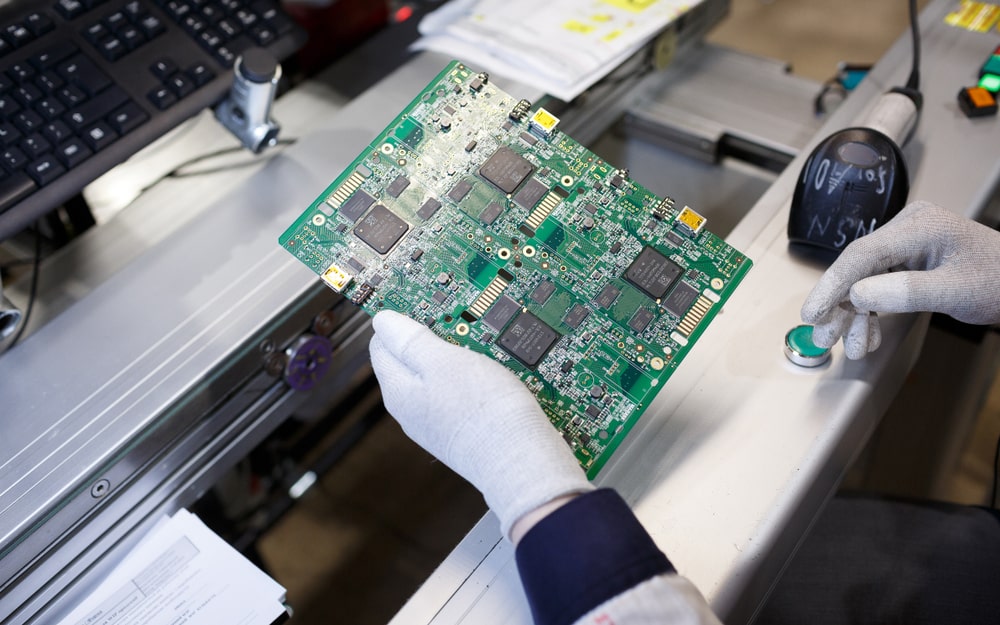
- Precious Metals: Printed circuit board (PCB) assemblies undergo hydrometallurgical processing to recover high-purity gold, silver, copper, and palladium.
Certified Refurbishment and Testing
Drives suitable for secondary life deployment enter a multi-stage recertification pipeline:
- Automated Surface Scan: Disk platters and flash memory modules undergo full-surface read/write checks to evaluate bad sector counts and overall health.
- Firmware Reset: Custom vendor settings are purged, and standardized enterprise firmware is restored to factory defaults.
- Stress Testing: Devices operate under thermal and load stress tests to guarantee long-term operational reliability before entering secondary enterprise environments.
Frequently Asked Questions About Commercial Hard Drive Disposal
What types of hard drives are accepted for commercial recycling?
Commercial recycling programs accept virtually all enterprise and corporate storage media, including SATA, SAS, Fibre Channel HDDs, enterprise NVMe modules, PCIe add-in cards, solid-state drives, and legacy 3.5-inch or 2.5-inch server storage arrays.
Can enterprise hard drives from any manufacturer be recycled?
Yes. Professional ITAD and e-waste recycling programs are completely brand-agnostic. Whether you are decommissioning storage equipment manufactured by Seagate, Western Digital, Toshiba, Dell EMC, HPE, or Intel, enterprise recyclers process all hardware in volume.
What should a business do with working drives during an upgrade?
Working enterprise drives should undergo NIST 800-88 logical sanitization and be evaluated for asset recovery. Partnering with an experienced ITAD vendor allows your business to remarket functional media on secondary markets, offsetting the financial cost of your infrastructure refresh.
Conclusion
Managing retired enterprise storage media doesn’t have to be a trade-off between strict risk management and corporate environmental responsibility. By combining certified NIST 800-88 data destruction with structured refurbishment and zero-landfill recycling channels, your organization can protect sensitive data, satisfy legal compliance requirements, and dramatically reduce corporate e-waste. The strongest programs document every transfer, verify the final disposition of each drive, and keep audit-ready records tied to serial numbers and certificates of destruction.
At Innovative IT Solutions, we provide secure, EPA-compliant, and fully documented IT asset disposition services for businesses throughout Oklahoma City, South OKC, and the surrounding areas. Contact us today to establish a customized electronic recycling program for your business.


