
Why the ITAD Chain of Custody Is the Most Overlooked Data Security Risk
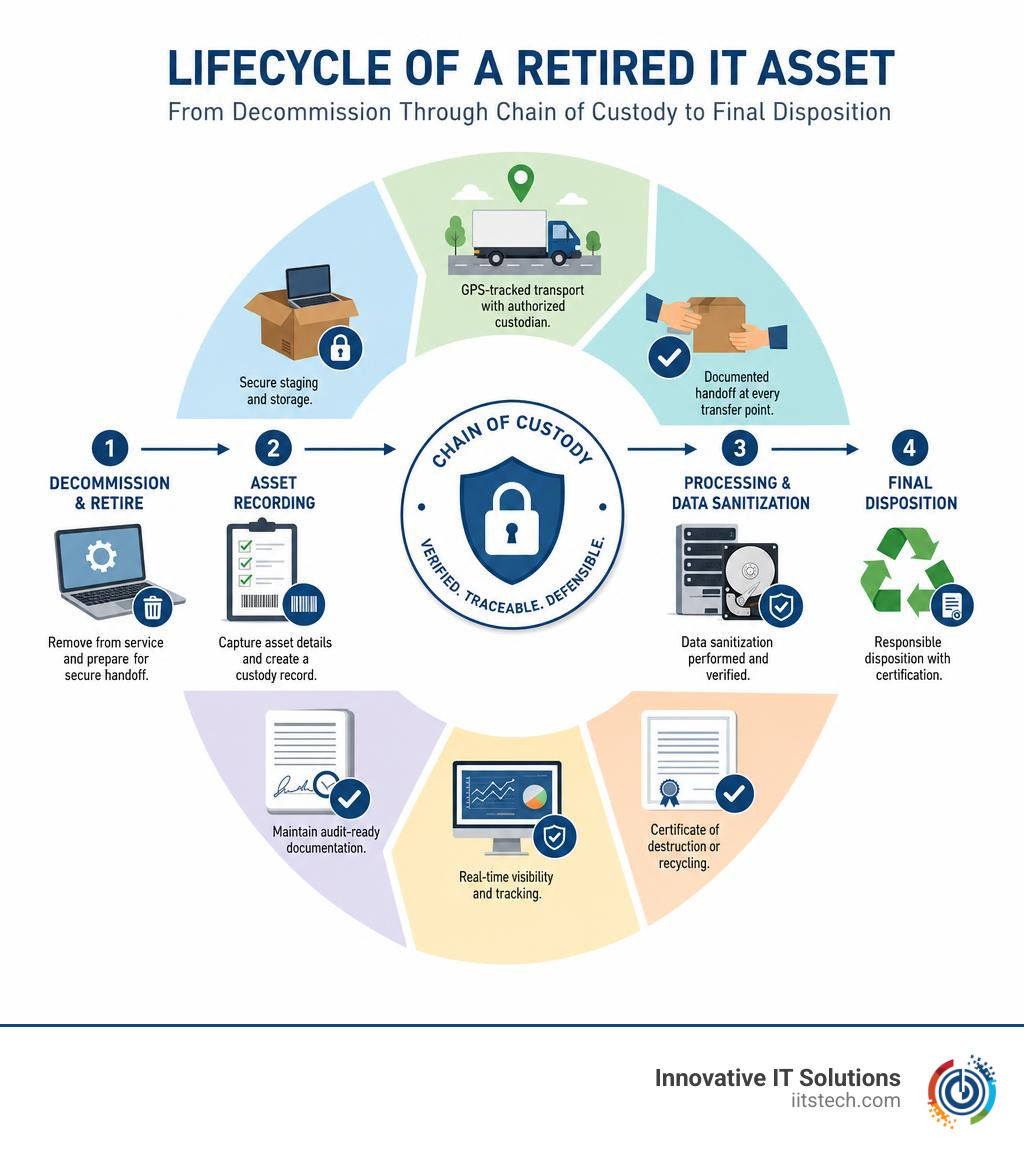
An ITAD chain of custody is the documented, verifiable trail that tracks every retired IT asset — from the moment it leaves your facility to its final destruction, redeployment, or recycling.
Here’s what it covers at a glance:
| Stage | What Gets Documented |
|---|---|
| Asset retirement | Serial number, device type, assigned user, condition |
| Pickup & transport | Custodian, timestamp, GPS tracking, handoff signatures |
| Processing | Data sanitization method, technician, verification |
| Final disposition | Certificate of destruction, recycling record, audit report |
Most IT managers focus on protecting active data. But retired devices — laptops, servers, hard drives — often still contain sensitive information long after they’ve been powered down and removed from service.
The risk is real: 20% of data breaches are linked to disposal phase failures, where retired devices end up somewhere they shouldn’t be with no way to trace what happened.
When custody breaks down, you can’t prove where a device went or who handled it. That gap creates serious exposure under regulations like HIPAA, GDPR, and CCPA — even if the data was eventually destroyed.
A single missing hard drive can trigger an audit, a breach notification, or worse.
I’m Mike Haden, Founder and Director of Business Development at Innovative IT Solutions, and over 14 years of building an R2v3-certified ITAD operation, maintaining a defensible ITAD chain of custody has been central to every secure disposition program we’ve built for our clients. In this guide, I’ll walk you through exactly how to keep that chain unbroken — from internal staging all the way through final certification.
What is an ITAD Chain of Custody?

In simple terms, an ITAD chain of custody is the chronological, unbroken record of who had possession of an IT asset, when they had it, where it was stored or transported, and what physical or digital state it was in at every stage of its retirement journey.
Many businesses make the mistake of thinking their responsibility ends the moment they place old laptops or server drives into a cardboard box and hand them over to a courier. In reality, your legal liability for the data on those devices remains active until you have verifiable, audit-ready proof that the data has been securely destroyed.
To understand why this is so critical, it helps to read about What is Chain of Custody in ITAD and Why It Matters. This process is not just about general inventory management; it is a legally defensible security protocol designed to prevent data leaks, theft, and regulatory non-compliance.
Why a Secure ITAD Chain of Custody Is Critical for Compliance
When regulatory bodies or internal auditors ask for proof of compliance, they do not just want to see a receipt. They want to see a detailed, step-by-step paper trail. A secure chain of custody provides:
- Absolute Accountability: You know exactly which employee, driver, or technician was responsible for an asset at any given minute.
- Tamper Prevention: By logging custody transfers instantly, you prevent unauthorized personnel from accessing data-bearing drives.
- Inventory Reconciliation: It ensures that if you decommissioned 100 hard drives in your South OKC server room, exactly 100 hard drives arrived at the processing facility and were destroyed.
- Regulatory Defense: Should a breach occur elsewhere, an unbroken custody record proves your business handled its retired assets responsibly, shielding you from massive fines.
To ensure your processes hold up under scrutiny, they must align with federal and global guidelines, such as the NIST Guidelines for Media Sanitization. NIST SP 800-88 outlines the exact specifications required to ensure that data is completely unrecoverable, making it the golden standard for compliant ITAD.
Key Data Points to Track for Every Asset
A truly defensible custody log cannot rely on vague descriptions like “box of 20 laptops.” To survive a compliance audit, your tracking system must capture these five key data points for every single asset:
- Serial Number & Asset Tag: The unique identifier of the physical device and its internal storage drive.
- Device Type & Model: Specific hardware descriptions (e.g., Dell PowerEdge R740 Server, Samsung 1TB SSD).
- Custodian: The name and signature of the person currently responsible for the asset.
- Timestamp: The exact date and time of every handoff, scan, or processing step.
- Physical Condition & State: Notes on whether the asset is functional, damaged, or already physically locked in a secure container.
The Critical Stages of a Secure ITAD Process

A secure chain of custody is only as strong as its weakest link. If there is a single gap where an asset’s location is unknown, the entire chain is broken. To prevent this, let’s break down the three critical stages of a secure ITAD process, and learn more about What Happens to Your Equipment After ITAD once it leaves your sight.
Stage 1: Internal Inventory and Staging
The chain of custody does not start when the ITAD vendor’s truck pulls up to your loading dock in Oklahoma City. It starts inside your own office or data center the moment a device is marked for retirement.
- Asset Tagging: Before a device is moved to a storage closet, scan its asset tag and serial number into your internal IT Asset Management (ITAM) system.
- Pre-Disposal Checklist: Verify that all cloud accounts are unlinked, local credentials are removed, and critical data is backed up.
- Secure Staging: Place retired devices in a locked, badge-access-only room with 24/7 camera surveillance. Leaving old laptops piled in an open hallway or an unsecured closet is one of the most common ways assets “go missing” before they are even picked up.
Stage 2: Secure Transport and Handoff
The transition from your facility to the transport vehicle is where many custody chains fail. To keep transport secure, we employ strict logistics protocols:
- GPS-Tracked Vehicles: All transport vehicles should be locked and monitored via real-time GPS tracking from departure to arrival.
- Tamper-Evident Seals: Secure containers holding data-bearing drives should be locked and sealed with numbered, tamper-evident tags that are documented on the manifest.
- Bill of Lading & Signatures: Every handoff must be accompanied by a signed Bill of Lading, confirming that the asset count leaving your facility perfectly matches what the driver is accepting.
Stage 3: Processing and Verified Data Destruction
Once the assets arrive at our secure facility, they enter a highly controlled processing environment.
- Reconciliation: The shipment is immediately checked in, and every serial number is scanned to verify that it matches the original pickup manifest.
- Data Sanitization: Storage media is either digitally wiped using NIST SP 800-88 compliant software or physically shredded.
- Certification: After destruction is complete, a formal Certificate of Data Destruction is generated, linking the specific serial number of each drive to the method of its destruction. For a deeper look into why this step is non-negotiable, read about Why Should Your Business Use Certified Data Destruction Services for Compliance.
Risks and Consequences of a Broken Custody Trail
To understand the strategic importance of an unbroken chain of custody, it is helpful to look at what happens when things go wrong.
| Secure Chain of Custody | Unsecure / Broken Chain of Custody |
|---|---|
| Complete, serial-level tracking from pickup to destruction | “Batch” tracking with gaps during transport or staging |
| Tamper-evident, locked containers with GPS-monitored transit | Standard cardboard boxes shipped via general, untracked couriers |
| Audit-ready Certificates of Data Destruction within days | No physical proof of destruction, leaving you open to liability |
| Complete peace of mind and full regulatory compliance | High risk of data breaches, fines, and reputational damage |
If your vendor fails to maintain these standards, you face significant vulnerabilities. You can protect your business against these potential failures by reviewing ITAD Liability Insurance: Protecting Your Business When Vendors Fail.
Regulatory Compliance Failures (GDPR, HIPAA, CCPA)
Under modern data privacy laws like HIPAA (healthcare), GDPR (global/EU), and CCPA (California), organizations are legally required to protect Personally Identifiable Information (PII) and Protected Health Information (PHI) throughout its entire lifecycle.
If a retired hard drive containing medical records or customer credit card details is lost or stolen because of a weak custody trail, the regulatory penalties are severe. HIPAA enforcement actions regularly result in multi-million dollar fines for businesses that cannot produce verifiable records of data destruction. To keep your business safe, read our guide on ITAD Compliance: How to Keep Your Business Audit-Ready and Secure.
Financial and Legal Liabilities
As of May 2026, data breach costs have reached historic highs, with class-action lawsuits and contract breaches compounding the financial damage.
Consider the famous Coca-Cola data breach, where stolen laptops exposed the PII of 74,000 employees due to a lack of proper ITAD oversight. Similarly, American Express experienced a major breach linked to weak security controls at a third-party service provider. In both cases, the lack of an airtight, documented chain of custody left the companies unable to defend their actions, resulting in massive legal liabilities and severe damage to their brand credibility.
How to Verify Your Vendor’s Custody Protocols
You should never simply take an ITAD vendor’s word that they are secure. You must verify their protocols, inspect their facilities, and understand Why Your ITAD Provider’s Downstream Partners Matter. If your vendor passes your assets to an uncertified downstream recycler, your chain of custody is broken.
Best Practices for Maintaining an Unbroken ITAD Chain of Custody
To keep your internal and external processes perfectly aligned, follow these industry-proven best practices:
- Conduct Regular Audits: Do not wait for an official compliance emergency. Learn How to Prepare for a Third-Party IT Disposal Compliance Audit and run internal mock audits first.
- Train Your Employees: Ensure your local South OKC or North OKC IT staff understand that retired assets must be locked away immediately, not left on desks or in public staging areas.
- Use Secure Portals: Work only with ITAD providers who offer a secure online portal where you can track your assets in real-time, view processing milestones, and instantly download certificates.
Key Questions to Ask Your ITAD Provider
When vetting a partner, read our comprehensive guide on How to Choose the Right ITAD Vendor for Your Business and ask these direct questions:
- Are you R2v3 or e-Stewards certified? (These certifications require strict, third-party audited chain of custody protocols).
- Do you scan serial numbers at our location or only after arrival at your facility? (Scanning at your location is always the safer choice).
- What physical security measures protect your transport vehicles and processing facilities?
- Can you provide a complete downstream audit trail for all recycled materials?
For organizations comparing regional providers, reviewing industry frameworks like the ITAD Chain of Custody: Protecting Data & Ensuring Compliance guidelines can help clarify what standard to expect. Additionally, general resources such as ITAD Services in Oklahoma City – Alta Technologies demonstrate how critical localized, secure logistics are to businesses operating within Oklahoma.
Frequently Asked Questions about ITAD Chain of Custody
What is the difference between asset tracking and chain of custody?
Asset tracking is a general inventory management process used to know where active hardware is located for daily business operations. Chain of custody is a highly secure, legally defensible protocol designed specifically to verify security, document ownership transitions, and prove compliant data destruction for retired assets.
How long should we retain ITAD chain of custody documentation?
Most major regulatory standards, including HIPAA, GDPR, and SOX, require businesses to retain records of data destruction and device handling for up to 7 years to remain fully audit-ready.
What happens if an asset is lost during transit?
If an asset is lost, we immediately initiate a reconciliation protocol, comparing the pickup manifest against the receiving scan. If a drive is confirmed missing, security footage is reviewed, GPS transport records are analyzed, and if necessary, data breach notification protocols are triggered based on the sensitivity of the data on the missing device.
Conclusion
Maintaining an unbroken ITAD chain of custody is not just a nice-to-have operational detail—it is the foundation of modern data security and regulatory compliance. When you retire your organization’s hardware, you are trusting your vendor with your reputation, your customer data, and your compliance record.
At Innovative IT Solutions, we provide EPA-compliant, zero-landfill, and NIST-compliant IT asset disposition services right here in Oklahoma City. With our certified data destruction processes and complete, audit-ready documentation, we ensure your business remains secure and fully compliant while maximizing your financial returns.
Ready to secure your retired hardware and protect your business? Contact us today to learn more about our Secure Asset Recovery Services.


