
Why Secure Data Destruction in Oklahoma Is a Business-Critical Decision
Secure data destruction in Oklahoma is the process of permanently eliminating sensitive information from storage devices — hard drives, SSDs, backup tapes, and more — so it can never be recovered or misused.
Here’s a quick summary of what you need to know:
| Question | Quick Answer |
|---|---|
| What methods are available? | Physical shredding, data wiping, degaussing, certified equipment destruction |
| What laws apply in Oklahoma? | HIPAA, GLBA, SOX, Oklahoma Security Breach Notification Act (SB 626) |
| What’s the penalty for a breach? | Civil fines up to $150,000 per breach under SB 626 |
| What’s the most secure method? | Physical shredding — the only method that guarantees data is unrecoverable |
| What certifications should vendors have? | NAID AAA, R2v3, ISO 14001, NIST 800-88 compliance |
| Do I get proof of destruction? | Yes — a Certificate of Destruction with serial numbers and destruction method |
Most IT managers assume that deleting files or reformatting a drive is enough. It isn’t. Data recovery tools available to anyone online can pull information off a “wiped” drive in minutes. And under Oklahoma’s updated Security Breach Notification Act — effective January 1, 2026 — the financial and legal consequences of getting this wrong have never been higher.
Whether you’re decommissioning a single laptop or retiring an entire server room, the stakes are real: identity theft, regulatory penalties, and reputational damage that no company can afford.
I’m Mike Haden, Founder and Director of Business Development at Innovative IT Solutions, where I’ve spent 14 years building an R2v3-certified ITAD operation focused on secure data destruction in Oklahoma and responsible technology disposition. In that time, we’ve processed over a million pieces of enterprise IT equipment with a strict emphasis on chain-of-custody, compliance, and data security at every step.
Primary Methods of Secure Data Destruction
When it comes to retired IT assets, simply hitting “delete” or dragging files to the trash bin does absolutely nothing to the underlying data. It merely removes the pointers to those files, leaving the actual binary data intact and ripe for forensic extraction. To truly protect your organization, we must look at the primary methods of professional sanitization and understand Physical Destruction vs Data Wiping When Each Method is Required.

Physical Hard Drive Shredding
Physical shredding is the undisputed gold standard of data elimination. This mechanical process uses high-torque, industrial shredders to slice, tear, and crush hard drives, solid-state drives (SSDs), backup tapes, and optical media into tiny, unreadable fragments.
It is important to note that traditional Hard Disk Drives (HDDs) and modern Solid-State Drives (SSDs) require different physical destruction approaches. An HDD stores data magnetically on spinning platters, meaning a standard shred width of 1.5 inches is often sufficient to destroy the magnetic tracks beyond recovery. However, SSDs store data on microscopic flash memory chips. If an SSD is run through a standard large-width shredder, entire memory chips can slip through the blades completely intact.
To safely destroy solid-state media, we utilize specialized micro-shredders that reduce the drive to particles of 2mm or smaller, obliterating the memory chips entirely. For organizations handling highly sensitive information, choosing certified hard drive shredding services ensures that no physical component survives.
Data Wiping and NIST 800-88 Standards
For businesses looking to preserve the value of their hardware for resale or reuse, physical destruction isn’t always the best first step. In these cases, we employ certified data wiping (also known as software sanitization).
This is not a basic format. Certified data wiping uses specialized software to overwrite every single sector of the storage media with random patterns of ones and zeros. To ensure this is done correctly, we adhere strictly to the National Institute of Standards and Technology (NIST) Special Publication 800-88 Rev. 1, which is the federal benchmark for media sanitization. Businesses can review the official NIST Guidelines for Media Sanitization for additional technical detail on approved sanitization methods.
NIST 800-88 outlines three levels of sanitization:
- Clear: Overwriting storage spaces using logical interface commands.
- Purge: Executing physical or logical commands to make target data recovery impossible using advanced laboratory techniques (such as cryptographic erasure).
- Destroy: Physical destruction methods like shredding or degaussing.
When properly executed, NIST-compliant wiping makes forensic recovery impossible while leaving the physical drive fully functional for refurbishing.
Degaussing for Magnetic Media
Degaussing is a highly effective sanitization method specifically designed for magnetic storage media, such as older hard disk drives and magnetic backup tapes. A degausser is a machine that generates an incredibly powerful, localized magnetic field.
When an HDD or tape is passed through this field, the magnetic alignment of the media is completely disrupted. This instantly demagnetizes the drive, wiping out the recorded data and the factory-written servo tracks. Because the servo tracks are destroyed, the drive can never be used again. If your business relies on magnetic media, you can Learn More About Data Degaussing to see how this fits into your security workflow. It is vital to remember that degaussing has zero effect on SSDs, which do not rely on magnetic fields to store data.
Compliance and Regulations: Navigating Secure Data Destruction Oklahoma Requirements
In May 2026, data security is no longer just an IT concern—it is a legal mandate. Failing to properly sanitize retired IT assets exposes your company to massive federal and state penalties, not to mention devastating public relations nightmares. Understanding the regulatory landscape is the first step toward protecting your business.

Federal Mandates: HIPAA, GLBA, and SOX
Depending on your industry, several federal frameworks dictate how you must handle and destroy end-of-life data:
- HIPAA (Health Insurance Portability and Accountability Act): Requires healthcare providers, insurers, and their business associates to safeguard Protected Health Information (PHI). The HIPAA Security Rule mandates formal policies for the final disposal of electronic PHI and the hardware on which it resides.
- GLBA (Gramm-Leach-Bliley Act): Forces financial institutions to protect personal financial information. Under the FTC Disposal Rule, financial entities must take reasonable measures to protect against unauthorized access to consumer information during its disposal.
- SOX (Sarbanes-Oxley Act): Governs corporate governance and financial reporting for public companies, requiring strict retention and secure destruction of corporate records to prevent tampering or leaks.
To avoid catastrophic federal penalties, Oklahoman enterprises must understand Why Should Your Business Use Certified Data Destruction Services for Compliance.
The Role of Secure Data Destruction Oklahoma in Risk Mitigation
At the state level, the legal landscape has grown significantly stricter. Oklahoma’s Security Breach Notification Act was amended by Senate Bill 626 (effective January 1, 2026), drastically raising the stakes for local organizations.
Under this updated law:
- Civil Fines: Organizations face civil penalties of up to $150,000 per breach. However, if a business can prove it maintained “reasonable safeguards” (such as certified data destruction policies) and provided timely notice, these fines can be reduced to $75,000.
- Reporting Timelines: Oklahoma organizations must notify the State Attorney General within 60 days of discovering a breach affecting state residents. For insurers governed by the Insurance Data Security Act, major incidents must be reported to the Insurance Commissioner within 3 business days if the breach impacts 250 or more consumers.
Implementing a documented, certified process for secure data destruction in Oklahoma acts as your primary shield against these liabilities. By physically shredding or certifiably wiping retired storage media, you ensure that even if an old computer is stolen from a scrap pile, there is zero readable data on it—meaning no breach has occurred.
On-Site Mobile Shredding vs. Off-Site Destruction Services
When planning your data destruction project, you must decide where the physical destruction or wiping will take place. Both mobile (on-site) and plant-based (off-site) services offer distinct advantages depending on your security tolerance and operational logistics.
| Feature | On-Site Mobile Shredding | Off-Site Plant Destruction |
|---|---|---|
| Location | At your facility (loading dock/parking lot) | Secure ITAD processing facility |
| Witness Capability | High (watch the shredder live or via CCTV) | Video-recorded destruction options |
| Chain of Custody | Direct (media never leaves your site intact) | Serialized tracking with sealed transport containers |
| Cost Profile | Typically higher due to mobile unit dispatch | More cost-effective for large, bulk batches |
| Operational Impact | Requires staff coordination on-site | Seamless pickup and transport with minimal disruption |
For government contractors, aerospace firms, and financial institutions in OKC, on-site mobile shredding is often preferred because it eliminates the transit risk entirely. Drives go straight from your server racks into the mobile shredder parked outside.
For large-scale corporate refreshes, off-site destruction at our secure facility offers high-capacity throughput—allowing us to process upwards of 5,000+ drives per day under strict, multi-layered security controls.
Selecting a Certified ITAD Partner
With so many local options, choosing the right vendor is critical. You cannot simply hand your drives to a local scrap metal recycler and assume your data is safe. You need an experienced IT Asset Disposition (ITAD) partner that prioritizes both information security and environmental compliance.
If you are looking for localized services, it is important to find certified partners capable of handling physical media destruction.
Choosing a Partner for Secure Data Destruction Oklahoma
To guarantee compliance, verify that your chosen ITAD partner holds the following industry-standard certifications:
- NAID AAA Certification: Awarded by the National Association for Information Destruction, this is the highest credential for data elimination. It requires unannounced third-party audits, rigorous employee background checks, and strict operational security verification.
- R2v3 (Responsible Recycling) Standard: Ensures that all electronic waste is recycled in an environmentally responsible manner, with a strong focus on downstream vendor accountability and data security.
- ISO 14001 & 45001: These standards prove the vendor maintains world-class environmental management and occupational health and safety systems.
At Innovative IT Solutions, our zero-landfill, EPA-compliant processes guarantee that your retired assets are handled safely, securely, and sustainably.
Chain of Custody and Certificates of Destruction
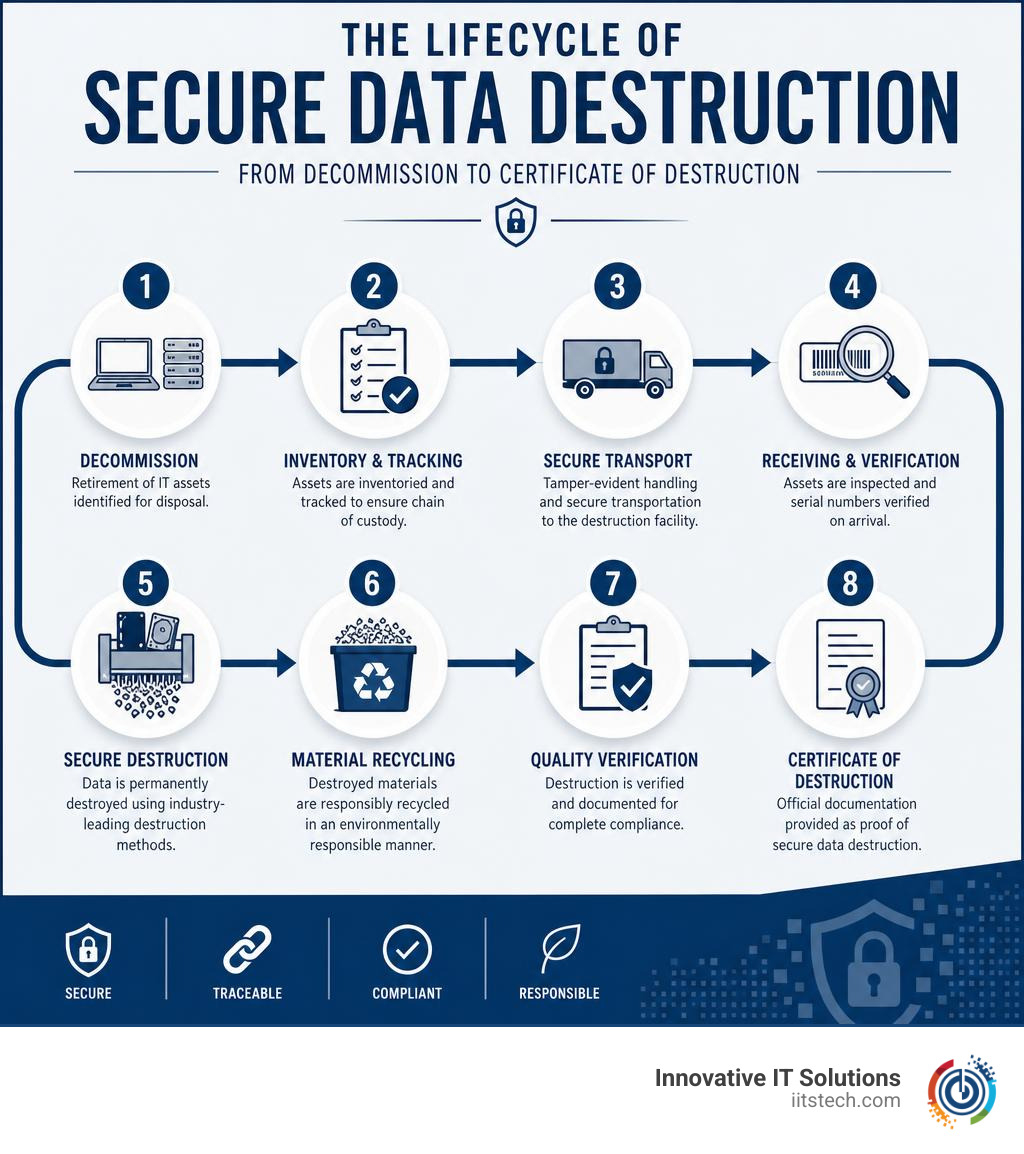
A professional data destruction service is only as good as its documentation. When we handle your data assets, we maintain an unbroken, audit-ready chain of custody.
This process includes:
- Serialized Scanning: Scanning the barcode/serial number of every single hard drive, SSD, or tape at the point of collection.
- Tamper-Evident Containers: Transporting the assets in locked, sealed bins.
- GPS-Tracked Vehicles: Monitoring transport from your facility directly to our processing center.
- Certificate of Destruction: Upon successful processing, we issue a formal, serialized Certificate of Destruction. This document lists the make, model, serial number, date, and exact method used to destroy each device. This certificate is your legal proof of compliance during corporate or regulatory audits.
Frequently Asked Questions
Why is physical destruction preferred over software erasure?
While software-based data wiping is excellent for reusable hardware, physical destruction remains the most secure choice. Software wiping can fail if a drive has bad sectors that the software cannot access, leaving pockets of readable data behind. Additionally, if a drive is physically damaged or won’t power on, software wiping is impossible. Physical shredding guarantees 100% data destruction regardless of the drive’s physical condition or interface type.
For highly secure or classified data, government standards like the NSA guidelines often mandate a multi-layered approach: degaussing first to scramble the magnetic fields, followed by physical shredding to reduce the drive to tiny fragments.
What penalties do Oklahoma businesses face for improper data disposal?
Under the newly amended Oklahoma Security Breach Notification Act (SB 626), businesses face civil penalties of up to $150,000 per breach. If you cannot prove that you used reasonable safeguards—such as working with a certified data destruction provider—you will face the maximum fine. You will also have to absorb the massive costs of notifying all affected state residents, paying for credit monitoring services, and navigating the devastating blow to your brand’s reputation.
How does secure data destruction Oklahoma protect the environment?
Throwing electronic waste (e-waste) into Oklahoma landfills is not only illegal under many environmental acts, but it is also incredibly destructive. Hard drives and circuit boards contain hazardous materials like lead, mercury, and cadmium.
By partnering with an R2v3-certified ITAD provider like Innovative IT Solutions, you ensure a 99%+ diversion rate from landfills. Once the drives are shredded, the raw metals (aluminum, steel, and precious metals) are separated and sent to certified downstream refiners to be recycled into new products.
Conclusion
Securing your company’s data doesn’t stop when an employee logs off for the last time. It extends all the way through the retirement, recycling, and destruction of the physical hardware. Relying on uncertified, DIY methods to clear your drives is an open invitation for data breaches, legal penalties, and financial ruin.
At Innovative IT Solutions, we provide fully certified, NIST-compliant, and zero-landfill IT Asset Disposition (ITAD) services right here in Oklahoma City. We take the hassle and risk out of technology retirement, providing you with ironclad compliance documentation and the peace of mind that your data is gone forever.
Ready to secure your business and properly retire your old tech? Read our comprehensive guide on How to Properly Dispose of Electronics Computer Recycling in Oklahoma City or contact us today to schedule your secure data destruction service.