
Understanding Hardware End of Life vs. Data and Asset Value
If you find yourself asking, “My Visa gift card expired, what can I do?” the practical answer is simple: check its balance through the issuer’s official website or phone number, then request a replacement card. The printed date may stop the physical card from working at checkout, but under U.S. federal regulations, gift card funds generally remain valid for at least five years from purchase or initial loading. Ask the card issuer if a replacement or maintenance fee applies, and keep the original card until your funds transfer. The same mindset applies when assessing expired enterprise technology: before writing off any asset as completely depleted, verify what residual value and compliance risk remain.
Business computers and server components need a different disposition process, but the first question is identical: what value remains? Before disposal, an IT team should identify the equipment, protect any sensitive data it holds, and assess whether it can be reused, resold, or recycled. Enterprise hardware often reaches end of life because vendor support ends or performance no longer meets workload demands, not because every component has failed. That distinction matters because functional processors, memory modules, storage controllers, and chassis materials can still carry measurable recovery value.
I’m Mike Haden, founder of Innovative IT Solutions. My 14 years recovering value from retired business hardware inform how I approach legacy assets: check what remains before treating an expired item as worthless. In IT asset disposition, that means separating data security obligations from hardware recovery opportunities before any equipment leaves your control.
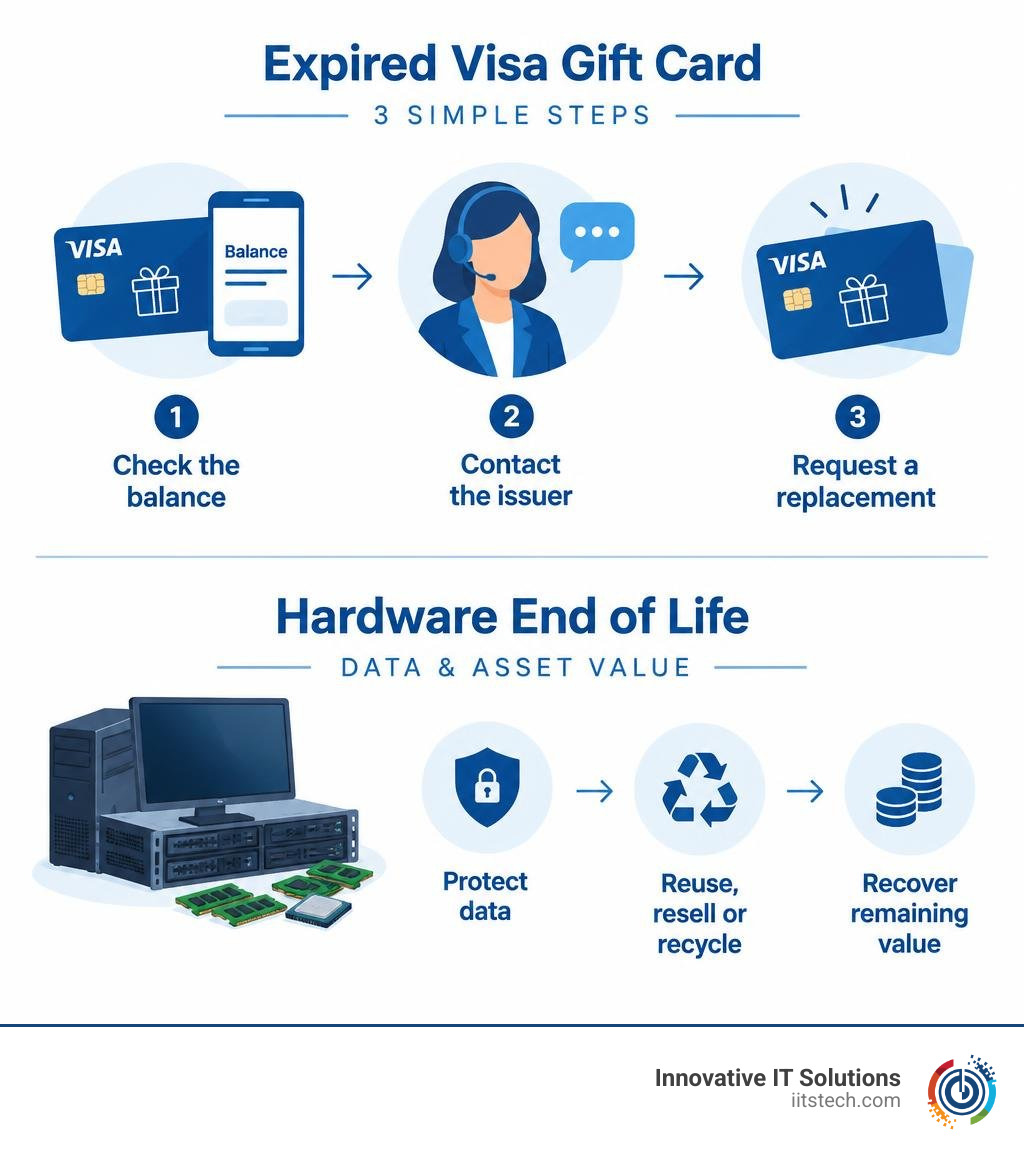
When enterprise hardware reaches end-of-life (EOL), organizations face two distinct concerns: data security liabilities and residual asset value. Physical wear or discontinued vendor support does not render enterprise equipment completely worthless, just as an expiration date on a card does not automatically extinguish underlying value.
Enterprise servers, rack enclosures, and office workstations contain reusable silicon, memory modules, processors, and structural metals. However, before any recovery value can be realized, sensitive corporate data must be sanitized to eliminate security risks. A documented ITAD workflow addresses both sides of that equation: certified data destruction protects the organization, while component testing and remarketing convert retired hardware into recovered capital instead of landfill waste.
My Business Computers or Server Components Are End of Life: What Can I Do?
When enterprise infrastructure reaches its official retirement stage, managing the transition systematically protects corporate data while recapturing investment capital. The most common mistake is treating an entire server or workstation fleet as a single disposal problem. In practice, each unit contains multiple asset classes: data-bearing media that must be destroyed, reusable components that can be tested and resold, and scrap materials that should enter a compliant recycling stream.
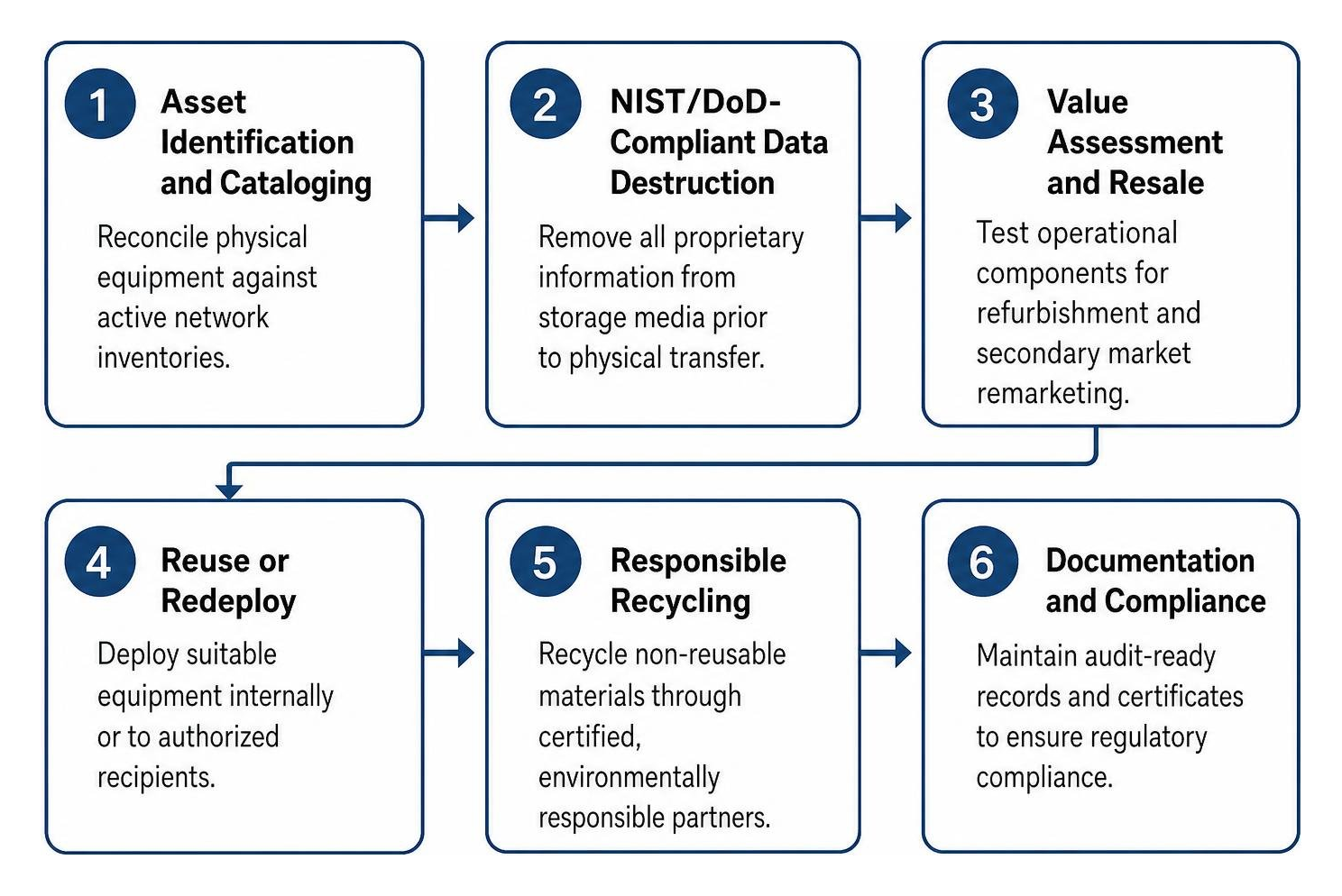
An effective IT Asset Disposition (ITAD) strategy balances data sanitization, hardware evaluation, and regulatory compliance across four core pathways:
- Asset Identification and Cataloging: Reconciling physical equipment against active network inventories.
- NIST/DoD-Compliant Data Destruction: Removing all proprietary information from storage media prior to physical transfer.
- Value Assessment and Resale: Testing operational components for refurbishment and secondary market remarketing.
- Zero-Landfill Material Recycling: Processing failed or obsolete components according to environmental protection standards.
Each pathway generates its own documentation trail. Without that trail, a business may still face audit questions years after the hardware has left the building. With it, the organization can demonstrate exactly how data was destroyed, where materials went, and what recovery value was returned.
Step-by-Step Guide: What Should I Do First With Retired Business IT Hardware?

A structured decommission plan prevents data leakage, lost asset value, and compliance gaps. Rushing straight to disposal skips the steps that protect both security and return on investment.
- Isolate and Catalog All Hardware: Quarantine retired units in a secure, badge-access area. Record model types, form factors, serial numbers, and asset tags. This inventory becomes the foundation for every later decision and every compliance record.
- Identify Data-Bearing Media: Locate all storage media, including spinning hard drives (HDDs), solid-state drives (SSDs), NVMe cards, RAID controllers with flash memory, and hybrid cache modules. Even decommissioned servers can contain hidden storage in expansion slots or embedded controllers.
- Execute Verifiable Data Sanitization: Apply cryptographically verifiable wiping across data drives or run them through physical degaussing and shredding systems. The method should match the media type and the organization’s compliance requirements.
- Separate Functional Systems from Raw Scrap: Test compute nodes, power supply units, RAM, and CPUs to determine resale viability versus material recycling. Functional enterprise components often retain meaningful secondary market value.
- Issue Formal Disposition Records: Secure detailed Certificates of Data Destruction and chain-of-custody documentation for compliance reporting. These records should tie each serialized asset to a specific destruction method and date.
Preparing Hardware for Recovery, Resale, or Recycling
Evaluating components by functional condition and market demand determines the best path for each unit. A blanket “recycle everything” approach leaves money on the table, while a blanket “resell everything” approach can put data-bearing devices into the wrong hands.
| Asset Category | Target Hardware | Action Taken | Primary Benefit |
|---|---|---|---|
| Asset Recovery & Resale | Modern multi-core CPUs, ECC server RAM, enterprise workstations | Multi-pass testing, cosmetic grading, resale | Maximum ROI return |
| Refurbishment | Functional modular servers, enterprise desktops | Component repair, memory upgrades | Extended lifecycle utility |
| Zero-Landfill Recycling | Defective server motherboards, chassis scrap, legacy cards | EPA-compliant material separation | Environmental compliance |
Testing is the pivot point. Components that pass functional and stress testing can move into resale or refurbishment channels. Components that fail enter material recovery, where ferrous metals, copper, aluminum, and trace precious metals are separated for reuse. Both outcomes should produce documentation that supports internal audits and environmental reporting.
Compliance and Documentation for Business IT Asset Disposition
Data breaches involving retired media carry significant regulatory and financial penalties. Modern corporate compliance frameworks require clear proof that data storage media was permanently sanitized. A verbal assurance from a vendor is not enough; auditors expect serialized records that connect each device to a specific destruction method, date, and responsible party.
At Innovative IT Solutions, our workflows follow NIST SP 800-88 Rev. 1 and DoD 5220.22-M standards to ensure drives are sanitized beyond forensic recovery. Each serialized storage device receives a tamper-evident audit record documenting the date, technician, method of destruction, and device serial number. That level of detail matters because compliance questions often surface months or years after disposition, when the original hardware is no longer available for inspection.
Our downstream material recovery adheres strictly to EPA regulations, using closed-loop, zero-landfill methodologies that keep heavy metals, lead, and hazardous processing byproducts out of local landfills. Environmental compliance is not a secondary concern; it is part of the same documentation package that proves responsible disposition from intake to final processing.
For businesses in Oklahoma City, OKC, South OKC, and across Oklahoma, maintaining that documentation also supports local regulatory expectations and corporate sustainability commitments. The goal is a complete record set: asset manifests, chain-of-custody logs, destruction certificates, and recycling receipts that together tell a defensible story about every retired server and workstation.
Special Scenarios: Incomplete Inventories, Data-Bearing Components, and Mixed Equipment
In corporate environments, mergers, rapid office upgrades, and departmental handoffs often leave behind uncataloged hardware in server closets. These situations create risk because undocumented equipment can bypass standard disposition controls. The hardware still contains data and still holds recovery value, but neither is protected until the equipment enters a formal tracking process.
What If Retired Computers or Server Components Were Never Added to the Inventory?
When undocumented servers or computers emerge during a decommission, take the following steps:
- Place Items on Secure Intake Hold: Log the item immediately in an intake queue to establish custody before moving it. Even a temporary holding record prevents the equipment from disappearing into an unmonitored disposal path.
- Inspect for Embedded Storage: Check all internal drive bays, PCIe expansion slots, and M.2 connectors for unlisted storage drives. Many undocumented servers contain multiple storage devices that were never recorded in an asset database.
- Cross-Reference Serial Numbers: Check vendor databases or historical purchase orders using chassis serial numbers to confirm corporate ownership. This step also helps identify whether the equipment was part of a prior lease or warranty program.
- Generate a Secondary Chain of Custody: Assign an internal tracking ID to ensure the undocumented unit follows standard sanitization protocols. The secondary record should link to the primary disposition manifest so no asset remains outside the audit trail.
Secure Data Destruction and Recovery Documentation

A comprehensive disposition document package includes:
- Serialized chain-of-custody tracking from intake to final processing
- Method-specific sanitization logs (such as physical shredding or NIST-compliant overwriting)
- Detailed Certificates of Data Destruction signed by certified ITAD engineers
- Downstream environmental recycling reports confirming zero-landfill processing
These records serve two audiences. Internal stakeholders use them to confirm that retired hardware was handled responsibly and that recovery value was captured. External auditors and regulators use them to verify that data protection and environmental requirements were met. In both cases, the documentation is only as strong as the serialized detail it contains.
Frequently Asked Questions About Retired Business IT Hardware
Can business computers or server components be resold after data destruction?
Yes. Once data storage drives pass certified sanitization or are replaced with clean drives, non-data-bearing components—such as processors, ECC memory modules, enterprise power supplies, and network interface cards—can be tested, refurbished, and resold. The resale process should include functional testing, cosmetic grading, and a clear record that all data-bearing media was removed or sanitized before transfer. This approach returns capital to the business while keeping sensitive information out of the secondary market.
What happens to business IT hardware that cannot be resold?
Hardware that is broken, proprietary, or too outdated for the secondary market goes through physical material separation. Ferrous metals, copper, aluminum, and precious metals are recovered through EPA-compliant, zero-landfill recycling facilities. The process keeps hazardous materials out of landfills and converts scrap into reusable raw materials. Businesses should receive recycling documentation that confirms the downstream destination and environmental compliance of the material stream.
What records should businesses retain after IT asset disposition?
Companies should permanently store their serialized asset manifests, signed chain-of-custody transfer records, Certificates of Data Destruction, and EPA-compliant recycling receipts to support internal audits and corporate compliance reviews. Retaining these records indefinitely is the safest practice because data protection and environmental regulations can trigger inquiries years after the original disposition. A complete record set also simplifies future decommission projects by establishing a repeatable documentation standard.
Conclusion: Protecting Data and Recovering Value From Retired IT Hardware
Treating enterprise technology as simple trash exposes companies to severe data security risks and throws away valuable hardware equity. Whether sanitizing multi-node rack servers or liquidating enterprise desktop fleets, a secure, documented ITAD process protects corporate data and captures available return on investment.
At Innovative IT Solutions, our NIST/DoD-compliant data destruction, zero-landfill electronic recycling, and hardware resale services help you protect corporate security while recovering maximum value from retiring enterprise infrastructure. From Oklahoma City to South OKC and across Oklahoma, we provide the documentation and processing discipline that turn end-of-life hardware into a controlled, compliant, and financially productive transition.


