
Why Asset Disposition Compliance Documentation Can Make or Break Your Next Audit
Asset disposition compliance documentation is the complete set of records that proves your organization destroyed, transferred, or recycled retired IT hardware in a way that satisfies data privacy laws, environmental regulations, and financial reporting requirements.
At a minimum, a compliant documentation package includes:
- Serialized Certificate of Destruction — per device, listing serial number, destruction method, NIST 800-88 level, date, location, and technician
- Chain-of-Custody Manifest — signed at pickup, listing every device by make, model, and serial number
- Erasure Audit Logs — for any software-based data sanitization
- Recycling or Disposition Report — confirming downstream handling
- Vendor Agreements — BAA (HIPAA), service provider agreement (PCI-DSS), or Data Processor agreement (GDPR)
- Asset Inventory Reconciliation — matching physical devices to your IT asset register before transfer
These records must typically be retained for 7 years to satisfy the most stringent overlapping frameworks (SOX, HIPAA, GLBA).
Every regulation that governs how your organization handles sensitive data also governs what happens when the device storing that data reaches end of life. Yet for most IT teams, disposition is an afterthought — something that happens after the refresh budget is spent and the new hardware is already racked.
That gap is expensive. In 2016, Morgan Stanley hired a moving company with no data destruction expertise to decommission two wealth management data centers. Devices containing unencrypted customer data ended up on public auction sites. By the time regulators finished, the cumulative cost exceeded $161.5 million in penalties across the OCC, SEC, and state-level actions.
The root cause wasn’t a cyberattack. It was missing documentation and a vendor that never should have touched the hardware.
I’m Mike Haden, Founder and Director of Business Development at Innovative IT Solutions. Over 14 years operating an R2v3-certified ITAD company, I’ve helped hundreds of organizations close the exact asset disposition compliance documentation gaps that put companies like Morgan Stanley at risk. In that time, we’ve processed over a million pieces of enterprise IT equipment — and the single most consistent finding is that documentation problems start long before a device ever leaves the building.
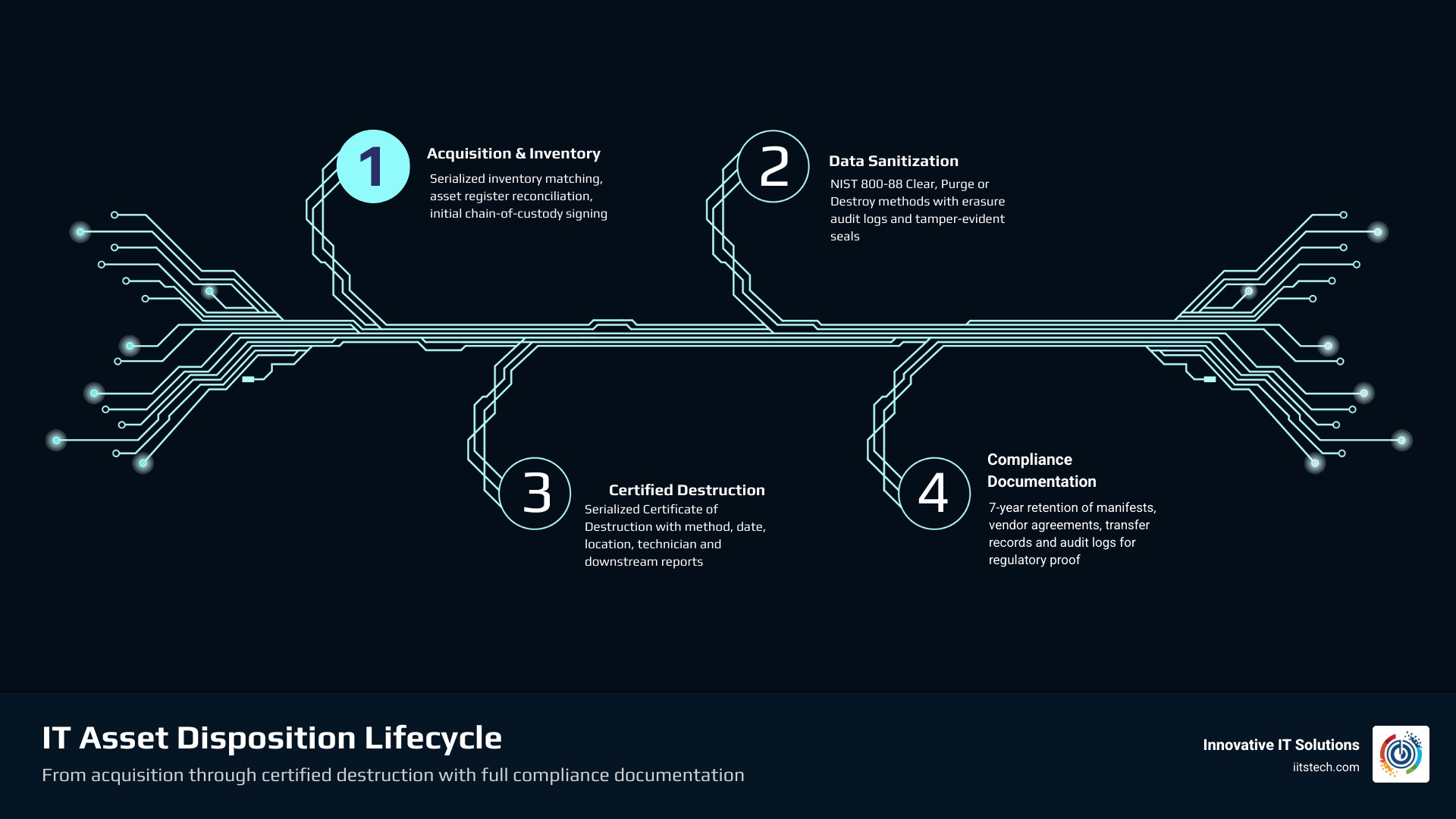
Basic asset disposition compliance documentation terms:
The Regulatory Landscape for IT Asset Retirement
Regulated industries do not get to treat retired hardware like office clutter. A laptop, server, firewall, backup appliance, printer, or mobile device can still contain protected data long after its useful life ends.
That is why asset disposition compliance documentation matters so much in healthcare, finance, public sector environments, and any business handling consumer or payment data.
Key frameworks include:
- HIPAA: Requires covered entities and business associates to protect ePHI through secure disposal. If a third party handles devices containing ePHI, a BAA is typically required. HIPAA penalties updated for 2025 range from $145 per violation to over $2 million per violation depending on culpability.
- GLBA: Financial institutions must safeguard customer information, including during disposal. Regulators expect evidence that retired devices were sanitized or destroyed in a defensible way.
- SOX: Public companies need strong internal controls and auditable records. Disposal records can become part of broader control evidence, especially when retired hardware affects financial records or audit trails.
- FACTA Disposal Rule: Applies broadly to businesses handling consumer information and requires reasonable measures to prevent unauthorized access during disposal.
- PCI-DSS Requirement 9.8: Requires media containing cardholder data to be destroyed when no longer needed for business or legal reasons.
- NIST SP 800-88 Rev. 2: This is not a law by itself, but it is the practical benchmark many auditors and regulated organizations use to define defensible media sanitization: Clear, Purge, or Destroy.
- Basel Convention amendments effective January 1, 2025: Cross-border e-waste shipments now face stricter prior informed consent and documentation requirements. If retired equipment moves internationally, environmental paperwork matters as much as data destruction paperwork.
- Environmental rules and state e-waste laws: Even outside highly regulated sectors, improper disposal creates liability. For example, California’s DTSC can impose penalties up to $70,000 per violation per day for improper e-waste disposal.
For a broad overview of the overlapping rules, see this ITAD regulations guide and our own resource on keeping your ITAD program audit-ready.
The simple takeaway: different regulations use different language, but they all point to the same operational expectation. You must know what left your building, who handled it, how data was destroyed, where materials went, and how long you can prove it.
Essential Asset Disposition Compliance Documentation
A compliant disposition package should tell a complete story from pickup through final disposition. If one chapter is missing, the whole story gets shaky fast.

Here are the core documents we recommend for every disposition event:
Serialized asset inventory
- Device type
- Manufacturer
- Model
- Serial number
- Asset tag
- Location
- Custodian or department
- Data sensitivity classification
Chain-of-custody manifest
- Signed at pickup
- Lists each item individually
- Includes time, date, and responsible parties
- Documents every handoff
Transfer manifests and seal records
- Useful when assets are palletized, boxed, or transported in locked containers
- Tamper-evident seal numbers should be logged and verified at receipt
Erasure audit logs
- Required when software-based sanitization is used
- Should show pass/fail result, device identifier, method used, date, and operator or system record
Serialized Certificate of Destruction
- This is the star witness in most audits
- It should be device-level, not batch-level
- It should reference the sanitization or destruction standard met
Recycling or disposition report
- Confirms whether equipment was reused, remarketed, dismantled, recycled, or destroyed
- Helps support environmental reporting and downstream transparency
Vendor agreements and compliance addenda
- BAA for HIPAA-related handling
- Service-provider obligations for PCI-DSS
- Data processor terms where applicable
- Breach notification, indemnification, and insurance language
Internal approvals and exception records
- Approval to destroy instead of remarket
- Approval to remarket after successful erasure
- Exception handling for missing serial numbers or damaged labels
Here is a simple comparison of NIST 800-88 sanitization outcomes:
| Method | What it means | Typical use | Documentation needed |
|---|---|---|---|
| Clear | Logical removal of data using standard overwrite or reset methods validated for the media | Lower-risk reuse inside controlled environments | Erasure audit log, asset serial, validation result |
| Purge | More rigorous sanitization such as cryptographic erase or approved methods that make recovery infeasible | Devices leaving organizational control | Erasure report, method used, technician/system evidence |
| Destroy | Physical destruction so media cannot be reused and data cannot be reconstructed | High-sensitivity assets, failed drives, many SSD workflows | Serialized Certificate of Destruction, witness or facility records |
A quick reality check: a factory reset is usually not enough. It removes user-facing data references, not necessarily the underlying recoverable data. That is especially true for many modern SSDs, flash devices, printers, and multifunction equipment with internal storage. Hardware has a long memory. Sometimes a little too long.
For more on chain of custody, read What is Chain of Custody in ITAD and Why It Matters.
Preparing for Audits with Asset Disposition Compliance Documentation
The best time to prepare for an ITAD audit is before the hardware refresh, not the night before your compliance team starts asking uncomfortable questions.
A strong audit prep process usually includes:
Inventory reconciliation
- Match every device scheduled for retirement against your IT asset register or CMDB
- Resolve missing serial numbers before pickup
- Confirm the physical count matches the documented count
Data classification
- Identify which devices held ePHI, cardholder data, financial records, legal files, or internal confidential data
- Use that classification to decide between erasure, shredding, or other approved methods
Retention schedule review
- Make sure records stored on the device have met retention requirements before destruction
- This is especially important where legal hold, public records, or financial retention obligations apply
Vendor documentation review
- Validate certifications
- Review destruction procedures
- Confirm downstream handling
- Verify insurance and contractual protections
Audit trail assembly
- Keep the inventory list, pickup manifest, erasure logs, certificate of destruction, and final disposition report together
- If auditors ask for one device, you should be able to trace that device from office floor to final outcome
Our guide on preparing for a third-party IT disposal compliance audit walks through this process in more detail.
For Oklahoma organizations, records governance also matters at the state level. The 2024 OMES Records Disposition Schedule is useful when public-sector or records-management obligations intersect with IT retirement.
As a practical rule, many organizations adopt a 7-year retention policy for disposition records because it generally covers the longest common overlap across SOX, HIPAA, and GLBA-related expectations. More specific examples often cited are:
- HIPAA: 6 years
- GLBA: commonly treated as at least 5 years in practice for disposal-related evidence
- SOX: 7 years for relevant audit-related records
- PCI-DSS: at least 1 year for certain security logs, though asset disposal evidence may need longer retention under broader policy
If you are in financial services, examiner expectations can be higher than the bare text of the rule. FFIEC-style scrutiny often focuses on whether your records are serialized, cross-referenced, and complete.
Mitigating Risk through Asset Disposition Compliance Documentation
Good documentation does not prevent every mistake. But it dramatically improves your ability to prevent, detect, and defend against them.
The Morgan Stanley case is the clearest modern warning. A vendor without proper data-destruction capability handled decommissioned equipment, devices containing unencrypted customer data were exposed, and the company faced more than $161.5 million in combined penalties and settlements. The lesson was not just “choose a better vendor.” It was “keep evidence strong enough to prove the vendor did what they claimed.”
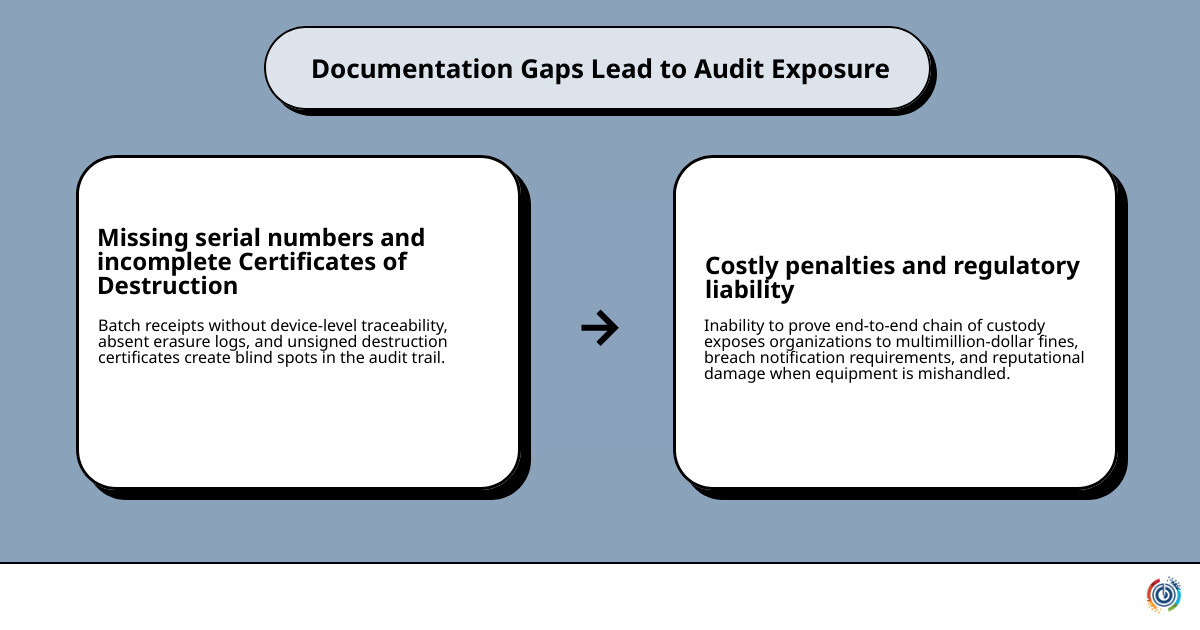
The most common documentation gaps we see are:
- Batch-level receipts with no device serial numbers
- Missing or incomplete Certificates of Destruction
- No erasure logs for devices marked as sanitized
- Unverified downstream recycling partners
- Gaps between internal inventory and pickup manifests
- Expired vendor certifications
- Missing contractual language for breach notification or indemnification
- No documented process for incident escalation if equipment goes missing
These gaps become painful during:
- Regulatory audits
- Cyber insurance claims
- Breach investigations
- Discovery in litigation
- Internal control testing
- Environmental reporting reviews
That is why documentation should tie into broader risk controls such as:
- vendor due diligence
- liability insurance
- downstream partner review
- incident response
- contract management
For related reading, see our resources on ITAD liability insurance and why downstream partners matter.
A defensible contract package should usually address:
- Confidentiality obligations
- Data protection responsibilities
- Breach notification timelines
- Indemnification terms
- Insurance coverage
- Audit rights
- Subcontractor restrictions
- Documentation delivery requirements
In short, if something goes wrong, your documentation should answer five questions fast:
- What device was involved?
- What data may have been on it?
- Who handled it at each step?
- What destruction or sanitization method was used?
- What proof do we have?
Vendor Selection and Industry Certifications
Your documentation is only as trustworthy as the process behind it. And the process is only as trustworthy as the vendor running it.
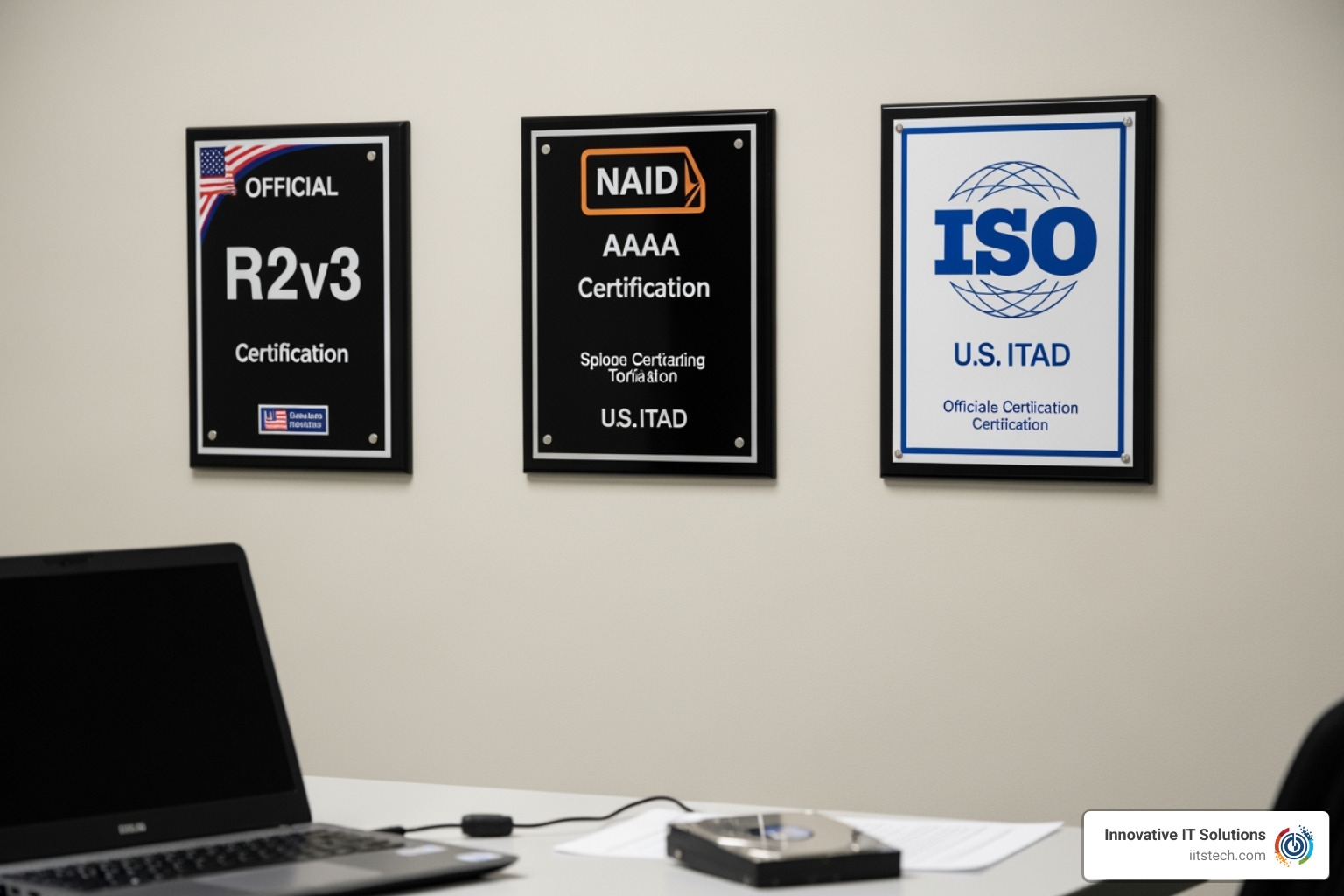
When evaluating an ITAD provider, we recommend looking for a strong certification stack and verifying it, not just admiring it on a brochure.
Important certifications and standards include:
R2v3
- Focuses on responsible recycling, data security, equipment reuse, and downstream accountability
- Especially relevant when you want both compliance and value recovery
NAID AAA
- Focuses on secure destruction processes and chain-of-custody controls
- Helpful for organizations that need documented destruction rigor
e-Stewards
- Often considered where environmental controls and international movement of electronics are a concern
ISO 14001
- Supports environmental management system discipline
ISO 27001
- Supports information security management and documented controls
Certifications do not replace due diligence, but they do provide audited evidence that the vendor has formal controls in place.
Your vendor checklist should include:
- Active certification verification
- Description of sanitization methods by media type
- Serialized reporting capability
- Chain-of-custody controls
- Downstream transparency
- Insurance coverage
- Written breach response procedures
- Zero-landfill or environmentally responsible processing policy
- Ability to support resale and value recovery where appropriate
This matters financially too. Remarketing and value recovery are the fastest-growing segment of the ITAD market, accounting for nearly 28% of the market by 2025. That means a good provider should help you balance risk reduction with asset recovery instead of defaulting to “destroy everything and hope accounting likes it.”
For more guidance, read How to Choose the Right ITAD Vendor for Your Business.
Financial Reporting and Asset Derecognition
Disposition is not just a security and environmental process. It also affects accounting, tax, and asset lifecycle reporting.
If equipment is sold, recycled for value, donated, abandoned, or written off, finance may need documentation supporting derecognition, proceeds, salvage value, and any gain or loss on disposal.
Useful references include:
From a practical standpoint, your finance and ITAD records should align on:
- Date removed from service
- Disposition path taken
- Sale proceeds or recycling value
- Book value and salvage value
- Supporting approvals
- Final destruction or transfer documentation
Under U.S. GAAP, asset sale accounting may fall under ASC 610-20 depending on the nature of the transaction. Under IFRS 5, assets held for sale have their own classification and disclosure considerations. For banks and regulated institutions, additional regulatory filings may apply in specialized circumstances.
This is another reason complete asset disposition compliance documentation matters. If a device is remarketed, you need proof it was sanitized before sale. If it is destroyed, you need proof for write-off support. If it is recycled, you may need environmental support plus financial disposition records.
Done well, documentation supports three goals at once:
- compliance defensibility
- environmental accountability
- maximum return on retired assets
Frequently Asked Questions about ITAD Compliance
How long must we retain asset disposition compliance documentation?
A good default is 7 years unless a longer contract, litigation hold, or agency-specific schedule applies. That period generally aligns with the strictest common overlap across SOX, HIPAA, and GLBA-related expectations. Public-sector entities in Oklahoma should also review applicable records schedules, including the OMES Records Disposition Schedule.
What are the most common documentation gaps that lead to fines?
The biggest ones are:
- No serialized Certificate of Destruction
- Chain of custody that tracks boxes or pallets but not individual devices
- Missing erasure logs for devices that were resold or redeployed
- No inventory reconciliation before pickup
- Missing vendor contracts, BAA, or breach notification terms
- Failure to verify downstream recyclers
- Retaining records too briefly or storing them in systems no one can access during an audit
If we had to name one single high-risk failure, it would be this: you cannot prove what happened to a specific device.
Is a factory reset sufficient for NIST 800-88 compliance in 2026?
Usually, no.
A factory reset is not the same thing as a validated sanitization method under NIST SP 800-88 Rev. 2. For many modern devices, especially SSDs and flash-based media, organizations should use approved purge methods such as cryptographic erase where appropriate, or physical destruction when reuse is not safe or technically reliable. The correct choice depends on the media type, data sensitivity, and intended disposition path.
Conclusion
The real job of asset disposition compliance documentation is simple: prove that your organization stayed secure, stayed compliant, and stayed environmentally responsible after the hardware left active service.
When that documentation is weak, everything else gets harder:
- audits
- breach response
- vendor oversight
- insurance claims
- financial reporting
- sustainability reporting
When it is strong, ITAD becomes a controlled lifecycle process instead of a last-minute cleanup project.
At Innovative IT Solutions, we help Oklahoma organizations build that proof into every retirement event through secure data destruction, electronics recycling, asset recovery, resale, and full reporting support using NIST/DoD-compliant, zero-landfill, EPA-compliant processes.
If you want to go deeper, these resources are a good next step:
- What is IT Asset Disposition (ITAD) and Why It Matters in 2025
- IT Asset Disposition: Why Every Business Needs a Secure ITAD Strategy
- Electronic recycling program for your business
If your team is preparing for an audit, planning a refresh, or cleaning out a storage room full of “we should deal with that later” equipment, now is the right time to tighten your documentation. Later has a way of showing up with auditors.


