
Why NIST Compliant Cisco Disposal in Oklahoma Is a Critical Business Decision
NIST compliant Cisco disposal in Oklahoma means sanitizing retired Cisco routers, switches, UCS servers, and storage arrays using the methods defined in NIST Special Publication 800-88 — Clear, Purge, or Destroy — so that no recoverable data remains before equipment leaves your control.
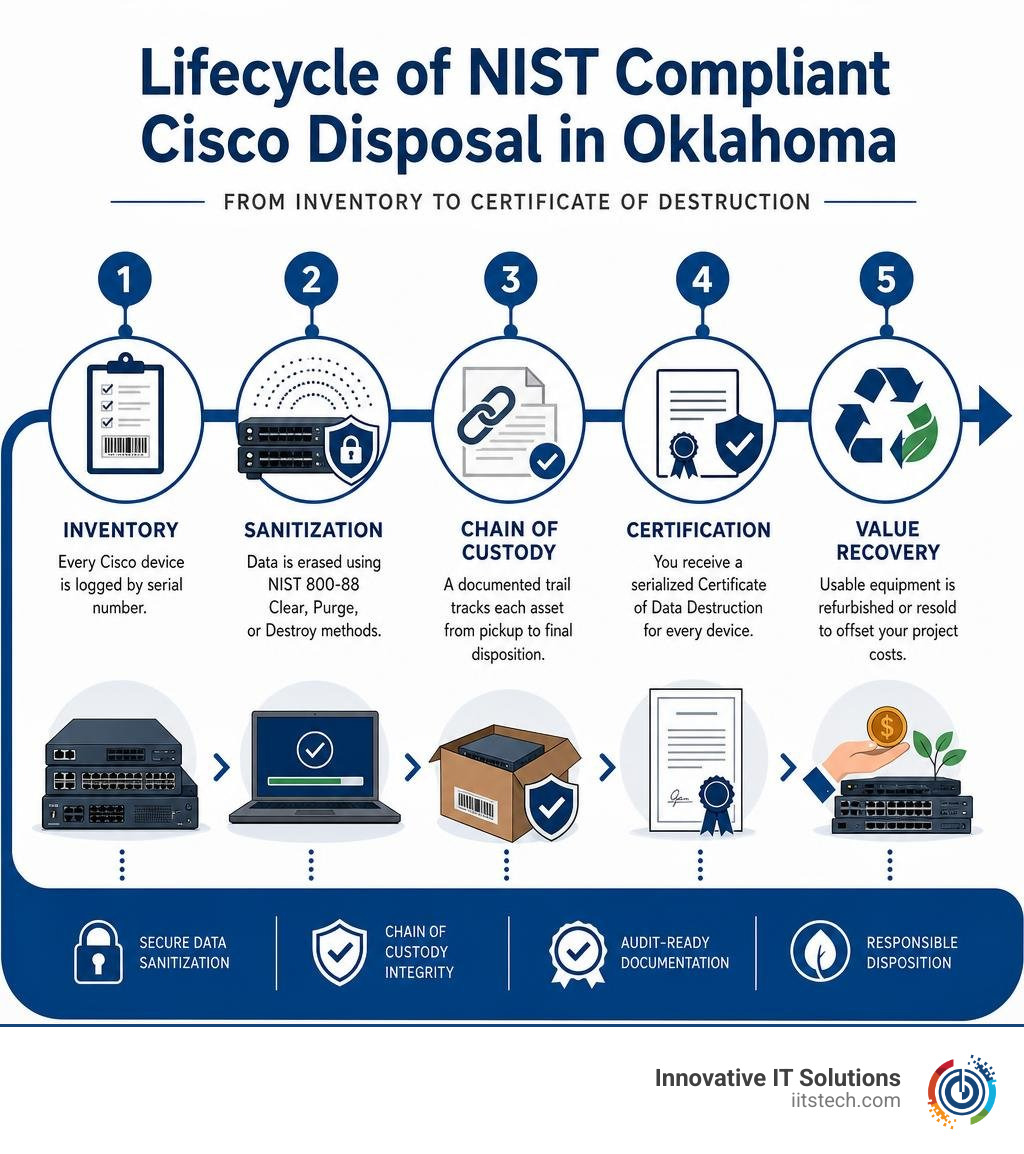
Here is a quick summary of what that looks like in practice:
| Step | What Happens |
|---|---|
| Inventory | Every Cisco device is logged by serial number before anything moves |
| Sanitization | Data is erased using NIST 800-88 Clear, Purge, or Destroy methods |
| Chain of Custody | A documented trail tracks each asset from pickup to final disposition |
| Certification | You receive a serialized Certificate of Data Destruction for every device |
| Value Recovery | Usable equipment is refurbished or resold to offset your project costs |
This process is very different from standard recycling. Standard recycling does not guarantee that configuration files, cryptographic keys, or sensitive data stored in Cisco NVRAM and flash memory are ever removed. That gap is exactly where data breaches happen.
For Oklahoma businesses operating under HIPAA, PCI-DSS, or other compliance frameworks, a single non-compliant disposal event can trigger regulatory fines, legal liability, and serious reputational damage.
I’m Mike Haden, Founder and Director of Business Development at Innovative IT Solutions, where I’ve spent 14 years building an R2v3-certified ITAD operation focused on NIST compliant Cisco disposal in Oklahoma and beyond. Our team has processed over one million pieces of enterprise IT equipment with a strict emphasis on data security, chain-of-custody integrity, and responsible reuse.
Understanding NIST Compliant Cisco Disposal Oklahoma
When enterprise-grade Cisco networking equipment reaches the end of its useful life, many organizations treat it like standard office IT scrap. This is a massive cybersecurity mistake. Cisco hardware—ranging from core routers to high-performance switches—does not just route packets; it stores highly sensitive data.
NIST Special Publication 800-88 (specifically Revision 1) is the gold standard for media sanitization. It outlines the precise physical and logical steps required to ensure that data-bearing devices are completely unrecoverable. In the context of NIST compliant Cisco disposal in Oklahoma, this standard dictates how we handle the flash memory, NVRAM, and physical storage drives embedded in your retired networking assets.
If your business operates in Oklahoma City, South OKC, or the surrounding areas, understanding how NIST 800-88 applies to your network infrastructure is critical. Leaving old routing tables, VPN configurations, or administrative credentials intact on a decommissioned switch is an open invitation to cybercriminals. This is why a secure IT asset disposition (ITAD) program must be integrated directly into your corporate security protocols. To learn more about this integration, read about Why ITAD Should Be Part of Your Cybersecurity Strategy.
The NIST 800-88 Framework: Clear, Purge, and Destroy
The NIST 800-88 framework categorizes media sanitization into three distinct levels: Clear, Purge, and Destroy. Each level represents a different level of security and physical modification to the hardware.
- Clear: This logical sanitization method applies to data-bearing devices in a way that protects against simple, non-invasive data recovery techniques. For Cisco equipment, this typically involves executing manufacturer-approved commands to reset the device to factory settings and overwrite user-accessible storage areas.
- Purge: A more advanced logical and physical action, purging protects against robust laboratory data recovery techniques. For solid-state drives (SSDs) and flash memory commonly found in modern Cisco routers and switches, this involves executing firmware-level secure erase commands or cryptographic erasure (where the encryption keys are permanently destroyed).
- Destroy: When a drive or a device cannot be logically cleared or purged, or if the security policy of your organization demands absolute physical termination, destruction is the final answer. This includes physical shredding, degaussing (for magnetic media), or disintegration.
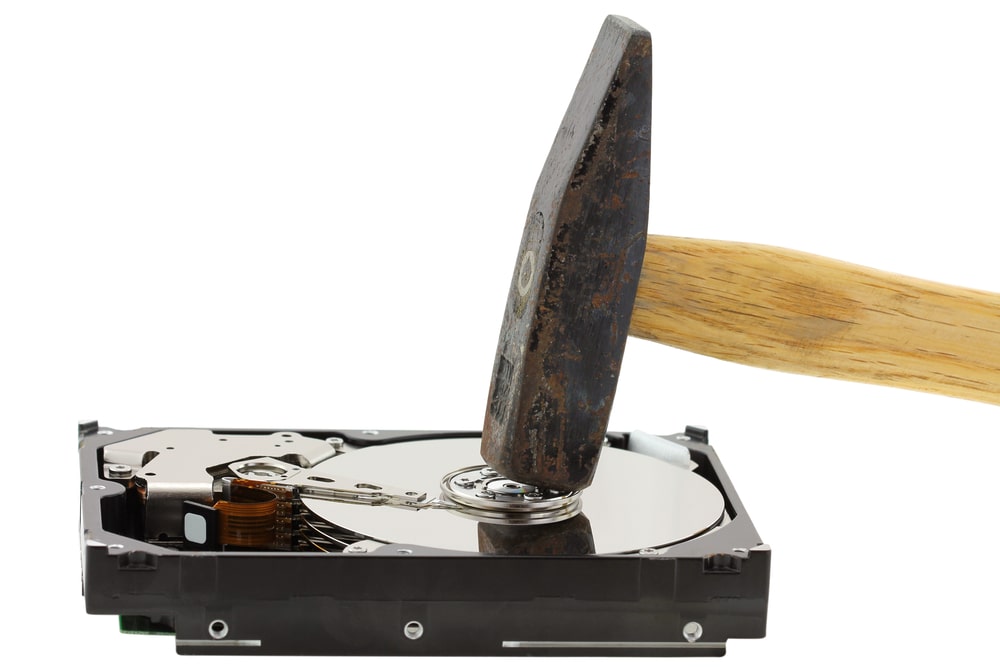
Understanding which method to deploy is essential for balancing security compliance and hardware value recovery. For a detailed breakdown of these two pathways, refer to our guide on Physical Destruction vs Data Wiping: When Each Method Is Required.
Why Standard Recycling Fails NIST Compliant Cisco Disposal Oklahoma Requirements
Many standard electronic recyclers in Oklahoma focus primarily on commodity recovery from mixed consumer and residential electronics—extracting copper, gold, and plastic. While environmentally noble, these general recycling processes are not designed for enterprise-grade business IT hardware and rarely prioritize data security.
Standard recycling fails to meet NIST compliant Cisco disposal in Oklahoma requirements for several reasons:
- Configuration File Leakage: Cisco devices store startup and running configurations in NVRAM. These files contain IP addresses, SNMP community strings, local user accounts, and hashed passwords. Standard scrap processes do not verify that this data is wiped before the physical boards are crushed or shipped.
- Cryptographic Key Persistence: Modern Cisco security appliances generate and store cryptographic keys used for VPN tunnels and secure management. If these keys are not purged, they can theoretically be extracted from intact flash chips.
- No Audit Trail: Standard recyclers usually weigh your e-waste and hand you a basic receipt. They do not provide a serialized, audit-ready chain of custody or a Certificate of Data Destruction linked to each specific Cisco asset.
Simply throwing a switch into an e-waste bin opens your business up to immense liability. To understand the financial and legal ramifications of these oversights, see The Hidden Costs of Skipping Data Destruction Services.
Cisco Hardware Requiring NIST-Compliant Sanitization
Not all Cisco hardware is created equal, but almost all of it contains some form of data-bearing media. From the massive Cisco Catalyst and Nexus switches driving your local area networks to the UCS servers powering your private clouds, each asset class requires a specific sanitization protocol.
To ensure that no security gaps exist, your ITAD partner must be capable of identifying and sanitizing every data-bearing component across your entire Cisco footprint. This includes cross-referencing devices against government-validated security standards like the Cryptographic Module Validation Program CMVP to ensure that cryptographic modules are properly zeroized.
Sanitizing Cisco Routers, Switches, and Firewalls
Cisco routers, switches, and firewalls (such as the Cisco ASA, Firepower 4100, and Firepower 9300 series) utilize specialized operating systems like Cisco IOS, IOS-XE, and FX-OS. These systems store configurations and operating code in flash memory, boot ROMs, and NVRAM.
When sanitizing these devices, we must address the specific cryptographic boundaries validated under FIPS 140-2 and FIPS 140-3 standards. For instance, Cisco security policies like the CISCO FIPS Object Module Security Policy outline how cryptographic keys and Critical Security Parameters (CSPs) are stored and how they can be logically zeroized.
Our technicians use authorized Cisco command-line interface (CLI) commands, such as write erase, combined with hardware-level factory resets and firmware-level flash sanitization, to ensure that all custom configurations, local user databases, and cryptographic keys are permanently cleared or purged according to NIST guidelines.
Handling Cisco UCS Servers and Storage Arrays
Cisco Unified Computing System (UCS) servers and storage arrays present a different sanitization challenge. These systems contain enterprise-grade hard drives (HDDs) and solid-state drives (SSDs) that store actual corporate databases, emails, and operating systems.
For businesses utilizing Cisco’s Unified Computing System Drive Retention Service, managing the lifecycle of failed or retired drives is a strict contractual and compliance requirement. When these drives are retired, they must undergo rigorous sanitization.
Our process for UCS drives involves high-throughput logical wiping using advanced software that supports multiple drive interfaces (SAS, SATA, NVMe) and block sizes (including 512 and 520 blocks). If a drive is physically damaged or fails the wiping process, it is immediately routed to our physical shredder for complete destruction. For a closer look at how we handle corporate drive sanitization, check out our resource on Hard Drive Disposal for Businesses: Secure, Compliant, and Hassle-Free.
Verifying Compliance, Logistics, and Value Recovery in Oklahoma
Executing secure ITAD is only half the battle; the other half is proving it. For businesses in Oklahoma City, South OKC, and the wider Oklahoma region, verifying that your ITAD vendor actually follows NIST 800-88 guidelines is critical for maintaining audit readiness.
When choosing an ITAD partner, you must look at their logistics, chain-of-custody protocols, and value-recovery capabilities. A true partner does not just protect your data; they help you offset the cost of decommissioning through robust buyback programs. For tips on evaluating potential providers, see How to Choose the Right ITAD Vendor for Your Business.
To help you visualize the choices involved in this process, here is a comparison of the typical costs, security levels, and value recovery outcomes of the two primary data destruction pathways:
| Sanitization Method | Security Level | Average Cost per Drive | Hardware Value Recovery | Best Suited For |
|---|---|---|---|---|
| Data Wiping (Logical Purge) | High (NIST 800-88 Compliant) | Low to Moderate | High (Preserves resale value) | Functional modern Cisco switches, UCS servers, and SSDs |
| Physical Shredding (Destroy) | Absolute (Physical Destruction) | Moderate to High | None (Recycled as raw commodities) | Defective drives, obsolete hardware, and ultra-secure data policies |
Essential Certifications: R2v3, NAID AAA, and RIOS
The easiest way to verify that an ITAD provider is qualified to handle your Cisco equipment is to check their industry certifications. You should never rely on a vendor’s verbal promises. Instead, look for three essential certifications:
- R2v3 (Responsible Recycling): This standard focuses on the entire lifecycle of electronics, ensuring that retired assets are managed safely, securely, and in an environmentally responsible manner. R2v3 requires strict downstream tracking, meaning your equipment will never end up in a landfill or be exported illegally.
- NAID AAA: Awarded by the International Secure Information Governance Association, this certification verifies that a provider meets the highest standards for physical data destruction, including employee background checks, secure facility monitoring, and strict access controls.
- RIOS (Recycling Industry Operating Standard): This certification integrates quality, environmental, and health and safety management systems into a single cohesive framework.
These certifications complement NIST 800-88 by ensuring that the facility processing your data is held to rigorous, third-party audited operational standards. To learn how to leverage these certifications for your compliance audits, read about ITAD Compliance: How to Keep Your Business Audit-Ready and Secure.
Serialized Documentation and Certificates of Destruction
At the conclusion of any Cisco disposal project, your ITAD provider must supply you with comprehensive, serialized documentation. This documentation acts as your shield during regulatory audits or corporate security reviews.
A compliant documentation package should include:
- Serialized Asset Log: A complete inventory of every Cisco device collected, including its model, serial number, asset tag, and operational status.
- Certificate of Data Destruction (CoD): A legally binding document certifying that the data-bearing media inside each listed device (identified by serial number) has been successfully sanitized or physically destroyed in accordance with NIST 800-88 standards.
- Environmental Impact Summary: Documented proof that any non-marketable components were recycled in accordance with EPA guidelines and zero-landfill policies.
Maintaining this audit trail is a cornerstone of modern corporate defense. For more insight into how this documentation fits into your security posture, read What Is the Role of Data Destruction in Cybersecurity?.
Maximizing ROI and Scheduling NIST Compliant Cisco Disposal Oklahoma Services
Disposing of enterprise Cisco hardware doesn’t have to be a pure expense. In fact, because Cisco equipment retains its value exceptionally well on the secondary market, many Oklahoma businesses can recover significant capital during a network refresh.
At Innovative IT Solutions, we provide a streamlined, secure buyback process:
- Fast Valuations: Send us your inventory list, and our team will provide a fair-market valuation for your marketable Cisco switches, routers, and UCS servers.
- Secure, Local Logistics: We coordinate secure pickups throughout Oklahoma City, South OKC, and the surrounding regions, utilizing dedicated, GPS-tracked vehicles and background-checked drivers.
- Rapid Payment and Processing: Once the hardware is verified and sanitized at our facility, we issue detailed reporting and rapid payouts—often within 48 to 72 hours—helping you maximize your project ROI.
To prepare your hardware for the buyback process and maximize its resale value, read our articles on Learn How to Sell Your Used Cisco Equipment Easily and 5 Essential Tips to Recycle Your Used Cisco Equipment.
Frequently Asked Questions About Cisco ITAD
What are the risks of non-compliant Cisco equipment disposal?
Disposing of Cisco hardware without verified, NIST-compliant sanitization exposes your business to severe risks, including:
- Data Breaches: Access to old configuration files can allow cybercriminals to map your internal network, compromise active VPN tunnels, or exploit administrative credentials.
- Regulatory Fines: Failure to protect sensitive data can lead to massive penalties under HIPAA, PCI-DSS, GLBA, and state-level data privacy laws.
- Brand Damage: A publicly reported data breach originating from discarded IT assets can permanently damage customer trust and corporate reputation.
How does NIST 800-88 apply to Cisco flash memory and SSDs?
Unlike traditional magnetic hard drives, solid-state media (like flash memory and SSDs found in Cisco UCS servers and advanced routers) cannot be reliably sanitized using standard magnetic degaussers. NIST 800-88 dictates that solid-state media must be sanitized using logical block-erase commands, cryptographic erasure, or physical disintegration/shredding to a specific particle size to prevent microscopic data reconstruction.
Can we recover value from older Cisco Catalyst and Nexus switches?
Yes. While technology moves fast, there is a robust global secondary market for refurbished Cisco Catalyst and Nexus switches. Even if a switch is a few generations old, it may still hold significant value for businesses, labs, or educational institutions that do not require cutting-edge throughput. Partnering with an ITAD provider who excels in refurbishment and resale is the best way to capture this value and offset your disposal costs.
Conclusion
Securing your network doesn’t stop when you unplug your old hardware. Safely retiring your Cisco infrastructure requires a deliberate, documented, and certified approach to data destruction. By choosing a partner who provides NIST compliant Cisco disposal in Oklahoma, you protect your business from catastrophic data leaks, maintain absolute compliance with federal and state regulations, and potentially recover valuable capital to fund your next technology upgrade.
At Innovative IT Solutions, we are dedicated to helping Oklahoma businesses navigate the complexities of secure IT asset disposition. From South OKC to the heart of Oklahoma City, our certified processes, secure logistics, and expert team ensure that your retired assets are handled with the highest level of security and environmental responsibility.
Ready to secure your retired network infrastructure and maximize your return on investment? Partner with Innovative IT Solutions for Secure Cisco Disposal.