
Why the EPA Zero Landfill Policy Matters for Your Business
The EPA zero landfill policy framework is not a single law — it’s a set of guidelines, tools, and regulations that together push communities and organizations to stop sending waste to landfills.
Here’s what you need to know at a glance:
| Key Element | What It Means |
|---|---|
| Zero Waste Goal | Eliminate waste sent to landfills, incinerators, or the environment |
| Core Strategy | Prevent waste first, then reuse, then recycle and compost |
| Main EPA Tools | Managing and Transforming Waste Streams Tool, WARM model, case studies |
| Key Regulations | Clean Air Act, RCRA Subtitle C and D |
| Who It Affects | Federal agencies, local governments, businesses — including yours |
Landfills are the third largest source of methane in the United States. Methane is roughly 80 times more potent than carbon dioxide over a 20-year period. And studies suggest actual emissions may be two to four times higher than official estimates.
That’s a big deal — not just for the planet, but for companies trying to hit sustainability targets and stay compliant.
If your organization disposes of decommissioned IT equipment, you’re part of this story. Electronics that end up in landfills contribute to toxic leachate, wasted recoverable materials, and potential regulatory exposure.
I’m Mike Haden, Founder and Director of Business Development at Innovative IT Solutions, where I’ve spent 14 years helping enterprises responsibly manage surplus technology in alignment with sustainability goals — including those tied to the EPA zero landfill policy. Understanding these guidelines is the first step toward turning your e-waste challenge into a compliance advantage.
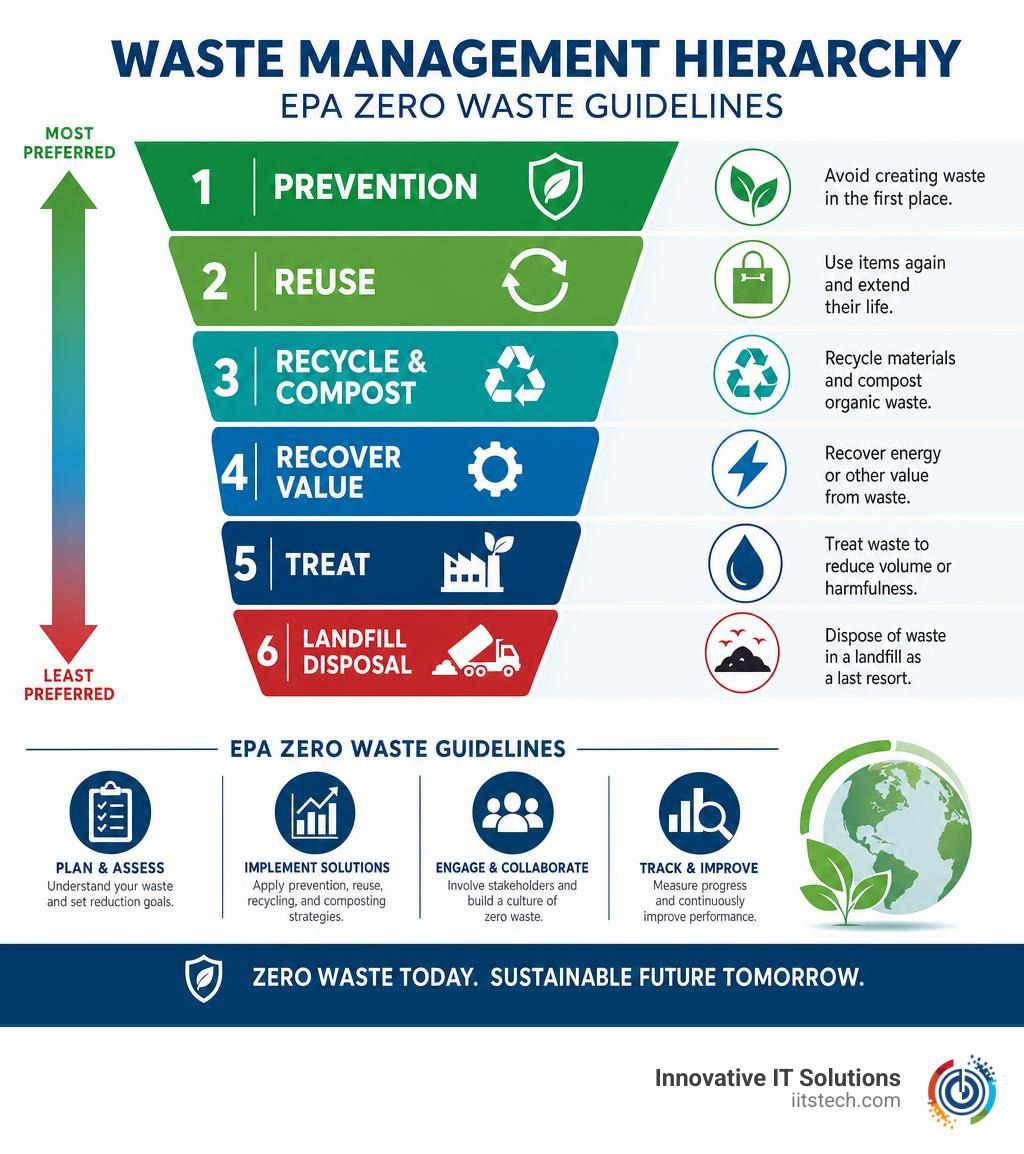
Defining Zero Waste: EPA Guidelines vs. Global Standards
To understand how the EPA zero landfill policy operates in practice, we first have to look at how “zero waste” is defined. It turns out that different organizations look at this goal through slightly different lenses. While some focus strictly on diversion rates, others view it as a complete redesign of our industrial systems.
According to the resource guide on How Communities Have Defined Zero Waste | US EPA, definitions vary across municipal, national, and international lines, but they consistently share a core philosophy: eliminating discharges to land, water, or air that threaten human health and the environment.
The EPA Definition of Zero Waste
The EPA approaches zero waste through the framework of Sustainable Materials Management (SMM). This systemic approach seeks to use and reuse materials more productively over their entire lifecycles.
Instead of just managing waste at the end of its life, the EPA’s guidelines emphasize environmental protection at every stage—from resource extraction and product design to manufacturing, distribution, and eventual recovery. The ultimate goal is to conserve resources, reduce waste, and minimize the environmental footprint of the products we rely on daily.
Zero Waste International Alliance (ZWIA) and Other Frameworks
The Zero Waste International Alliance (ZWIA) provides a peer-reviewed definition that has been adopted by numerous U.S. cities, the U.S. Conference of Mayors, and organizations like the Solid Waste Association of North America (SWANA).
ZWIA defines zero waste as:
“The conservation of all resources by means of responsible production, consumption, reuse, and recovery of products, packaging, and materials without burning and with no discharges to land, water, or air that threaten the environment or human health.”
The primary distinction is that ZWIA explicitly excludes high-temperature destruction (incineration and waste-to-energy) from its definition of zero waste, whereas some local municipal frameworks allow for limited thermal recovery once all recycling and composting options have been exhausted.
| Feature | EPA Sustainable Materials Management | ZWIA Definition |
|---|---|---|
| Core Philosophy | Lifecycle resource conservation | Complete elimination of waste discharges |
| Thermal Recovery | Permitted as a last resort before landfilling | Strictly excluded (no burning) |
| Systemic Focus | Industrial systems and product design | Consumer behavior and circular systems |
| Primary Goal | Minimize environmental footprint | Zero discharges to land, air, or water |
Navigating the EPA Zero Landfill Policy: Rules, Regulations, and Frameworks

While “zero waste” is an aspirational philosophy, the EPA enforces several hard regulations under federal law to control what actually enters landfills and what happens to the waste once it is there.
Whether you operate a commercial facility in Oklahoma City or manage a municipal program, staying compliant means understanding how the Clean Air Act and the Resource Conservation and Recovery Act (RCRA) govern modern waste disposal.
Clean Air Act and Landfill Methane Regulations
Because landfills are massive contributors to global warming, the EPA uses the Clean Air Act to regulate landfill gas emissions. In the Federal Register, Volume 81 Issue 167 (Monday, August 29, 2016), the EPA finalized standards that significantly lowered the emissions threshold at which municipal solid waste landfills must install gas collection and control systems (GCCS).
These rules mandate rigorous surface emissions monitoring and wellhead monitoring to ensure that methane and non-methane organic compounds (NMOCs) do not escape into the atmosphere. For businesses, this means the cost of operating landfills is rising, making waste diversion and recycling a much more economically viable path.
RCRA Subtitle C and D Standards
The Resource Conservation and Recovery Act (RCRA) splits waste management into two primary categories:
- Subtitle C (Hazardous Waste): Establishes a “cradle-to-grave” system for controlling hazardous materials.
- Subtitle D (Non-Hazardous Solid Waste): Governs municipal solid waste landfills and captive industrial landfills.
Under these frameworks, the EPA regulates the liquid runoff from landfills, known as leachate. According to the Development Document for Proposed Effluent Limitations Guidelines and Standards for the Landfills Point Source Category, landfills must implement advanced wastewater management systems to treat leachate and gas condensate before discharging them into local waterways.
For businesses disposing of electronics, RCRA Subtitle C is particularly critical. Many IT assets contain heavy metals like lead, cadmium, and mercury. If thrown into a standard Subtitle D municipal landfill, these items can leach toxins into the groundwater, leading to severe regulatory penalties and environmental damage.
Practical Tools and Local Success Stories
Achieving a zero-landfill status requires practical tools and actionable strategies. The EPA doesn’t just regulate; it also provides extensive resources to help local governments and private enterprises design, fund, and execute waste diversion programs.
How Local Governments Leverage the EPA Zero Landfill Policy
One of the most valuable resources provided by the agency is the Managing and Transforming Waste Streams tool. This interactive database provides local governments with over 100 specific policies, program ideas, and contract language templates.
By utilizing these pre-approved contract and franchise agreement templates, municipalities can easily write zero-waste requirements directly into their agreements with private waste haulers, ensuring that recycling and composting are prioritized at every level of community collection.
Case Studies: San Francisco, Berkeley, and Austin
Cities across the country have successfully used these tools to build highly effective circular models:
- San Francisco: By adopting the waste reduction hierarchy (prevent, reduce, reuse, recycle, compost), the city successfully diverted millions of tons of material from landfills, aiming to send zero discards to landfills or high-temperature destruction.
- Berkeley: Developed a highly successful public-private salvage and reuse program, diverting building materials and household goods directly back into the local economy.
- Austin: The City of Austin estimated that the value of materials sent to its landfills and lost to the local economy was over $40 million annually. To recapture this value, the city enacted the Austin Resource Recovery Master Plan, targeting a 90% diversion rate.
These case studies highlight why businesses must pay close attention to the Environmental Impact of Corporate Electronic Waste. When local economies lose millions in buried resources, companies that proactively recycle their retired IT hardware help keep valuable metals and plastics in the manufacturing loop rather than the trash.
Measurable Progress in California and the Pacific Islands
The impact of these EPA-supported frameworks extends across states and territories:
- California: Through its comprehensive Zero Waste Plan, the state has successfully collected over 500 billion bottles and cans, 11 million mattresses, and 300 million used tires for recycling. Yet, even with these massive wins, over 40 million tons of waste still go to landfills each year in California alone, proving that there is still a long way to go.
- Guam: In 2023, Guam composted a record-breaking 146,798 tons of green waste and food scraps, driving its reported recycling rate to over 60%.
- American Samoa: Across 56 villages, local initiatives removed 13,215 pounds of litter in 2024 and recycled 362,075 pounds of lead-acid auto batteries.
These milestones show that zero-waste initiatives are highly effective when backed by community engagement and the right processing infrastructure. However, for businesses holding onto piles of obsolete tech, there is a distinct risk.
Keeping retired electronics sitting in storage closets introduces The Hidden Environmental Cost of Keeping Old IT Equipment, as these unused assets degrade over time and miss their window for high-value reuse and recycling.
Challenges, Gaps, and the Path Forward
Despite the clear economic and environmental benefits of the EPA zero landfill policy framework, several systemic hurdles remain.
Overcoming Obstacles to Meet the EPA Zero Landfill Policy Standards
Achieving true zero waste is not without its difficulties. Many communities and businesses struggle with:
- Funding Limitations: Building advanced sorting facilities, composting yards, and specialized electronics recycling hubs requires significant upfront capital.
- Regulatory Enforcement: In many jurisdictions, enforcement of existing waste diversion laws remains inconsistent.
- Market Development: For recycling to be self-sustaining, there must be a robust market for post-consumer recycled materials. When virgin plastics or metals are cheaper than recycled alternatives, circular economies stall.
To bridge these gaps, organizations must look to specialized private partners who can turn waste streams into profitable resource streams.
The Economic and Environmental Cost of E-Waste
Electronic waste is the fastest-growing waste stream in the world. It is also the most resource-dense. Throwing away a computer means burying gold, copper, silver, and engineered plastics—materials that require massive amounts of energy to mine and refine.
This is where smart business practices intersect with environmental stewardship. By partnering with certified IT asset disposition (ITAD) providers, companies can implement Smart IT Equipment Recycling for Businesses: Turning E-Waste into Opportunity. Proper ITAD ensures that retired hardware is securely wiped, refurbished for resale, or broken down into clean raw materials, keeping your business fully aligned with zero-landfill goals.
Frequently Asked Questions About Zero Landfill Initiatives
What is the difference between zero waste and zero landfill?
While they sound similar, they represent different levels of sustainability. Zero Landfill means that no waste from a facility is sent to a landfill. However, some of that waste may still be incinerated or converted to energy. Zero Waste, as defined by ZWIA, goes a step further by requiring a 90% or higher diversion rate without utilizing incineration or high-temperature destruction, focusing instead on redesigning products to eliminate waste entirely.
How does the EPA regulate landfill methane emissions?
Under the Clean Air Act, the EPA establishes Standards of Performance for Municipal Solid Waste Landfills. These rules require landfills that exceed specific size and emissions thresholds to install gas collection and control systems (GCCS). These systems capture methane before it escapes, routing it to be flared or converted into pipeline-quality natural gas or electricity.
What is the role of the private sector in achieving zero waste?
The private sector is the engine of the circular economy. While the EPA provides the regulatory boundaries and local governments set municipal goals, private businesses develop the logistics, processing technologies, and remarketing channels that make recycling viable. From commercial recycling programs to specialized ITAD services, private-sector collaboration is essential to keep valuable materials out of our landfills.
Conclusion: Partnering for a Zero-Landfill Future
Aligning your business with the EPA zero landfill policy framework is more than just a regulatory box to tick—it is an investment in corporate sustainability and resource efficiency. By keeping toxic e-waste out of municipal landfills, your business actively reduces greenhouse gas emissions, protects local groundwater, and preserves valuable resources for the future.
At Innovative IT Solutions, headquartered in Oklahoma City, we help businesses throughout Oklahoma navigate this transition seamlessly. We provide comprehensive IT asset disposition (ITAD) services, including secure, NIST/DoD-compliant data destruction, certified electronics recycling, and asset recovery.
Our zero-landfill, EPA-compliant processes ensure that your retired IT hardware is managed responsibly, giving you full compliance documentation and maximum financial returns.
Ready to eliminate “trash talk” from your corporate sustainability reports? Let us build a secure, sustainable strategy for your business. Explore our Secure ITAD Strategy and Asset Disposition Services today.


